

CCSD code G5100: Bypass of duodenum billing guide
CCSD code G5100 bills a bypass that leaves the duodenum in place CCSD code G5100...

Last Updated: Oct 16, 2026
V2761 is the HCPCS Level II code for mirror coating, any type, solid, gradient or equal, any lens material, per lens. It's an add-on to a base lens code and bills one unit per coated lens, so a pair of glasses takes two units.
Coders most often confuse it with the tint codes V2744 (photochromatic) and V2745 (any-color tint), or with V2762, which covers polarization. Traditional Medicare Part B excludes routine eyewear, so V2761 is non-covered there and needs a signed Advance Beneficiary Notice (ABN) before dispensing. Commercial vision plans and state Medicaid programs each set their own rules.
Let Pabau's smart automation suggest the right codes, reduce claim denials, and keep your practice compliant—effortlessly.
Automate repetitive tasks and focus on what matters most—your patients.
Reduce coding errors and ensure compliance with the latest regulations.
Clean claims, fewer denials, and faster reimbursements.
Powerful insights and reporting to help your practice thrive.
HIPAA compliant SOC 2 certified GDPR-compliant Trusted by 4,000+ clinics worldwide

V2761 covers solid and gradient mirror coatings on any lens material, billed once per lens (two units for a pair of glasses).
Medicare Part B does not cover routine eyeglass services, so V2761 is typically non-covered. Get a signed ABN before dispensing to a Medicare beneficiary.
V2761 must always appear on the claim with a base lens code (V2100-V2615 range). Submitting it alone is the most common denial trigger.
Tint and polarization bill on their own codes: V2744 or V2745 for tint, V2762 for polarization.
Claims management software like Pabau helps optical practices catch a missing base lens code or ABN before the claim goes out.
HCPCS code V2761 covers a mirror coating on any lens material, billed per lens as an add-on to a base lens code. The table below sets out the billing facts to check first. All information is drawn from the CMS HCPCS Level II code set, maintained annually by the Centers for Medicare and Medicaid Services (CMS).
The full official descriptor breaks into five billing-relevant qualifiers, each of which affects how the code is applied in practice.
Read together, the qualifiers describe a lens treatment rather than the lens itself. V2761 is therefore an add-on code, and the base lens must be coded separately. Other lens treatments take their own add-on codes, including V2760 for scratch-resistant coating.
A payer auditor reviewing a V2761 claim will look for a specific chain of documentation. Missing any link in that chain is grounds for denial or recoupment.
Capture this chain at the point of dispensing, while the prescription and lab order are still at hand. Rebuilding it weeks later for an auditor is slower, and pieces often go missing.
Medicare Part B does not cover routine vision services, including eyeglass frames, standard lenses, and lens add-ons such as mirror coatings. This exclusion is established under the CMS Medicare Benefit Policy Manual, Chapter 15, Section 120. As a result, HCPCS code V2761 is non-covered under traditional Medicare Part B in nearly all circumstances.
Four payer contexts come up most often for V2761.
An ABN (form CMS-R-131) must reach the patient before the service whenever the provider expects Medicare not to pay. For mirror coating, this applies any time a Medicare Part B beneficiary requests the upgrade, because traditional Medicare’s vision exclusion makes denial predictable.
Without a valid ABN, the provider cannot bill the patient for the non-covered service even after Medicare denies the claim. The ABN is both a compliance requirement and a financial protection for the practice.
Because Medicare Part B does not cover V2761, there is no national limiting charge or published Medicare fee schedule amount for this code. Reimbursement is entirely payer-contract dependent or, for Medicare patients with a valid ABN, patient-pay at whatever rate the practice charges.
For state Medicaid programs that do cover mirror coating add-ons, rates are published in each state’s vision services fee schedule. These figures change annually. Check the current state Medicaid fee schedule directly. Use the CMS Physician Fee Schedule lookup to confirm whether a federal rate exists for any given HCPCS code in a given year. The AAPC HCPCS code database also provides reference reimbursement data from commercial sources.
After adjudication, the electronic remittance advice (ERA) shows how each payer handled the V2761 line. It tells you whether a contractual adjustment, patient responsibility or denial reason code was applied.
V2761 is billed per lens. A complete pair of eyeglasses contains two lenses, so a standard dispensing encounter generates a quantity of 2 for V2761. Billing one unit for a complete pair is one of the most common unit errors for this code. It results in underpayment or a claim edit.
Document the quantity clearly in the superbill or dispensing order. Practices using paper superbills should include a dedicated field for lens add-on units to prevent the “one-unit-for-a-pair” error. A well-structured superbill for ophthalmic dispensing captures both the base lens code and each add-on with its unit count at the point of service.
Mirror coating sits beside three other per-lens treatment codes, and coders regularly reach for the wrong one. The distinction matters because payers apply different coverage rules and fee schedule logic to each.
The most common mix-up starts when a patient picks “mirrored sunglasses.” The coder bills a tint code, V2744 or V2745, because mirror and tint feel similar. A mirror coating is a reflective surface layer. A tint changes the lens color, and polarization (V2762) filters glare reflected off flat surfaces.
A claim that pairs a mirror coating with a tint also needs a current tint code. V2742, the rose tint code for glass lenses, was deleted at the end of 2003, so bill V2745 instead.
A dark mirrored lens often carries two or three of these treatments. Document each one line by line, exactly as the lab applied it. Before billing, confirm the current descriptor for each code in the PGM Billing HCPCS lookup tool.
V2761 is an add-on code and cannot be submitted on a claim without a corresponding base lens code. The base lens codes fall within the V2100-V2615 range, which covers sphere lenses, bifocal lenses, trifocals, and other lens types by power and material.
A sample claim for a complete pair of mirrored single-vision lenses uses V2100 as the base lens code:
When V2761 is submitted without a base lens code, most payer systems return it as an unbundling error or an “invalid code combination” denial. This is the single most common coding error on mirror coating claims. The diagram below sets that sequence beside the codes for the other treatments a mirrored pair may carry.
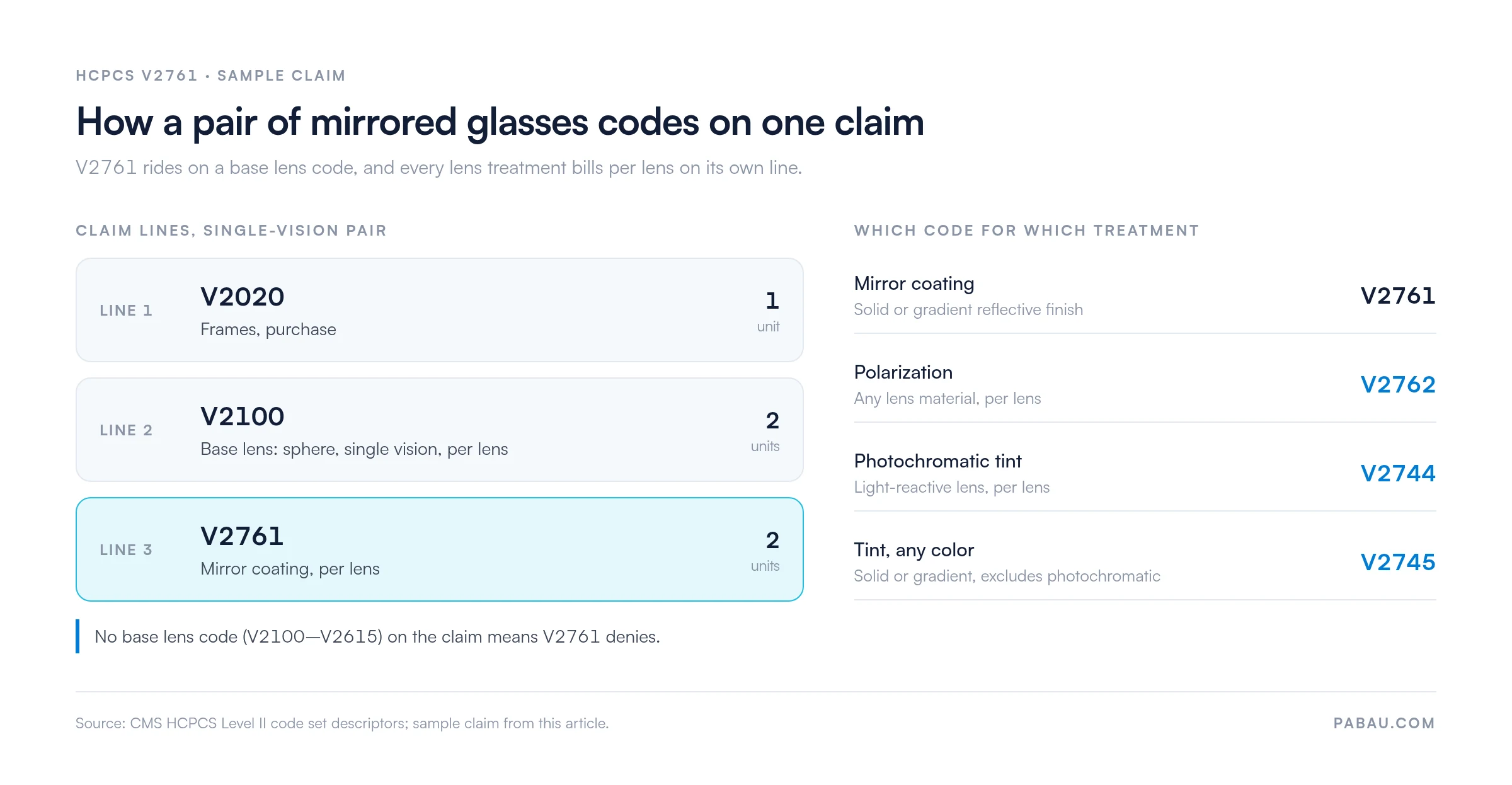
Run a pre-submission edit check on every ophthalmic claim. It should confirm that any V2761 line has a V2100-V2615 base lens code on the same claim. Many practice management systems can be configured with a claim rule that flags V2761 if no base lens code is present. Setting this up once prevents the most common denial reason for mirror coating claims.
Most V2761 denials fall into five categories. Each has a distinct fix or appeal pathway.
Tracking V2761 denials over time shows where the process breaks, such as the ABN workflow or the superbill design. Fixing that once saves correcting each claim individually. Read the CARC code on each remittance against these medical billing denial codes to pin down the specific reason.
Practices using claims management software can configure rules that catch common V2761 errors before submission. That cuts denials without a manual review of every optical claim.
Commercial vision plans handle mirror coating add-ons differently from medical payers. Their rules go well beyond the standard CMS guidance, and each plan sets its own.
The major managed vision plans each take a distinct approach. Understanding payer policy before dispensing is the most reliable way to avoid the non-covered denial. For premium add-ons like mirror coating, check the plan’s provider manual or call provider services before the patient picks up their glasses.
For an optical practice, that means verifying benefits before the appointment, including which add-ons the plan covers and at what co-pay. This matters most for premium lens treatments, where the patient may expect the plan to cover the full cost.
Most V2761 denials trace back to three checks done by hand. Is there a base lens code on the claim, are both lenses billed, and is a signed ABN on file? On a busy dispensing day, one of them gets skipped.
Practice management software like Pabau keeps the prescription, lab order, dispensing record and invoice on the patient’s record. Pre-submission claim rules flag a V2761 line with no base lens code or a single unit, so the coder fixes it before it goes out.
The signed ABN can be stored on the same record as a digital form. That way the front desk sees before dispensing whether a Medicare patient has signed. Your billing staff then spend their time on exceptions instead of reviewing every optical claim.

Pabau helps optical and ophthalmology practices check base lens pairings, per-lens units and ABNs before submission, so fewer mirror coating claims come back denied.

Mirror coating claims deny for predictable reasons, which makes them preventable. If you fix only one step, make it the ABN.
A missing base lens code or a wrong unit count can be corrected and resubmitted. A valid ABN can’t be obtained after the glasses are dispensed, so that error costs the practice the full charge.
Once the ABN is settled, build the base lens and per-lens unit checks into your superbill or claim rules. They then run on every mirror coating claim without anyone having to remember them.
Book a demo to see how Pabau checks V2761 claims for base lens codes, units and ABNs before they reach the payer.

Need guidance on managing claim denials systematically? Denial management in healthcare covers the workflows and tools practices use to track, appeal, and prevent recurring rejections.
Unsure how to structure your optical superbill? Superbill documentation walks through the fields that support clean ophthalmic claims, including add-on code units.
Want to understand the full billing cycle for vision claims? Revenue cycle management fundamentals explains how eligibility verification, claim submission, and remittance processing connect end to end.
Billing a photochromatic lens as well? HCPCS code V2744 covers the per-lens rules for the tint code most often confused with mirror coating.
Want optical claims accepted first time? Clean claim guide explains what a payer checks before it accepts a claim for processing.
HCPCS code V2761 covers mirror coating, any type, including solid and gradient finishes, applied to any lens material, billed per lens. It’s an add-on code for the reflective surface treatment on ophthalmic lenses. Bill it alongside a base lens code from the V2100-V2615 range.
No. Traditional Medicare Part B does not cover routine vision services, including eyeglass lenses and lens add-ons such as mirror coatings. V2761 is non-covered under Part B, so get a signed ABN before dispensing and bill the patient directly. Medicare Advantage plans may differ, so verify benefits with the specific plan.
Bill 2 units. V2761 is billed per lens, and a complete pair contains two lenses. Submit one claim line with a quantity of 2. Alternatively, submit two separate lines, each with a quantity of 1 and the specific lens identified. Billing one unit for a complete pair is a common error that results in underpayment.
V2761 covers mirror coating, a reflective metallic surface treatment that creates a mirror or flash effect. V2762 covers polarization, any lens material, per lens, which filters glare reflected off flat surfaces. Tint has its own codes, V2744 for photochromatic and V2745 for any-color tint. A polarized mirrored lens carries both V2761 and V2762, so document each treatment the lab applied and confirm the payer’s edit policy first.
Yes, for virtually every traditional Medicare Part B patient. Medicare treats mirror coating as a non-covered routine vision service, so the provider has reason to expect denial. Present the ABN (CMS-R-131) to the patient before dispensing. The ABN must be signed before the service, not after. Without a valid pre-service ABN, the provider cannot bill the patient even after Medicare denies the claim.
Five reasons cover most denials. The first two are a non-covered service under the vision benefit, most often Medicare Part B, and a missing base lens code. The rest are incorrect units for a pair, a missing or invalid ABN, and missing lab documentation during an audit. The CARC code on the remittance advice names the specific reason. Then follow the correction or appeal pathway for that denial category.



