



HCPCS code E0198: Water pressure pad billing guide
HCPCS code E0198 is a water pad for a standard mattress HCPCS code E0198 is the ...

Last Updated: Oct 13, 2026

CPT code 99455 covers a work-related or medical disability examination that the treating physician performs, not an independent medical examiner.
The exam must include medical history, physical examination, diagnosis formulation, impairment calculation, and a future treatment plan to support billing.
Report CPT 99455 only when no active management of the condition occurs during the visit. Use Modifier 25 on any same-day E/M code per payer guidance.
Pabau’s claims management software and digital forms streamline disability exam documentation and reduce workers’ compensation claim denials.
Most workers’ compensation claim denials trace back to one of three problems: the wrong provider billed the code, the visit included active treatment, or the documentation missed a required component. CPT code 99455 has specific rules on all three fronts, and getting any one wrong triggers a denial that can take months to appeal.
This guide, sometimes billed under the shorthand CPT 99455, covers everything billing staff and treating physicians need to bill the code correctly the first time.
According to the American Medical Association (AMA), CPT code 99455 falls under the Special Evaluation and Management Services category (codes 99450-99456). These codes sit apart from standard E/M services because they cover evaluations driven by legal, administrative, or occupational context rather than direct clinical management.
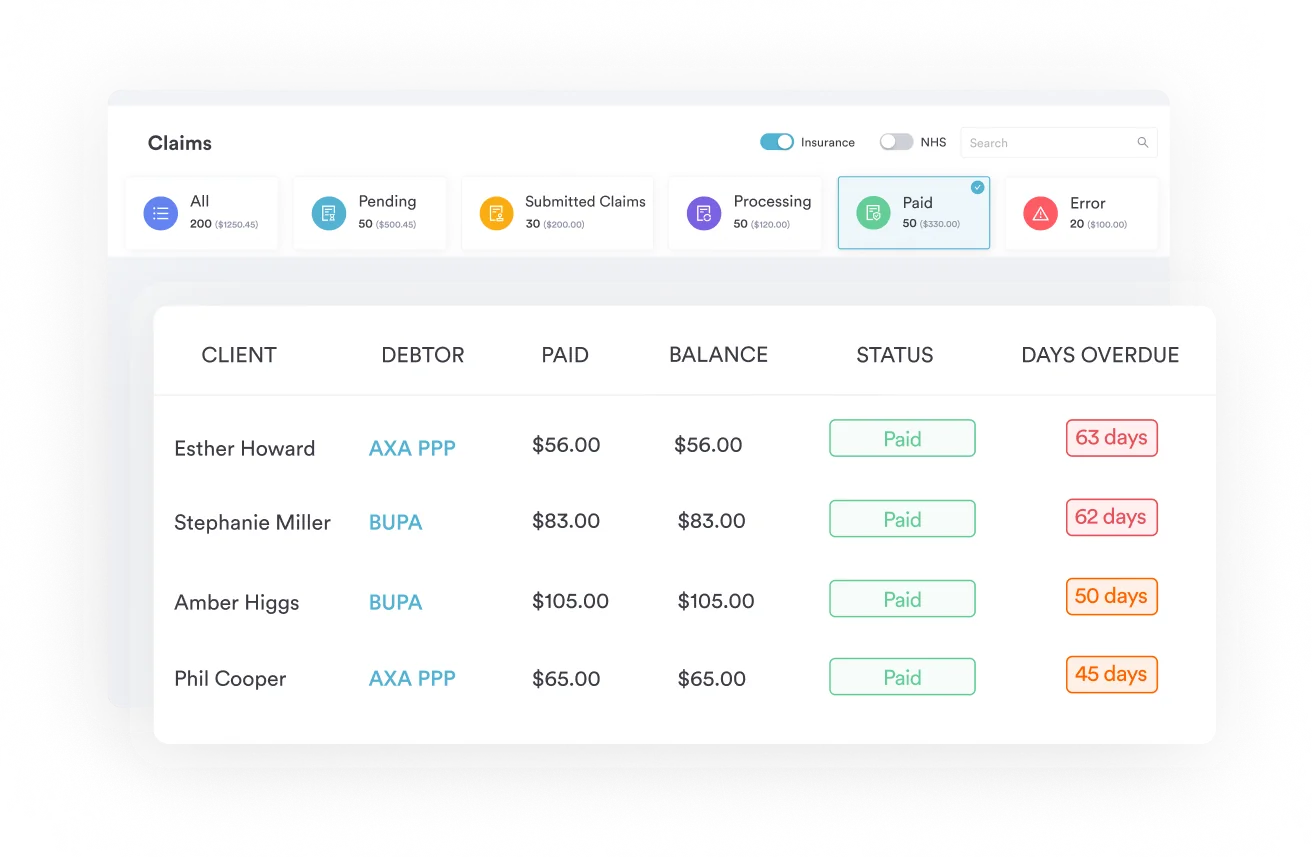
Pabau’s claims management software helps practices track these visits separately and attach the correct documentation before submission.
CPT code 99455 describes a work-related or medical disability examination performed by the treating physician. The official descriptor requires five components to be completed and documented during the encounter.
All five components must be present. Leaving out the impairment calculation or failing to document the treatment plan gives auditors grounds to deny or downcode the claim. This is not a code for simply completing paperwork. It requires a face-to-face examination. Practices billing coaching CPT codes or similar evaluation-heavy services will recognize this documentation pattern.
Use CPT code 99455 when the visit purpose is to evaluate a patient’s work capacity or disability status, not to manage an active condition. Per CPT guidelines, report this code only when no active management of the problem occurs during the contact.
Common clinical scenarios that support billing CPT code 99455 include:
The most common coding confusion in this category comes down to provider type. The treating physician bills CPT code 99455. Any physician or qualified healthcare professional other than the treating physician, such as an independent medical examiner (IME), bills CPT code 99456.
| Code | Who bills it | Typical context |
|---|---|---|
| 99455 | Treating physician | Impairment rating, disability certificate, return-to-work exam by the clinician who manages the patient’s care |
| 99456 | Any physician other than the treating physician | Independent medical examination (IME), second opinion requested by insurer or employer |
| 99450 | Any physician | Basic life and/or disability examination (no work-injury context required) |
| 99080 | Any physician | Completing paperwork only, without a face-to-face examination |
Per the American Academy of Family Physicians (AAFP), 99455 and 99456 cover the same exam components. The only differentiator is the physician’s relationship to the patient. If your practice manages the patient’s ongoing care, bill 99455. If you are conducting an examination at the request of an insurer or employer and have no prior treating relationship, bill 99456.
Practices serving workers’ compensation patients across both roles benefit from occupational therapy software that flags provider type at the scheduling stage, stopping staff from submitting the wrong code before the visit even ends.
Document the treating physician relationship explicitly in the encounter note. State that the physician has an ongoing care relationship with this patient. Payers auditing CPT 99455 claims look for this distinction first.
With built-in video consultations, follow-up E/M visits happen without the patient leaving home.
Incomplete documentation is the primary driver of 99455 denials. Each of the five required components must appear in the clinical record with enough specificity to withstand payer scrutiny.
The history and exam do not have a defined level requirement the way standard E/M codes do, but they must be “commensurate with the patient’s condition.” In practice, this means a thorough review of the injury or illness history, prior treatment, current medications, and functional limitations. The physical examination should directly relate to the work-related condition under evaluation.
This component separates 99455 from a routine office visit. The physician must assess the patient’s current capabilities and stability, then calculate a whole-person impairment rating when applicable.
Workers’ compensation systems, including the Georgia State Board of Workers’ Compensation, require that this calculation follow the AMA Guides to the Evaluation of Permanent Impairment. Georgia SBWC mandates CPT code 99455 specifically for impairment rating billing and sets a professional allowance of $217.22 for this service.
The encounter note must outline a plan for future medical treatment. This can be brief (e.g., ongoing physical therapy, no further intervention needed, referral recommended) but must exist as a distinct element.
The physician must also complete all required documentation and certificates requested by the insurer or employer. Using Pabau’s digital forms to pre-build workers’ compensation report templates reduces documentation time and ensures the report captures every required element.


Pabau helps occupational health and workers’ comp practices manage disability exam documentation, attach required forms to claims, and track submission status in one place.

Standard Medicare Part B does not typically cover CPT code 99455. State-administered systems and private workers’ compensation insurers handle these claims, not Medicare. When a patient receives care under both Medicare and workers’ compensation, Medicare acts as secondary payer only after the workers’ compensation payer exhausts or denies benefits.
For Medicare patients with a concurrent workers’ compensation claim, verify coverage with the specific workers’ compensation payer before billing 99455 to Medicare. Use the CMS Physician Fee Schedule lookup to confirm Medicare payment status and any applicable national coverage determinations.
State workers’ compensation fee schedules govern reimbursement in most cases. Alabama’s 2019 disability rating fee schedule sets the allowance for CPT code 99455 at $278.28, while the 2009 schedule allowed $236.64. Georgia SBWC publishes an allowance of $217.22.
Rates vary significantly by state and can change annually. Always verify against the current state fee schedule before estimating reimbursement. Practices managing multi-state workers’ compensation billing benefit from reviewing relevant IVF CPT codes and other specialty billing patterns to understand how state fee schedule variation affects revenue across code types.
Commercial health insurers and self-insured employers may cover 99455 under separate workers’ compensation or disability policies. Coverage terms, prior authorization requirements, and documentation expectations vary by payer contract. Always check the individual payer policy before billing, and retain a copy of the payer’s written coverage determination in the patient’s record.
Before billing CPT 99455, confirm whether the payer requires a prior authorization or specific form submission for disability evaluations. Some state workers’ compensation systems mandate pre-approval for impairment rating visits. Document the authorization number in the claim.
Modifier use with CPT code 99455 requires careful attention, particularly when you bill an E/M service on the same date of service.
If the treating physician performs both a standard office visit (an E/M service) and a disability evaluation on the same day, you may bill both codes only when the services are distinct and separately documented.
Per Georgia workers’ compensation guidance, append Modifier 25 to the E/M code to show that the physician performed a separately identifiable E/M service on the same day as the disability evaluation. The documentation must clearly separate the active management portion of the visit from the evaluation and reporting components.
Bundling both into a single note without Modifier 25 typically results in the payer paying only one code and denying the other. Reviewing how similar modifier rules apply to ADHD screening CPT codes and other evaluation services helps billing teams build consistent modifier workflows across code families.
Verify current modifier guidance and payer-specific editing rules for CPT code 99455 against a current coding reference before you finalize claims.
Understanding denial patterns protects revenue before you submit claims. These are the most frequently cited errors with CPT code 99455.
Practices managing high volumes of workers’ compensation visits also benefit from reviewing Bupa procedure codes and fee schedules to understand how disability-linked billing documentation standards compare across insurance systems. The HIPAA compliance for medical offices guide covers documentation practices and applies to the workers’ compensation records that covered entities hold.
The applicable state workers’ compensation fee schedule determines reimbursement for CPT code 99455, not Medicare’s Physician Fee Schedule. Because standard Medicare does not cover this code for most disability evaluation purposes, the CMS fee schedule figures are not typically the operative rate.
Verified state fee schedule allowances include Alabama ($278.28 under the 2019 schedule, $236.64 under the 2009 schedule) and Georgia ($217.22 per SBWC). Private workers’ compensation insurers negotiate rates independently and may pay above or below the state schedule depending on the contract.
The CPT code 99455 fee a practice actually collects depends on the payer contract, not a single national number. Review Work RVU, Practice Expense RVU, and Malpractice RVU values with a current RVU lookup tool as a reference point when negotiating payer contracts.
Practices considering adding disability evaluation services should include 99455 reimbursement estimates in their revenue projections. The guide to starting a medical practice covers financial planning frameworks that apply to specialist and occupational health settings. Pabau’s client record management supports the longitudinal documentation needed for impairment rating follow-up visits, keeping all disability-related records in a single auditable location. Claim scrubbing catches the mismatches that would otherwise come back as a denial two weeks later. Where a practice bills both markets, mapping between code sets is manual, so MBS item numbers are checked separately.
Workers’ compensation billing denials for disability evaluations almost always come down to the same set of avoidable errors: wrong provider type, missing documentation components, or incorrect modifier use on same-day E/M codes.
Getting CPT code 99455 right means confirming treating physician status before billing, documenting all five required components in the record, and attaching Modifier 25 whenever an office visit accompanies the evaluation.
Pabau’s claims management and documentation tools give occupational health and sports medicine practices the workflow structure to capture every required element before a claim is submitted. To see how Pabau handles workers’ compensation documentation end to end, book a demo.

Billing a semi-electric hospital bed? Semi-electric hospital bed billing Covers HCPCS code E0261 and when the bed bills without a mattress supplied separately by another source.
Need the code for a total electric bed? Total electric hospital bed billing Covers HCPCS code E0265 and the capped rental rules that differ from the semi-electric bed code.
Billing a replacement innerspring mattress? Innerspring mattress billing guide Covers HCPCS code E0271 and the documentation gaps and modifier errors that most often cause denials.
CPT code 99455 is the billing code for a work-related or medical disability examination that the treating physician performs. It covers a face-to-face evaluation that includes medical history, physical examination, impairment calculation, a future treatment plan, and completion of required disability documentation or certificates.
The treating physician who manages the patient’s ongoing care bills CPT 99455. Any other physician, such as an independent medical examiner conducting an evaluation at the request of an insurer or employer, bills CPT 99456. Both codes cover the same required exam components.
Standard Medicare Part B does not typically cover CPT code 99455 for workers’ compensation-related disability evaluations. State workers’ compensation fee schedules and private payer contracts govern reimbursement. Verify coverage with the specific workers’ compensation insurer before submitting a claim to Medicare.
Yes, as long as you document the services separately and they remain medically distinct. Append Modifier 25 to the E/M code to show that the physician performed a separately identifiable service on the same date. The encounter record must clearly distinguish active treatment from the disability evaluation components.
The most common modifier is Modifier 25, which you append to a same-day E/M code when you bill both services together. Modifier 32 applies when the evaluation is mandated by a court or government agency. Modifier 59 distinguishes CPT 99455 as a distinct service when you bill other procedures on the same date.
Reimbursement depends on the state workers’ compensation fee schedule. Verified rates include $278.28 in Alabama (2019 schedule) and $217.22 in Georgia (SBWC). Private insurers negotiate rates independently. Use your state’s published fee schedule or a contract rate to estimate reimbursement accurately.



