CPT code 97152: ABA supporting assessment billing guide
CPT code 97152 is the technician’s ABA assessment code CPT code 97152 bill...

Last Updated: Nov 11, 2026
95808 is the CPT code for polysomnography at any age, with sleep staging and 1-3 additional parameters of sleep, attended by a technologist.
It covers an in-lab study that stages sleep but records only a short list of extra channels, such as oxygen saturation and airflow. Four or more extra channels move the claim to 95810, or to 95782 under age 6. The channel count in the sleep report decides the code.
Let Pabau's smart automation suggest the right codes, reduce claim denials, and keep your practice compliant—effortlessly.
Automate repetitive tasks and focus on what matters most—your patients.
Reduce coding errors and ensure compliance with the latest regulations.
Clean claims, fewer denials, and faster reimbursements.
Powerful insights and reporting to help your practice thrive.
HIPAA compliant SOC 2 certified GDPR-compliant Trusted by 4,000+ clinics worldwide

CPT code 95808 bills attended polysomnography with sleep staging plus 1-3 additional parameters, for a patient of any age.
Count only the channels recorded beyond EEG, EOG and chin EMG. Four or more extra channels mean 95810 at age 6 or older, or 95782 under 6.
The technologist must stay on site for the whole recording, and the report should name them, their credential and the attendance times.
Medicare coverage runs through your A/B MAC’s polysomnography LCD, so check the diagnosis code against that LCD before the claim goes out.
Pabau, the practice management platform we build, pre-fills the claim from the patient record and handles eligibility, 837P submission and ERAs through Claim.MD.
CPT code 95808 is the code for an attended, in-lab sleep study that stages sleep and records one to three extra physiologic channels.
The American Medical Association descriptor reads: “Polysomnography; any age, sleep staging with 1-3 additional parameters of sleep, attended by a technologist.” Each part of that wording changes how you bill the study.
The parameter count starts after EEG, EOG and chin EMG, because those three are what staging needs. Oxygen saturation, airflow, respiratory effort, leg EMG, ECG and body position each count as one extra parameter.
A typical 95808 montage adds SpO2 and airflow, or SpO2, airflow and leg EMG. Add respiratory effort belts to that last set and the study has four extra parameters.
A technologist has to be physically present throughout the recording, not on call or reviewing the data from home. Remote monitoring doesn’t meet the attended requirement, and a claim billed as attended on that basis is exposed on audit.
Three questions settle the code: was sleep staged, how many extra parameters ran, and how old is the patient. An attended study with no sleep staging is 95807, so staging comes first.
The path below walks through all three questions in order.
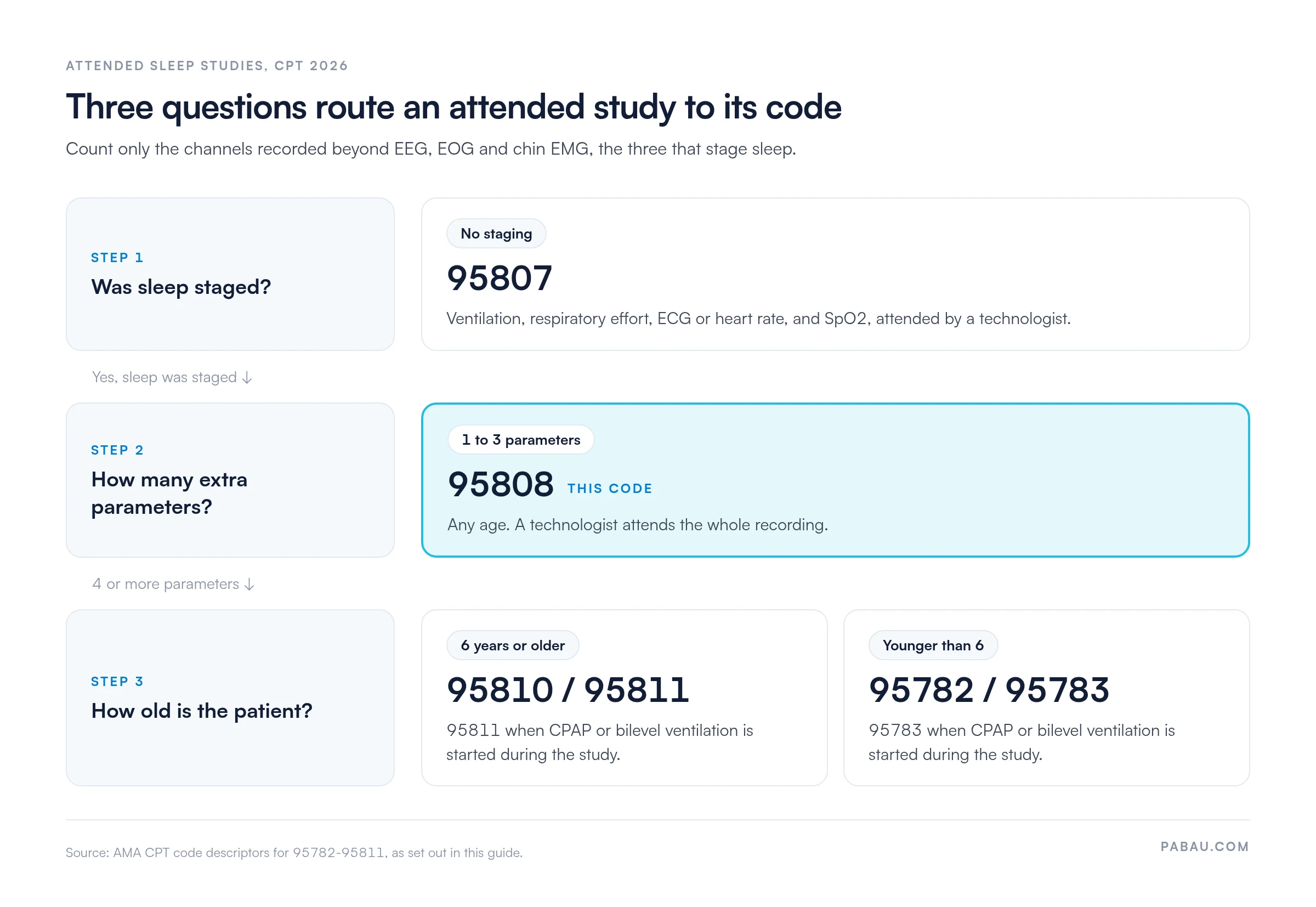
The table puts the attended codes side by side, including the two codes for children younger than 6.
The 95808 vs 95810 decision: Count every channel recorded beyond EEG, EOG and chin EMG. SpO2 plus airflow is two parameters, so 95808 fits. SpO2, airflow, respiratory effort and leg EMG make four, so a patient aged 6 or older needs 95810. Billing 95808 for that study underbills it, while billing 95810 for a three-channel study is upcoding.
One more branch overrides the count. If CPAP or bilevel ventilation starts during the night, including a split-night study, report 95811 for a patient aged 6 or older.
Medicare covers CPT code 95808 under the applicable A/B MAC polysomnography LCD (varies by jurisdiction, e.g. L36839, L36902, L36861, L36593). You can find yours in the Medicare Coverage Database. Coverage needs a documented clinical evaluation, symptoms that point to a sleep disorder, and a physician order stating the reason for the study.
Payment depends on place of service. Hospital-based settings use the facility rate, and freestanding centers use the non-facility rate. Rates reset each January with the Medicare Physician Fee Schedule.
Check this year’s figure in the CMS Physician Fee Schedule search tool for your locality. Pabau’s electronic claims via Claim.MD support eligibility checks, 837P submission and ERA remittances.
Traditional Medicare doesn’t require prior authorization for most attended sleep studies, as long as the chart shows medical necessity under the applicable LCD. Medicare Advantage plans, commercial payers and Medicaid managed care plans often do, and their rules change at plan renewal. A request usually needs four items:
Run insurance eligibility verification when you schedule the study, not on the night. An authorization problem found at booking still leaves time to fix it.
Confirm prior authorization separately for each payer type. Medicare, Medicare Advantage and commercial plans all set different rules for CPT code 95808. Never assume coverage from an earlier approval, especially after a plan year renewal.
Payers judge medical necessity from the ICD-10-CM codes on the claim. The most common pairing is G47.33, obstructive sleep apnea, but your MAC’s LCD sets the accepted list.
LCD diagnosis lists follow the ICD-10-CM update each October. Recheck yours before the new codes take effect, because a code missing from the list sends the claim to medical-necessity review.
95808 has a technical part (the recording) and a professional part (the interpretation). Split billing between a facility and a reading physician is the most common reason to add a modifier, followed by a short recording.
A coder can only confirm 95808 from what the chart shows. Before you bill, the record needs these six items.
Scoring should follow AASM rules for sleep staging, respiratory events and limb movements, since auditors compare the report against them. A clean claim is one where the chart and the claim agree, down to the parameter count and the technologist’s credential.
With the documentation in place, the claim itself follows six stages. Most problems start in the first two, long before anyone opens the claim form.
Take an illustrative case. A 45-year-old patient with daytime sleepiness and loud snoring is booked for an attended study. The order lists SpO2 and nasal airflow, two extra parameters, so the scheduler expects 95808.
On the night, the technologist sees irregular breathing and adds respiratory effort belts and bilateral leg EMG. The final report lists four extra parameters. The correct code is now 95810, and billing 95808 would underbill the study.
The fix is procedural. Code from the final report’s channel list, never from the order, and make sure the technologist’s log names each channel. Had the same patient been 5 years old, the four-parameter study would have been 95782.
Run through this list on each claim before it leaves the practice.
Denials on 95808 tend to repeat the same handful of patterns. The table pairs each one with its root cause and the fix.
Map each CARC and RARC on the remittance to its corrective action before you resubmit. Our guide to medical billing denial codes explains the common ones.
Run a quarterly parameter-count audit across your PSG claims. Pull every 95808 and 95810 claim for the period and compare the channel count in the report with the code billed. A repeated mismatch points to a workflow problem rather than one coder’s error.
The sleep codes run from unattended home tests to in-lab studies that start CPAP. Knowing the neighbors helps when a study doesn’t fit 95808 cleanly, and the AAPC code range for 95700-95811 lists each descriptor in full.
Most of what goes wrong with 95808 starts before coding. An authorization goes unchecked, or the claim is retyped from a paper report and a field goes missing.
Pabau’s claims management software builds the claim from the patient record instead. The CPT code attached to the service lands on the charge line, and the diagnosis slots draw on the recorded problem list. Required fields, such as authorization numbers, must be complete before the claim can be sent.
In the US, Pabau sends claims through Claim.MD, with eligibility checks, 837P submission, claim status tracking and ERA posting. Your billing team then works each denial from the same patient record that holds the study notes.
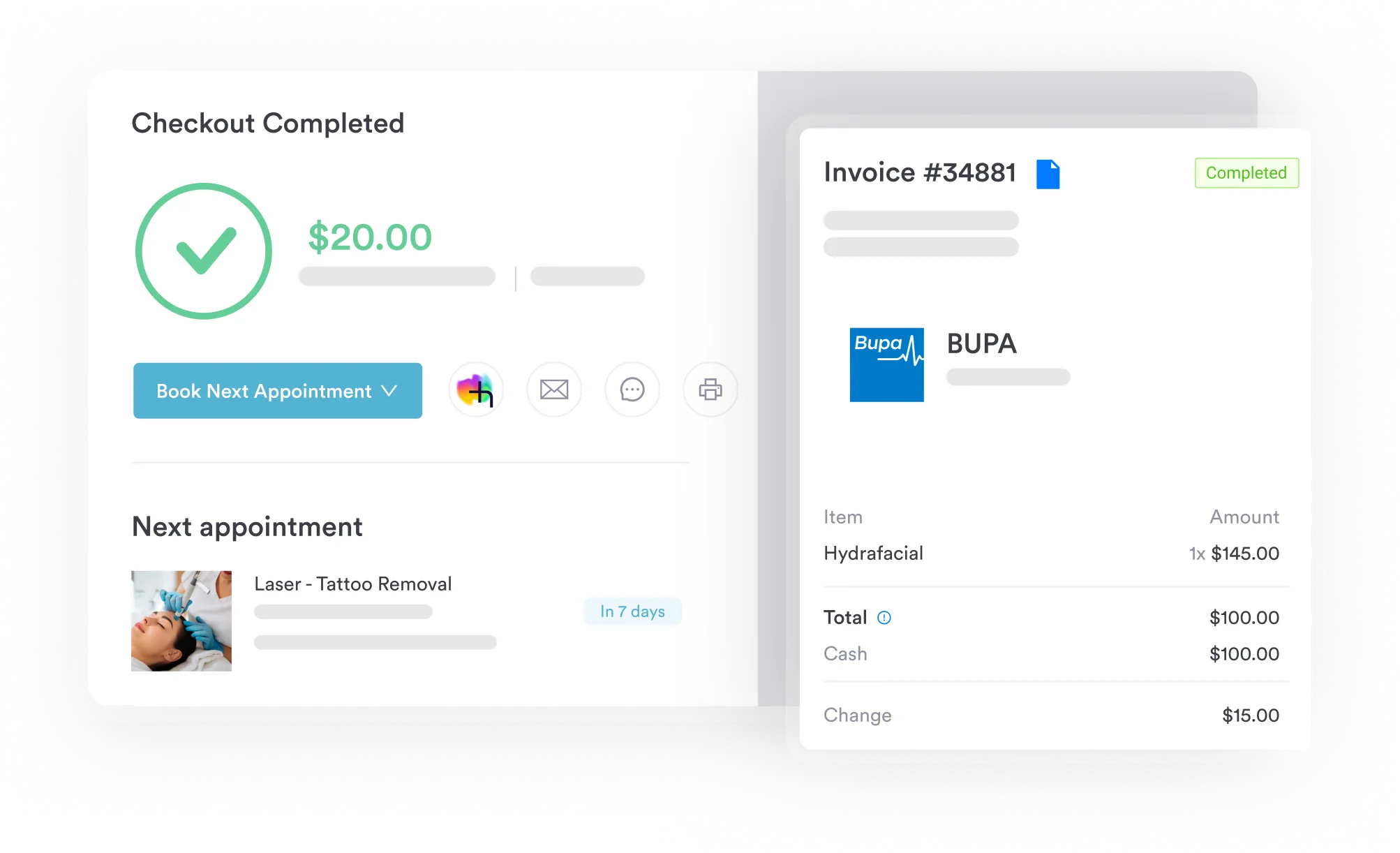

Pabau pre-fills each claim from the patient record and checks required fields before it goes out. Eligibility checks, submission and remittances run through Claim.MD.

Bill 95808 from the finished sleep report, not from the order. The channel count, the patient’s age and the technologist’s attendance decide the code. All three should be visible in the chart before anyone opens the claim.
If you change one habit, make it the parameter count at coding. It catches an underbilled four-channel study and an upcoded three-channel one, and it takes a minute per claim. Pair it with an LCD check on the diagnosis code, and the claim answers the two questions payers ask first.
Book a demo to see how Pabau carries a sleep study from order to paid claim, with each check built into the record.

Billing a home study instead? CPT code 95806 covers the unattended study that records airflow and effort without sleep time.
Is sleep time recorded on the home test? CPT code 95800 explains the unattended study that adds sleep time to the respiratory channels.
Building an appeals routine for sleep claims? Denial management in healthcare sets out a root-cause workflow for recurring denials.
Posting sleep study remittances? Electronic remittance advice explains how to read and act on ERA files after adjudication.
Capturing every service at the visit? Superbill guide covers the fields a superbill needs before coding starts.
No. When CPAP or bilevel ventilation starts partway through the night, report 95811 for a patient aged 6 or older, or 95783 under 6. Don’t add 95808 or 95810 for the same night.
Home sleep apnea testing suits adults with a high likelihood of moderate to severe obstructive sleep apnea and no major comorbidities. Significant heart or lung disease, neuromuscular conditions or suspected non-apnea sleep disorders usually call for an attended study.
Billed globally, yes. The global service covers the technical recording and the physician’s interpretation and report. When a facility and a reading physician bill separately, the facility adds modifier TC and the physician adds modifier 26.
Snoring is R06.83. On its own it rarely supports medical necessity for a sleep study, so document the symptoms around it, such as witnessed apneas or daytime sleepiness.
Yes. 95808 has no age limit, so a child of any age with 1 to 3 extra parameters fits it. Under age 6, a study with 4 or more extra parameters is 95782, or 95783 if CPAP or bilevel ventilation is started.