



HCPCS code E0198: Water pressure pad billing guide
HCPCS code E0198 is a water pad for a standard mattress HCPCS code E0198 is the ...

Last Updated: Oct 13, 2026

CPT code 95806 describes an unattended home sleep apnea test that records heart rate, oxygen saturation, respiratory airflow, and respiratory effort at once.
Medicare covers 95806 primarily for obstructive sleep apnea (G47.33), and a non-covered ICD-10 pairing is the most common denial trigger.
The 2026 Medicare non-facility rate runs roughly $91 to $107, varying by MAC region and by whether interpretation is billed separately.
A device recording only two or three channels belongs on 95801, so the chart has to name the device model and its channel count.
Pabau’s claims management software checks CPT and ICD-10 pairings inside the billing workflow, so errors surface before the claim leaves the practice.
CPT code 95806 is the billing code for an unattended home sleep apnea test (HSAT) that records four parameters at once. Those parameters are heart rate, oxygen saturation, respiratory airflow, and respiratory effort. A qualified physician interprets the download afterward, and that interpretation is part of the code.
Denials on this code rarely come from the study itself. They come from the record built around it. The physician order, the ICD-10 pairing, and the signed interpretation report stop more 95806 claims than any coding subtlety.
This guide covers the code definition, the four required channels, and the ICD-10 codes that support medical necessity. It also covers the 2026 Medicare fee schedule, documentation and prior authorization requirements, modifier selection, and the denial patterns worth tracking.
CPT code 95806 describes a sleep study, unattended, with simultaneous recording of heart rate, oxygen saturation, respiratory airflow, and respiratory effort.
Effort is usually captured as thoracoabdominal movement. The American Medical Association (AMA) maintains the CPT code set and files 95806 under sleep medicine testing.
“Unattended” means no sleep technician is present during the recording. The patient wears a portable monitoring device at home overnight. The raw data is downloaded afterward and interpreted by a qualified physician. That is what separates 95806 from attended in-lab codes such as 95810 and 95811.
The American Academy of Sleep Medicine (AASM) classifies the study 95806 describes as a Type III home sleep apnea test. Type III devices record at least four channels, which is what the 95806 descriptor requires. Type IV devices record only two or three channels, and those studies bill under 95801 rather than 95806.
Every 95806 claim requires simultaneous recording of exactly these four parameters. Missing even one makes the procedure non-billable under this code.
CPT 95806 does not include EEG, EMG, or eye-movement recording. If those channels are required, the procedure moves to 95807 or a higher polysomnography code. The AMA descriptor draws the line there, and CMS LCD article A57496 applies the same boundary in coverage policy.
Sleep medicine billing involves a family of closely related codes. Billing 95806 when 95800 or 95801 applies is a common error. The comparison below captures what separates them.
The decision turns on the channel count and the setting. A device that records EEG or EMG in a supervised facility puts you in 95810 or 95811 territory. A device that omits respiratory effort puts you in 95801.
Pairing 95806 with a non-covered ICD-10 code is the single most common reason these claims are denied. Medicare’s coverage policy, set out in CMS LCD article A57496, recognizes obstructive sleep apnea and related sleep disorders as the primary covered indications.
Snoring (R06.83) and insomnia (G47.00) do not support medical necessity for HSAT on their own. If a patient presents with snoring plus suspected OSA, document the clinical suspicion so the order carries G47.30 or G47.33.
Most 95806 claims are built on G47.33, so it is worth knowing which clinical findings that code expects in the note. Covered code lists also change, so check your MAC’s current Local Coverage Determination each year.
Medicare pays CPT 95806 under the Physician Fee Schedule. Rates differ between facility and non-facility settings. They also differ between the technical component, which is the recording, and the professional component, which is the physician interpretation. Check current figures with the CMS Physician Fee Schedule Look-Up Tool.
These are CY2026 national averages. Confirm the rate for your own MAC region before you submit. Geographic adjustment through locality factors shifts payment by roughly 10% to 20% either side of the national figure.
The split between the two components matters when a contracted physician reads the studies. Billing only the technical component gives up roughly 40% of the global fee. Price that arrangement with the interpreting physician before you sign it.
An incomplete medical record is the second most common denial trigger after ICD-10 mismatches. Medicare and most commercial payers want all of the following in place before a 95806 claim will pay.
Complete each element at the time of service. Reconstructing a record after a denial takes far longer than capturing it at chart closure, and payers can treat late additions as unsupported.
Build a documentation checklist into your sleep study ordering workflow. Before the patient leaves with the device, confirm three items: the signed order, the documented clinical indication, and the device type in the chart. Catching a missing item at setup takes a minute. Catching it after a denial costs 30 to 60 days of follow-up per claim.
Medicare does not currently require prior authorization for CPT 95806 in most MAC jurisdictions. Local Coverage Determinations still impose coverage criteria that work as de facto authorization requirements. Commercial payer rules vary widely, so verify each plan before the study is scheduled.
Record the payer’s requirement at the scheduling stage rather than at billing. By the time a biller finds the missing authorization, the device has already been worn and the service cannot be undone.
When prior authorization is required, payers typically ask for the clinical notes documenting OSA symptoms, the ordering physician’s details, and the planned device type. Some also want a note on failed conservative treatment. Criteria change by plan year, so record the PA reference number and approval date before the device is dispensed.
Modifier selection turns on one question. Does the same entity perform both the technical recording and the professional interpretation, or are those two jobs split between separate billing entities?
Billing both TC and 26 from the same provider on one claim flags as unbundled. Modifier requirements follow the billing relationship on the date of service, not the date of submission. Check with a certified coder when your arrangement with an interpreting physician changes mid-year.
Five triggers account for the majority of 95806 rejections. Each one has a root cause that can be fixed upstream of the claim, which is what the table below sets out.
Reviewing the medical billing denial codes on your 95806 remittances maps each CARC back to one of these root causes. All five are created before the claim is built, at a specific point in the workflow. The sequence below shows where each check belongs.
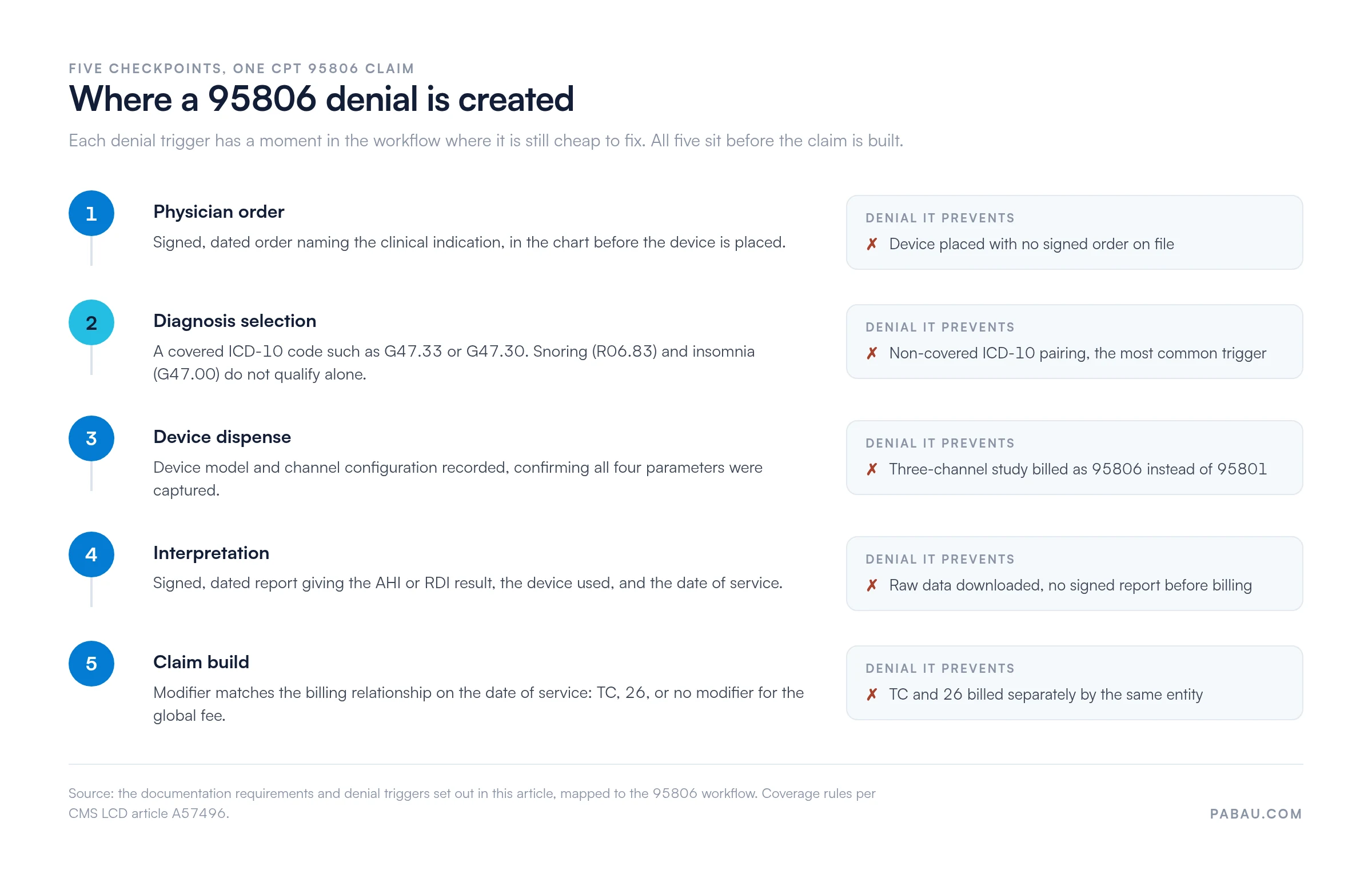
Track your 95806 denials by reason code rather than by total volume. If CO-11 keeps appearing, the procedure conflicts with the diagnosis, so your ICD-10 pairing needs a fix at the ordering stage. CO-4 points somewhere else: the procedure code conflicts with the modifier used, or a required modifier is missing. CO-97 means the payer treats 95806 as bundled with another code billed that day.
The documentation failures and ICD-10 mismatches behind most 95806 denials happen long before the claim reaches a clearinghouse. They happen at scheduling, at device dispense, and at chart closure. Software that connects those three points cuts the number of places an error can start.
Pabau is practice management software built for medical and aesthetic practices. Its claims management software holds CPT and ICD-10 pairing logic inside the billing workflow. A mismatched pair is flagged before submission, so the G47.33 requirement is checked at the claim rather than discovered on a remittance weeks later.
The ordering workflow carries the other half of the job. Required fields for the signed order, the clinical indication, and the device configuration can sit in the appointment itself. A device then cannot be dispensed against an incomplete chart.
Electronic remittance data flows back into the same record after submission. That keeps the denial log current without manual reconciliation, so you can see which of the five triggers your practice actually hits.

Pabau connects scheduling, documentation, and claim submission in one platform. See how automated ICD-10 pairing and prior authorization tracking help sleep practices get paid faster.

Selecting CPT 95806 is straightforward once the channel count is settled. Almost every denial on the code comes from something the practice controls: the order, the diagnosis pairing, the device configuration, or the signed report.
That makes 95806 a workflow problem with a workflow answer. Move each check to the point where it is still cheap, and the denial rate falls without anyone learning a new coding rule. The trade-off is an ordering workflow that carries more required fields than clinicians usually like.
Start with the two checks that fail most often: the ICD-10 pairing and the signed order. Book a demo to see how Pabau validates both before a 95806 claim leaves the practice.

Need to understand how clearinghouse submission works for sleep study claims? Pabau’s Claim.MD clearinghouse guide covers electronic claim submission, eligibility verification, and ERA processing end to end.
Sending the patient to the sleep lab instead? CPT code 95810 covers attended in-lab polysomnography, including the channel requirements 95806 does not carry.
Need the diagnosis side of the claim? ICD-10 code G47.33 sets out what an obstructive sleep apnea note needs to support medical necessity.
Want to reduce manual errors across the billing cycle? Revenue cycle management fundamentals explains the workflow from scheduling through payment posting, and how each stage affects reimbursement.
Handling denials across multiple CPT codes? Medical billing software options for US practices reviews platforms that support multi-code sleep study billing, including clearinghouse connectivity and denial analytics.
CPT code 95806 covers an unattended home sleep apnea test (HSAT) that simultaneously records four parameters: heart rate, oxygen saturation, respiratory airflow, and respiratory effort. The study runs without a sleep technician present, using a portable monitoring device the patient wears at home overnight. The code includes physician interpretation of the recorded data.
CPT 95806 is for unattended sleep studies only. No sleep technician monitors the patient during the recording. If a technician is present throughout the study in a supervised facility, use 95810 or 95811 instead. Which one applies depends on whether CPAP titration is performed.
The 2026 Medicare national average for CPT 95806 billed globally is approximately $91 to $107 in a non-facility setting. That figure covers both the technical and professional components. Exact rates vary by MAC locality. Use the CMS Physician Fee Schedule Look-Up Tool to confirm the current rate for your area before submitting claims.
Both codes describe unattended home sleep studies with four recorded parameters. CPT 95806 records heart rate, oxygen saturation, respiratory airflow, and respiratory effort. CPT 95800 records sleep time in place of respiratory effort, usually derived from actigraphy or peripheral arterial tone. Sleep time substitutes for a channel rather than being added as a fifth one.
Bill 95801 when the device records three parameters: heart rate, oxygen saturation, and respiratory airflow. CPT 95806 requires a fourth channel for respiratory effort, usually measured as thoracoabdominal movement. A Type IV device recording two or three channels belongs on 95801, and billing that study as 95806 is a common denial trigger.
Medicare generally does not require prior authorization for CPT 95806, though specific MAC coverage criteria must be met. Commercial payer requirements vary significantly by plan. Always verify the individual payer’s current policy before scheduling the study. When authorization is required, record the PA reference number and approval date in the patient record.
The most common modifiers are TC and 26. Use TC when one entity provides the device and recording only, and 26 when a separate physician performs the interpretation. When the same practice provides both the recording and the interpretation, bill without a modifier for the global fee. Modifier GY applies when the service is statutorily excluded from Medicare coverage.



