

CCSD code G5100: Bypass of duodenum billing guide
CCSD code G5100 bills a bypass that leaves the duodenum in place CCSD code G5100...

Last Updated: Oct 16, 2026
95807 is the CPT code for sleep study, simultaneous recording of ventilation, respiratory effort, ECG or heart rate, and oxygen saturation, attended by a technologist.
It is an attended cardiorespiratory study, not polysomnography, because the lab does not stage sleep. Once sleep is staged with EEG, EOG, and chin EMG, the study moves to 95808, 95810, or 95811.
Let Pabau's smart automation suggest the right codes, reduce claim denials, and keep your practice compliant—effortlessly.
Automate repetitive tasks and focus on what matters most—your patients.
Reduce coding errors and ensure compliance with the latest regulations.
Clean claims, fewer denials, and faster reimbursements.
Powerful insights and reporting to help your practice thrive.
HIPAA compliant SOC 2 certified GDPR-compliant Trusted by 4,000+ clinics worldwide

CPT code 95807 reports an attended sleep study that records ventilation, respiratory effort, ECG or heart rate, and oxygen saturation, with no sleep staging.
Sleep staging is the line between 95807 and polysomnography. Once the lab stages sleep, the study belongs under 95808, 95810, or 95811 instead.
A technologist must attend the whole study, and a recording shorter than six hours is reported with modifier 52.
The 2026 national Medicare amount is $443.56 for the global service, or $384.11 for the technical component and $59.45 for the professional component.
Pabau, the practice software we build, submits and tracks 95807 claims through Claim.MD using the data already on the patient record.
CPT code 95807 is the code for an attended cardiorespiratory sleep study. A technologist stays with the patient while the lab records ventilation, respiratory effort, ECG or heart rate, and oxygen saturation.
Sleep is not staged, so 95807 is not polysomnography. The descriptor names no EEG, EOG, or chin EMG channels. A scorer needs those signals to tell wake, NREM, and REM sleep apart.
The American Medical Association’s CPT code set places 95807 among the sleep medicine testing codes. It sits between the unattended studies, such as 95806, and the polysomnography codes 95808, 95810, and 95811.
The AMA descriptor for 95807 reads: “Sleep study, simultaneous recording of ventilation, respiratory effort, ECG or heart rate, and oxygen saturation, attended by a technologist.” The sleep medicine code list from the American Academy of Sleep Medicine carries the same wording. Check the current year’s CPT codebook before billing, because descriptors can receive editorial revisions.
The descriptor lists four signals, recorded at the same time, plus technologist attendance. Each one should appear in the recording and in the scored report.
A 95807 study does not record EEG, EOG, or chin EMG, so the report cannot give sleep stages, total sleep time, or sleep efficiency. Respiratory events are counted against the monitored or recording time instead.
Coding guidance for the sleep medicine codes expects at least six hours of recording. The report should state the recording time, because a shorter study is reported with modifier 52.
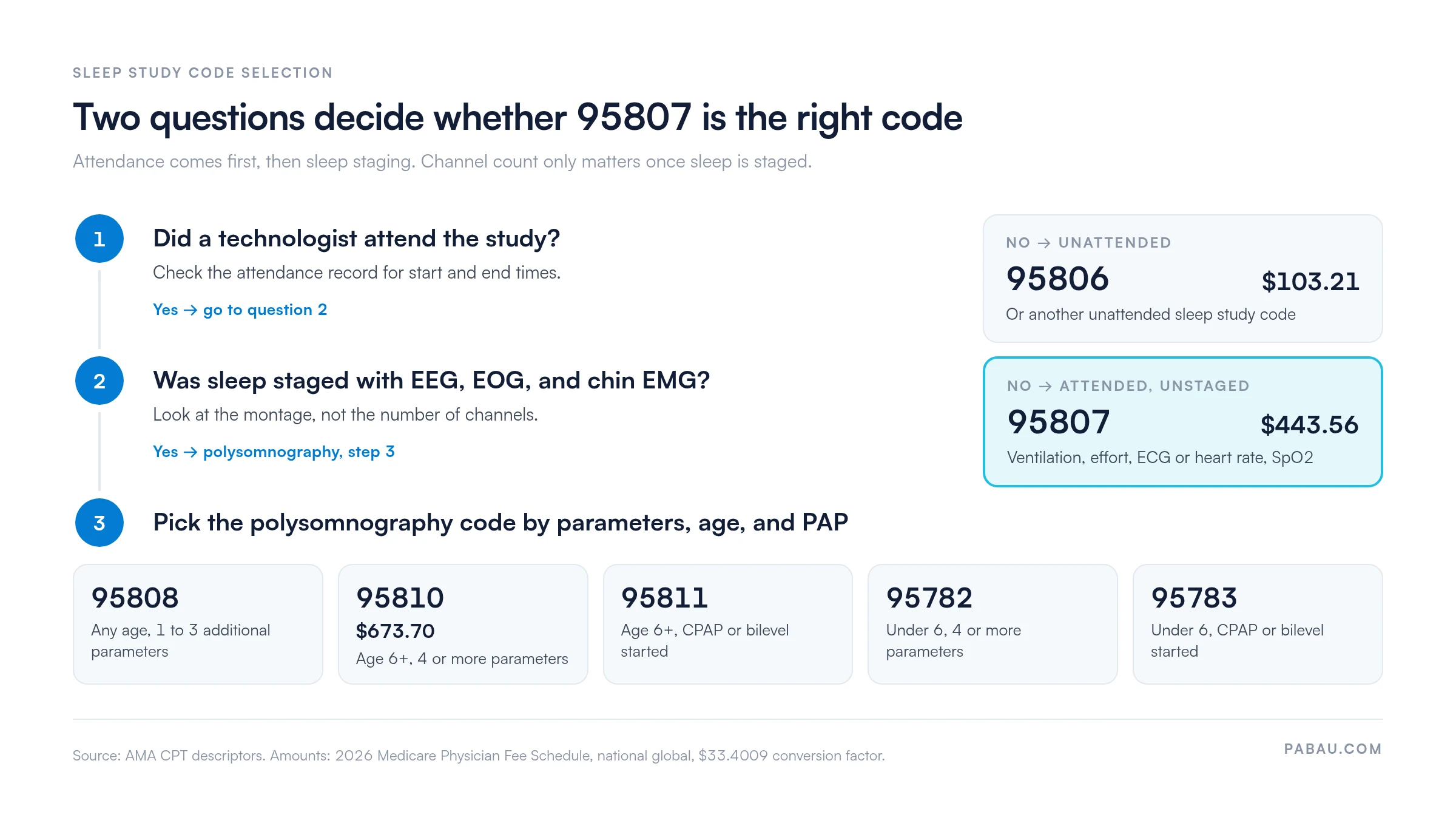
The sleep study codes split on three questions. Was a technologist present, was sleep staged, and was positive airway pressure started? Channel count only matters once sleep is staged.
Patients younger than 6 have their own polysomnography codes. 95782 covers staging with 4 or more additional parameters, and 95783 adds the start of CPAP or bilevel ventilation.
Key distinctions: If the lab staged sleep with EEG, EOG, and chin EMG, the study is polysomnography. Pick 95808, 95810, or 95811 by the number of additional parameters, the patient’s age, and whether PAP was started.
If sleep was not staged and a technologist attended, 95807 applies. If no technologist attended, the study belongs under 95806 or one of the other unattended codes. Counting channels never moves a study from 95807 to 95810, because 95807 has no staging to count from.
The diagram below runs the same checks in order. It also adds the 2026 national Medicare amount for each code this guide prices.
A 95807 study answers questions about breathing and oxygenation during the night. The diagnosis on the claim should match that purpose, and it should explain why an attended study was ordered instead of a home test. Obstructive sleep apnea, coded G47.33, is a common pairing when the order asks about breathing during sleep.
Insomnia on its own rarely supports in-lab testing, because sleep testing is not usually a covered indication for it. Only report diagnoses that the ordering clinician documented in the patient record.
Write the reason for an attended study into the physician order itself, not only into the report. A line such as ‘attended study ordered because of significant cardiopulmonary disease’ gives the payer the answer before it asks.
Payers look for a consistent record that runs from the order to the signed report. A well-organized superbill documentation process captures the billing fields at the point of service instead of at claim time.
Confirming insurance eligibility verification before the study night prevents a completed study from going unbilled because coverage lapsed or prior authorization was missing.
Medicare pays for 95807 as a Part B service. In a hospital outpatient department, the hospital bills the technical component on its facility claim. The interpreting physician then bills the professional component with modifier 26.
Covered indications come from the polysomnography and sleep testing local coverage determination (LCD) of the Medicare Administrative Contractor (MAC) for your region. Read your own MAC’s LCD and billing article before you bill. Key points to check include:
Submitting a clean claim for 95807 depends on a few checks before the claim leaves the lab.
The CMS fee schedule allows a professional and technical split for 95807, so TC and 26 are valid. Apply any modifier only when the record supports it.
A single night’s recording is reported with one sleep study code. Before you append modifier 59 to any pair of codes on the same date, check the current NCCI procedure-to-procedure edits.
Effective denial management in healthcare starts with naming the root cause before drafting the appeal. These are the patterns to check first on a 95807 denial.
For denials with specific adjustment reason codes, a reference for denial codes in medical billing maps each CARC code to the documentation the appeal needs.
The 2026 Medicare Physician Fee Schedule gives 95807 a global total of 13.28 RVUs, with a work RVU of 1.25 and an XXX global period. At the non-qualifying APM conversion factor of $33.4009, that comes to $443.56 nationally.
The fee schedule lists no facility amount for the global or technical service. In a hospital, that part is paid on the facility claim. Qualifying APM participants are paid at $33.5675, which gives $445.78 for the global service.
Code choice moves payment more than any modifier. 95810 carries 20.17 RVUs, or $673.70 nationally, and 95806 carries 3.09 RVUs, or $103.21. A staged study billed as 95807 leaves $230.14 unclaimed, while 95810 billed without staging is an overcode.
These are national figures before geographic adjustment (GPCI). Check your locality’s amount in the CMS Physician Fee Schedule lookup tool before projecting revenue.
Most sleep labs keep the physician order, the scored report, and the claim in separate places. Staff then rekey demographics, insurance details, and codes into a clearinghouse portal, and a typo there becomes a denial weeks later.
Pabau’s claims software for specialty practices pulls the patient and insurance details already on the record into a pre-filled claim. It submits that claim through Claim.MD, checks eligibility in real time, tracks claim status, and posts ERA remittances back to the account.
Your coders still choose the CPT code, the modifiers, and the diagnosis from the clinical record. The rekeying step disappears, so a 95807 claim reaches the payer with the data your team checked. A stalled claim also shows up on the dashboard.

Pabau pulls the patient and insurance data already on the record into a pre-filled claim, then submits and tracks it through Claim.MD. Your team spends less time rekeying and more time on the claims that need attention.

Before you code 95807, open the study montage and ask one question: was sleep staged? If not, and a technologist attended, 95807 is right. If it was, the study is polysomnography, and the parameter count, the age, and PAP decide between 95808, 95810, and 95811.
Settling that question first protects revenue in both directions. A staged study is no longer underpaid at the 95807 rate. An unstaged study stays out of the polysomnography codes, where an audit would reverse the payment.
Getting the claim out cleanly is the second half of the job. Book a demo to see how Pabau submits and tracks sleep study claims without rekeying the record.

Want a walkthrough of the medical billing process from intake to payment? What is medical billing covers the full revenue cycle workflow for specialty practices.
Dealing with a specific denial code on your 95807 claim? Denial codes in medical billing maps common CARC adjustment reason codes to corrective actions.
Looking to streamline how your lab submits 837P claims? 837 file submission guide explains the electronic claim format and how clearinghouse validation works.
Did the lab start CPAP during the study night? CPT code 95811 covers polysomnography with PAP initiation for patients aged 6 or older.
CPT code 95807 is an attended sleep study that records ventilation, respiratory effort, ECG or heart rate, and oxygen saturation at the same time. A technologist attends the study, and sleep is not staged, so it is not polysomnography.
No. Polysomnography codes require sleep staging with EEG, EOG, and chin EMG, and 95807 records no staging channels. A staged study is billed under 95808, 95810, or 95811, or under 95782 or 95783 for children younger than 6.
The 2026 national Medicare amount is $443.56 for the global service at the $33.4009 conversion factor. The technical component pays $384.11 and the professional component pays $59.45, before geographic adjustment.
A single night’s recording is reported with one sleep study code, so 95807 is not billed with 95810 or 95811 for the same study. Check the current NCCI edits before appending modifier 59 to any same-date pair.
Common pairings are G47.33 for obstructive sleep apnea, G47.31 for primary central sleep apnea, and G47.30 while the apnea type is unknown. R06.83 for snoring works as a supporting code. Limb movement disorders such as G47.61 and G47.69 need polysomnography instead.



