HCPCS code E0198: Water pressure pad billing guide
HCPCS code E0198 is a water pad for a standard mattress HCPCS code E0198 is the ...

Last Updated: Oct 13, 2026

CPT code 95800 covers an unattended home sleep apnea test (HSAT) on a Type III portable monitor. It simultaneously records heart rate, oxygen saturation, respiratory analysis, and sleep time.
Plan for a 2027 coding change: CPT 95800, 95801, and 95806 are being deleted effective January 1, 2027. Six new complexity-tiered sleep study codes replace them, so watch for the final AMA and CMS numbering.
Four recording channels are required for a valid 95800 claim. Missing any one channel, especially sleep time, is the most common reason coders reach for 95801 incorrectly.
Medicare national average reimbursement for CPT 95800 runs from roughly $105 to $175, depending on MAC jurisdiction. Rates are updated annually via the Medicare Physician Fee Schedule.
Practice management software like Pabau carries a built-in CPT code library and automated claim workflows. Both help sleep medicine practices reduce 95800 denials and submit clean claims faster.
Important coding change for 2027: CPT codes 95800, 95801, and 95806 are being deleted effective January 1, 2027. The AMA CPT Editorial Panel has accepted six replacement codes, tiered by complexity. CMS has already proposed RVUs for them in the CY2027 Physician Fee Schedule proposed rule.
The final numbering publishes with the 2027 CPT code set, so the replacement code numbers are not confirmed yet. The guidance in this article applies to claims dated through December 31, 2026. Check the AMA 2027 code set and the final CY2027 fee schedule rule before you bill a sleep study in 2027.
CPT code 95800 is the billable code for an unattended home sleep apnea test. One session has to capture four channels: heart rate, oxygen saturation, respiratory analysis, and sleep time.
This guide covers the official descriptor, HSAT device requirements, and Medicare and commercial payer rules. It also covers paired diagnosis codes, documentation requirements, and the billing errors that trigger rejections.
It is written for medical coders, sleep medicine billers, and practice managers who bill these tests every week. All reimbursement figures reflect 2025-2026 Medicare Physician Fee Schedule data. Verify them against the CMS Physician Fee Schedule lookup tool for your MAC jurisdiction.
The American Medical Association’s CPT code set gives CPT code 95800 a four-part descriptor. It reads: Sleep study, unattended, simultaneous recording; heart rate, oxygen saturation, respiratory analysis (e.g., by airflow or peripheral arterial tone), and sleep time. That definition contains the four channels that must all be captured in a single session for CPT code 95800 to apply.
Each channel is a hard requirement, not a preference. A device that records only three of the four parameters does not qualify for 95800, however many hours the patient wore it.
The American Academy of Sleep Medicine (AASM) classifies CPT code 95800 as appropriate for Type III portable monitoring devices. Some payer policies also allow Type IV devices.
The test is unattended, so no technician is present during the recording. A qualified physician must interpret the results and document a signed report before the claim is submitted.
Not every home sleep device qualifies for CPT code 95800. CMS billing and coding article A57496 sets out the coverage criteria and the device type requirements, and its companion policy is LCD L33405. Understanding the AASM Type I through Type IV classification prevents the single most common device-related denial.
Type III devices are the primary vehicle for CPT code 95800. Some commercial payers accept Type IV devices under 95800 when sleep time is captured, but this varies by plan. Verify against current payer policy documents before submitting a Type IV claim under 95800.
Selecting the wrong code between 95800 and 95801 is a top denial trigger. The distinction comes down to one channel: sleep time. CPT code 95800 requires it. CPT 95801 does not.
If the device your practice uses does not capture sleep time, whether by actigraphy or by peripheral arterial tone, CPT 95801 is the correct code. Billing 95800 when sleep time was not recorded is upcoding, and it creates audit exposure for every claim in that batch.
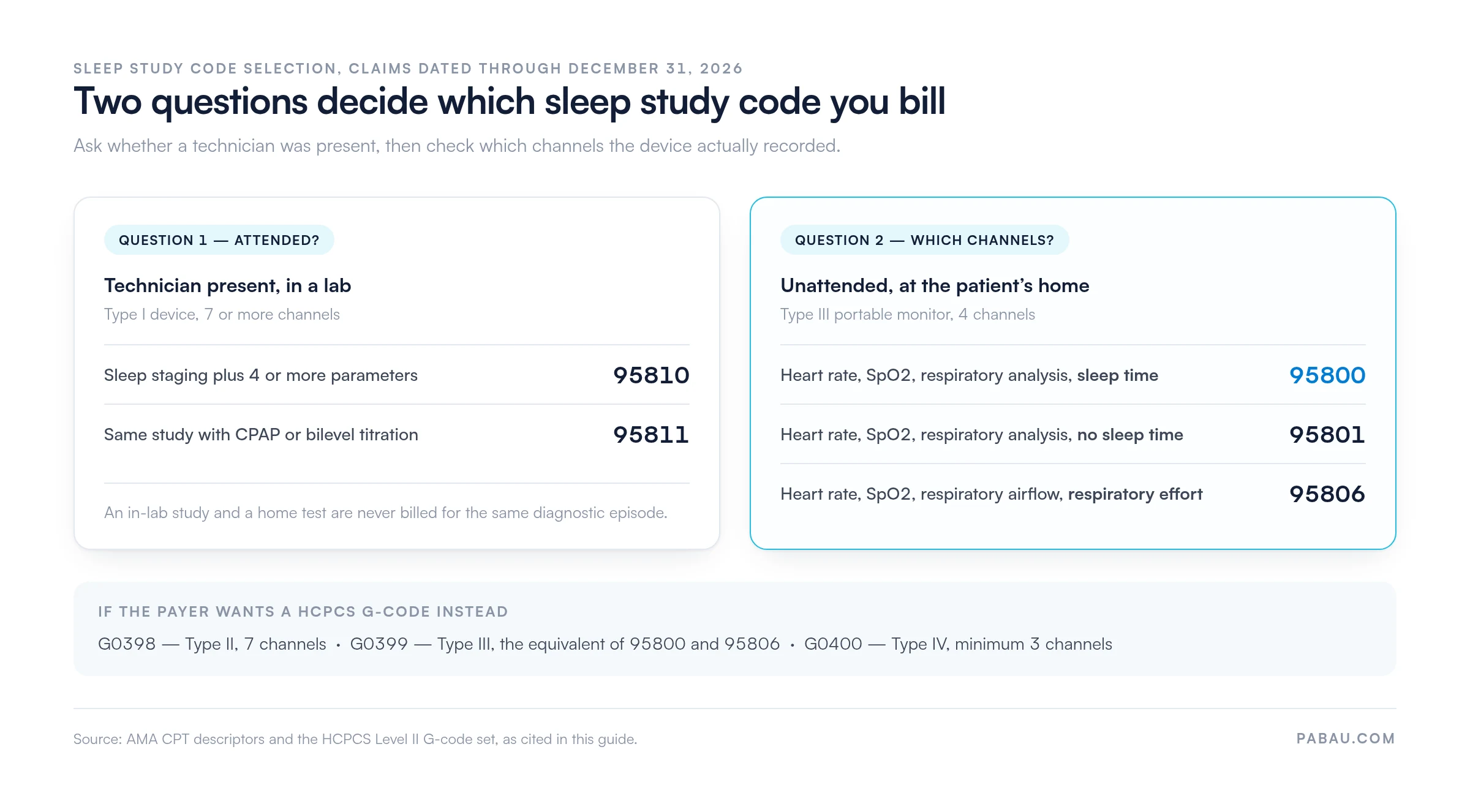
CPT code 95800 sits within a broader family of sleep testing codes, and the correct one changes with the device and the setting. Some Medicare Advantage plans and DME contractors want HCPCS Level II G-codes rather than CPT codes for the same test. The HCPCS codes index carries the current descriptors for the G-code series below.
CPT 95806 is the code most often confused with 95800. Its AMA descriptor covers four parameters: heart rate, SpO2, respiratory airflow, and respiratory effort.
Sleep time is not one of them, and respiratory effort is not part of 95800. So the two are not interchangeable, even though both describe an unattended four-channel study. Read the device report against the descriptor before you pick the code.
CPT 95800, 95801, and 95806 all sunset on January 1, 2027. The six replacement codes are tiered by complexity, so this table’s channel-count distinctions will not map one-to-one onto the new set.
Day to day, the choice comes down to two questions asked in order. Was a technician present during the recording, and which channels did the device actually write to the report?
Every CPT code 95800 claim requires a paired ICD-10 diagnosis code that establishes medical necessity. CMS billing and coding article A57496 lists the diagnosis codes that support coverage. Pairing 95800 with a non-covered diagnosis is one of the most common clean-claim failures in sleep medicine.
Most CPT code 95800 claims pair with G47.33. MAC jurisdictions vary, so confirm your local contractor’s covered diagnosis list before submitting. The central sleep apnea codes, G47.31 and G47.37, may face narrower coverage criteria depending on the jurisdiction.
Medicare reimburses CPT code 95800 under the Medicare Physician Fee Schedule (MPFS), at rates that vary by geographic locality. The national average for 2025-2026 is roughly $105 to $175. Where a claim lands in that range depends on the MAC jurisdiction, and on whether the practice bills as facility or non-facility.
Always verify current rates with the CMS MPFS lookup tool linked above. Commercial payers including UnitedHealthcare, Aetna, and Blue Cross Blue Shield generally follow Medicare guidelines for CPT 95800 coverage, though individual plan fee schedules differ. Some Medicare Advantage plans also require prior authorization before the test is performed.
Run insurance eligibility verification before scheduling the HSAT. Some Medicare Advantage plans require prior authorization for CPT 95800 that traditional Medicare does not. Miss that step before the test and you get a denial that many MAC jurisdictions will not let you appeal retroactively.
Commercial payers handling home sleep apnea test billing typically align with CMS billing and coding article A57496, but their implementation varies. Before submitting a CPT code 95800 claim to a commercial insurer, confirm three points with the payer directly.
Check whether the specific device used qualifies, whether prior authorization is required, and whether the plan restricts diagnosis codes.
Treat every commercial plan as having prior authorization requirements until you have verified otherwise. That is the safest default for any practice billing CPT code 95800. Documenting the verification step protects the practice in a retrospective audit.
A complete documentation package prevents most CPT code 95800 denials before they happen. Practices that build the checklist into the clinical workflow catch a missing element earlier than practices that leave it to a coder at submission. The elements below are required for a valid 95800 claim under CMS billing and coding article A57496.
Sleep medicine billing sees a predictable set of denial reasons, and most of them are preventable. Each error below maps to a specific step in the workflow, which is where it is cheapest to catch.
Sleep medicine practices billing CPT code 95800 carry a heavier documentation load than most outpatient specialties.
Every claim needs a physician order, a device report with all four channels confirmed, and a signed interpretation. A supported diagnosis code is also required, and in many cases a prior authorization. Miss one element and the claim comes back.
Practice management software like Pabau closes that loop before the claim leaves the building. Pabau’s claims management software holds the order, the device report, and the signed interpretation against the same client record. The coder sees what is still outstanding on the claim instead of finding out from a remittance three weeks later.
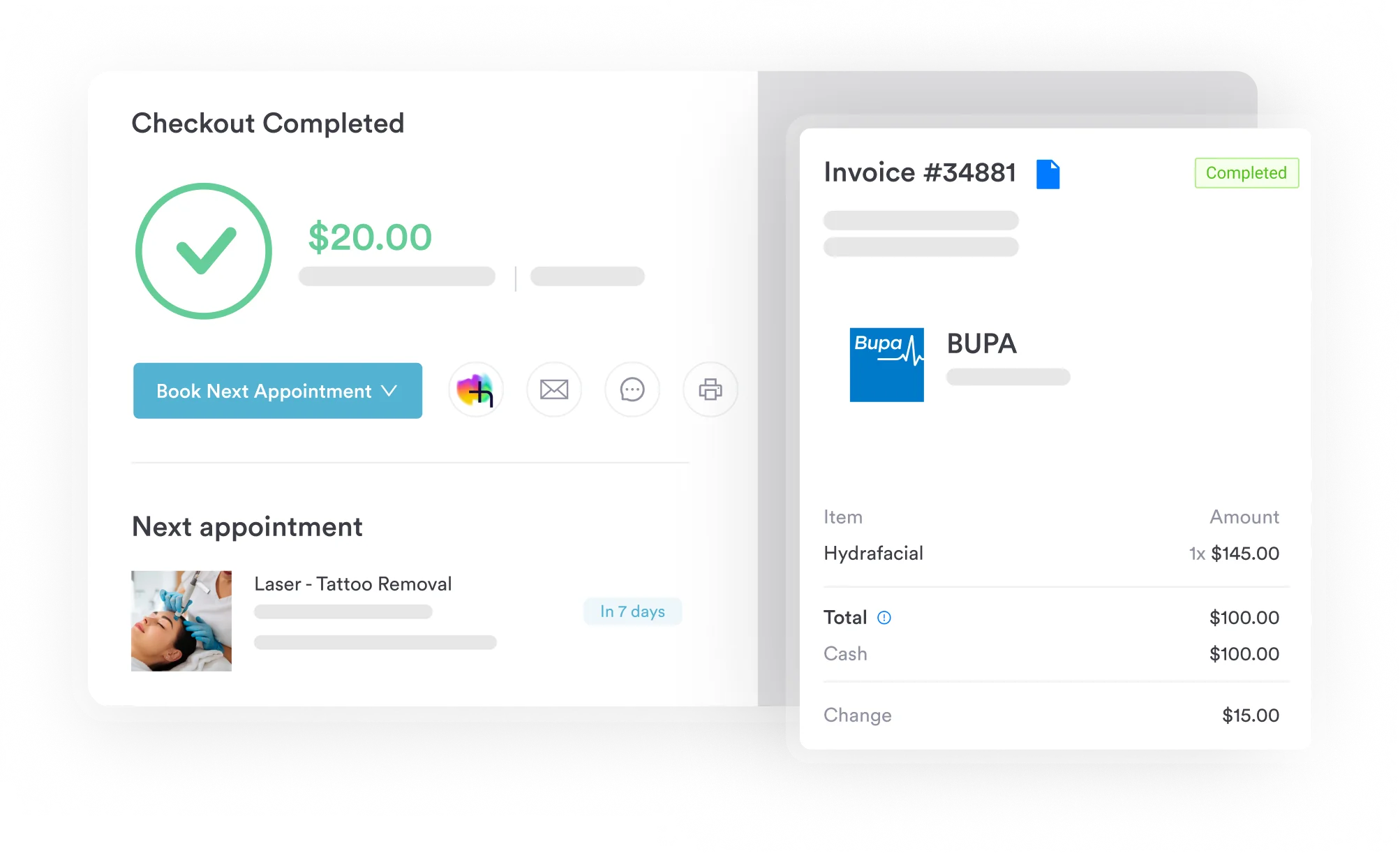
Pabau also integrates with Claim.MD, which gives sleep medicine practices real-time eligibility verification across thousands of US payers before the HSAT is performed.
That is where a prior authorization requirement or an inactive plan shows up, while the appointment can still be moved. Electronic 837P claims and ERA remittances then flow through the same connection, so nobody rekeys a payer response by hand.
The practical outcome is fewer 95800 denials for reasons that had nothing to do with the clinical work. A shared documentation checklist also keeps your coders off signature-chasing duty. Their time goes to the genuinely difficult scenarios instead, such as a Type IV device or an unusual diagnosis pairing.
Audit your 95800 denials by reason code every quarter. CARC 4 (service not covered by plan) usually points at a prior authorization step that was skipped. CARC 18 (duplicate claim) often means a resubmission was coded incorrectly. Reading denial reason codes by CPT code surfaces a systematic billing error faster than reviewing claims one at a time.

Pabau’s built-in claims management tools help sleep medicine practices submit cleaner CPT code 95800 claims. Track prior authorization requirements by payer and catch a missing document before it reaches the clearinghouse.

Bill 95800 from the device report, not from the order. If the report shows sleep time alongside heart rate, oxygen saturation, and respiratory analysis, the code holds up. If it does not, downcoding to 95801 costs about $60 and protects the practice from an audit that would cost far more.
The 2027 deletion changes the work rather than ending it. Complexity-tiered codes will still be decided by what the device recorded. A practice that documents channels properly today has less to rewrite in January 2027. Build that habit now, while the current codes are still live.
Want to see how a claim workflow catches a missing interpretation report before your payer does? Book a demo and we will walk through a sleep study claim end to end.

Need help structuring clean claim submissions? Clean claim submission guide covers the documentation elements that prevent first-pass rejections across outpatient billing.
Want to understand how clearinghouses process your claims? Medical claims clearinghouse overview explains how 837P files move from practice to payer and where denials originate.
Seeing recurring denials across multiple CPT codes? Denial codes in medical billing provides a reference guide for the most common CARC and RARC codes and how to address each one.
CPT code 95800 covers an unattended home sleep apnea test (HSAT). It simultaneously records four parameters: heart rate, oxygen saturation, respiratory analysis (airflow or peripheral arterial tone), and sleep time. It is performed on a Type III portable monitor with no technician present. A physician interpretation report is required before billing.
CPT 95800 requires sleep time as a fourth channel. CPT 95801 does not include sleep time and requires only three channels: heart rate, oxygen saturation, and respiratory analysis. If your HSAT device does not capture sleep time, 95801 is the correct code. Billing 95800 without documented sleep time data is upcoding.
The AMA descriptor for 95806 covers heart rate, oxygen saturation, respiratory airflow, and respiratory effort. Sleep time is not one of its parameters, and respiratory effort is not part of 95800. Both codes describe an unattended four-channel study, so the device report decides which one applies. The two are never billed together for the same test.
The 2025-2026 Medicare national average for CPT code 95800 is approximately $105 to $175, varying by MAC jurisdiction and by facility versus non-facility setting. Always verify current locality-specific rates with the CMS Physician Fee Schedule lookup tool. Rates are updated annually and vary by geographic area.
G47.33 (obstructive sleep apnea, adult) is the primary ICD-10 code paired with CPT 95800. CMS billing and coding article A57496 also supports G47.30 (sleep apnea, unspecified) and G47.31 (primary central sleep apnea). G47.37 (central sleep apnea in conditions classified elsewhere) is on the covered list too. R06.83 (snoring) alone does not establish medical necessity, so it should not be used as the sole diagnosis code.
Traditional Medicare (Parts A and B) does not require prior authorization for CPT 95800. Medicare Advantage plans have statutory authority to impose prior authorization requirements that go beyond traditional Medicare, and many of them do. Always verify with the specific MA plan before scheduling the HSAT.
No. CPT 95800 (unattended HSAT) and CPT 95810 (attended in-lab polysomnography) describe different types of sleep tests. They are not billed together for the same diagnostic episode. If a patient needs an in-lab study after a failed or inconclusive HSAT, 95810 is billed for that separate encounter with its own supporting documentation.