CCSD Code F3400: Tonsillectomy guide for ENT practices
What is CCSD Code F3400? CCSD Code F3400 is the Clinical Coding and Schedule Dat...

Last Updated: Oct 22, 2026

CPT code 95251 covers the analysis, interpretation, and written report of at least 72 continuous hours of ambulatory CGM data.
Only a physician, nurse practitioner, or physician assistant may report 95251, and the signed report is the billable service.
95249 and 95250 split on who supplied the equipment, not on training versus hookup, so check the device’s owner first.
Medicare pays 95251 through the Physician Fee Schedule, and neither 95250 nor 95251 may be reported more than once a month.
Practice management software like Pabau ties the signed interpretation note to the claim, so billing sees it without a manual handoff.
CPT code 95251 covers the analysis, interpretation, and written report of ambulatory continuous glucose monitoring (CGM) data. The recording has to span at least 72 continuous hours, and only a physician, nurse practitioner, or physician assistant may report the code. Most 95251 denials turn on that second half.
A signature goes missing, the report reads like a template, or the sensor came off at hour 68. Each one is a billing office problem, and each one is fixable before the claim goes out.
What follows is the descriptor, the documentation payers ask for, how Medicare pays the code, and where 95249 and 95250 fit around it.
CPT code 95251 carries this official descriptor. Ambulatory continuous glucose monitoring of interstitial tissue fluid via a subcutaneous sensor for a minimum of 72 hours; analysis, interpretation and report.
The American Medical Association (AMA) maintains the CPT code set and places 95251 in the endocrinology subsection under Medicine.
One service component sits inside the code: reading the glucose tracing and writing the interpretation up. Everything physical, from the device to the sensor on the patient’s arm, belongs to a different code.
Professional CGM billing runs across three codes, and the first two are widely described the wrong way. 95249 is not the training code and 95250 is not the hookup code. Both include sensor placement, hookup, calibration, and patient training.
What separates them is who supplied the device: 95249 covers a patient-provided monitor, 95250 covers one the office provides. 95250 also covers taking the sensor off again.
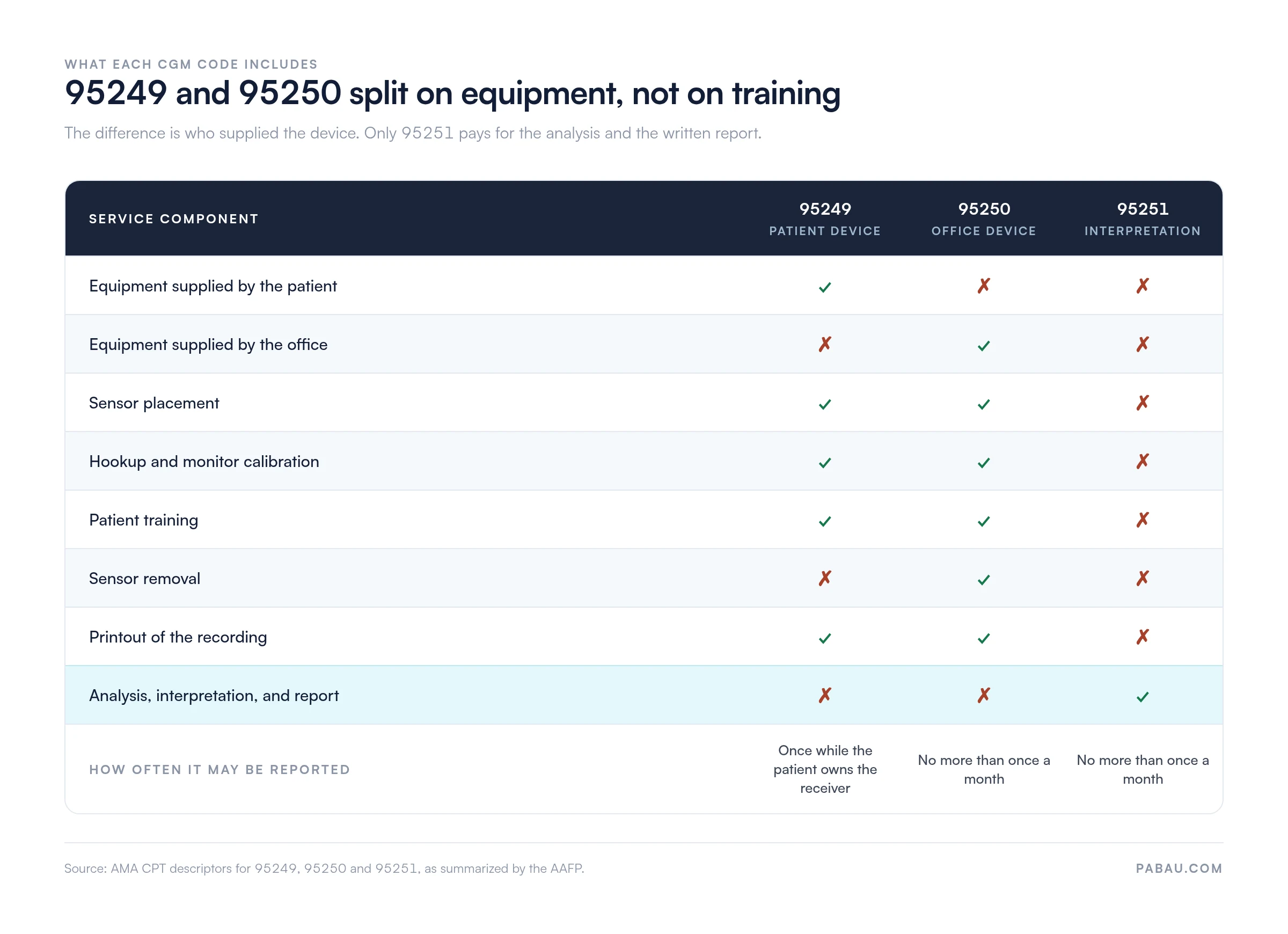
The reporting rules differ too, and they catch practices out more often than the descriptors do.
One point trips people up. You can report 95251 on its own when the patient wore their own CGM and your practice only read the data. The codes support each other, but none of them depends on another being billed.
Reporting is restricted to a physician, a nurse practitioner, or a physician assistant. The reason is in the descriptor: someone has to read the tracing and reach a clinical conclusion, which is not delegable work.
Here is how that plays out by role:
Independent billing for NPs and PAs is the grey area. State scope of practice sets the outer limit, incident-to rules narrow it under Medicare, and individual payer contracts narrow it again. Verify with your Medicare Administrative Contractor (MAC) and your commercial contracts before you assume it.
Incomplete documentation causes more 95251 denials than any coding decision does. Every element below belongs in the record before the claim goes out, not after an audit letter arrives.
Pair the interpretation with the diagnosis that justified the monitoring. For a patient whose type 2 diabetes is running high, that is often E11.65.
Put the start and end timestamps of the monitoring session in the interpretation report itself, not only in the device download. Auditors reviewing 95251 want the 72-hour window stated in the clinical note, not inferred from device logs.
Medicare pays 95251 through the Medicare Physician Fee Schedule (MPFS). Rates move with each annual final rule and vary by locality. Look the current figure up in the CMS fee schedule search rather than quoting a national number.
Frequency is the constraint practices hit first: neither 95250 nor 95251 may be reported more than once a month for the same patient.
Commercial coverage for 95251 is less predictable than Medicare’s. Most large insurers pay for professional CGM, but the conditions attached to it move from plan to plan.
Professional CGM billing usually needs HCPCS codes as well as the 95249 to 95251 family. The CPT codes pay for professional work, and the HCPCS codes pay for the hardware and the consumables.
Whether both appear on one claim depends on who supplied the device.
Both codes sit on the durable medical equipment side of Medicare, under the glucose monitor policy that governs equipment and supplies. That policy does not reach 95251, so do not look to it for rules about the interpretation.
Supply code applicability also varies by brand, so confirm the codes for the device in front of you before billing.
The code sits at the end of a short chain, and each link is somewhere a claim can stall. This is the route a clean one takes.
The same handful of errors show up in 95251 denials across endocrinology and primary care. All of them are catchable before submission, which is why denial rates on this code say more about workflow than about coding knowledge.
Five questions catch most of what comes back. Ask them while the claim is still open, because each answer is cheap now and expensive on appeal.
In most practices the interpretation report and the claim live in two places. The provider writes the report in the chart, and someone in billing has to go looking for it before the charge line can go out. That handoff is where 95251 claims sit for days.
Practice management software like Pabau keeps both in the same record. Pabau’s claims management software pre-fills the claim form straight from the encounter.
The CPT code attached to the service lands on the charge line, and the diagnosis is seeded from the patient’s recorded problem list. Built-in ICD-10 and CPT lookup libraries let a biller confirm a code without leaving the claim.
Before anything can be sent, Pabau checks that the fields the payer requires are filled in. Membership and authorization numbers have to be present, and the send button stays locked until they are.
Submission then runs electronically through the clearinghouse for your region, which in the US is Claim.MD, connecting practices to thousands of US payers.
On the US pipeline that also brings real-time eligibility checks, claim status tracking, and electronic remittance posting. The screen that holds the signed report is the screen that tells you whether the payer took the claim.
Audit the 95251 claims denied for missing documentation once a month. If more than one in 20 comes back that way, look at the handoff between the interpreting provider and the billing team first. Retraining on documentation standards rarely fixes a routing problem.

Pabau pre-fills the claim from the patient record, checks the fields your payer requires, and submits it electronically. Your billing team sees the signed interpretation report without chasing anyone for it.

The 95251 claims that get paid are the ones where the report was finished, signed, and attached before anyone opened the claim. Work backwards from that and the code stops being difficult. Check the recording length, check the signature, check the provider on the claim line.
The trade-off worth remembering is timing. Waiting for the report costs a few days of cash flow. Submitting without it costs an appeal, plus the staff hours the appeal eats. The first is cheaper every time.
If your interpretation notes and your claims sit in two systems today, that wait is a routing problem you can remove. Book a demo to see how Pabau moves a signed CGM interpretation onto the claim without a manual handoff.

New to the mechanics behind the claim? Medical billing fundamentals walks through documentation standards, payer expectations, and how a charge becomes a payment.
Want to catch coverage problems before the sensor goes on? Insurance eligibility verification covers what to check at scheduling and which denials it heads off.
Aiming to get claims paid on the first pass? What makes a clean claim sets out the fields and checks that keep a submission from bouncing.
Dealing with a stack of denials already? Denial management strategies for healthcare practices outlines the pre-submission and appeal workflows worth building.
Looking at the wider revenue picture? Revenue cycle management traces the billing lifecycle from registration through to reimbursement.
CPT does not bundle 95251 into an office visit. Many payers accept both on the same date, as long as each service is documented on its own. The visit note has to stand up without the interpretation report, and the report has to stand up without the visit. Check the payer’s edits before you send both.
No. 95249, 95250, and 95251 apply to a single CGM recording of at least 72 hours. Remote physiologic monitoring codes cover device supply and the monthly time a provider spends reviewing readings. They are separate code families with separate documentation, so one never substitutes for the other.
The recording no longer meets the descriptor, so 95251 cannot be reported for that episode. Note the failure and its reason in the chart, restart the monitoring, and report the code once a qualifying recording exists. Billing a partial recording is the fastest route to a technical denial.
Staff can pull the data and produce the printout. The analysis and the written interpretation have to be the reporting provider’s own work. Only a physician, nurse practitioner, or physician assistant may report 95251. A countersignature over someone else’s interpretation does not satisfy the code.