CPT code 52648: Laser ablation of the prostate billing guide
What CPT code 52648 covers, and what it bundles in CPT code 52648 is the code fo...

Last Updated: Oct 21, 2026

CPT code 93976 describes a limited duplex scan of arterial inflow and venous outflow of abdominal, pelvic, scrotal, and retroperitoneal structures.
93976 is the limited study, and CPT 93975 is the complete study of the same anatomy. Billing the wrong code is a common audit trigger.
Medicare’s 2026 national average for a global 93976 is about $155.98, and the office and facility rates are identical. Split billing pays about $37.07 for modifier 26 and $118.91 for modifier TC.
Pabau’s claims management software helps vascular and radiology practices attach the correct ICD-10 codes, apply modifiers, and route 93976 claims for electronic submission.
CPT code 93976 is a limited duplex scan of arterial inflow and venous outflow of abdominal, pelvic, scrotal contents and/or retroperitoneal organs. That wording is the official descriptor in the American Medical Association’s CPT code set.
The procedure uses B-mode ultrasound imaging combined with Doppler spectral waveform analysis. It evaluates blood flow in one or more of the covered anatomical regions. “Limited” means not all elements of the complete study were performed or interpretable.
Selecting between 93976 and 93975 is the most common coding decision in this family. What the report documents decides which code applies.
Upcoding 93976 to 93975 when only a limited study was performed may constitute fraud under Medicare billing rules. The report must explicitly state what was and was not evaluated.
Medicare and commercial payers require a supported clinical indication before covering 93976. The CMS Physician Fee Schedule and local coverage determinations (LCDs) from Medicare Administrative Contractors (MACs) define what qualifies as medically necessary. Before submitting, confirm that insurance eligibility has been verified and the diagnosis code sits on the covered list for your MAC’s jurisdiction.
Common accepted clinical indications include:
CMS article 57591 in the Medicare Coverage Database governs billing and coding for non-invasive abdominal vascular studies. Coders should verify their MAC’s specific LCD because covered ICD-10 codes can vary by contractor jurisdiction.
The diagnosis code attached to a 93976 claim is the primary medical necessity signal for payers. The table below lists commonly covered ICD-10-CM codes. Always verify against your MAC’s current LCD, as coverage lists are updated annually.
Routine screening without a documented clinical indication is generally non-covered under most LCDs. Pair the ICD-10 code with a detailed clinical note explaining why the limited study was ordered.
Relative value units (RVUs) set Medicare payment before the conversion factor and locality adjustment are applied. The figures below come from CMS’s 2026 Physician Fee Schedule relative value file. The three components for 93976 are work (wRVU), practice expense (PE RVU), and malpractice (MP RVU).
Both columns carry the same numbers, which catches out coders who expect a lower facility value. CMS assigns 93976 no site-of-service practice expense differential, so the global RVUs are identical in an office and in a hospital. The equipment cost gets separated out by modifier instead.
Practice expense also dominates the code, at 3.82 of its 4.67 total RVUs. The technical side of 93976 is therefore worth about three times the interpretation. Who owns the ultrasound machine moves the money here far more than where the scan is performed, as the split below shows.
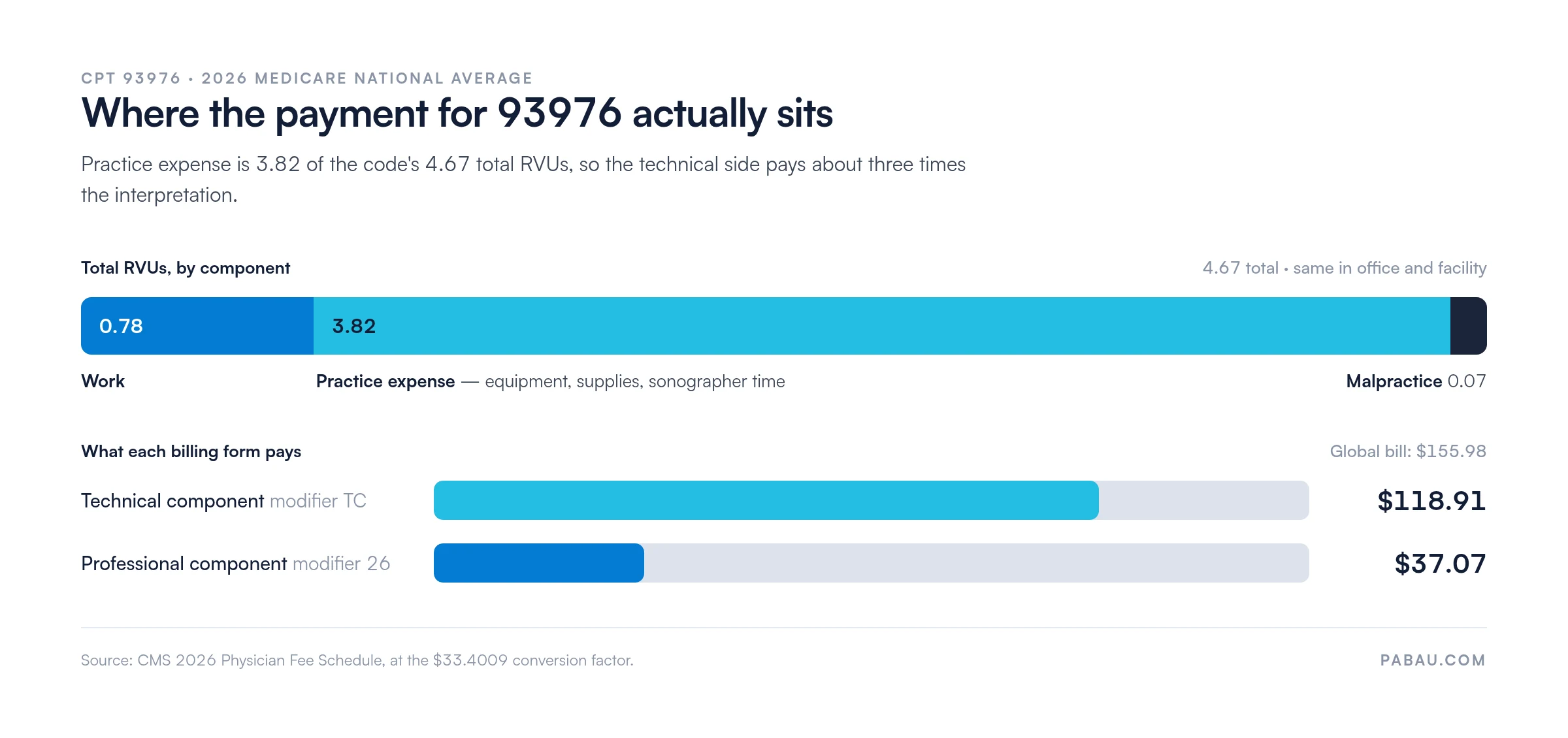
Medicare payment equals total RVU multiplied by the national conversion factor, then adjusted by the geographic practice cost index (GPCI) for your locality. At the CY2026 conversion factor of $33.4009, the 4.67 total RVUs for 93976 produce a national average allowed amount of about $155.98. That amount applies in the non-facility and the facility setting alike, because CMS lists the same total RVUs for both.
Most 93976 claims never go out as a global bill. Where the interpreting physician and the equipment owner are separate entities, the code splits into a professional and a technical component. Each side then bills its own share.
Always use the CMS Physician Fee Schedule lookup tool to confirm rates for your specific locality. The amounts above are national averages taken before the GPCI adjustment. Your MAC’s allowed amount will sit above or below them depending on the locality.
Incorrect modifier use is one of the top denial triggers for 93976. The four modifiers most relevant to this code address the professional and technical component split, laterality, and distinct services.
Do not append modifier 59 solely to bypass a bundling edit between 93976 and 93975. NCCI edits may bundle these codes when billed on the same date for the same anatomy. Only a clinically distinct and separately documented service justifies modifier 59.
Clean claims for 93976 start with clinical documentation that supports both the study level and the diagnosis. A clean claim needs each of the following elements in the medical record before billing.
The 93975 and 93976 pair belongs to a broader family of non-invasive vascular diagnostic studies. Knowing the family prevents unbundling errors and helps coders select the correct code when the anatomy or study type changes. The AAPC CPT code lookup provides full descriptions and bundling notes for each.
Denials for 93976 follow a predictable pattern. The five below account for most of them, and each one is preventable at the point of billing.
Reading the medical billing denial codes alongside the 93976 patterns above helps billing staff triage remittance advice faster and cut rework cycles.
Run a five-point check before you submit any 93976 claim. First, confirm the ICD-10 code is on your MAC’s covered list. Second, check that the report states why the study was limited. Third, match the place of service to the actual site. Fourth, confirm modifier 26/TC or global billing is set up for your practice model. Fifth, make sure 93975 was not billed for the same anatomy on the same date.
Getting paid accurately for 93976 depends on three details lining up. You need the right diagnosis code, the correct modifier, and a clean electronic claim that reaches the payer. Practice management software like Pabau handles all three in one workflow, through its claims management software.
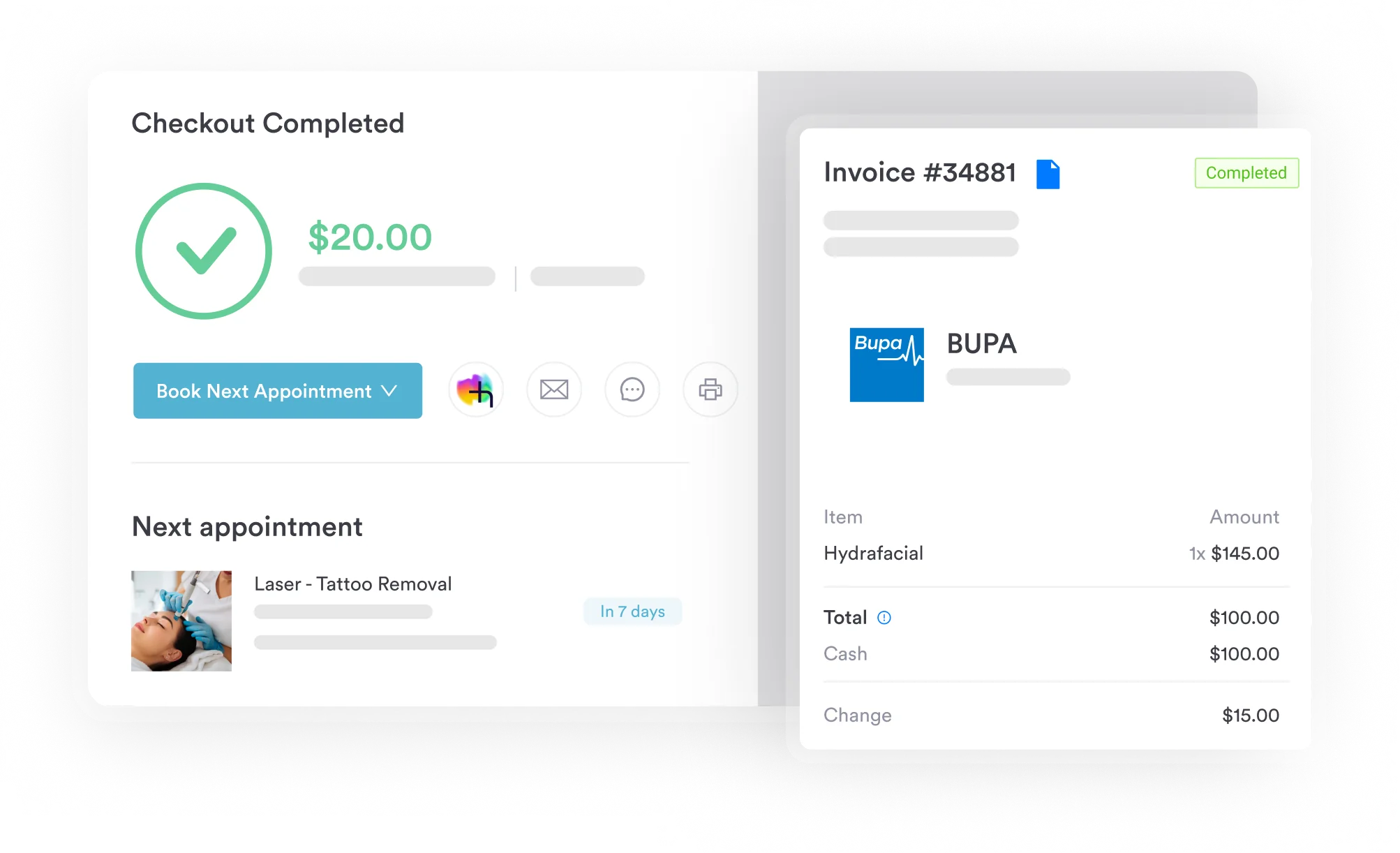
Practices using Pabau submit 93976 claims electronically through Claim.MD, our integrated clearinghouse partner. Claim.MD connects to over 4,000 US payers and validates claims against CPT and ICD-10 catalogs before transmission. Diagnosis mismatches and modifier errors surface at that point, rather than three weeks later on a remittance.
Pabau also generates superbills with the procedure and diagnosis codes already populated, so nobody retypes them at charge capture. Documentation from the clinical note flows into the billing workflow. The ICD-10 code that supports medical necessity is attached before the claim leaves the practice.

Pabau’s claims management tools help vascular and radiology practices attach the right ICD-10 codes, apply modifiers correctly, and submit 93976 claims electronically. Fewer denials, faster reimbursement.

CPT code 93976 is a precise code with a narrow definition. Three variables decide whether the claim pays or denies. They are the limited-versus-complete distinction, the ICD-10 code attached to the claim, and the modifier that splits the professional and technical components. Get those right and 93976 is a straightforward submission.
The money follows the equipment, so decide your billing model before the first scan rather than after the first denial. Pabau’s claims management tools and clearinghouse connection make that routine for practices billing non-invasive duplex scans. Book a demo to see how a 93976 claim moves from the clinical note to a paid remittance.

Want to see how a claim reaches the payer? Claim.MD clearinghouse integration with Pabau explains how electronic claims for vascular procedures reach over 4,000 US payers.
Need to tighten your clean claim rate? Medical billing compliance guidance covers the documentation and process checks that prevent denials before submission.
Reconciling 93976 payments line by line? Electronic remittance advice shows how to match every paid line against the rate you expected.
Are denials piling up in your queue? Denial management in healthcare sets out how to work an appeal and how to prevent the next one.
Curious what the claim file itself contains? The 837 file format walks through the fields a payer reads on an electronic claim.
CPT code 93976 is used to bill a limited duplex scan of arterial inflow and venous outflow of abdominal, pelvic, scrotal, and retroperitoneal structures. It applies when not all elements of the complete study (93975) were performed or were interpretable, such as a targeted follow-up or a single-vessel evaluation.
CPT 93975 is the complete study, requiring all elements of arterial and venous evaluation to be performed and interpretable. CPT 93976 is the limited study, used when the scan was restricted in scope. Billing 93975 when only a limited study was performed is the most common audit finding for this code family.
Medicare pays about $155.98 for a global CPT 93976 in 2026. That is the code’s 4.67 total RVUs multiplied by the $33.4009 conversion factor, and the office and facility rates are the same. Split billing pays roughly $37.07 for the professional component (modifier 26) and $118.91 for the technical component (modifier TC). Use the CMS Physician Fee Schedule lookup for your own MAC jurisdiction.
Commonly covered ICD-10-CM codes include I71.4 (abdominal aortic aneurysm), I70.1 (atherosclerosis of renal artery), I86.2 (pelvic varices), and N28.0 (ischemia and infarction of kidney). Covered codes vary by MAC jurisdiction and LCD version, so always verify against your local contractor’s current coverage policy.
Modifier 26 applies when the physician interprets only and the facility owns the equipment. Modifier TC applies to the facility billing the technical component separately. Modifier 59 may apply only when a clinically distinct and separately documented service justifies overriding a bundling edit. LT/RT modifiers apply to lateralized structures when required by the payer.
Generally no. NCCI edits bundle 93976 and 93975 when billed on the same date for the same anatomical region. Billing both codes for the same anatomy on the same service date will result in denial of the lesser code. The one exception is a distinct service documented in the record.