CPT code 41112: Tongue lesion excision with closure
CPT code 41112: definition and clinical scope The American Medical Association&#...

Last Updated: Oct 22, 2026

CPT code 90651 covers the 9-valent HPV vaccine (Gardasil 9) for intramuscular use on a 2- or 3-dose schedule.
Administration is always billed separately: use CPT 90471 for the first vaccine and 90472 for each additional vaccine at the same visit.
When the dose comes free through the VFC program, bill only the administration code with modifier SL, never the vaccine product code.
There is no HCPCS Level II equivalent for 90651, and Medicare covers the HPV vaccine under Part D rather than Part B.
Pabau attaches the administration code automatically and holds 90651 off VFC claims before they are drafted.
CPT code 90651 is the billable code for the 9-valent human papillomavirus vaccine (Gardasil 9), given intramuscularly on a 2- or 3-dose schedule. The code covers the vaccine product only. Administration is billed on its own line with 90471 or 90472, and a claim carrying just one of the two lines will not be paid.
According to the American Medical Association (AMA), 90651 sits in the Vaccines, Toxoids section of the CPT code set, which the AMA updates annually. This guide covers the descriptor, payer coverage in 2026, administration pairing, modifiers, ICD-10 codes, VFC rules, and the denial patterns worth designing out.
CPT code 90651 describes the human papillomavirus 9-valent vaccine (9vHPV) for intramuscular use. It is given on a 2-dose or 3-dose schedule, depending on the patient’s age and immune status. The 9-valent formulation, marketed as Gardasil 9 by Merck, protects against HPV types 6, 11, 16, 18, 31, 33, 45, 52, and 58.
The dosing schedule decides what the clinical note has to show at claim submission. Get it wrong and the claim denies immediately.
The official AMA descriptor for CPT code 90651 is: Human Papillomavirus vaccine, 9 valent (9vHPV), 2 or 3 dose schedule, for intramuscular use. It replaced the earlier 4-valent and 2-valent HPV codes once Gardasil 9 became the only HPV vaccine distributed in the United States after 2016.
CPT code 90651 belongs to the Vaccines, Toxoids subsection. Knowing where it sits relative to its predecessor codes prevents upcoding errors and helps when crosswalking older claims.
90649 and 90650 are retained in the CPT code set for historical crosswalk purposes, but neither should appear on a current claim. Using either on a 2026 claim for Gardasil 9 administration results in an immediate denial.
No Medicare Physician Fee Schedule rate exists for CPT code 90651. Medicare Part B pays for four preventive vaccines only. That list is influenza, pneumococcal, hepatitis B, and COVID-19. Gardasil 9 sits outside it, so Medicare covers the HPV vaccine under the Part D drug benefit instead.
In practice, a commercial plan or Medicaid pays for almost every 90651 claim. Non-grandfathered commercial plans cover ACIP-recommended immunizations without cost-sharing when the patient stays in network. What reaches the practice’s account is set by the contracted rate on the product line plus the rate on the administration line.
CMS publishes quarterly Part B vaccine pricing files, and HPV vaccine is not among the products listed there. That is the fastest way to settle the coverage question in front of a payer rep. For the product line itself, check the contracted rate against your acquisition cost before you accept it.
The same routing applies to the shingles vaccine. Medicare pays Shingrix through Part D, so 90750 has no Physician Fee Schedule rate either.
Vaccine claims carry two lines, and missing either one leaves reimbursement on the table. Start with an insurance eligibility verification before the patient arrives. That check confirms HPV vaccine coverage, the payer’s age limits, and any prior authorization requirement.
A pediatric hepatitis A dose can be the second vaccine given at the same visit. Report 90633 for that product and 90472 for its administration line.
Catch-up polio doses follow the same claim shape. An adolescent who still needs inactivated poliovirus vaccine can receive it at the HPV visit, billed as CPT 90713 with its own 90472 line.
Three scenarios cover almost every HPV vaccine encounter a practice bills, and the stock the dose came from is what separates them.
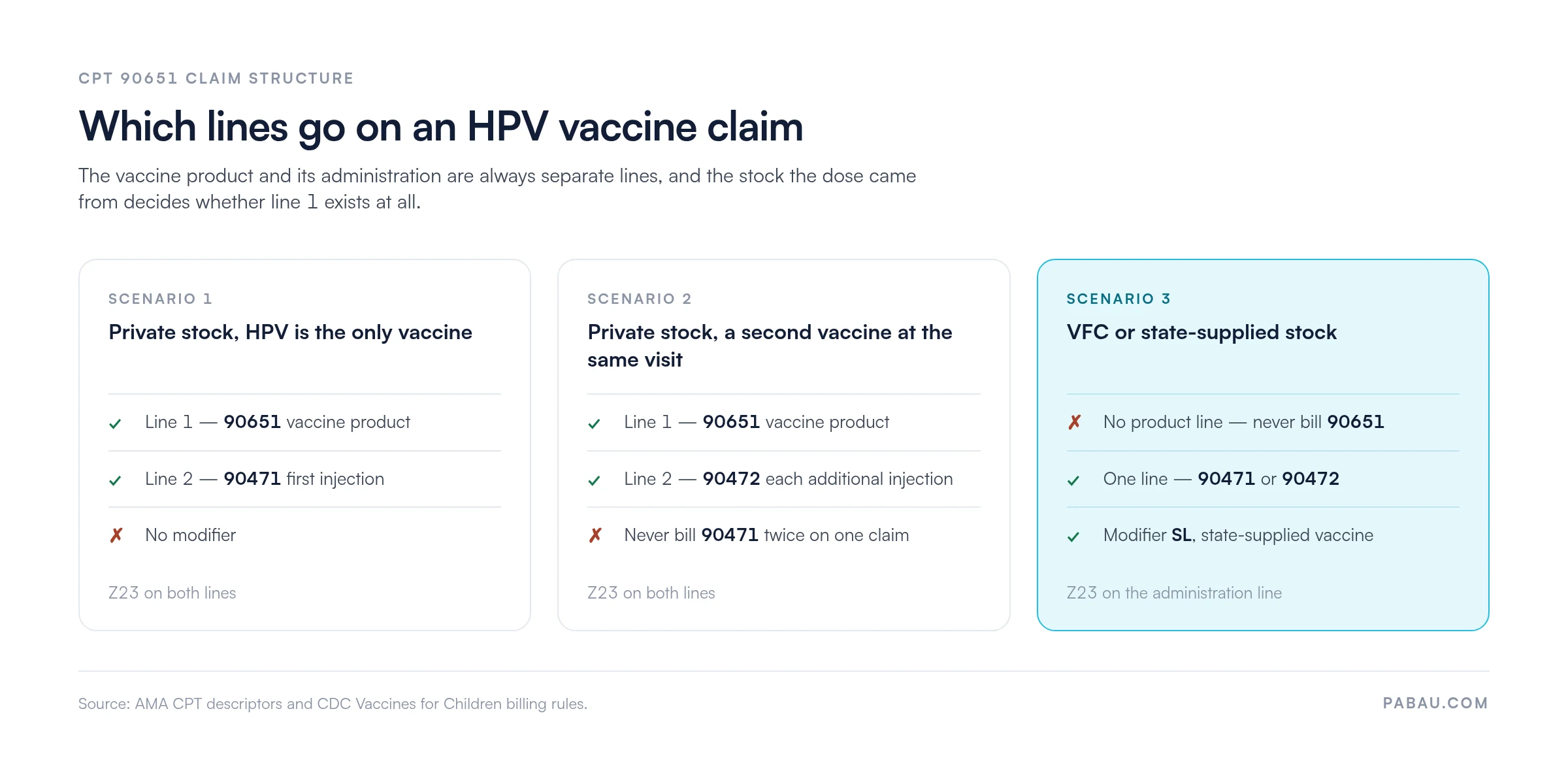
Bill 90471 when HPV is the only vaccine given at a visit. Switch to 90472 only when HPV accompanies a second vaccine at the same encounter, such as Tdap or meningococcal. Billing 90471 twice on one claim triggers an automatic duplicate denial.
Modifier use on vaccine claims is narrow. Apply one only when a specific clinical or billing circumstance calls for it. Incorrect modifier application is one of the leading audit triggers on immunization claims.
The SL modifier does most of the work on HPV vaccine claims. It tells Medicaid that the dose came from a state or federal program at no cost to the practice. Only the administration line is payable. Omitting SL on a VFC claim, or billing 90651 on one, is a compliance violation that can trigger recoupment.
Every claim line for 90651 needs a linked ICD-10-CM diagnosis code that establishes medical necessity. For routine preventive HPV vaccination, the encounter codes do the heavy lifting.
Z23 is the standard primary diagnosis for a routine HPV vaccination encounter, and it belongs on both claim lines. When the vaccination happens inside a comprehensive preventive visit, the preventive E&M code carries the age-appropriate Z00 encounter code. Z23 still applies to the vaccine and administration lines.
CPT code 90651 has no HCPCS Level II equivalent, and no standard crosswalk exists for it. Bill the CPT code to every payer, including state Medicaid programs and managed care plans that use HCPCS codes elsewhere on the claim.
Q2040 is frequently cited online as the crosswalk for 90651. It is not. Q2040 is tisagenlecleucel, the CAR-T cell therapy sold as Kymriah, and it has no connection to HPV vaccination. Submitting it in place of 90651 will not produce a paid claim.
The administration side has the same shape. Under Medicare Part B, HCPCS codes G0008, G0009, and G0010 cover administration of the influenza, pneumococcal, and hepatitis B vaccines. No G code exists for HPV, so 90471 and 90472 stay on the claim whichever payer receives it.
The Vaccines for Children (VFC) program supplies 9vHPV vaccine at no product cost to enrolled providers serving eligible children. Billing 90651 on a VFC claim is a federal compliance violation. Bill only the administration code when the dose was VFC-supplied.
VFC eligibility covers patients who are Medicaid-enrolled, uninsured, underinsured, or American Indian and Alaska Native. Eligibility applies through age 18 for most vaccines. Confirm it at every visit, because coverage status can change between doses in a series.
Run a monthly audit comparing your VFC stock usage logs against claims that include 90651. Any date of service where VFC stock was pulled and 90651 appears on the claim is a compliance flag. Correct it immediately and review it for recoupment exposure.
HPV vaccine claims fail at a higher rate than most preventive services. They need coordinated two-line billing, age-specific documentation, and VFC awareness at the point of care. Each of those depends on a step that happens before the biller sees the encounter.
Reviewing the common denial codes on your remittance advice is what turns one denial into a systemic fix. A single documentation habit repeated across 50 HPV vaccine claims in a quarter adds up to meaningful uncollected revenue.
HPV vaccine billing usually fails at the workflow level rather than the knowledge level. Billers know the rules, but the system does not enforce them at the moment the claim is built. Practice management software like Pabau closes that loop. Its claims software for practices attaches 90651 and the matching administration code as soon as the vaccine is documented in the record.

For practices enrolled in the VFC program, Pabau tracks the stock source against each encounter. When VFC-supplied stock is documented, the system holds 90651 off the claim and keeps only the administration line. The superbill pre-populates Z23 as the primary diagnosis, so billers confirm the code rather than recall it.
Claims then go out electronically through the Claim.MD clearinghouse, with CPT and ICD-10 catalogues that validate the pairing before transmission. A practice running 100 or more HPV vaccine encounters a year feels that quickly. Errors caught before transmission never turn into appeals. Book a demo to see how Pabau handles vaccine billing end to end.

Pabau pairs CPT 90651 with the correct administration code, applies VFC billing rules, and validates claims through the Claim.MD clearinghouse before errors reach the payer.

The two-line structure is the whole job. Once 90651 and its administration code always travel together, most of the denial pattern disappears. Add an automatic block on the product line for VFC stock and the rest goes with it.
The rules that catch practices out are the ones that sound plausible and turn out to be wrong. There is no HCPCS crosswalk to fall back on, and Medicare will not pay a Part B claim for this vaccine. Build both facts into your billing setup rather than into your team’s memory.
Set the pairing rule once and the claim builds itself correctly every time after that. Book a demo to see how Pabau keeps HPV vaccine claims paired, coded, and out of the denial queue.

Need guidance on managing medical billing compliance? Medical billing compliance covers the core requirements practices need to meet to avoid audits and recoupments.
Want to understand how clearinghouses process your claims? How a medical claims clearinghouse works explains the transmission pathway from practice to payer.
Looking to reduce claim denial rates across your practice? Denial management in healthcare outlines systematic approaches to reducing and recovering denied claims.
CPT code 90651 bills the 9-valent Human Papillomavirus vaccine (9vHPV), marketed as Gardasil 9, given by intramuscular injection. It covers either a 2-dose or a 3-dose schedule. It is the only active HPV vaccine CPT code in the United States, since the 4-valent and 2-valent products were discontinued. The code covers the vaccine product only, so administration is billed separately with 90471 or 90472.
CPT 90650 covered the 2-valent HPV vaccine (Cervarix), which is no longer distributed in the United States. CPT 90651 covers the 9-valent HPV vaccine (Gardasil 9), which is the current standard of care. Claims submitted with 90650 for Gardasil 9 administration will be denied, because the code does not match the administered vaccine product.
Bill 90651 for the vaccine product and 90471 for the administration on separate lines of the same claim, with the same date of service. If another vaccine is given at the same visit, use 90472 on the HPV administration line instead. In that case 90471 goes to the first vaccine administered. Both lines carry Z23 as the primary ICD-10-CM diagnosis code.
No. Medicare Part B pays for four preventive vaccines only. That list is influenza, pneumococcal, hepatitis B, and COVID-19. Gardasil 9 is not among them, so 90651 has no Physician Fee Schedule rate and is not payable as a Part B claim. Medicare beneficiaries get HPV vaccine coverage through their Part D drug plan instead. In practice, almost every 90651 claim goes to a commercial plan or to Medicaid.
Yes. Gardasil 9 is covered under the Vaccines for Children (VFC) program for eligible patients through age 18. When the dose is supplied through VFC, providers must not bill 90651. Only the administration code may be billed, using 90471 or 90472 with the SL modifier.
CPT code 90651 has no HCPCS Level II equivalent, and no standard crosswalk exists for it. Q2040 is widely cited as the equivalent, but Q2040 is tisagenlecleucel (Kymriah), a CAR-T cell therapy unrelated to HPV vaccination. Bill the CPT code to every payer, including state Medicaid programs and managed care plans that use HCPCS codes elsewhere on the claim.