

CPT Code 98981: RTM Treatment Management Billing Guide
CPT code 98981: Definition and official descriptor CPT code 98981 is an add-on c...

Last Updated: Nov 9, 2026
87522 is the CPT code for infectious agent detection by nucleic acid (DNA or RNA); hepatitis C, quantification, includes reverse transcription, when performed.
It reports a hepatitis C viral load as a number in IU/mL. Labs bill it to confirm active infection after a positive antibody test, set a treatment baseline, monitor therapy and confirm cure. A qualitative detected or not detected result bills as 87521 instead.
Let Pabau's smart automation suggest the right codes, reduce claim denials, and keep your practice compliant—effortlessly.
Automate repetitive tasks and focus on what matters most—your patients.
Reduce coding errors and ensure compliance with the latest regulations.
Clean claims, fewer denials, and faster reimbursements.
Powerful insights and reporting to help your practice thrive.
HIPAA compliant SOC 2 certified GDPR-compliant Trusted by 4,000+ clinics worldwide

CPT code 87522 bills a quantitative hepatitis C RNA test, reported as a viral load in IU/mL.
A qualitative detected or not detected result is 87521, and a direct probe test without amplification is 87520.
B18.2 supports most treatment and monitoring claims, while Z11.59 fits screening orders only.
Medicare pays 87522 from the Clinical Laboratory Fee Schedule, and MolDX MACs may apply additional evidence criteria.
Only the CLIA-certified lab that ran the assay bills 87522, under its own NPI and CLIA number.
CPT code 87522 reports a quantitative hepatitis C virus (HCV) RNA test. The American Medical Association descriptor reads: Infectious agent detection by nucleic acid (DNA or RNA); hepatitis C, quantification, includes reverse transcription, when performed.
The word that matters is “quantification.” The lab returns a viral load in international units per milliliter (IU/mL). That number is what sets 87522 apart from the other two codes in its family.
All three codes share one descriptor stem and split on technique and output. Picking the wrong one is the most common coding error here, so this is how they line up.
87522 sits in the microbiology section of CPT’s pathology and laboratory chapter. Gastroenterology, infectious disease and hepatology practices see it most. So does any lab running RT-PCR, transcription-mediated amplification (TMA) or branched DNA (bDNA) assays for HCV.
The viral load drives four different clinical decisions. Each one is a separate medical justification, and the order has to say which applies.
Payers look for that scenario in the chart note. An order that reads only “HCV RNA PCR,” with no treatment phase or diagnosis, is the fastest route to a medical necessity denial.
The classic mistake is billing 87521 for a quantitative assay. 87521 reports presence or absence only. If the lab report shows a numeric IU/mL result, the code is 87522, whichever method the lab used to get there.
Two questions on the report settle the choice, as the diagram below shows.
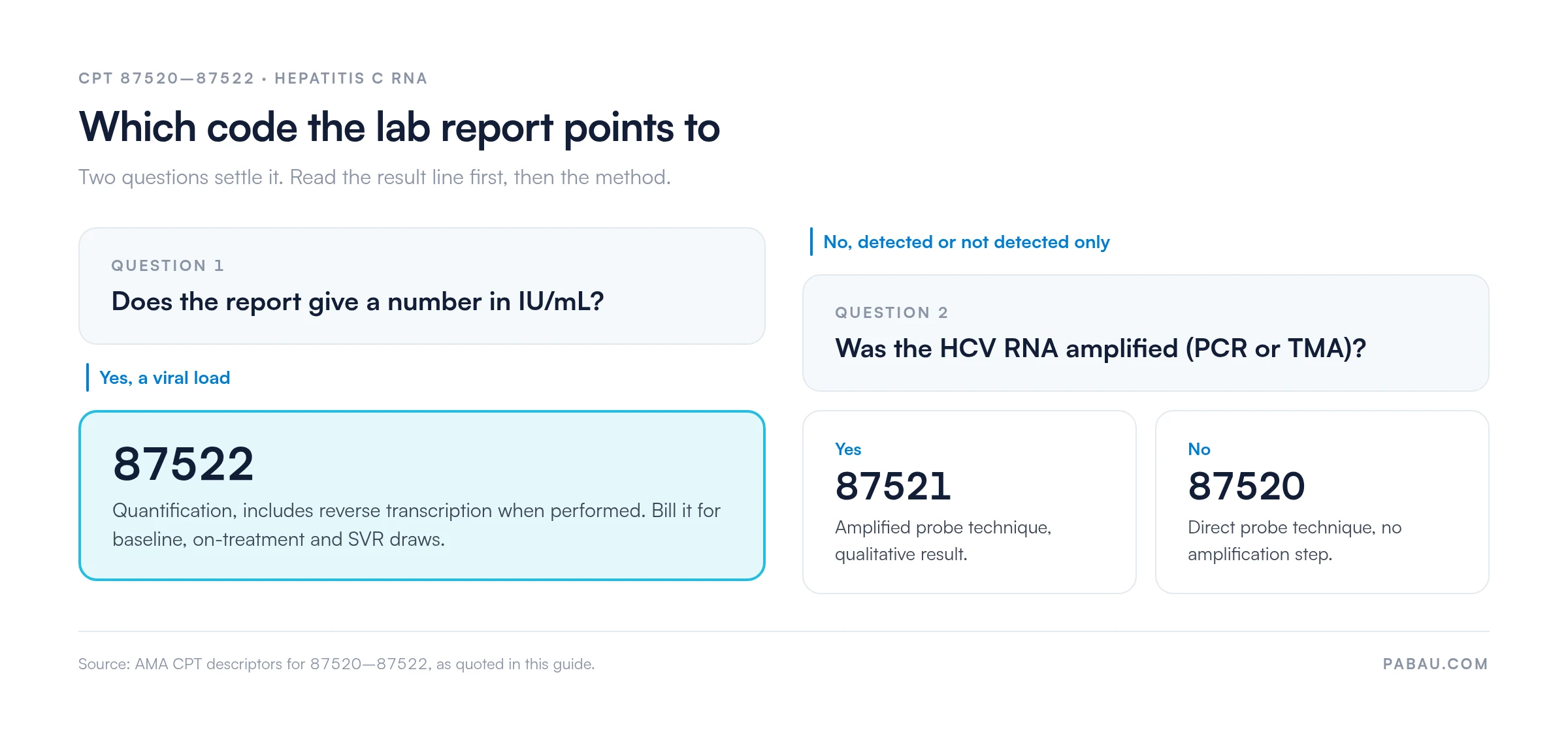
When the report is unclear, ask the performing lab for its assay description. That document, not the wording on the order, decides the code.
Payer policies, Local Coverage Determinations (LCDs) and their billing articles set medical necessity for 87522. In MolDX jurisdictions, the Medicare Administrative Contractor (MAC) may also apply additional evidence criteria. A claim that holds up under review usually carries five elements.
Check the applicable LCD before you submit. MolDX MACs use the same CPT code but may apply additional evidence criteria that non-MolDX MACs don’t.
A diagnosis code the payer doesn’t accept for 87522 is one of the most common reasons this code is denied. Confirm each code is current with the CDC/NCHS ICD-10-CM lookup tool before each claim cycle. These are the pairings that come up most.
B18.2 is the primary diagnosis on most 87522 claims. Z11.59 belongs on a screening order and nowhere else. Confirming a positive antibody is diagnostic work, so code the documented finding, such as R76.8, or B18.2 once HCV is established.
On a genuine screening claim, some payers also want a secondary code for the risk factor behind the screen. Z72.89 (other problems related to lifestyle) or a substance use history code are typical choices.
Seven hand-offs sit between the order and the money. Knowing where each one can fail tells you where to look when a claim stalls.
Steps one and four are the weak points. A vague indication fails at adjudication, while a wrong code or CLIA number bounces at the clearinghouse.
CMS pays CPT 87522 under the Clinical Laboratory Fee Schedule (CLFS), not the Physician Fee Schedule. Physician office labs and reference labs bill it on a CMS-1500 or 837P. The amount comes from the annual CLFS update, not from relative value units.
CLFS rates change every calendar year, so look up the current figure in the Clinical Laboratory Fee Schedule files on the CMS site. Historically, 87522 has paid more than 87521, reflecting the extra work of quantifying the virus.
Private payer rates follow each contract. Reference labs with rates negotiated above the CLFS collect more per test, and in-network physician office labs are held to their contracted rates.
Pabau, the practice management and billing platform we build, connects to US payers through Claim.MD. Your team can run an eligibility check before the draw and receive the ERA after adjudication.
Run an eligibility check before every treatment-monitoring draw. Confirm the plan covers repeat HCV viral load testing and that the patient isn’t close to a frequency limit. A problem caught before the draw costs a phone call, while one caught after costs an appeal.
Prior authorization (PA) for 87522 varies by payer and plan. Medicare fee-for-service generally doesn’t require PA for lab tests paid under the CLFS. Medicare Advantage plans often set their own PA rules, separate from traditional Medicare.
Commercial payers and Medicaid managed care plans vary the most. Many require PA for repeat viral load testing within a plan year. Run insurance eligibility verification before every draw, not just at diagnosis, so a PA requirement shows up before the specimen is taken.
When a plan does require PA, the request usually includes:
Send the request at least five business days before the planned draw.
Yes, in most cases. CPT 87902 identifies the HCV genotype (1a, 1b, 2, 3 and so on), which guides the choice of DAA regimen. Ordering it with 87522 at treatment start is standard. The viral load sets the baseline, and the genotype picks the regimen.
We know of no National Correct Coding Initiative (NCCI) edit that bundles 87902 with 87522. Both can generally be billed on the same date of service when both assays were run. The note should still give the reason for each, so a reviewer sees two distinct purposes.
NCCI edits update quarterly, so check the current tables before submitting any code pair. The AAPC code lookup shows current edits beside each descriptor.
Denials for 87522 tend to cluster around five causes. The denial management workflows you use for other lab claims apply here, with a few twists specific to this code.
To appeal a denied 87522 claim, send the lab report showing the quantitative result and the note with the indication. Add the AASLD/IDSA guidance section that supports the draw frequency, and cite the payer’s LCD by number.
Our guide to medical billing denial codes explains the remittance codes you’ll meet. On 87522, CARC 50 (not deemed medically necessary) and CARC 97 (payment included in another service) come up most often.
Only the entity that performed the assay bills 87522. An ordering provider bills it only when their practice runs a CLIA-certified physician office lab (POL) approved for the test’s complexity. When the specimen goes to a reference lab, that lab bills under its own NPI and CLIA number.
In any setting, clean claim submission for 87522 needs three matching pieces. The CLIA number goes in item 23 of the CMS-1500 or the matching 837P segment. The ordering provider’s NPI goes in the referring field, and the performing lab’s NPI is the billing entity.
Audit CLIA numbers once a quarter. Confirm the number on each claim matches the certificate held by the performing lab, not the ordering office. A mismatch is rejected at the clearinghouse before a payer ever sees the claim.
Most 87522 problems start before the claim exists. The order is vague, the eligibility check gets skipped, or the result never makes it back to the chart. Each one turns into an appeal weeks later.
Practices can switch on lab ordering in Pabau. US practices order Quest tests from the patient record, and Quest and Labcorp results import automatically. A results chart on the record shows each viral load against the last, so the treatment story is documented as it happens.
Claims run from the same record. Eligibility checks, CMS-1500 and 837P claims and ERA remittances go through Claim.MD, so your billing team works from the note and result the clinician saw.

Pabau connects to US payers through Claim.MD. Your team checks eligibility before the draw, submits 837P claims and tracks ERA responses from the patient record.

The code itself is rarely what sinks an 87522 claim. It follows the lab report, and the report is clear once someone reads the result line. Claims fail on the paperwork around the number, such as a missing treatment phase or a screening code on a confirmation draw.
So put the effort upstream. Write the indication into every order, check eligibility before each draw rather than once per course, and keep Z11.59 for screening. With claims management software doing the checks, those errors surface before submission instead of in an appeal.
Book a demo to see how Pabau links HCV lab orders, results and claims on one patient record.

Need to understand how clearinghouse submission works for lab claims? Claim.MD clearinghouse guide explains how electronic lab claims route from practice to payer and back.
Getting ERA remittance codes you don’t recognize? Electronic remittance advice explained breaks down ERA file structure and how to read CARC and RARC denial reason codes.
Billing the antibody test that comes before the viral load? CPT code 86803 covers the hepatitis C antibody test and how to bill it.
Ordering a full acute hepatitis workup instead? CPT code 80074 covers the acute hepatitis panel, which includes the HCV antibody.
Looking for a revenue cycle overview that covers lab billing? Revenue cycle management guide covers the full claim lifecycle from patient registration through payment posting.
Yes. A quantitative HCV RNA PCR reports a viral load, so it bills as 87522. A qualitative HCV RNA PCR, which reports only detected or not detected, bills as 87521.
Yes. The code describes the test performed, not the result. A quantitative assay that returns not detected, or a value below its limit of quantification, still bills as 87522.
Yes, when both tests were run, for example when a positive antibody reflexes to a viral load. The order should allow reflex testing, and the viral load line should carry the abnormal antibody finding as its diagnosis.
It depends on the payer. Medicare contractors and commercial plans set frequency limits through LCDs and medical policies. Record the protocol and treatment week on each order, and check the limit before every draw.
Not quite. A hospital outpatient lab bills under the hospital’s CLIA certificate through its outpatient billing, usually on an institutional claim. A reference lab bills on a CMS-1500 or 837P under its own NPI.




