



HCPCS code E0198: Water pressure pad billing guide
HCPCS code E0198 is a water pad for a standard mattress HCPCS code E0198 is the ...

Last Updated: Oct 13, 2026

CPT code 86803 describes a hepatitis C antibody test, qualitative or semiquantitative, used for HCV screening and diagnosis
The 2026 Medicare national non-facility reimbursement rate should be verified against the CMS Physician Fee Schedule; geographic adjusters apply by MAC locality
Bill ICD-10 Z11.59 for screening encounters and B18.2 for known chronic HCV; choosing the wrong pairing is a leading cause of denials
Pabau’s claims management software automates ICD-10 pairing and pre-submission scrubbing for lab codes, reducing denial rates for high-volume tests like 86803
CPT code 86803 is defined by the American Medical Association as: Hepatitis C antibody; qualitative or semiquantitative. It sits within the Immunology subsection of the Pathology and Laboratory chapter of the CPT code set. The test detects antibodies to the hepatitis C virus (HCV) in serum or plasma, confirming that a patient’s immune system has mounted a response to HCV exposure at some point in their history.
A few distinctions matter for accurate coding. “Qualitative” means the result is reported as reactive or non-reactive. “Semiquantitative” means a signal-to-cutoff ratio is reported alongside the qualitative interpretation, but this is not the same as a viral load measurement. CPT 86803 covers both test formats under a single descriptor. It does not cover HCV RNA quantitative testing, reflex PCR, or genotyping.
The U.S. Preventive Services Task Force (USPSTF) issued a Grade B recommendation in 2020 for HCV screening in all adults aged 18 to 79. That recommendation drives the majority of 86803 orders in primary care and infectious disease settings. Beyond the universal adult screening window, several clinical populations warrant testing regardless of age.
Sexual health panels that include 86803 often carry syphilis screening on the same claim. When the laboratory runs a treponemal assay, that test is reported separately under CPT code 86780.
Medical necessity documentation must link the order to one of these clinical scenarios. A bare order without a supporting ICD-10 code or documented indication is the most common reason payers deny 86803 claims.
Lab codes like 86803 are paid under the Clinical Laboratory Fee Schedule, not the RBRVS-based Physician Fee Schedule. RVU lookups on tools calibrated for PFS codes may return misleading data. Always check the CMS CLFS file specifically for laboratory immunoassay codes when verifying payment rates.
Medicare reimburses 86803 under the Clinical Laboratory Fee Schedule (CLFS), not the Physician Fee Schedule. Rates are set nationally with no geographic adjustment for laboratory codes under CLFS. Always verify the current-year rate against the official CMS Physician Fee Schedule lookup tool and the CMS CLFS file before relying on any third-party source, as laboratory rates are finalized each November for the following year.
Submit 86803 claims through electronic claims via Claim.MD, Pabau’s integrated clearinghouse partner, which supports CMS-1500 and 837P claim formats across more than 4,000 US payers. Real-time eligibility verification before submission reduces preventable denials on Medicare HCV claims.
CPT 86803 is a laboratory code. Its RVU structure reflects the reality of high-volume automated testing: work RVUs are low (or zero, as CMS assigns no physician work component to many lab codes), while practice expense RVUs carry the reimbursement weight.
Use the FastRVU 2026 RVU lookup or the CMS data file to retrieve current RVU components for this code.
Correct ICD-10 selection is not optional for 86803 claims. Payers use diagnosis-to-procedure crosswalks to determine medical necessity, and mismatched pairs trigger automatic denials. The table below covers the most common pairings, but always confirm your payer’s current medical billing compliance policies before submitting.
CPT 86804 describes a hepatitis C antibody confirmatory (supplemental) test. Where 86803 is the initial screening antibody immunoassay, 86804 covers additional antibody testing performed to confirm a reactive 86803 result before reflexing to HCV RNA. They are not interchangeable, and billing both together requires documentation that the confirmatory test was clinically indicated.
This distinction confuses billers more than any other aspect of HCV coding. G0472 is a Medicare-specific HCPCS code covering hepatitis C screening for Medicare beneficiaries under the preventive benefit rules. CPT 86803 is the diagnostic lab code. Both describe an HCV antibody test at the laboratory bench, but the payer context, coverage pathway, and patient cost-sharing are fundamentally different.
Billing 86803 instead of G0472 for a Medicare screening encounter shifts the claim from preventive to diagnostic, triggering Part B cost-sharing for the patient. That is a compliance risk, not just an administrative error. Verify payer policy and encounter context before selecting between these two codes.
A reactive CPT 86803 result does not confirm active HCV infection. Antibodies persist for life after resolved infection, so a positive antibody screen must be followed by HCV RNA quantitative real-time PCR testing (typically billed under CPT 87522) to determine whether viremia is present. This reflex testing sequence is now standard of care per CDC and AASLD guidelines.
Understanding how to bill the full revenue cycle management workflow for reflex orders prevents the most common multi-code billing errors on HCV claims.
Review common denial codes in medical billing for reflex lab panels before setting up your billing workflow. Reflex orders denied for bundling or duplicate billing are among the most time-consuming to appeal.

Pabau integrates claim scrubbing, ICD-10 pairing, and clearinghouse submission in one workflow. See how practices reduce lab code denials without leaving their practice management system.

Getting paid for 86803 consistently requires documented medical necessity, correct code selection, and a clean claim on initial submission. The sections below cover the most common documentation and billing errors.
Proactive denial management workflows catch most of these errors before claims reach the payer. Track denial rates by CPT code monthly so high-volume lab codes like 86803 get early attention when patterns change.
High-volume lab codes create a specific billing risk: the faster a practice orders them, the more frequently the small errors compound. A biller manually selecting ICD-10 codes at claim time, without a crosswalk built into the workflow, makes the Z11.59 versus B18.2 mistake repeatedly. Practices that handle significant HCV testing volume need a system that removes that ambiguity at the point of order, not at the point of claim.
Pabau’s claims management software supports pre-submission scrubbing, helping teams identify ICD-10 pairing issues and documentation gaps before claims leave the practice. Combined with clearinghouse integration, eligibility verification, and electronic remittance advice reconciliation, the workflow closes the loop from lab order to paid claim in a single system.
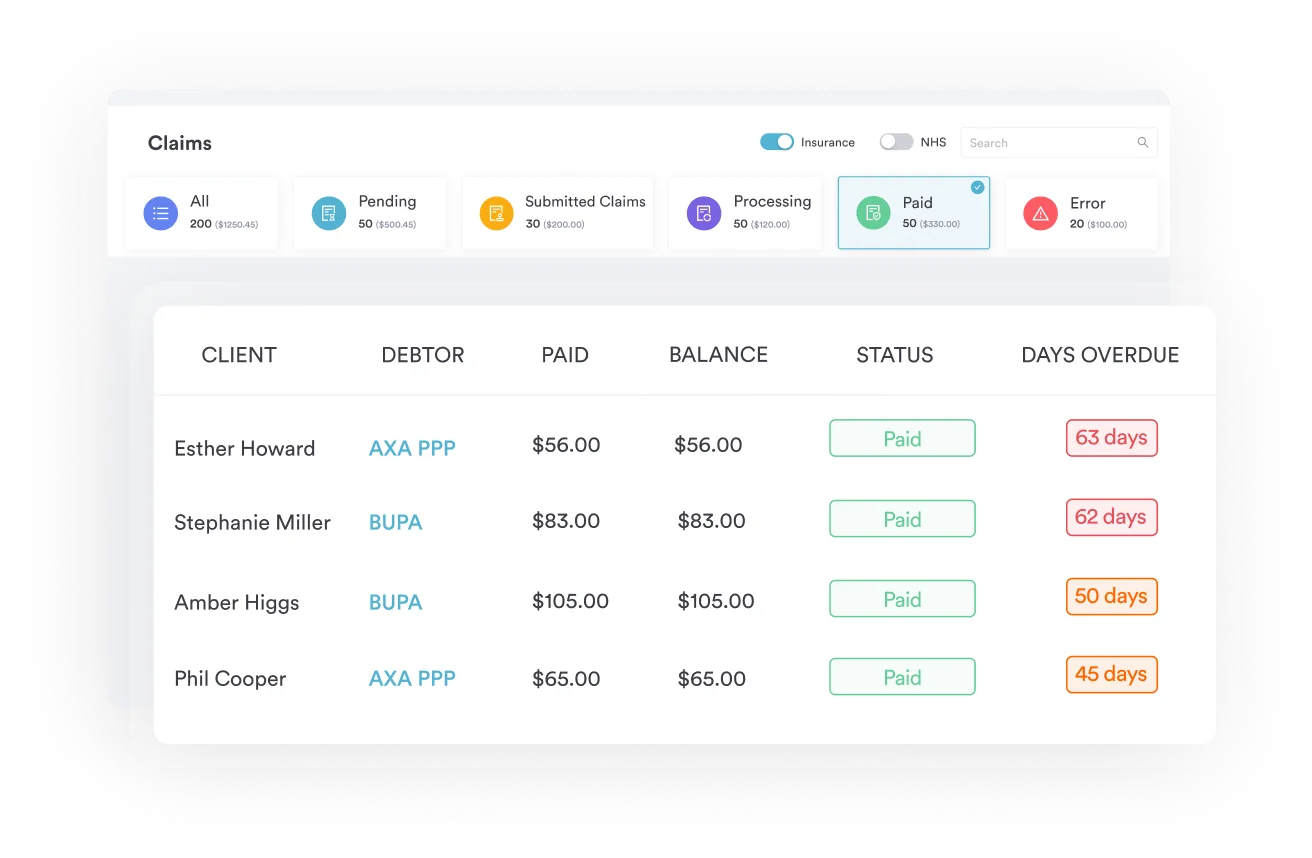
Review your 86803 denial rate quarterly by payer. If Medicare denials spike, check whether G0472 should be used instead for screening encounters. If commercial denials spike, confirm ICD-10 pairings against each payer’s medical necessity policy. A small process check every 90 days catches drift before it becomes a write-off pattern.
CPT code 86803 is a straightforward descriptor with billing complexity that catches practices off guard. The code itself is simple. The challenge is selecting the right ICD-10 pairing, knowing when G0472 applies instead, managing reflex testing sequences, and keeping documentation tight enough to withstand payer scrutiny.
Pabau’s integrated claims management connects the lab order, the ICD-10 pairing, and the clearinghouse submission in one workflow, reducing the manual steps where 86803 denials most commonly originate. To see how it handles high-volume lab billing for your practice, book a demo with the Pabau team.

Need to understand how claims move from submission to payment? Medical billing fundamentals covers the full claim lifecycle for lab and clinical codes.
Getting ERA files back but unsure how to read them? Electronic remittance advice explained breaks down ERA components and how to reconcile payments.
Want to reduce denials before they happen? Clean claim best practices outlines the pre-submission checks that cut first-pass denial rates for lab codes.
CPT code 86803 covers a hepatitis C antibody test performed qualitatively or semiquantitatively. It is used to detect the presence of anti-HCV antibodies in serum or plasma, confirming prior or current exposure to the hepatitis C virus. It does not cover HCV RNA testing, genotyping, or confirmatory supplemental assays (those fall under CPT 86804).
Medicare reimburses CPT 86803 under the Clinical Laboratory Fee Schedule, not the Physician Fee Schedule. The national rate is updated annually each November; verify the current-year amount directly in the CMS CLFS data file or the CMS fee schedule lookup tool, as third-party sources may not reflect the most recent update.
The most common pairings are Z11.59 (encounter for screening for other viral diseases) for asymptomatic screening encounters, and B18.2 (chronic viral hepatitis C) for monitoring known HCV patients. Additional codes include Z72.89 for high-risk lifestyle factors and R74.8 for elevated liver enzymes prompting a hepatitis workup. Matching the ICD-10 to the clinical context is essential: using B18.2 for a screening-only encounter, or Z11.59 for a symptomatic patient, will trigger a payer crosswalk denial.
CPT 86803 is the initial hepatitis C antibody screening test. CPT 86804 is a confirmatory or supplemental antibody test ordered after a reactive 86803 result. They are not interchangeable: 86804 should only be billed when documentation confirms a reactive initial result, and the confirmatory assay was performed as an additional step before reflexing to HCV RNA testing.
Use G0472 for Medicare beneficiaries aged 18-79 receiving asymptomatic HCV screening under the Medicare preventive benefit, which waives patient cost-sharing. Use CPT 86803 for diagnostic testing in symptomatic patients, high-risk patients outside the preventive context, or for non-Medicare payers. Commercial and Medicaid payers generally do not accept G0472, so CPT 86803 is the correct code across non-Medicare payers regardless of clinical context.
The medical record must include the ordering provider’s documented clinical indication (screening rationale, symptoms, or risk factors), the patient’s age, the date of order, and the ordering provider’s NPI. For reflex orders, the original lab requisition must include reflex instructions. Missing or retroactive documentation is the leading audit finding for HCV antibody claims.



