

HCPCS code E0198: Water pressure pad billing guide
HCPCS code E0198 is a water pad for a standard mattress HCPCS code E0198 is the ...

Last Updated: Oct 13, 2026
80074 is the CPT code for the acute hepatitis panel, a four-test workup for acute Hepatitis A, B, or C infection. It bundles IgM hepatitis A antibody, IgM hepatitis B core antibody, hepatitis B surface antigen, and hepatitis C antibody into one billable unit.
Medicare pays the panel under the Clinical Laboratory Fee Schedule and covers it under NCD 190.33. Coverage turns on abnormal liver function test results, with or without symptoms, or on testing prior to and subsequent to liver transplantation. Denials usually trace back to incomplete panel documentation, a diagnosis code that is not on the covered list, or a screening-only order.
Let Pabau's smart automation suggest the right codes, reduce claim denials, and keep your practice compliant—effortlessly.
Automate repetitive tasks and focus on what matters most—your patients.
Reduce coding errors and ensure compliance with the latest regulations.
Clean claims, fewer denials, and faster reimbursements.
Powerful insights and reporting to help your practice thrive.
HIPAA compliant SOC 2 certified GDPR-compliant Trusted by 4,000+ clinics worldwide

CPT code 80074 covers the acute hepatitis panel, which bundles four component tests: IgM anti-HAV, IgM anti-HBc, HBsAg, and anti-HCV
Medicare reimburses 80074 under the CLFS, not the Physician Fee Schedule; the 2026 national limitation amount applies to all MAC jurisdictions
Total anti-HBc (86704) is not part of the panel, so it is billed on its own whenever a clinician adds it
Medicare covers the panel under NCD 190.33 when liver function results are abnormal, with or without symptoms, and for pre- and post-liver-transplant testing
Pabau’s claims management software pairs diagnosis codes with lab orders automatically, reducing denials on panels like 80074
CPT code 80074 is the American Medical Association’s designated code for the acute hepatitis panel. The panel is an organ-oriented laboratory workup that tells a clinician whether Hepatitis A, B, or C is behind a patient’s illness.
Panel codes bundle component tests that are commonly ordered together, according to the American Medical Association’s CPT code set. The code sits in the Organ or Disease-Oriented Panels category.
Clinicians order the panel when a patient presents with symptoms consistent with acute viral hepatitis, or when liver function tests come back abnormal. Those symptoms include jaundice, right upper quadrant pain, fatigue, or a known exposure event. A single panel code covers all four tests as one billable line item, which simplifies claims submission and reduces the risk of unbundling errors.
CPT code 80074 includes exactly four component tests. All four must be ordered and resulted before the panel code can be billed.
Total hepatitis B core antibody (anti-HBc total, CPT 86704) is not one of the four. It reports past or resolved exposure rather than acute infection, so the acute panel leaves it out. Labs that add it to the workup bill 86704 as a separate line.
If a clinician orders only two or three of these four tests, the lab cannot bill CPT code 80074. The individual component codes (86709, 86705, 87340, 86803) should be used instead. Billing the panel when fewer than four components were performed is a compliance violation and an unbundling risk in the other direction.
CPT code 80074 is reimbursed by Medicare under the Clinical Laboratory Fee Schedule (CLFS), not the Physician Fee Schedule that governs evaluation and management codes. The CLFS sets a national limitation amount (NLA), which is the maximum Medicare will pay any laboratory for this panel in a given year.
For 2026, the national limitation amount for CPT code 80074 is approximately $24.00 to $26.00. Verify current rates against the CMS clinical laboratory fee schedule before submitting claims, since CLFS rates are updated annually. Individual Medicare Administrative Contractors (MACs) may pay at or below the NLA, never above it.
Place-of-service rules differ too. Independent labs bill under the CLFS, while hospital outpatient labs billing for the technical component may have separate rates.
Practice management software like Pabau runs a real-time eligibility check before the visit. The front desk then knows whether the patient’s plan covers the acute hepatitis panel. Confirming benefits at that point costs far less than arguing about them at remittance. Payment posts against the claim automatically when the electronic remittance advice arrives.
Medicare covers CPT code 80074 under National Coverage Determination 190.33, which governs both the hepatitis panel and the acute hepatitis panel specifically. The CMS coding policy manual for that NCD lists two indications for coverage.
The first is detecting viral hepatitis infection when liver function test results are abnormal, with or without signs or symptoms of hepatitis. The second is testing prior to and subsequent to liver transplantation. The abnormal liver result is the gating criterion, so symptom documentation is not a condition of payment.
Reading that indication list as written is what keeps this code payable. An abnormal AST, ALT, alkaline phosphatase, or bilirubin result supports the panel on its own, even when the patient reports no symptoms. Symptoms strengthen the clinical picture, but the NCD does not require them.
The hepatic function panel reports all four of those values, and labs bill it under CPT code 80076. An abnormal result on that panel documents the NCD 190.33 indication before the hepatitis order reaches the lab.
Routine screening is the clear exclusion. Take a patient who requests the panel at an annual wellness visit. With normal liver results and no signs, symptoms, complaints, or personal history of hepatitis, that order misses the medical necessity threshold. Have the patient sign an Advance Beneficiary Notice (ABN) before the test is performed.
The coding policy manual sets no frequency cap on this panel. Its one stated limitation is narrower. Once a hepatitis diagnosis is established, individual tests are what the patient needs, so the full panel stops being appropriate.
Where the diagnosis is still unclear, the manual contemplates repeating the panel two weeks to two months later. Check your MAC’s local coverage determination for any frequency edit applied on top of the national policy.
Coverage on this panel comes down to two questions at the point of order, plus one rule about what happens after the diagnosis lands.
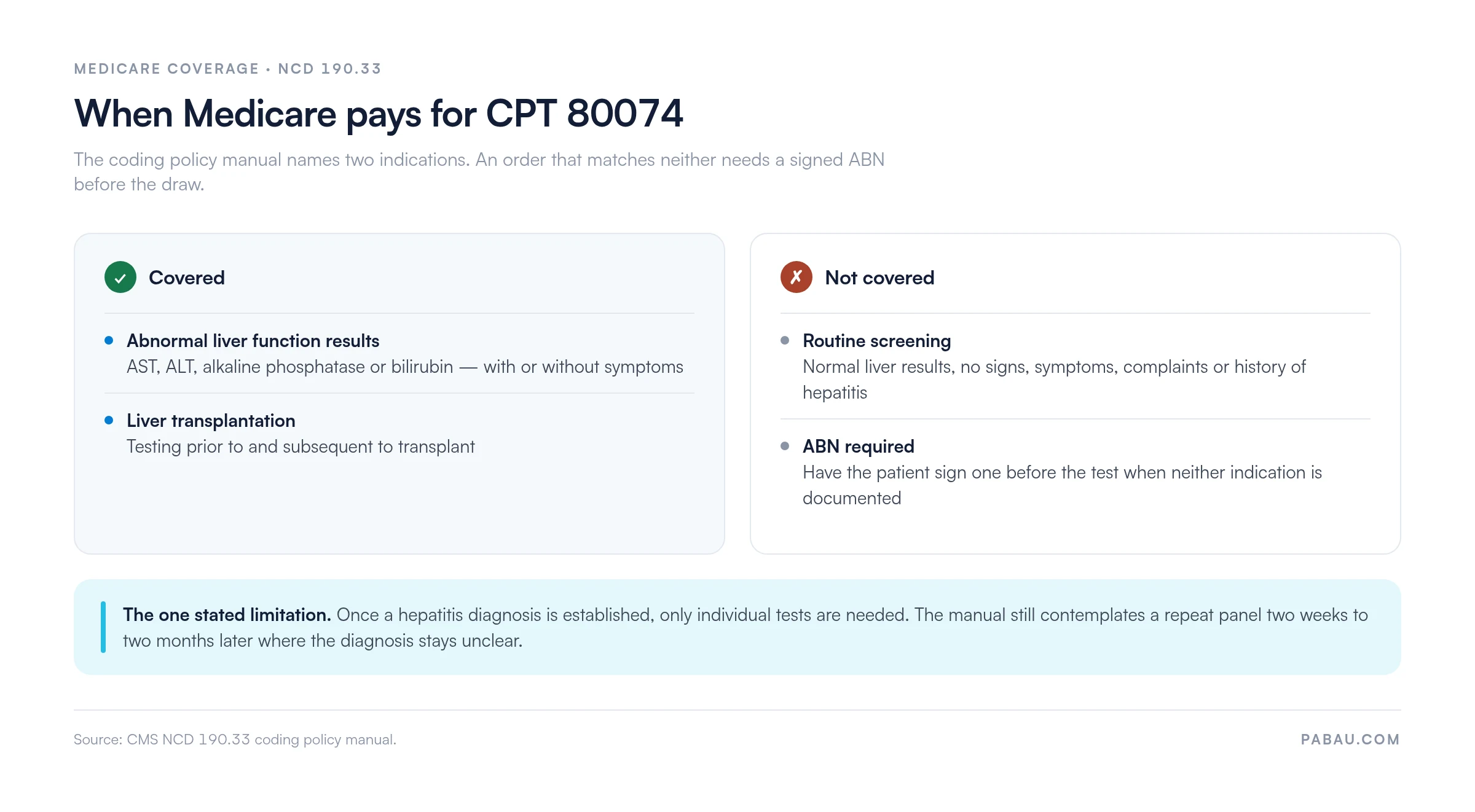
Before ordering CPT code 80074 for a Medicare beneficiary, check the chart for a recent abnormal liver function result. An elevated AST, ALT, alkaline phosphatase, or bilirubin meets the NCD 190.33 indication on its own, symptoms or not. Testing around a liver transplant qualifies as the second indication. Record which of the two applies in the order note, and the medical necessity question is answered before the claim goes out.
Pairing CPT code 80074 with the correct ICD-10 diagnosis code is required for Medicare to process the claim. The covered diagnosis codes reflect the clinical scenarios NCD 190.33 recognizes as medically necessary.
The CMS ICD-10 codes page lists the current code files. Every code in the table below appears on the covered-code list CMS publishes for NCD 190.33.
Two codes coders reach for by habit are missing from that list. Z20.5 covers contact with and suspected exposure to viral hepatitis, and K76.89 covers other specified diseases of liver. Neither is published as a covered diagnosis for NCD 190.33, so neither will support the claim on its own. Pair the panel with a hepatitis code, a documented symptom, or an abnormal liver result instead.
Cross-reference covered codes against your MAC’s local coverage determination. An LCD may add or restrict diagnosis codes beyond what NCD 190.33 specifies nationally. Use the AAPC CPT code lookup to verify crosswalk pairings when building billing templates for this panel.
The chart, the order, and the lab report all have to support the claim before it reaches the payer. Documentation on a lab panel starts with a complete ordering provider signature. It needs a clinical indication note as well, plus all four component results on the lab report.
Yes, but only when fewer than all four components are ordered and performed. The rule works in both directions. If all four tests are ordered, you must bill the panel code 80074. Billing them as four individual codes when all four were performed is unbundling, which violates AMA panel billing rules and creates an overpayment risk.
If only two tests are ordered and resulted, bill those two codes on their own, for example 86705 (IgM anti-HBc) and 86803 (anti-HCV).
Some practices build order sets that default to all four components. When a clinician deselects one test mid-order, the billing system needs to catch the change and switch from the panel code to individual codes automatically. Without that logic, the wrong code ships on the claim. A clean claim depends on the order and the bill matching the lab report exactly.
Key documentation checklist for CPT code 80074:
Submit the claim as a single line item using CPT code 80074, with the diagnosis code in Box 21 of the CMS-1500 form. The 837P electronic claim file carries the same information in the corresponding loops.
Understanding the component-level codes helps coders recognize when the panel applies and when individual tests are appropriate. Where a clinician orders only the hepatitis C antibody, 86803 is billed on its own.
The table below lists the four codes that make up the acute hepatitis panel. Three more are commonly ordered alongside it during an infectious disease workup.
Most denials on CPT code 80074 fall into a small number of repeating patterns. Each stems from a different root cause in the documentation, ordering, or coding workflow. Knowing which root cause drives which denial type makes it faster to build a prevention protocol than to chase individual remittances.
Categorize each denial before the appeal, so the rejection log becomes a fix list. The five patterns below cover the ones a lab sees repeatedly on this panel. Tracking them by root cause points the billing team at the upstream process rather than another resubmission.
Reviewing the denial codes that land on this panel, the most common CARC values are CO-50, CO-4, and CO-97. CO-50 flags medical necessity, CO-4 an incompatible modifier or procedure code, and CO-97 a service already covered by another allowance, which points to unbundling. Knowing which CARC maps to which root cause tells the billing team where the fix belongs.
Run a monthly query on all CPT 80074 remittances filtered by denial reason. If CO-50 (medical necessity) accounts for more than 15% of rejections, look at the ordering encounter note before you look at the codes. Add a required clinical-indication field so the lab order cannot be released without one.
Two denial triggers dominate CPT code 80074. Documentation goes missing at the point of order, and the ICD-10 pairing goes wrong at the point of billing.
Both happen because the order, the chart note, and the billing system operate independently in many practices. Connect the three and the diagnosis captured at the encounter travels with the order all the way to the claim.
Capturing the clinical indication inside the ordering workflow keeps that work off the biller’s desk. Nobody should have to reconstruct it from a lab report.
Pabau’s automated claims management links the diagnosis code entered during the encounter directly to the lab order. The ICD-10 code then follows the claim through to submission without manual re-entry.
Pabau’s Claim.MD integration validates claims against payer edits before transmission, catching code incompatibilities before the claim reaches the MAC. On a panel like 80074, both the unbundling logic and the ICD-10 pairing have to be correct. Pre-transmission validation settles a clean claim before it leaves the building, which is cheaper than an appeal weeks later.

Pabau pairs diagnosis codes with lab panel orders automatically and submits clean claims through Claim.MD’s clearinghouse to thousands of US payers. See how labs and practices use Pabau to reduce CPT 80074 denials.

CPT code 80074 is straightforward in concept but regularly denied in practice. Thin documentation, an uncovered diagnosis pairing, and order logic that fails to enforce the all-four-or-none rule account for most rejections. Getting these right requires connecting the clinical ordering workflow to the billing system so that each step supports the next.
Pabau’s claims management software links encounter diagnosis codes to lab orders and validates 80074 claims through Claim.MD before transmission. Billing teams get one fewer manual step between a clean chart and a paid claim. To see how it works in your lab or practice workflow, book a demo with Pabau.

Need help managing lab claim denials across multiple codes? Understanding denial management in healthcare walks through the full denial lifecycle from CARC code identification to appeal submission.
Want to understand how clearinghouses process lab claims? Medical claims clearinghouses explained covers how claim validation works between the practice and the payer.
Looking for guidance on clean claim requirements for lab panels? Clean claim submission standards outlines the elements every lab claim must satisfy before reaching adjudication.
CPT code 80074 is the billing code for the acute hepatitis panel, a four-test laboratory workup for Hepatitis A, B, or C infection. The code sits under Organ or Disease Oriented Panels. Medicare reimburses it through the Clinical Laboratory Fee Schedule.
The four components are IgM hepatitis A antibody (86709), IgM hepatitis B core antibody (86705), hepatitis B surface antigen (87340), and hepatitis C antibody (86803). All four must be ordered and resulted to bill the panel code.
No. The panel requires only the IgM hepatitis B core antibody, CPT 86705. Total anti-HBc, CPT 86704, is a separate standalone code that reports past or resolved exposure. Ordering it alongside the panel does not change how 80074 is billed.
Yes. Under NCD 190.33, Medicare covers CPT code 80074 when liver function test results are abnormal, with or without signs or symptoms of hepatitis. It is also covered prior to and subsequent to liver transplantation. Routine screening without a clinical indication is not covered, and an Advance Beneficiary Notice is required when coverage may not apply.
Covered ICD-10 codes include B15.0 and B15.9 for Hepatitis A, B16.0-B16.9 for acute Hepatitis B, and B17.10 and B17.11 for acute Hepatitis C infection. Symptom codes such as R17 and R74.01 are also covered. Z20.5 is not on the list for this NCD, so check your MAC’s LCD for local additions.
CPT 86803 is the standalone code for the hepatitis C antibody test (anti-HCV) only. CPT code 80074 bundles anti-HCV with three other hepatitis tests into a single panel code. When a clinician orders only the hepatitis C antibody without the other three components, bill 86803 instead of 80074.
NCD 190.33 is the CMS National Coverage Determination that governs Medicare coverage for the hepatitis panel and acute hepatitis panel. It lists two indications: abnormal liver function test results, with or without signs or symptoms of hepatitis, and testing around liver transplantation. Routine screening orders are excluded. The manual states no frequency cap, but once a hepatitis diagnosis is established, only the individual tests are needed.



