HCPCS Code A4627: Spacer and valved holding chamber
HCPCS Code A4627: official descriptor and code definition HCPCS Code A4627 is th...

Last Updated: Oct 21, 2026
84550 is the CPT code for uric acid; blood, a quantitative measurement of uric acid in serum or plasma. Practices order it to diagnose gout, monitor urate-lowering therapy, and track hyperuricemia and chronic kidney disease.
The code sits in the Chemistry subsection (82009-84999) of the AMA's Pathology and Laboratory section. Uric acid is not part of any standard metabolic panel, so every 84550 claim needs its own ICD-10 diagnosis to show medical necessity. Medicare pays it under the Clinical Laboratory Fee Schedule at one national rate.
Let Pabau's smart automation suggest the right codes, reduce claim denials, and keep your practice compliant—effortlessly.
Automate repetitive tasks and focus on what matters most—your patients.
Reduce coding errors and ensure compliance with the latest regulations.
Clean claims, fewer denials, and faster reimbursements.
Powerful insights and reporting to help your practice thrive.
HIPAA compliant SOC 2 certified GDPR-compliant Trusted by 4,000+ clinics worldwide

CPT code 84550 bills a quantitative uric acid test on blood, separate from urine uric acid (84560) and from every metabolic panel.
Medical necessity needs a linked ICD-10 code, and gout (M10.x), hyperuricemia (E79.0) and CKD (N18.x) are the strongest pairings.
Medicare pays 84550 under the Clinical Laboratory Fee Schedule at one national rate of about $4.50, with no MAC-region adjustment.
Missing or non-covered ICD-10 codes cause most denials, and modifier 91 applies only to a clinically distinct same-day repeat.
CPT code 84550 is officially described as “Uric acid; blood” in the AMA CPT code set. The semicolon is standard CPT shorthand that separates this blood code from its other-source sibling, 84560.
It sits in the 82009-84999 range of the Chemistry subsection, within Pathology and Laboratory. Medicare pays it under the Clinical Laboratory Fee Schedule (CLFS), not the Physician Fee Schedule.
The analyte is uric acid, the end product of purine metabolism. High serum levels drive monosodium urate crystal deposits in joints and soft tissue, which is the mechanism behind gout. Low levels matter in some metabolic conditions.
The test must run in a CLIA-certified lab. When a practice sends the specimen to a reference lab such as Quest Diagnostics, the lab usually bills 84550. The practice bills only the blood draw.
CPT code 84550 covers a single quantitative measurement of uric acid in blood, usually serum or plasma from a venipuncture. Whole-blood point-of-care testing also bills as 84550. On a CLIA-waived device, Medicare expects modifier QW. Commercial payer rules vary, so confirm them before billing.
Three situations fall outside 84550’s scope and cause billing errors when misapplied.
Payers require a documented clinical reason for every uric acid blood test before approving the claim. Adding the test to a routine metabolic panel without a supporting diagnosis is one of the fastest routes to denial.
According to AAPC coding guidance, medical necessity must be established before the specimen is collected, not constructed after the order.
Accepted clinical indications for 84550 include the scenarios below. Recording at least one of them in the chart before the order is placed is the most effective way to prevent denials. Document the specific indication in the same encounter note that generates the lab order.
Selecting the right ICD-10 code is the most important step in submitting a clean 84550 claim. Payers validate the diagnosis against their local coverage determination (LCD) before processing the claim. Using a code that falls outside the covered list, even when the clinical reasoning is sound, results in an automatic denial.
The table below lists the most commonly accepted codes, and the CrossCoder crosswalk tool is useful for confirming current payer-specific coverage pairings.
Always confirm active code status for the current ICD-10-CM edition. Use a site-specific M10.0x code when the chart documents the joint involved. M10.9 is a valid fallback, but a specific code holds up better in an audit.
Check your MAC’s LCD for uric acid (84550) before using E88.81 (metabolic syndrome) as the sole diagnosis. This indication has inconsistent coverage across MAC regions, and billing it without verifying the local policy is a predictable denial. Pull the LCD, confirm the code appears in the covered diagnosis list, and document the metabolic syndrome diagnosis explicitly in the encounter note.
CPT code 84550 covers the analysis, not the specimen collection. The two are billed as separate services, and the superbill should capture both when the practice performs the blood draw.
Several coding decisions around 84550 trip up billers consistently. Knowing which codes bill separately, which are bundled, and when modifiers apply prevents both undercoding and compliance exposure. The electronic claim must carry every code and modifier accurately, or it rejects before adjudication.
Modifier 91 is specifically misapplied on 84550 claims. It is valid only when a second uric acid measurement is medically necessary on the same calendar day. That means a change in clinical status, such as a repeat draw after acute treatment. Using it to rebill a failed specimen or a quality-control re-run is incorrect and constitutes a billing error.
Phosphorus works the same way on a renal chemistry order. 84100 is not a component of 80053 or 80048 either, so a CKD workup bills it on its own line.
CPT code 84550 is paid under the Medicare Clinical Laboratory Fee Schedule (CLFS), not the Physician Fee Schedule. Since the Protecting Access to Medicare Act (PAMA), the CLFS sets one national rate per code. There is no adjustment by MAC region or place of service.
The current Medicare CLFS rate for CPT 84550 is approximately $4.50, which makes it a low-reimbursement but high-volume chemistry code. Commercial payers typically reimburse at a multiple of the Medicare rate, often between 1.2x and 2.0x, though contracted rates vary.
Lab codes carry no RVUs, so check the CMS Clinical Laboratory Fee Schedule for the current national rate. Electronic remittance advice (ERA/835 files) from the clearinghouse shows the exact allowed amount per payer once claims adjudicate.
Place of service codes tell the payer where the test was performed and who is billing it. They don’t change the Medicare CLFS rate. The most common are:
Collect an Advance Beneficiary Notice of Noncoverage (ABN) before drawing blood for 84550 whenever Medicare may not cover the test. Common triggers include:
The ABN must be completed on form CMS-R-131 before the service is performed. If the patient elects to receive the test and Medicare denies the claim, the practice may bill the patient. Modifier GA signals that an ABN is on file. Modifier GZ signals that no ABN was obtained when one was required, which leaves the provider financially liable. Never use GZ intentionally, because that charge cannot be collected from the patient.
Most 84550 denials fall into five patterns, and each has a specific fix. Knowing which pattern applies to a denied claim speeds up the appeal. Track denial reason codes on 84550 claims separately from general lab denials, because the fix differs from most other chemistry codes.
Each pattern maps to one check made before the claim leaves the practice, as the chart below shows.
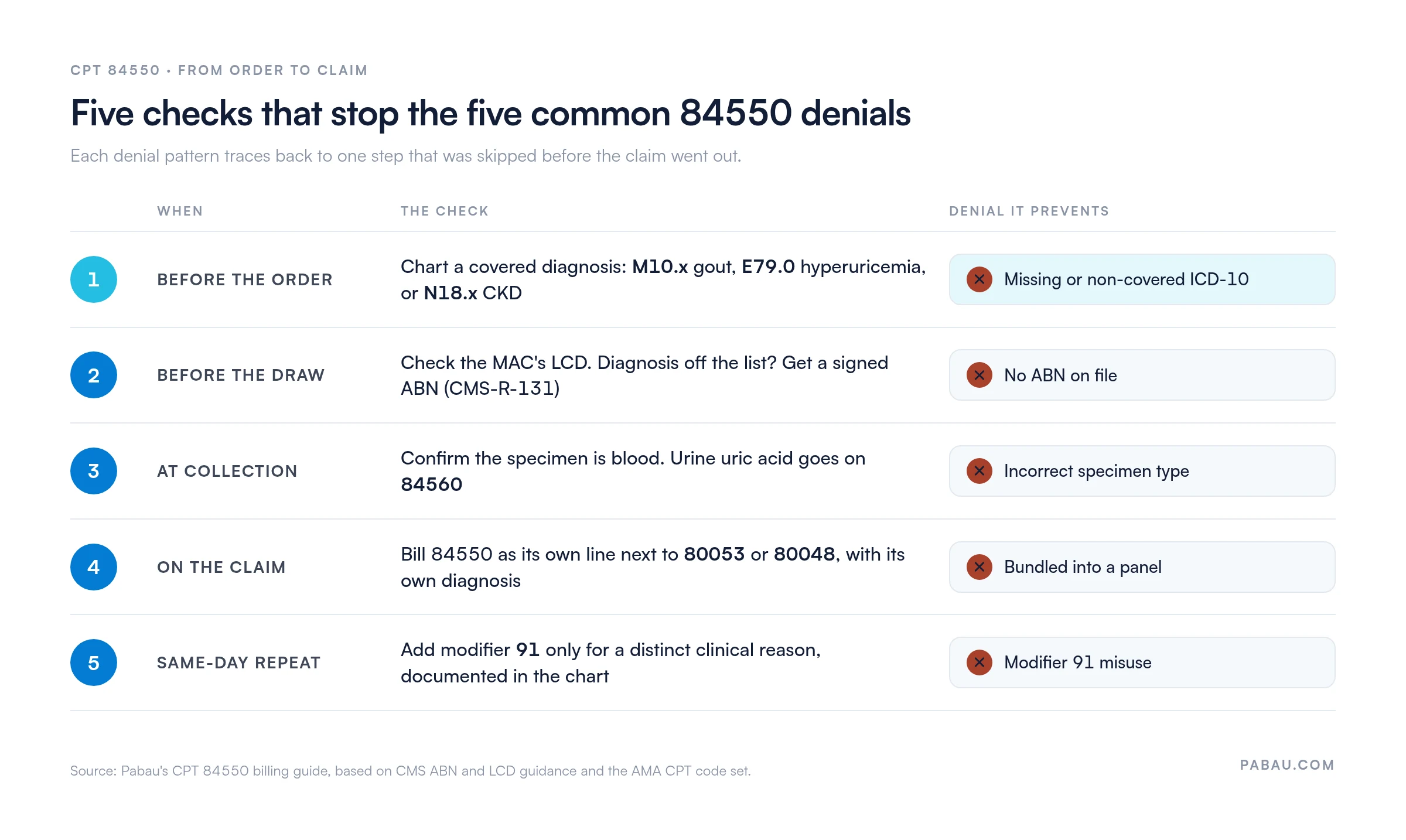
Clean claim submission for 84550 needs attention at each stage of the revenue cycle, from order entry to the day the ERA posts. Treat each chemistry code as a distinct billing event with its own documentation and eligibility checks. Folding lab claims into the general batch unchecked is how small errors repeat.
Build an ICD-10 crosswalk into your lab order workflow for 84550. When a provider orders a uric acid test, the ordering system should prompt selection from the covered diagnosis list rather than accepting a free-text note. This single step eliminates the most common denial pattern and reduces the volume of ABN conversations with patients.
Most 84550 denials start before the claim exists. A provider orders the test, the diagnosis sits in a free-text note, and billing staff key the code in later.
Claims management software in a practice management system like Pabau builds the claim from the encounter instead. The diagnosis attached to the lab order carries onto the claim, and 36415 and 84550 go out together on one encounter claim.
Claims then submit electronically through Claim.MD, Pabau’s clearinghouse integration, which connects to thousands of US payers. Remittance files post back against the same claim, so your team sees a denied 84550 line and its reason code without chasing paper.

Pabau’s claims management tools help you submit 84550 and related chemistry codes with the right ICD-10 pairings attached, reducing denials before they happen. See how Pabau handles lab billing workflows from order to ERA.

Treat 84550 as a documentation task that happens before the draw. When the chart names a covered diagnosis and the ABN question is settled first, the claim itself is routine.
The trade-off is the payment. At about $4.50 per test, a denied 84550 line is rarely worth the staff time to appeal, so prevention pays better than rework. Book a demo to see how Pabau carries the diagnosis from the lab order onto every lab claim.

Need guidance on clearinghouse submission for lab codes? Claim.MD clearinghouse overview explains how electronic lab claims route through the clearinghouse to payers, including real-time eligibility checks before submission.
Want to understand what happens after a clean claim leaves the practice? Medical billing fundamentals walks through the full claim lifecycle, from charge capture to payment posting, with practical guidance for in-house billing teams.
Dealing with recurring denials across multiple codes? Medical billing compliance practices covers the audit trail documentation requirements that protect practices during payer reviews and post-payment audits.
Billing the blood draw too? CPT code 36415 explains venipuncture billing, the collection service that usually rides on the same claim as 84550.
Need a system for working lab denials? Denial management in healthcare sets out how to track, appeal and prevent recurring claim denials.
CPT code 84550 is a Chemistry Procedures billing code for a quantitative uric acid measurement performed on a blood specimen (serum or plasma). It is reimbursed under the Medicare Clinical Laboratory Fee Schedule and requires a supporting ICD-10 diagnosis code to establish medical necessity.
The Medicare Clinical Laboratory Fee Schedule pays approximately $4.50 for CPT 84550. The CLFS sets one national rate per code, so the rate does not vary by MAC region. Rates update annually, so confirm the current figure in the CMS CLFS files.
The strongest ICD-10 pairings are M10.9 or site-specific M10 codes for gout, E79.0 for hyperuricemia without inflammatory arthritis, and N18.x codes for chronic kidney disease. E88.81 for metabolic syndrome carries higher scrutiny and requires LCD verification by MAC region before use.
Yes. CPT 36415 (venipuncture) is separately billable alongside 84550 in most payer contexts. Current CCI edits do not bundle the collection code with the chemistry analysis code. Bill both on the same claim when your practice performs the blood draw.
An ABN is required when there is reason to believe Medicare will not cover the test. Typical triggers are a diagnosis outside the MAC’s covered list or testing more often than the LCD allows. Use form CMS-R-131 before the draw and apply modifier GA when the ABN is on file.
No. Uric acid is not a component of CPT 80053 (comprehensive metabolic panel) or CPT 80048 (basic metabolic panel). When uric acid is ordered alongside a CMP, bill 84550 as a separate line item. It needs its own supporting ICD-10 diagnosis code.