CPT code 52648: Laser ablation of the prostate billing guide
What CPT code 52648 covers, and what it bundles in CPT code 52648 is the code fo...

Last Updated: Oct 21, 2026

CPT Code 82607 reports a quantitative serum measurement of Vitamin B-12 and sits in the Chemistry Procedures subsection of the CPT manual.
Medicare covers 82607 only when a qualifying ICD-10-CM diagnosis supports medical necessity, so a claim without one is denied automatically.
Medicare prices 82607 on the Clinical Laboratory Fee Schedule at one flat national amount, roughly $22 to $28 in 2026.
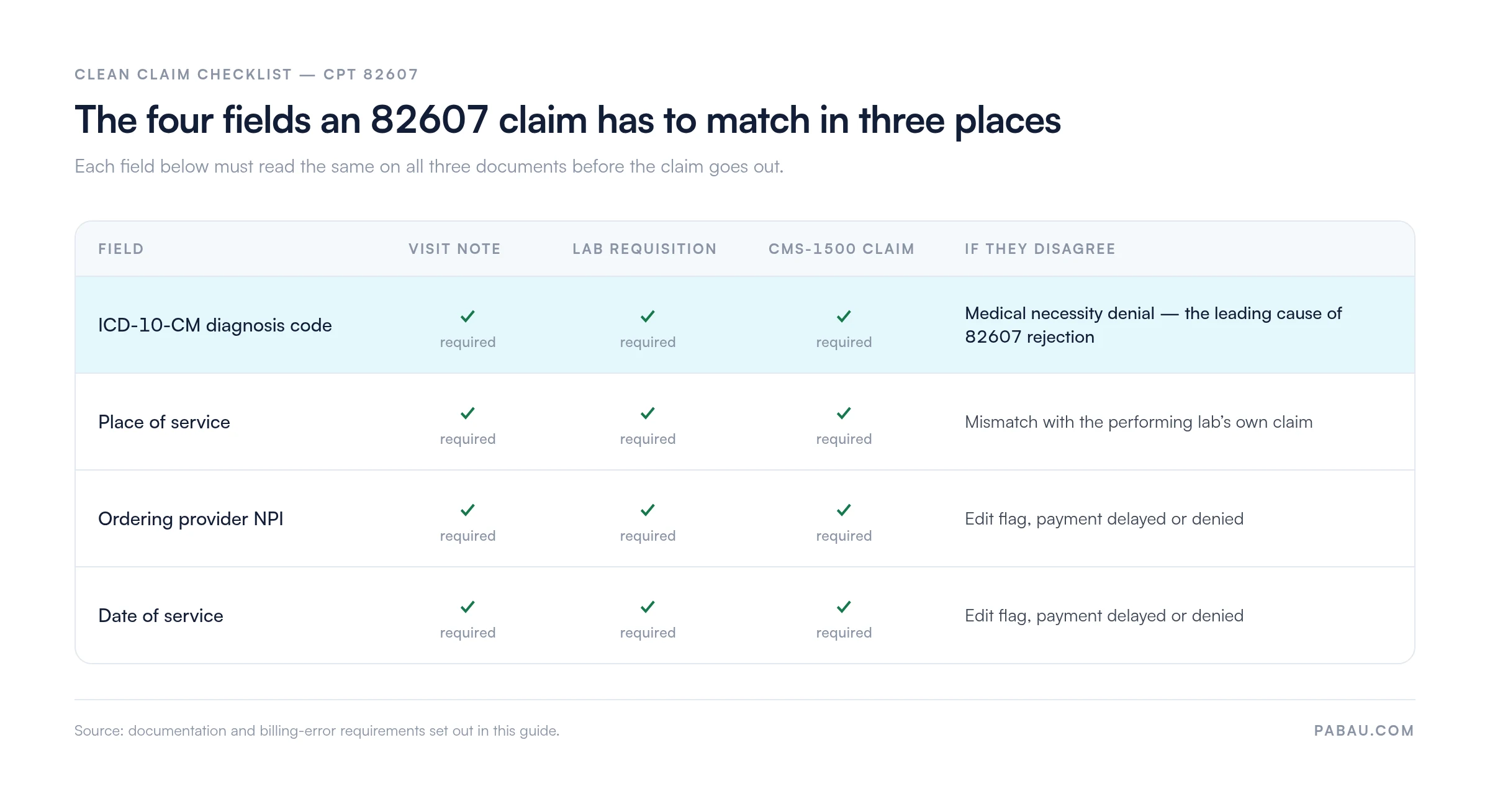
The same diagnosis code, place of service, NPI, and date of service must appear on the visit note, the lab requisition, and the claim.
Pabau links each lab order to its ICD-10 code at the point of entry, which cuts 82607 mismatch denials.
CPT Code 82607 is the billable code for a quantitative serum measurement of Vitamin B-12 (cyanocobalamin).
It sits in the Chemistry Procedures subsection of the AMA CPT manual. Payers treat it as a diagnostic lab test rather than a screening panel.
Coverage depends on a documented clinical indication and a matching ICD-10-CM diagnosis on the claim. This guide covers the descriptor, the 2026 Clinical Laboratory Fee Schedule rate, covered diagnoses, documentation, and the errors that drive 82607 denials.
CPT Code 82607 describes the laboratory measurement of Vitamin B-12 (cyanocobalamin) in serum. The code sits within the Chemistry Procedures subsection of the CPT manual and reports a quantitative assay of total circulating cobalamin.
The test measures total serum B12 rather than the metabolically active fraction. When a clinician suspects functional deficiency despite a normal serum level, methylmalonic acid (MMA) and homocysteine are ordered alongside 82607 to confirm tissue-level deficiency. Knowing that distinction prevents unnecessary repeat orders and guides correct code pairing.
CPT 82607 and CPT 82608 are frequently confused in billing. They describe different assays of the same vitamin system, and payers treat them as distinct procedures.
You can bill 82607 and 82608 together when both assays are clinically indicated and separately ordered. Review the NCCI (National Correct Coding Initiative) edits before submitting both on one date of service. Some payers bundle them. Check your MAC’s local coverage determination before billing both codes for the same encounter.
Medicare and most commercial payers cover CPT 82607 only when a documented clinical indication supports medical necessity. CMS requires the ordering provider’s documentation to name a specific symptom, condition, or risk factor that justifies the test. Billing without a qualifying indication is the leading cause of 82607 denial.
The following scenarios are commonly covered under applicable LCD policies, including Palmetto GBA L33418 and similar MAC policies:
Anthem’s commercial policy CG-LAB-19 confirms metformin-related B12 depletion as a covered indication. For Medicare patients, check the applicable MAC LCD before asserting coverage, because policies vary by jurisdiction.
Pairing CPT Code 82607 with a covered ICD-10-CM diagnosis is the single most important step to avoid denial. The table below lists commonly supported diagnosis codes drawn from CMS LCD guidance and commercial payer policies.
Coverage is payer-specific and subject to MAC jurisdiction. Verify each pairing against the CMS ICD-10-CM code list and your MAC’s current LCD before submitting.
An overly broad diagnosis code invites a medical necessity audit. Using a screening code when the patient has active symptoms is the most common version of that error.
When monitoring a known deficiency, use the condition-specific code rather than a screening Z code. Our ICD-10-CM code library carries the full descriptor and coverage notes for each diagnosis in the table.
Always verify your ICD-10 pairings against your MAC’s active LCD before submitting CPT Code 82607 claims. LCD coverage lists are updated annually, and a code valid last year may require additional documentation this year. Check the CMS Medicare Coverage Database at cms.gov for current Palmetto GBA and other MAC policies.
The 2026 Medicare allowed amount for CPT 82607 runs approximately $22 to $28. Medicare prices the code on the Clinical Laboratory Fee Schedule (CLFS), which sets one flat national amount per test. That amount does not move with geographic practice cost indices or relative value units, because lab codes carry no RVUs.
CMS resets CLFS rates from private-payer pricing data reported under PAMA. The amount therefore changes on the CLFS cycle, rather than in the annual physician fee rule. Check the current 82607 amount on the CMS fee schedule before you quote a figure to a payer or a patient.
Place of service (POS) errors are a common audit flag on lab claims. The POS has to name the setting where the sample was collected and processed. Billing POS 11 for a test a hospital outpatient lab ran creates a mismatch with the performing lab’s claim.
Review the remittance advice codes your clearinghouse returns after each 82607 cycle. A recurring POS adjustment shows up there long before an auditor finds it.
Commercial payer rates for CPT 82607 vary widely. Most private insurers negotiate their own lab fee schedules, and some cap reimbursement below the Medicare CLFS amount.
Medicaid rates are set state by state. Medi-Cal in California and other state programs publish independent allowables that can differ sharply from the CLFS. Verify the payer-specific fee schedule before you assume a Medicare rate applies.
Insufficient documentation is the second most common reason 82607 claims are denied, after an ICD-10 mismatch. The ordering provider’s note has to create an auditable link between the patient’s presentation and the lab order.
The following elements must be present in the medical record to support an 82607 claim:
A superbill that carries the ICD-10 code alongside the CPT code at the point of order cuts the risk of a mismatch later. The lab requisition and the CMS-1500 claim then inherit the same diagnosis code instead of being typed twice.
CPT 82607 billing errors cluster into four categories. Diagnosis mismatches, incorrect place of service, unbundling violations, and missing documentation each have a distinct fix. Working through the denial codes on each remittance shows which category is driving your rejections.
The same mismatch shows up in stool testing. A guaiac fecal occult blood test ordered for symptoms bills 82272, not the screening code 82270.
A clean 82607 claim carries the same diagnosis code, POS code, ordering provider NPI, and date of service in three places. Those three are the visit note, the lab requisition, and the CMS-1500 form. Any disagreement between them creates an edit flag that delays or denies payment.
B12 deficiency workups rarely involve a single code. The codes below are commonly ordered together in anemia evaluation, metabolic function screening, and nutritional deficiency panels. Verify each against the AAPC Codify CPT lookup for current descriptors and applicable NCCI edits.
J3420 is the HCPCS Level II code for the Vitamin B12 injection itself, not the serum test. A patient can receive a B12 injection and have a serum B12 level drawn on the same date. That encounter takes both J3420 for the injection and 82607 for the test, billed separately.
When a serum B12 result comes back borderline, CPT 83921 (methylmalonic acid) is the confirmatory test most payers expect to see. Order it on its own clinical indication and document why the serum result was inconclusive. Run an NCCI edit check before submitting 83921 and 82607 on the same date of service.
Manual lab billing creates predictable failure points. The ordering note, the lab requisition, and the claim all need the same diagnosis code. When three separate systems generate those three documents, they drift apart.
Practice management software like Pabau keeps them in one record. Pabau’s lab claims software connects each lab order to its ICD-10-CM code inside the patient chart. When a provider orders 82607 through the platform, the diagnosis travels with the order. It carries through to the superbill and onto the claim.
That removes the manual transcription step where most ICD-10 mismatches start. Practices running high volumes of chemistry panels see the effect first, because B12, iron, folate, and homocysteine orders all follow the same path.
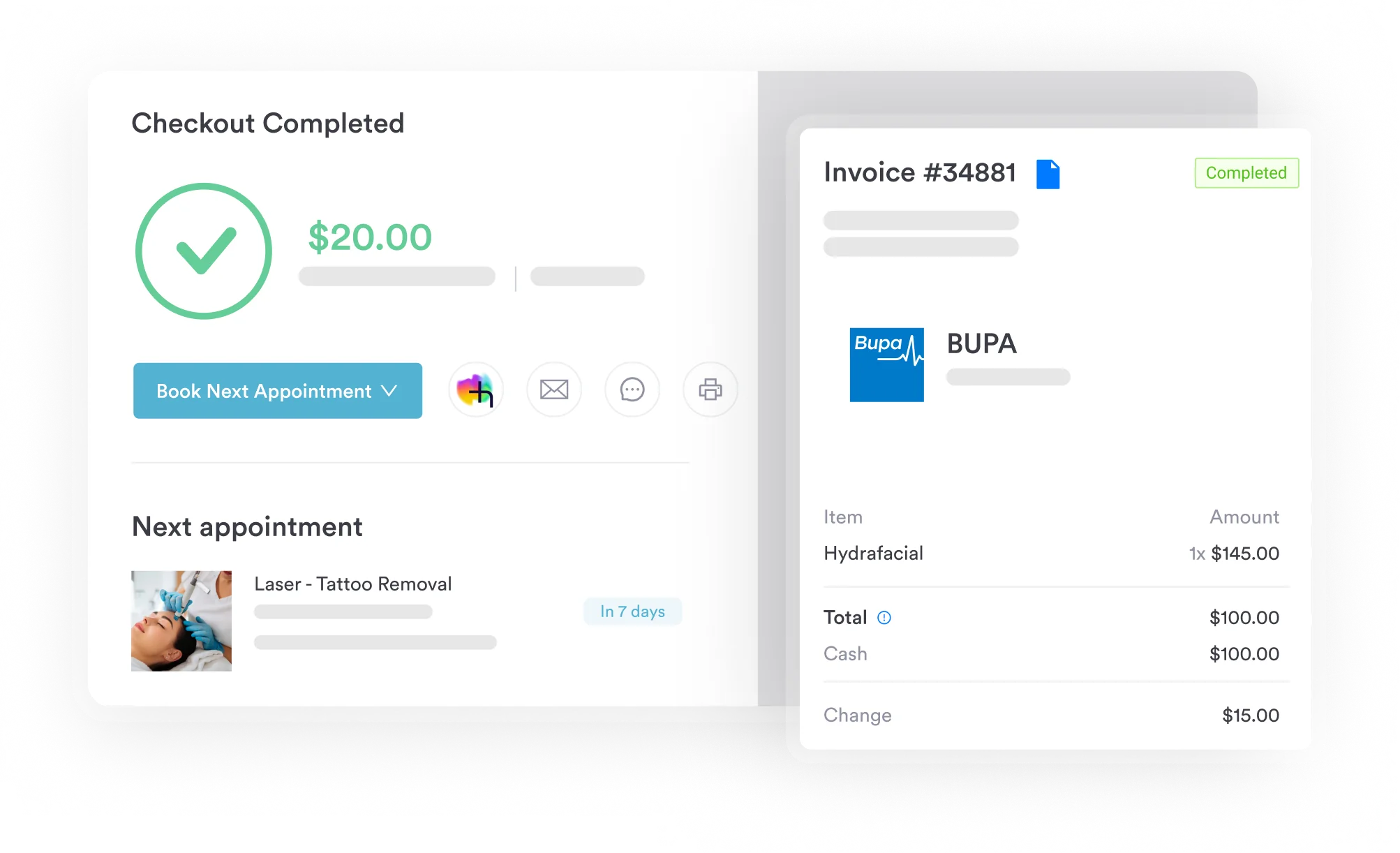
Submitting through a clearinghouse adds a validation layer before the claim reaches the payer. Pabau’s Claim.MD integration runs eligibility checks and scrubs claims for POS mismatches, missing NPIs, and diagnosis format errors. The ERA files that come back map each denial to its original claim line, so 82607 rejection patterns are easy to spot.

Pabau links each lab order to its ICD-10 code at the point of entry. That cuts mismatch denials and speeds up reimbursement for 82607 and other chemistry codes.

CPT 82607 denials are almost always preventable. Most trace to a wrong ICD-10 code, an incorrect place of service, or thin documentation. The fix in each case is to make the ordering note, the requisition, and the claim say the same thing.
The trade-off worth remembering is that the CLFS pays roughly $22 to $28 for this test. A single denial and rework cycle costs more staff time than the claim is worth. That is why the front-end check matters more than the appeal.
Pabau structures the workflow at the point of care. Lab orders then reach the clearinghouse with the right diagnosis code, the right POS, and a complete documentation trail. Book a demo to see how practices cut lab billing denials before the claim goes out.

Want the revenue cycle that sits behind a lab claim? What is revenue cycle management covers how lab billing fits the claim lifecycle from order to payment.
Need the checklist that gets a claim paid first time? Clean claim sets out the fields a payer checks before it adjudicates a lab line.
Working through a stack of 82607 rejections? Denial codes in medical billing decodes the CARC and RARC codes that come back on a lab remittance.
Reading the remittance file your clearinghouse returns? Electronic remittance advice explains how to map each adjustment back to the claim line that caused it.
Building the order-to-claim paperwork in your practice? Superbill shows which fields to capture at the point of order so the claim needs no re-keying.
CPT Code 82607 covers the quantitative serum measurement of Vitamin B12 (Cyanocobalamin). It is classified under Chemistry Procedures in the AMA CPT manual and is used to assess circulating cobalamin levels for diagnostic and monitoring purposes. It does not cover Vitamin B12 injections, which are reported under HCPCS code J3420.
The 2026 Medicare national amount for CPT 82607 is approximately $22 to $28. Medicare prices the code on the Clinical Laboratory Fee Schedule, which pays one flat national rate with no locality adjustment. Confirm the current amount on the CMS Clinical Laboratory Fee Schedule before quoting a figure.
Commonly covered ICD-10-CM diagnoses for CPT 82607 include D51.0 (pernicious anemia), D51.3 (dietary B12 deficiency anemia), and E53.8 (B group vitamin deficiency). G32.0 (subacute combined degeneration), G62.9 (polyneuropathy), and K90.0 (celiac disease) are also commonly supported. Coverage is payer-specific and LCD-specific, so verify against your MAC’s current local coverage determination.
No. CPT 82607 measures total serum Vitamin B12 (cyanocobalamin). CPT 82608 measures the unsaturated B12 binding capacity, a different assay used for absorption disorders and myeloproliferative conditions. They can be co-billed when both are separately medically necessary, but run an NCCI edit check first.
Required documentation starts with a signed provider note naming the clinical indication, whether a symptom, a condition, or a risk factor. The covered ICD-10-CM diagnosis code has to appear on both the lab requisition and the claim. The ordering provider’s NPI and the date of service must match across both. For repeat testing, the note must reference the prior abnormal result that justifies continued monitoring.
CPT 82607 is a laboratory test that measures the level of Vitamin B12 in a patient’s blood. HCPCS code J3420 covers the Vitamin B12 injection (cyanocobalamin injectable) administered as treatment. They are separate billing events, and both can be billed on the same date when a test and an injection occur.