CCSD code H4430: Examination of rectum under anaesthetic
CCSD code H4430 pays for the examination alone CCSD code H4430 is the UK private...

Last Updated: Oct 20, 2026
27279 is the CPT code for unilateral percutaneous or minimally invasive sacroiliac joint arthrodesis with image guidance, including bone graft when obtained. It applies when a transarticular or intra-articular device pierces the lateral or medial cortices of the ilium and the lateral cortex of the sacrum.
Under the 2026 CPT descriptors, CPT 27278 covers the same percutaneous approach with intra-articular devices that stay within the joint without piercing either cortex. Open fusion under direct visualization is CPT 27280. Payers deny 27279 claims when the operative report does not name the device trajectory or the imaging used.
Let Pabau's smart automation suggest the right codes, reduce claim denials, and keep your practice compliant—effortlessly.
Automate repetitive tasks and focus on what matters most—your patients.
Reduce coding errors and ensure compliance with the latest regulations.
Clean claims, fewer denials, and faster reimbursements.
Powerful insights and reporting to help your practice thrive.
HIPAA compliant SOC 2 certified GDPR-compliant Trusted by 4,000+ clinics worldwide

CPT code 27279 reports unilateral percutaneous SI joint fusion with image guidance, where at least one device pierces the ilium and sacrum cortices.
CPT 27278 covers the same percutaneous approach with intra-articular devices that do not pierce the cortices, while CPT 27280 covers open SI joint fusion.
Medicare LCDs cover minimally invasive SI joint fusion only with a transfixing device, so 27279 is covered when criteria are met and 27278 is not.
Practice management software like Pabau helps spine practices track prior authorizations, attach operative notes, and submit clean claims to clearinghouses.
CPT code 27279 describes percutaneous or minimally invasive sacroiliac joint arthrodesis with image guidance, including bone graft when it is obtained.
The 2026 descriptor defines the code as unilateral. It applies when a transarticular or intra-articular device pierces the lateral or medial cortices of the ilium and the lateral cortex of the sacrum. The code is published by the American Medical Association in the musculoskeletal surgery section. Orthopedic surgeons and neurosurgeons use it for SI joint stabilization through a small incision, without direct joint visualization.
The procedure involves inserting one or more implants (typically porous triangular titanium devices) across the sacroiliac joint under fluoroscopic or CT guidance. These implants pass through the cortices of the ilium and sacrum. Because the AMA descriptor explicitly bundles image guidance and bone graft acquisition, separately billing imaging codes or bone graft harvest codes would constitute unbundling.
The code sits in the arthrodesis group (27278-27286) of the Pelvis and Hip Joint subsection of CPT (26990-27299). The 2026 CPT revision rewrote 27278 and 27279 so that the implanted device, rather than the surgical approach, separates them. Open SI joint fusion stays with CPT 27280, which did not change.
CPT 27278 and CPT 27279 are both percutaneous or minimally invasive SI joint fusion codes, and the implanted device decides between them. Use 27278 when intra-articular devices sit within the joint without piercing the cortices of the ilium or sacrum. Use 27279 when a transarticular or intra-articular device pierces the lateral or medial iliac cortex and the lateral sacral cortex. Two questions settle the choice between all three codes.
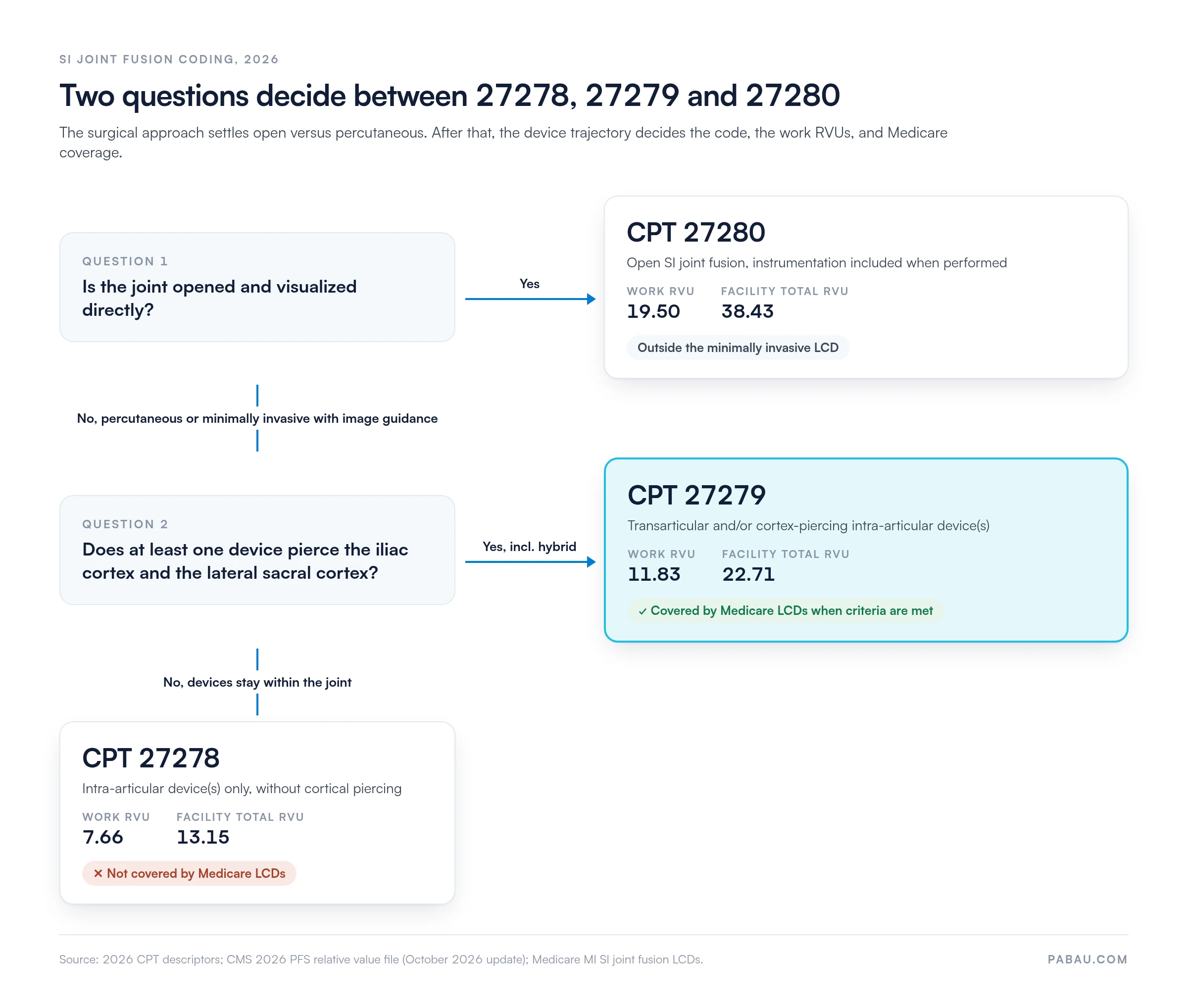
Open fusion is a third code. CPT 27280 covers SI joint arthrodesis through an open approach with direct visualization of the joint, including instrumentation when performed. A hybrid construct that combines intra-articular and transarticular devices is reported with 27279 when at least one device pierces the cortices. Report that construct with 27279 alone, without adding 27278 for the intra-articular component.
Some procedures begin percutaneously and are converted to open (CPT 27280). In those cases, code the procedure the operative note shows was completed, and confirm with a certified orthopedic coder when the note is unclear. Occasionally no existing code precisely fits a novel approach. CPT 27299 (unlisted procedure, pelvis or hip joint) may then apply, submitted with a cover letter.
Payers evaluate medical necessity for CPT code 27279 claims against the paired diagnosis code. The Medicare LCD and major commercial policies accept a defined list of ICD-10-CM codes. A diagnosis outside that list triggers an automatic medical necessity denial. The most commonly accepted codes are listed below.
Sacroiliitis, coded as M46.1, is the pairing most SI joint fusion claims lead with. Framing a claim with an unspecified back pain code (M54.50 or M54.59) when a more specific SI joint diagnosis is available will trigger denial. Always verify the current LCD for your MAC jurisdiction, because accepted diagnosis lists are updated periodically.
Medicare covers CPT code 27279 under a Local Coverage Determination (LCD) issued by each Medicare Administrative Contractor (MAC). The current LCDs share one title, “Minimally Invasive Arthrodesis of the Sacroiliac Joint (SIJ),” and each has a companion billing and coding article. Coverage is not automatic. The LCD lists indications that must be met before a claim is considered medically necessary.
The device rule matters most for code choice. The LCDs cover fusion only when a transfixing device pierces the lateral or medial iliac cortex and the lateral sacral cortex. That is the 27279 trajectory. Fusion without a transfixing device, the 27278 procedure, is not considered reasonable and necessary.
The Palmetto GBA LCD (L39797) also requires the following before surgery:
Wording and effective dates vary by MAC, so check the live LCD for your contractor rather than a saved copy.
Medicare Advantage plans set their own prior authorization rules, separate from traditional Medicare LCDs. A procedure covered under Original Medicare may still need PA from an MA plan. Confirm each plan’s current policy before scheduling.
Run an eligibility verification for every CPT 27279 patient before scheduling. Confirm whether the patient is enrolled in Original Medicare or a Medicare Advantage plan, then pull the applicable LCD or MA plan policy. Documenting this check in the practice management system protects the practice if coverage is later questioned.
Most commercial payers and many Medicare Advantage plans require prior authorization for CPT code 27279 before the procedure is performed. A claim submitted without a required PA usually comes back with CARC CO-197 (precertification, authorization, or notification absent). That denial is rarely reversible on appeal without the authorization itself.
A standard prior auth package for SI joint fusion includes the following elements:
Major commercial payers, including BCBS and Aetna, publish their own medical policies for sacroiliac joint procedures. These list diagnostic criteria and supporting documentation that mirror the Medicare LCD without always matching it. Dedicated claims software for surgeons tracks each authorization’s expiration date and attaches the supporting records before the claim goes out.
A clean claim for CPT code 27279 depends on an operative report that addresses every element of the code descriptor. Missing documentation is the most curable denial cause and the most preventable. The operative report must confirm:
Structured operative note templates catch these omissions before billing ever sees the chart. When approach, imaging modality, device trajectory, and laterality are required fields, the surgeon cannot sign a note that leaves one out.
Modifier selection for CPT 27279 depends on laterality, bilateral procedures, and any increased operative complexity. The 2026 descriptor defines the code as unilateral, so a bilateral fusion needs modifier 50 or payer-specific line reporting. Applying the wrong modifier triggers a denial. So does leaving off a modifier the payer requires.
Bilateral SI joint fusion (modifier 50) requires verification against CCI edits and individual payer policies before billing. Medicare pays bilateral 27279 at 150% under its bilateral surgery indicator. Other payers may apply a flat bilateral reduction or require two line items (27279 RT and 27279 LT). Confirm the payer’s bilateral billing policy before claim submission to avoid a CO-97 denial.
CPT code 27279 carries a 2026 work RVU of 11.83 and a facility total of 22.71 RVUs in the Medicare Physician Fee Schedule. That works out to a national unadjusted payment of about $758.53. Rates then vary by locality through the Geographic Practice Cost Index (GPCI). Use the CMS Physician Fee Schedule lookup tool for your MAC locality rate.
The 11.83 work RVU is the 12.13 value CMS finalized in 2020, less the 2.5% efficiency adjustment CMS applied to most procedures in 2026. For comparison, CPT 27278 carries 7.66 work RVUs and CPT 27280 carries 19.50. All figures come from the CMS 2026 relative value files, October 2026 update.
CPT code 27279 carries a 90-day global surgical period under CMS rules. Most post-operative services in the 90 days after surgery are bundled into the procedure payment. Billing a standard office visit for routine follow-up within the global period without a modifier is a common audit trigger.
Services that can be billed separately within the global period (with the appropriate modifier) include:
Tracking global period windows across a busy surgical practice is where billing errors compound. Your billing system should flag each patient’s 90-day end date. It should also hold any post-op charge that has not had a modifier review.
CPT code 27279 claims draw close scrutiny, because payer medical policies are strict and the documentation requirements are specific. The denial reason code tells you which fix the appeal needs. Our guide to claim adjustment reason codes explains every code a payer can return.
Appeals for CO-50 medical necessity denials do best alongside a peer-to-peer review request. Most payers let the treating surgeon speak directly with the payer’s medical director. Bring the diagnostic block result, the conservative treatment timeline, and the relevant LCD or policy section. Then log the denial reason by payer, so a repeat pattern gets fixed in the operative template instead of appealed claim by claim.
Most spine practices assemble a 27279 claim from several places. The operative note sits in one system, the prior authorization in a payer portal, and the denial history in a spreadsheet. When the note fails to state whether the device pierced the cortices, nobody notices until the payer asks.
Practice management software like Pabau keeps clinical notes, prior authorization tracking, and claims in the same patient record. Custom note templates can make approach, imaging, device trajectory, and laterality required fields before the claim is built. Claims then go out through the Claim.MD integration, and each denial reason is tracked by code and payer.
The result is fewer claims returned for missing documentation and a shorter route from surgery date to payment.

Pabau connects your clinical documentation, prior authorization tracking, and electronic claim submission in one place. Practices billing CPT 27279 use Pabau to reduce claim errors, track denial reasons by code, and route corrections through the Claim.MD clearinghouse without switching systems.

With 27279, the device trajectory carries the claim. An operative note that shows a device piercing the iliac and sacral cortices lines up the code, the RVUs, and Medicare coverage. A note that stays silent on trajectory leaves the claim open to a medical necessity denial, however well the surgery went.
So build the claim before the surgery date. Confirm the LCD criteria, secure the authorization, and make trajectory a required field in the operative template. Book a demo to see how Pabau keeps prior authorizations, operative notes, and SI joint fusion claims in one patient record.

Billing the diagnostic block that qualifies the patient? CPT code 27096 covers the image-guided SI joint injection behind the 75% relief threshold.
Need a framework for tracking claim denials by code and payer? Denial management in healthcare covers systematic approaches to identifying, appealing, and preventing recurring claim rejections across your billing team.
Want to understand how electronic claim submission works end to end? 837 file submission explains the EDI transaction format, how clearinghouses validate claims before payer submission, and what generates a rejection vs. a denial.
Preparing your first superbill for SI joint fusion cases? Superbill preparation walks through every line item a surgical practice needs to capture to support clean claim submission for high-complexity orthopedic procedures.
CPT code 27279 covers unilateral percutaneous or minimally invasive sacroiliac joint fusion with image guidance, including bone graft when obtained. At least one transarticular or intra-articular device must pierce the cortices of the ilium and sacrum. Intra-articular devices that do not pierce the cortices are CPT 27278, and open fusion is CPT 27280. Image guidance is bundled, so imaging codes are not billed separately.
Both are percutaneous or minimally invasive SI joint fusion codes, and the implanted device decides between them. CPT 27278 covers intra-articular devices that stay within the joint without piercing the cortices of the ilium or sacrum. CPT 27279 covers transarticular or intra-articular devices that pierce those cortices, including hybrid constructs. Open fusion under direct visualization is a separate code, CPT 27280.
Yes, bone graft acquisition is explicitly bundled into CPT 27279 when performed. Billing a bone graft harvest code (such as CPT 20937 or 20938) alongside 27279 is unbundling. It will result in a CO-97 denial or a potential audit flag.
Modifier RT or LT identifies laterality for unilateral procedures. Modifier 50 applies to bilateral SI joint fusion performed in the same session, and Medicare pays it at 150%. Verify bilateral coverage against CCI edits and payer policy before billing. Modifier 22 supports increased procedural complexity, and modifier 59 identifies distinct services such as separately billed IONM.
Yes, Medicare covers CPT 27279 under the minimally invasive SI joint fusion LCD issued by each Medicare Administrative Contractor. The LCD requires a transfixing device, failed conservative care, at least 75% relief from a diagnostic block, and imaging that excludes other causes. Medicare Advantage plans may add their own prior authorization requirements.
CPT 27279 carries a 90-day global surgical period. Routine post-operative visits within 90 days of the procedure date are bundled into the surgical payment. Unrelated E/M services, treatment of complications, and staged procedures may be separately billed with the appropriate modifier (24, 78, or 58 respectively).
The 2026 national unadjusted Medicare payment for CPT 27279 in a facility setting is about $758.53. That figure comes from 22.71 total RVUs, including a work RVU of 11.83. Local rates vary with the geographic adjustment, so check the CMS Physician Fee Schedule lookup tool for your locality.