CPT Code 31653: EBUS With 3+ Mediastinal Stations
CPT code 31653: Official descriptor and clinical scope CPT code 31653 is the pro...

Last Updated: Oct 20, 2026
92340 is the CPT code for fitting of spectacles, except for aphakia, monofocal. It covers the professional fitting of single-vision glasses, including measurements, frame adjustment, and patient instruction. Frames and lenses are billed separately with HCPCS V-codes.
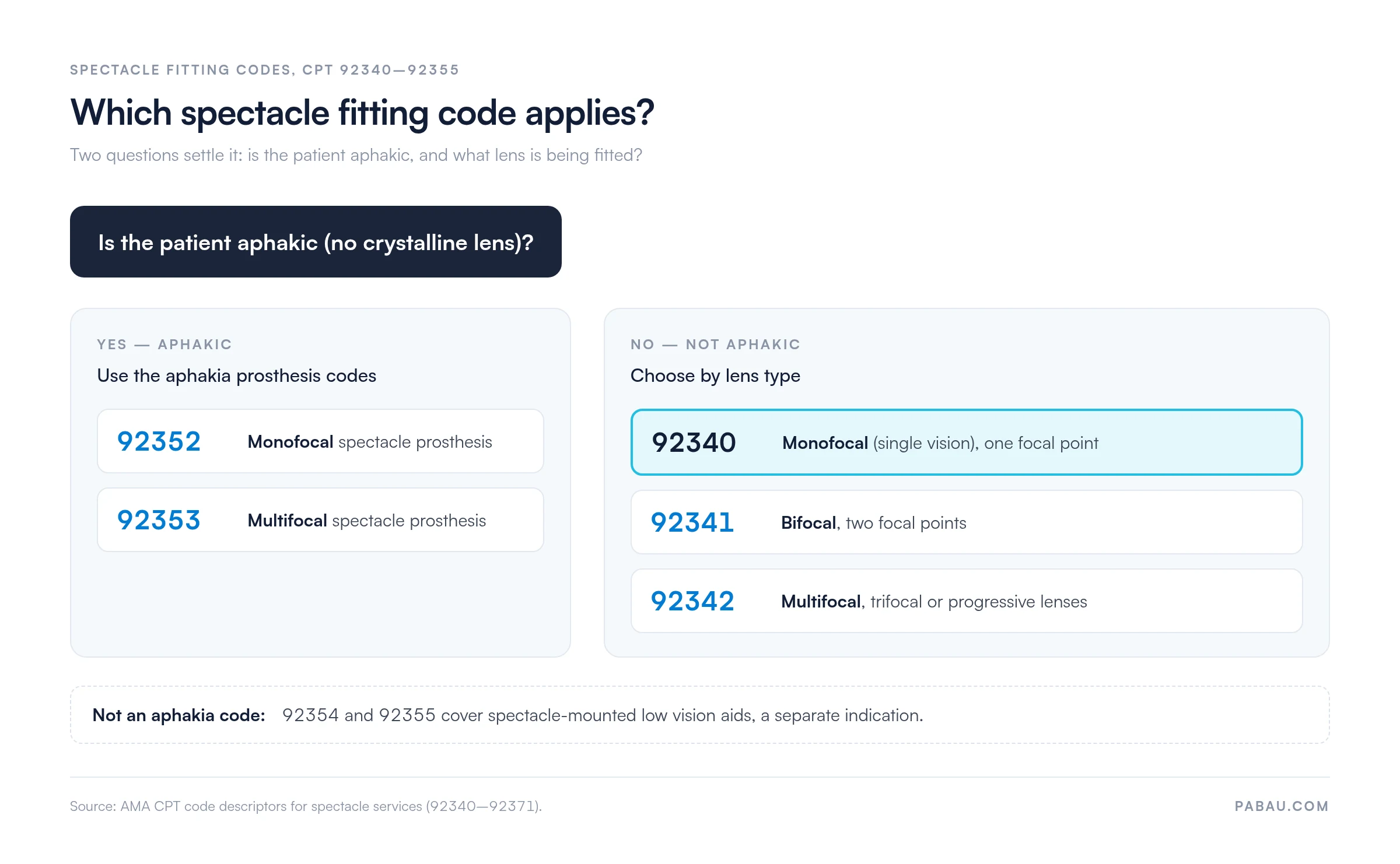
The code sits in the spectacle services family alongside 92341 for bifocal and 92342 for multifocal fittings. Aphakic patients are fitted under 92352 or 92353 instead, while 92354 and 92355 cover spectacle-mounted low vision aids.
Let Pabau's smart automation suggest the right codes, reduce claim denials, and keep your practice compliant—effortlessly.
Automate repetitive tasks and focus on what matters most—your patients.
Reduce coding errors and ensure compliance with the latest regulations.
Clean claims, fewer denials, and faster reimbursements.
Powerful insights and reporting to help your practice thrive.
HIPAA compliant SOC 2 certified GDPR-compliant Trusted by 4,000+ clinics worldwide

CPT code 92340 covers monofocal spectacle fitting for non-aphakic patients only, and aphakic patients are billed with 92352 or 92353.
The code pays for the professional fitting, while frames (V2020) and lenses (V2100-series HCPCS codes) go on the claim as separate supply lines.
The linked diagnosis should be an H52 refractive error, since an aphakia diagnosis on a 92340 claim points to the wrong fitting code.
Medicare Part B excludes routine spectacle fitting, so coverage depends on the patient’s Medicare Advantage, Medicaid, or commercial vision plan.
Practice management software like Pabau checks eligibility and submits 92340 claims electronically, so fewer optical claims come back denied.
CPT code 92340 covers the professional fitting of monofocal spectacles for patients who are not aphakic.
It sits in the spectacle services family of the CPT code set, published by the American Medical Association (AMA). The official descriptor reads: Fitting of spectacles, except for aphakia, monofocal.
Three conditions make the code correct. The patient needs single-vision correction with one focal point. They must not have aphakia, the absence of the crystalline lens that typically follows cataract removal. And the provider must measure, adjust, and instruct the patient, because prescribing lenses alone is not a fitting.
Knowing what the fitting bundles prevents both undercoding and duplicate billing. CPT 92340 pays for the professional fitting encounter, and the supplies and exams around it are billed on their own lines.
The spectacle fitting codes split on two facts, lens complexity and aphakic status. A code that doesn’t match the lens in the record is a frequent audit trigger in optical billing. Use the AAPC CPT code reference to verify descriptors for each code before submitting claims.
Key rule: if the patient has had cataract surgery and remains aphakic, 92340 is incorrect regardless of lens type. The aphakia codes 92352 and 92353 exist for that scenario. Codes 92354 and 92355 look like neighbors but cover spectacle-mounted low vision aids, a different indication. The decision path below shows how the two questions settle the code.
CPT 92340 covers the professional fitting service only. The physical frames and lenses are supply items billed under separate HCPCS Level II V-codes. Assuming 92340 covers both leaves revenue on the table and leaves the claim out of step with the dispensing record.
Payer bundling rules vary. Some Medicaid plans bundle V2020 and the lens codes with the fitting. Commercial vision plans typically pay for supplies separately, on their own fee schedule. Always verify the plan’s optical benefit before separating claims.
Before submitting any 92340 claim with V-codes, pull the patient’s vision benefit summary. Many commercial plans cap frame allowances at a fixed dollar amount annually and require the specific V-code range that matches the dispensed lens power. Using a generic V2100 when a higher-power V2112 applies can generate a partial denial on the supply portion even when the fitting code pays cleanly.
Payers reviewing 92340 claims look for five documentation elements. Missing any one of them can trigger a medical necessity denial or a request for records.
Build these five fields into the optical intake template, and staff record them during the visit instead of reconstructing them for an auditor months later.
The diagnosis linked to a 92340 claim must reflect a refractive condition, not aphakia or lens pathology. The H52 category, disorders of refraction and accommodation, holds the diagnoses that support monofocal spectacle fitting. Myopia of the right eye, for example, is coded H52.11.
Critical exclusion: aphakia codes (H27.0x) must never be the primary diagnosis on a 92340 claim. An aphakia diagnosis means 92352 or 92353 is the correct fitting code. A 92340 claim carrying one will likely deny as a code-diagnosis mismatch.
The fitting code itself rarely needs a modifier. Payer-specific rules and same-day services are the exceptions. A wrong or missing modifier is a common denial driver, so check each payer’s modifier policy when it changes.
Medicare generally excludes routine spectacle fitting and eyeglass supply from Part B coverage under the statutory vision exclusion in the Social Security Act. CPT code 92340 will therefore deny as non-covered for most Medicare beneficiaries billed for standard refractive correction. Checking the patient’s vision benefit before the fitting tells the front desk whether to collect payment up front.
Post-surgical exceptions exist but apply to the aphakic codes, not 92340. A patient who had cataract surgery and remains aphakic may qualify for Medicare-covered spectacle or contact lens fitting. The correct spectacle code is then 92352 or 92353, not 92340. Using 92340 in this scenario produces a code-diagnosis mismatch denial in addition to the coverage question.
That coverage path can also run through contact lenses rather than spectacles. A corneoscleral or scleral lens fitting is billed under CPT 92313, not a spectacle fitting code.
When coverage is uncertain, a clearinghouse with real-time eligibility checks can return benefit details before the patient leaves the dispensing area.
CPT code 92340 carries a relatively low relative value unit (RVU) weighting compared with diagnostic ophthalmology codes. That reflects a fitting service with no diagnostic interpretation involved. The 2026 Medicare Physician Fee Schedule rate varies by locality, through GPCI adjustments, and by facility or non-facility setting. For your MAC jurisdiction, query code 92340 in the CMS Physician Fee Schedule lookup tool.
For RVU-based calculations and reimbursement modeling, the FastRVU 2026 RVU lookup tool breaks out the work, practice expense, and malpractice RVU components from CMS data. Optical practices billing 92340 with V-codes should model the fitting and the supplies together. The total changes considerably when the optical benefit pays for frames and lenses separately.
Remittance advice across a run of 92340 claims also shows whether a payer is folding the fitting into the supply codes. That often breaks the plan’s own terms.
Most 92340 denials fall into six patterns, and each has a specific corrective action. Upfront eligibility checks and a coding review prevent most of them. Sorting denials by their CARC and RARC reason codes shows which pattern sits behind each one.
Tracking 92340 denials by payer across a rolling 90-day period shows whether a problem is practice-wide or payer-specific. Knowing the common medical billing denial codes helps billers route each appeal to the right team. CARC 97 means the benefit is included in the payment for another service already adjudicated, which usually points to a bundling edit. CARC 4 means the procedure code is inconsistent with the modifier used, or a required modifier is missing. Claims management software that groups denials by CPT code gives practice managers that picture before denials become write-offs.
Yes. CPT 92340 can generally be billed on the same date as refraction (92015) or an ophthalmology E&M code (92012 or 92014). Each service must be distinct, separately documented, and medically necessary on its own. Same-day billing is a common source of bundling denials, and the rules differ by payer.
92340 with refraction (92015): Refraction is a separate evaluation of optical power requirements; spectacle fitting is the physical dispensing service that follows it. When both occur on the same date, most payers permit separate billing if the refraction is documented as a distinct service. Some payers still bundle them, so check the plan’s coverage policy before billing both codes.
92340 with E&M (92012/92014): An ophthalmologist performing a complete eye exam (92014) and then fitting spectacles on the same visit may bill both. Modifier -25 must be appended to the E&M code to signal that a significant, separately identifiable evaluation preceded the fitting. Without modifier -25, many payers will deny the E&M as bundled. Submitting both on one 837P electronic claim, each on its own line, also cuts technical rejections.
When billing 92340 alongside 92014 or 92015, the clinical note must show that two distinct services occurred. A single paragraph describing the exam and the fitting as one continuous activity will not support separate billing. Write the fitting note as a separate entry in the encounter record, with its own time stamp, fitting measurements, and patient instruction confirmation.
An optical visit often ends with three kinds of line on one claim: the fitting, the frame, and the lenses. In many practices those codes are keyed in by hand after the patient leaves. Errors then surface weeks later on the remittance.
Practice management software like Pabau moves that work to the visit itself. Its claims management connects to Claim.MD, so eligibility is checked in real time before the fitting. The 92340 line and its V-codes then go out as one electronic encounter batch.
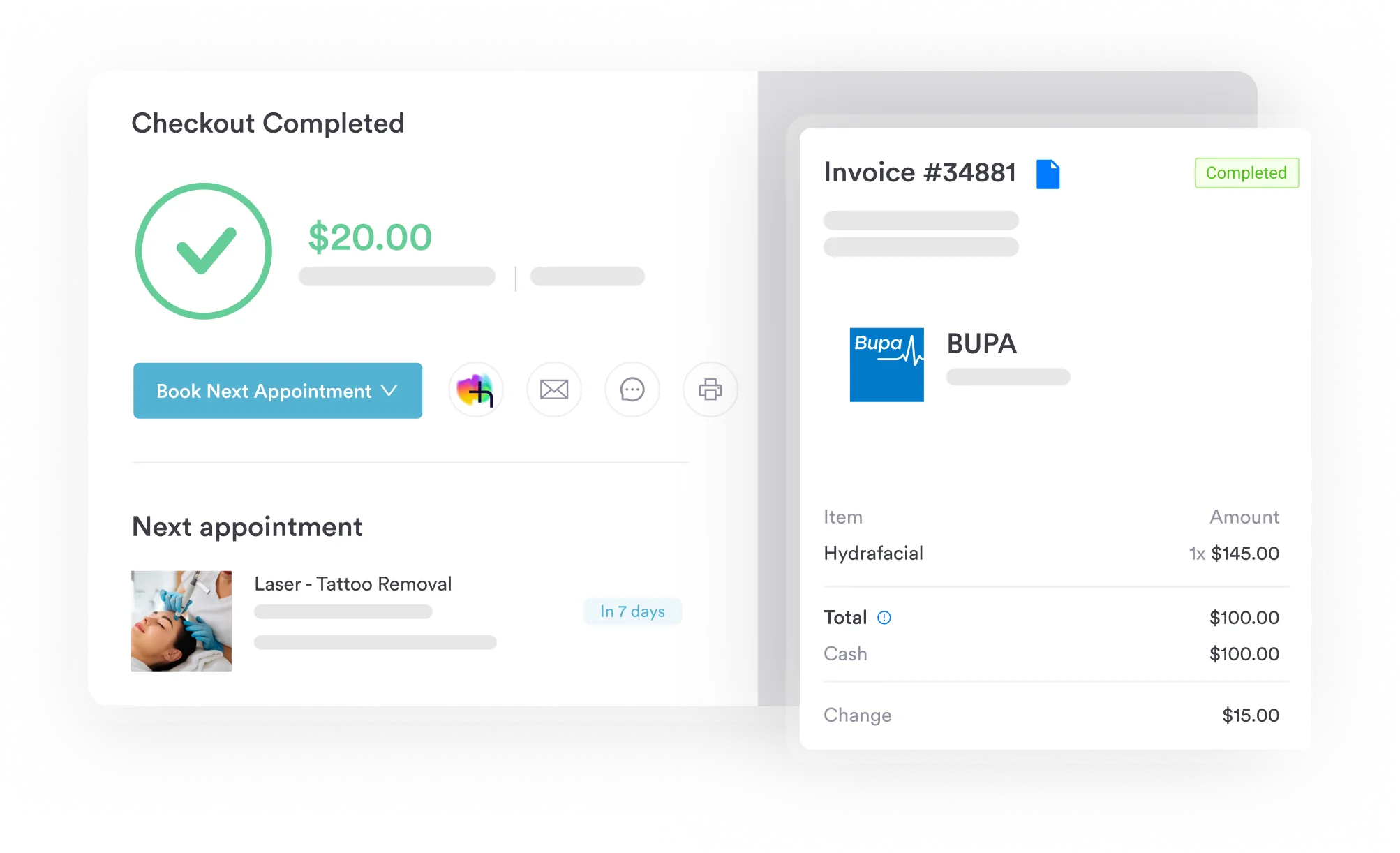
When the payer responds, 835 remittance files come back into the same system and reconcile against the claim. Your billing team sees which payer bundled the fitting or rejected a lens code, without opening a separate portal.

Pabau’s claims management connects to Claim.MD for electronic claims, real-time eligibility checks, and automated remittance reconciliation. Your spectacle fitting claims leave the practice clean.

Before 92340 goes on a claim, answer two questions from the record: is the patient aphakic, and is the lens single vision? If either answer is unclear, the claim isn’t ready, however clean the rest of it looks.
The trade-off is a minute of checking at the dispensing desk against weeks of rework on a denial. Practices that capture lens type, fitting measurements, and the H52 diagnosis during the visit rarely see this code come back.
If your optical claims still get assembled after the patient has gone, that is the step to change first. Book a demo to see how Pabau checks eligibility and submits 92340 with its V-codes in one pass.

Need a complete denial resolution framework? Denial management in healthcare covers root-cause analysis and appeal workflows for common claim rejection patterns.
Want to understand clearinghouse options for optical billing? Claim.MD pricing and features explains how the clearinghouse connects to practice management systems for optical and ophthalmology claims.
Checking vision benefits before the fitting? Insurance eligibility verification walks through what to confirm with the payer before the patient reaches the dispensing desk.
Reconciling optical claims after payment? Electronic remittance advice explains how to read 835 files and spot a payer bundling codes it shouldn’t.
Want to see where coding fits in the wider billing cycle? Revenue cycle management for medical practices covers the end-to-end billing workflow, from eligibility to final payment.
CPT code 92340 covers the professional fitting of monofocal (single-vision) spectacles for non-aphakic patients. That includes pupillary distance measurement, frame adjustment, patient instruction, and verification against the prescription. The frame and lenses are billed separately with HCPCS V-codes, and refraction is billed as CPT 92015.
CPT 92340 is for monofocal lenses, 92341 for bifocal lenses, and 92342 for multifocal lenses with three or more segments. All three apply to non-aphakic patients only. A code that doesn’t match the lens in the record is a frequent reason for audit requests.
Medicare Part B generally excludes routine spectacle fitting under the statutory vision exclusion, so 92340 is usually non-covered. Medicare Advantage plans with vision riders may cover it. Verify each plan’s Evidence of Coverage individually.
Modifier -52 applies to a reduced fitting, for example when the patient supplied their own frames. Modifier -25 goes on the same-day E&M code, not on 92340 itself. Modifier -50 (bilateral) is not appropriate, because spectacle fitting is inherently bilateral.
V2020 is the HCPCS supply code for purchased frames, billed per pair alongside CPT 92340. Lenses are billed with the V21xx code that matches the lens power dispensed. Bill supply codes separately unless the payer’s plan bundles them.
The six most common patterns are a non-covered benefit, a code-diagnosis mismatch, and the wrong code for the lens type. The other three are same-day bundling without modifier -25, an exceeded frequency limit, and missing fitting measurements. Each has a specific corrective action in the denial table above.