CCSD Code H5230: Haemorrhoid sclerosing injection
CCSD Code H5230: definition and clinical scope CCSD Code H5230 is the Clinical C...

Last Updated: Oct 21, 2026
99354 was the CPT code for the first hour of prolonged service with direct patient contact in the office or outpatient setting. The AMA deleted it effective January 1, 2023, along with 99355, 99356, and 99357.
Prolonged office and outpatient time is now reported with +99417, in 15-minute units. Prolonged inpatient, observation, and nursing facility time goes to +99418. Medicare accepts neither and uses G2212, G0316, G0317, or G0318 instead. Claims submitted with 99354 for a 2023 or later date of service are rejected.
Let Pabau's smart automation suggest the right codes, reduce claim denials, and keep your practice compliant—effortlessly.
Automate repetitive tasks and focus on what matters most—your patients.
Reduce coding errors and ensure compliance with the latest regulations.
Clean claims, fewer denials, and faster reimbursements.
Powerful insights and reporting to help your practice thrive.
HIPAA compliant SOC 2 certified GDPR-compliant Trusted by 4,000+ clinics worldwide

CPT code 99354 was deleted on January 1, 2023, along with 99355, 99356, and 99357. No payer accepts it for a current date of service.
Prolonged office and outpatient time is now reported with +99417, and prolonged inpatient, observation, or nursing facility time with +99418.
Both replacement codes count in 15-minute units and attach only to the highest-level visit selected by total time.
Medicare accepts neither CPT add-on and uses its own HCPCS codes instead: G2212, G0316, G0317, and G0318.
A 2023 or later claim that still carries 99354 is rejected as a deleted code, so correct the code and resubmit rather than appeal.
No. CPT code 99354 was deleted on January 1, 2023, and no payer accepts it for a 2023 or later date of service. That covers Medicare, Medicaid, Medicare Advantage, and commercial plans alike.
The AMA retired the whole family of prolonged service codes with direct patient contact at the same time. That meant 99354 and 99355 in the office and outpatient setting, and 99356 and 99357 in the inpatient setting. Two add-on codes took over. +99417 reports prolonged office or outpatient time, and +99418 reports prolonged inpatient, observation, or nursing facility time.
The AAFP 2023 CPT coding and Medicare payment update and the AAPC guidance on prolonged care coding both document the deletion. The American Medical Association (AMA) maintains the CPT code set and publishes each year’s deletions.
99354 was an add-on code for the first hour of prolonged service with direct patient contact, beyond the usual time of the primary service. It was reported once the extra time reached 30 minutes, so the first hour covered 30 to 74 minutes beyond the usual time. 99355 then added each further 30 minutes.
The code belonged to the office and outpatient setting only. Prolonged inpatient and observation time went to its sister codes, 99356 and 99357, which also covered nursing facility visits.
Its scope narrowed two years before it disappeared. From January 1, 2021, CPT barred 99354 from office and outpatient visits 99202 through 99215, where 99417 took over. Medicare used HCPCS G2212 for those same visits. For 2021 and 2022, 99354 stayed available for other outpatient services, such as consultations and psychotherapy sessions like 90837.
+99417 replaced 99354 and 99355 for office and outpatient visits. It is reported only with the highest-level visit selected by total time. Each unit needs a full 15 minutes beyond that visit’s minimum time.
Time now counts differently too. 99354 required face-to-face contact, while 99417 counts the total time the clinician spends on the patient that day, with or without the patient present.
CPT also allows +99417 with 99245 for office consultations, 99345 and 99350 for home or residence visits, and 99483 for cognitive assessment and care planning. The time rule is the same in each case.
+99418 is the add-on for prolonged inpatient, observation, and nursing facility time. It pairs with the highest-level time-based codes in those settings: 99223, 99233, 99236, 99255, 99306, and 99310. It never pairs with 99417, which is the separate office and outpatient add-on.
Each unit needs a full 15 minutes beyond the primary code’s minimum time. A 99233 subsequent hospital visit has a 50-minute minimum, so the first +99418 unit is reached at 65 minutes. A 99223 admission has a 75-minute minimum and reaches it at 90 minutes.
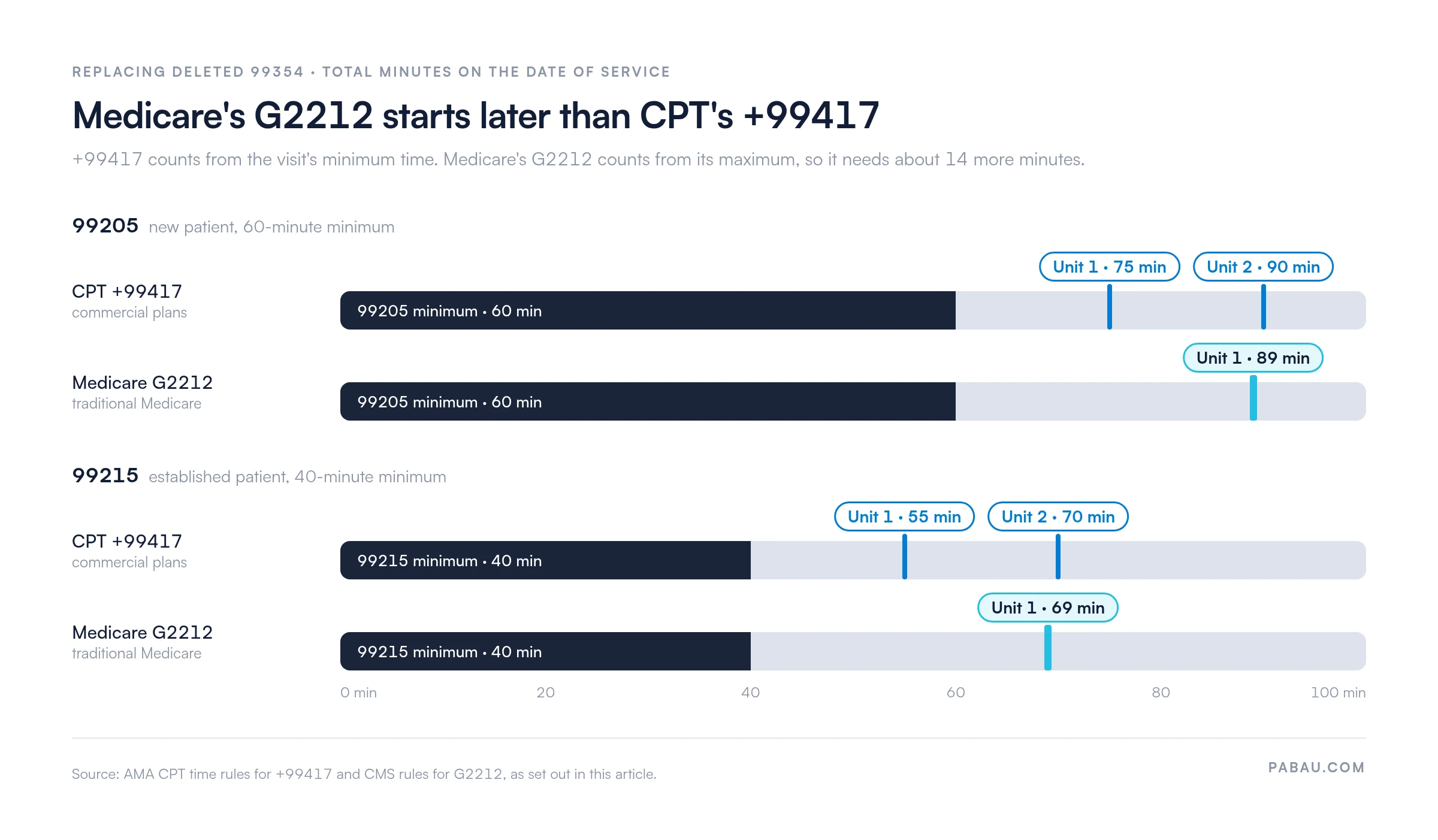
Medicare uses HCPCS G-codes for prolonged services and does not accept 99417 or 99418. CMS also sets a later trigger. It counts 15 minutes beyond the maximum time of the primary visit, rather than its minimum.
For office visits, that means a 99205 supports G2212 at 89 minutes and a 99215 at 69 minutes. Both land 14 minutes after the first +99417 unit for the same visit, as the timeline below shows.
Medicare Advantage plans usually follow the Medicare codes, but confirm with each plan before you bill. The CMS Physician Fee Schedule lists current payment values for each G-code.
The current prolonged service codes are time-based, so the note has to prove the total time on the date of service. Billing compliance reviews often focus on these claims, because the time is easy to overstate and hard to prove later.
Code validity follows the date of service. A corrected or late claim for a 2022 or earlier date follows the rules in force at the time. That includes the 2021 limits on 99354.
A claim for a 2023 or later date that carries 99354 is rejected as a deleted code. Correct the code and resubmit it within the payer’s filing window rather than appealing. Our guide to denial codes explains the rejection codes payers return.
Run a search of your claims history for 99354, 99355, 99356, and 99357 on any date of service from 2023 onward. Each hit is a claim that was rejected or paid in error, and each one points to a template or superbill that still needs updating.
Prolonged service denials usually trace back to the code choice or the time record. A clean-claim check before submission catches most of them.
The prolonged service codes changed twice in three years, and code sets change every January. A practice that bills from memory or an old superbill can keep sending 99354 long after it stopped paying.
Practice management software like Pabau keeps the charge list next to the clinical note. The add-on code sits with the documented time that supports it. Its claims management software sends claims through Claim.MD’s clearinghouse edits before they leave. A deleted code or a Medicare mismatch is flagged before the payer sees it.
The result is fewer rejected claims and less rework each time the code set changes. More prolonged visits get paid on first submission.

Pabau checks claims against clearinghouse edits before submission, so retired codes like 99354 are caught before they cost you a rejection.

CPT code 99354 has been off the code set since January 1, 2023, and the rules that replaced it are stricter about setting and time. Pick the add-on by where the visit happened, and send Medicare its G-code rather than a CPT add-on.
The prolonged visits that get paid are the ones with total time in the note and a code list updated every January. Pabau keeps the documented time beside the add-on code and flags a retired code before the claim goes out. Book a demo to see how it catches deleted prolonged service codes before they reach a payer.

Need to understand how clean claims reduce denials? Clean claim requirements walks through every field that determines whether a claim pays on first submission.
Looking for a guide to the 837 file format? 837 electronic file submission explains the EDI transaction set used to transmit claims to payers and clearinghouses.
Want to reduce denial volume across your entire claims workflow? Denial management in healthcare covers the most effective strategies for tracking, appealing, and preventing recurring claim denials.
Billing the code that replaced 99354? CPT code 99417 walks through the prolonged office and outpatient add-on, unit by unit.
Reporting prolonged time without the patient present? CPT code 99358 covers the prolonged service code for time spent without direct patient contact.
No. CPT code 99354 was deleted on January 1, 2023, and no payer accepts it for a 2023 or later date of service. Report prolonged office or outpatient time with +99417, or use G2212 for Medicare.
+99417 replaced 99354 and 99355 for office and outpatient visits. +99418 replaced 99356 and 99357 for inpatient, observation, and nursing facility visits. Both count in 15-minute units.
No. Medicare stopped accepting 99354 with office visits in 2021, and CPT deleted the code in 2023. Medicare now uses G2212 for office visits, G0316 for hospital visits, G0317 for nursing facilities, and G0318 for home visits.
99417 is the prolonged service add-on for office, outpatient, and home visits. 99418 is the add-on for inpatient, observation, and nursing facility visits. They never pair with each other, and each attaches to the highest-level visit selected by time.
99355 was the add-on for each additional 30 minutes of prolonged service after the first hour reported with 99354. It was deleted on the same date, and further units of +99417 now cover that time.
The payer rejects it as a deleted code. Replace 99354 with +99417, +99418, or the matching Medicare G-code, confirm the time threshold was met, and resubmit within the filing window.