HCPCS code G0245: Initial physician evaluation and management of a diabetic patient
HCPCS code G0245: definition, descriptor, and required exam components HCPCS cod...

Last Updated: Oct 21, 2026
77295 is the CPT code for a 3-dimensional radiotherapy plan, including dose-volume histograms. It covers the computer-generated 3D conformal plan a medical physicist builds from simulation images, including isodose curves and beam arrangements. The radiation oncologist reviews and signs the finished plan.
The code is usually reported once per treatment course. It sits after simulation (CPT 77290) and before treatment delivery, and it can't be reported with IMRT planning (CPT 77301) for the same course.
Let Pabau's smart automation suggest the right codes, reduce claim denials, and keep your practice compliant—effortlessly.
Automate repetitive tasks and focus on what matters most—your patients.
Reduce coding errors and ensure compliance with the latest regulations.
Clean claims, fewer denials, and faster reimbursements.
Powerful insights and reporting to help your practice thrive.
HIPAA compliant SOC 2 certified GDPR-compliant Trusted by 4,000+ clinics worldwide

CPT code 77295 covers 3D conformal radiotherapy planning with dose-volume histograms, not simulation or treatment delivery.
CPT 77295 and 77301 (IMRT planning) are mutually exclusive for the same treatment course, and billing both triggers NCCI edits.
The plan needs isodose curves, beam parameters and a physician signature. A missing signature is the top cause of 77295 denials.
Practice management software like Pabau submits and tracks 77295 claims through Claim.MD, with eligibility checks and denial tracking.
CPT code 77295 is the American Medical Association code for a 3-dimensional radiotherapy plan, including dose-volume histograms. It covers the computer-generated 3D plan built from simulation images. The plan includes isodose curves in multiple planes and a beam arrangement optimized across at least two fields. A medical physicist reviews and attests to the plan, and the radiation oncologist signs off on it.
The code belongs to the Medical Radiation Physics, Dosimetry, Treatment Devices, and Special Services subsection of the CPT codebook. That placement matters for claims. A payer that treats it as a physician evaluation code applies the wrong medical necessity rules and denies it on those grounds. Confirming the service category on the claim prevents that mismatch.
3D conformal radiation treatment planning with CPT code 77295 sits at a specific point in the care sequence: after simulation and before treatment delivery. Billing it out of sequence is one of the most common audit flags radiation oncology practices face. The delivery that follows the plan is reported per fraction, and single-isocenter photon sessions fall under CPT 77407.
The clinical workflow runs in this order. Understanding it helps coders verify that every service is separately reportable:
Steps 1 and 3 are the source of most unbundling confusion. CPT 77290 (simulation) and CPT 77295 (planning) are separate services performed on separate dates by different personnel. Billing them on the same date of service for the same patient requires clear documentation of each distinct service. The flow below shows which steps carry a code of their own.
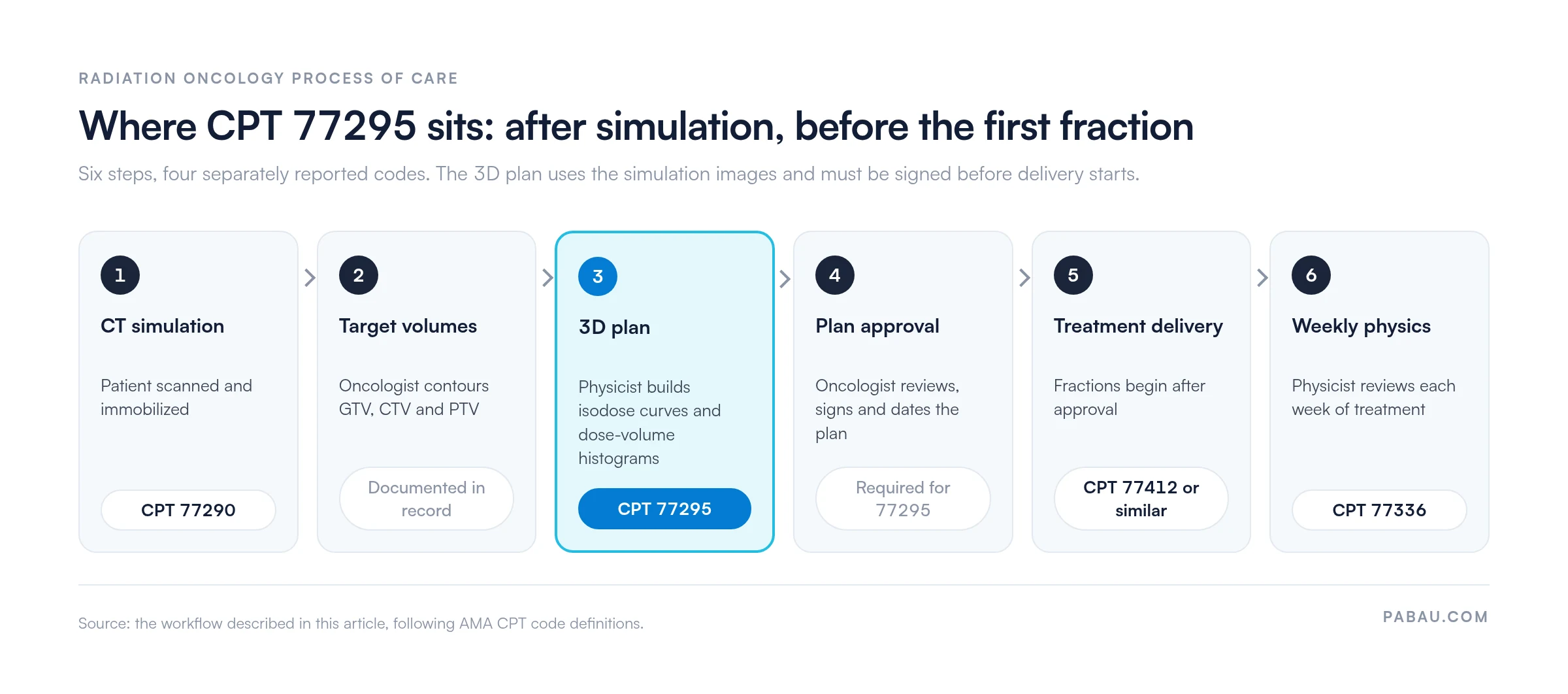
Dosimetry work adds another code to the sequence. Basic dosimetry calculations prescribed by the treating physician during the course carry their own code, 77300.
Both the radiation oncologist and the qualified medical physicist (QMP) are involved in delivering 77295. Who bills depends on the practice structure and which component of the service is being reported.
Under CMS rules, the medical physicist must meet the QMP definition in Chapter 15 of the Medicare Benefit Policy Manual. A physicist who does not meet QMP criteria cannot support a billable professional component claim. Verify QMP status before billing modifier 26 on any physics-intensive service.
Medicare reimbursement for CPT code 77295 varies by component billed, geographic locality, and annual CMS updates. Check the current rate in the CMS Physician Fee Schedule lookup tool before quoting it to patients or payers. The table below shows how each component is reported.
Geographic practice cost indices (GPCIs) adjust national rates by locality. A practice in a high-cost metro area will receive a higher Medicare payment than the national average for the same code. Commercial payers typically negotiate rates as a percentage of the Medicare fee schedule. That makes the Medicare baseline useful even when most of your payers are commercial.
Run an eligibility check before scheduling the planning session. Medicare Advantage plans often pay plan-specific rates for 77295 that differ from traditional Medicare. Confirming coverage upfront keeps treatment from stalling on a missing authorization.
Missing documentation is the single largest source of 77295 denials. The medical record must contain all of the following for the claim to survive audit or appeal. Coders should verify each element against the chart before submitting.
If your practice uses claims management software, add a pre-submission documentation checklist for 77295. It holds back unsigned plans before they turn into denials and rework.

Modifier selection for 77295 depends on who owns the equipment and how the service is structured. Incorrect modifier use is one of the top reasons claims are returned as unprocessable rather than denied outright.
The NCCI (National Correct Coding Initiative) tables govern whether 77295 and other radiation oncology codes can be billed together on the same claim line. Check current NCCI edits for any code pair before submission. These tables update quarterly, so a combination that was billable last quarter may carry a bundling edit now.
Traditional Medicare does not require prior authorization for CPT code 77295, but Medicare Advantage plans and commercial payers set their own rules. Radiation oncology is one of the service categories most actively managed by benefits management organizations.
A patient’s supplemental or secondary plan may require authorization even when traditional Medicare does not. Your insurance eligibility verification step should confirm the primary and any secondary plan’s rules before the planning session is booked. Skipping a commercial payer’s authorization requirement produces a denial that was entirely preventable.
CPT 77290 is a complex radiation therapy simulation code; CPT code 77295 is a 3D treatment planning code. They serve different clinical purposes, are performed at different points in the workflow, and are separately reportable. Even so, the distinction trips up experienced coders.
When 77290 and 77295 are billed on the same date of service, one of the codes needs Modifier 59. It establishes that separate, distinct services were performed. Documentation must show the simulation occurred first and the planning work began the same day as a distinct clinical activity.
Complexity also decides which simulation code applies. A session covering one treatment area with one or two fields and standard positioning falls under CPT 77280.
CPT 77301 is the code for intensity-modulated radiation therapy (IMRT) planning; CPT code 77295 covers 3D conformal planning. The two codes are mutually exclusive for the same treatment course, per NCCI bundling edits and ASTRO coding guidance. Auditors look specifically for cases where both were billed for a single patient episode.
Payers audit for upcoding from 77295 to 77301. If the treatment plan documentation shows fixed-beam conformal geometry, billing 77301 is indefensible. Conversely, if the team performed inverse planning with intensity modulation, billing 77295 would be underbilling. The clinical record must match the code billed. Resources from the AAPC coding guidance help coders confirm the correct code based on documented technique.
Yes. CPT 77295 (3D treatment planning) and CPT 77336 (continuing medical physics consultation) should both be billed when both services are performed. They cover different services at different points in care.
CPT 77336 is a weekly continuing medical physics consultation billed during the active radiation treatment course. It covers the physicist’s ongoing review of treatment parameters, monitor unit verification, and chart review throughout fractionated delivery. CPT 77295, by contrast, is a one-time planning service performed before treatment begins.
AMA parenthetical notes and CMS LCD guidance confirm that 77336 is not bundled into the 77295 planning code. The two are separately reportable, happen at different times, and carry separate RVU values.
The key documentation requirement for 77336 is a physicist note for each week of treatment, kept apart from the planning documentation. Keeping the two sets of notes distinct stops a bundling edit from absorbing the 77336 claim by mistake.
Medicare coverage for CPT code 77295 is governed by local coverage determinations issued by Medicare Administrative Contractors (MACs). The relevant LCD for radiation oncology planning is L34652, plus any successor LCD from your MAC jurisdiction. It defines the clinical scenarios in which 77295 is considered medically necessary.
The core coverage principles common across MACs include:
Check the CMS Medicare Coverage Database for the current LCD and coding article for your MAC jurisdiction. Your billing compliance process should include a review of MAC LCD updates as they are released.
Search the CMS Coverage Database by your MAC contractor name and filter for radiation oncology LCDs annually. LCD coverage criteria for 77295 have shifted over the past several years as 3D planning became standard of care. Outdated criteria in your billing policy documents can cause avoidable denials.
CPT code 77295 denials cluster around a small number of root causes. Most are preventable with front-end documentation checks before the claim is submitted. Our guide to medical billing denial codes explains the remittance advice codes you will see on returned 77295 claims.
Each returned claim carries a claim adjustment reason code (CARC) on its remittance advice. Log those codes against the six root causes above. Within a few months you will see which step in your 77295 workflow produces the most denials.
Most 77295 denials are decided before the claim is sent. The plan goes out unsigned, the modifier doesn’t match who owns the planning system, or nobody requested the Medicare Advantage authorization. Billing teams often find out only when the remittance comes back.
Practice management software like Pabau keeps the patient record, eligibility checks and claims in one system. US claims are submitted and tracked through Claim.MD, so your team can confirm coverage before the planning session and follow each claim through to payment.
Denied claims are tracked in the same place. Your coders still choose the codes and check NCCI pairs themselves. They just spend far less time working out where a 77295 claim stalled and why.

Submit and track CPT 77295 claims through Claim.MD, with eligibility checks and denial tracking beside the patient record. See how it fits your radiation oncology practice.

The cheapest 77295 denial to fix is the one that never leaves the practice. Hold every 3D planning claim until the signed plan, the physicist attestation and any authorization number are in the chart.
Treat 77301 as a hard stop on the same treatment course, and choose the modifier from who owns the planning system. Those two decisions settle whether the claim pays first time or turns into an appeal.
Book a demo to see how Pabau keeps eligibility checks, claim submission and denial tracking together for your radiation oncology team.

Billing the treatment that follows the plan? CPT 77412 covers level 3 radiation treatment delivery and what it needs on the claim.
Coding the devices built from the 3D plan? CPT 77334 explains complex treatment device billing and its documentation.
Checking coverage before the planning session? Insurance eligibility verification walks through what to confirm with each payer before the visit.
Want fewer claims coming back? What makes a clean claim breaks down the fields payers check before they pay.
Need to understand how clearinghouse submission works? Medical claims clearinghouse overview explains how 837P claims reach payers and where edits are applied.
CPT code 77295 covers 3-dimensional radiotherapy treatment planning, including computer-generated dose-volume histograms, isodose curves in multiple planes, beam arrangement optimization, and medical physicist attestation. It does not cover simulation (CPT 77290), treatment delivery, or ongoing physics consultations (CPT 77336).
CPT 77290 is a complex radiation therapy simulation code covering patient positioning and imaging acquisition. CPT 77295 is the 3D treatment planning code that uses the simulation data to generate the dosimetric plan. They are separate, sequential services and can both be billed when performed on different dates.
Traditional Medicare does not require prior authorization for CPT 77295, but Medicare Advantage plans and most commercial payers do. Many commercial plans route radiation oncology services through eviCore or RadMD, which require clinical documentation before issuing authorization.
Yes. CPT 77295 (3D planning) and CPT 77336 (continuing medical physics consultation) are separately reportable services. CPT 77336 is billed weekly during active treatment delivery and is not bundled into the one-time planning service represented by 77295.