



CCSD code G5100: Bypass of duodenum billing guide
CCSD code G5100 bills a bypass that leaves the duodenum in place CCSD code G5100...

Last Updated: Oct 16, 2026
CPT Code 77334 covers the design and construction of a complex treatment device in radiation oncology. Custom shielding blocks, tissue compensators, custom-fabricated bolus, and patient-specific immobilization systems are the devices that qualify. The charge follows each device or port constructed, so one course of treatment can carry several 77334 charges. Payers expect the record to show why the complex tier applies instead of the intermediate one.
This reference covers the official descriptor, the complexity criteria, and how 77334 differs from 77333 and 77332. It also covers 2025 Medicare rates, modifiers, ICD-10 pairings, documentation requirements, and the errors behind most denials.

CPT Code 77334 covers treatment device design and construction at the complex tier, within the CPT Radiation Oncology section.
Qualifying complex devices include custom shielding blocks, compensators, tissue-equivalent bolus, and immobilization systems built from individualized planning.
The code is billed per device or port constructed, so one course of treatment can carry several charges.
Modifiers TC and 26 split the technical and professional components, and misapplying them is a leading cause of denials.
Pabau’s claims management software validates 77334 claims before submission and tracks which denial reasons keep repeating.
CPT Code 77334 describes treatment devices, design and construction; complex. It applies when a radiation oncology team designs and constructs a patient-specific device that meets the complexity criteria. Those criteria come from the American Society for Radiation Oncology (ASTRO), whose coding FAQ is the clinical authority for this code family.
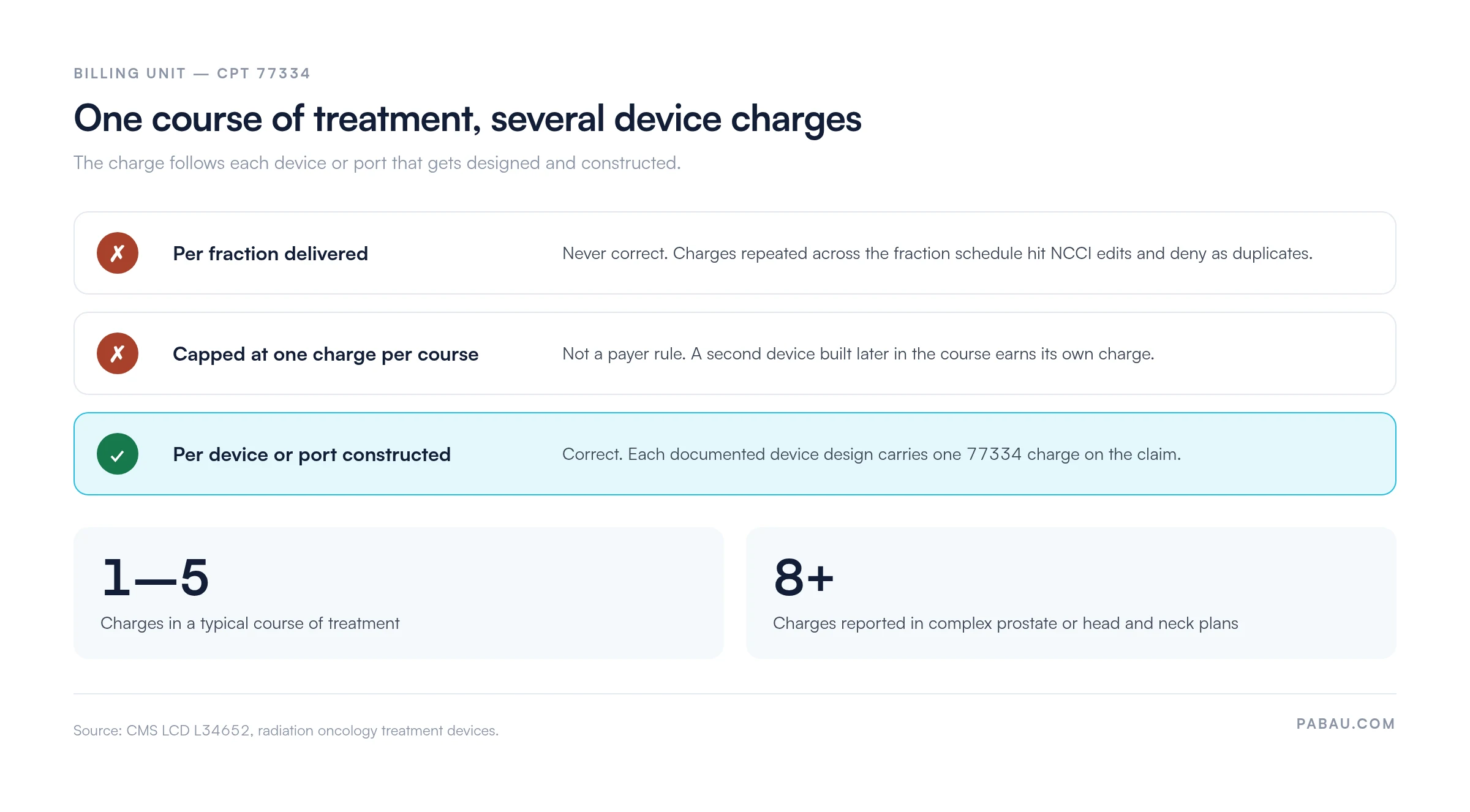
The code sits in the Radiation Oncology section of CPT, under Medical Radiation Physics, Dosimetry, Treatment Devices, and Special Services. The AMA’s CPT code set groups it there with the dosimetry and special services codes. Each device or port constructed is reported separately, so one course of treatment can carry more than one 77334 charge. CMS LCD L34652 treats one to five charges per course as typical, with eight or more in complex prostate or head and neck plans. The code is never billed per fraction delivered, and auditors flag that pattern consistently.
The chart below sets the three candidate billing units against each other, so the correct one is easy to hold on to.
Payers apply specific criteria when deciding whether a device meets the complex threshold. ASTRO and CMS LCD L34652 both describe the boundary between intermediate (CPT 77333) and complex (CPT 77334). That line comes down to the degree of customization and planning effort required.
The device categories that consistently qualify as complex are listed below. Multi-leaf collimator configurations may qualify depending on the degree of field shaping involved. Verify those against current ASTRO guidance and your MAC’s LCD before billing.
The three treatment device codes form a complexity ladder, and selecting the wrong tier is the main compliance risk in this family. According to AAPC’s CPT coding reference, 77332 covers simple devices, 77333 covers intermediate, and CPT Code 77334 covers complex. The practical distinction between intermediate and complex trips up even experienced radiation oncology coders.
Decision rule: CPT Code 77334 is the appropriate code when the device required three things. Those are a dedicated physics planning session, individualized fabrication from CT simulation data, and dosimetric verification. If any of those three steps is missing, evaluate whether 77333 or 77332 applies instead.
The dose calculations behind a custom block or compensator carry their own code, 77300. It is reported per calculation, which keeps that work separate from the device charge.
Medicare reimbursement for CPT Code 77334 varies by place of service. Facility rates apply when the service is performed at a hospital outpatient department or an independent radiation oncology center. Non-facility rates apply in physician-owned settings. Always verify current-year figures against the CMS Physician Fee Schedule Look-Up Tool, as rates update on January 1 each year.
The rates below reflect the 2025 Medicare Physician Fee Schedule. Confirm the work, practice expense, and malpractice RVU components for your own locality before you bill. Geographic adjustment moves the total between localities, so a national average is only a starting point.
Important: These figures are approximate national averages derived from CMS MPFS data and should be verified annually. Geographic practice cost indices adjust rates by locality, so actual reimbursement will vary. Check the CMS MPFS Look-Up Tool with your own MAC and locality code before submitting claims.
Run your CPT Code 77334 charges against the CMS MPFS Look-Up Tool in the first week of each calendar year. Medicare rates change on January 1, and billing from the prior year’s schedule underpays every course of treatment you submit. A recurring January review in the billing calendar is enough to catch it.
Three modifiers apply most frequently to CPT Code 77334. Which one you use depends on who performed the service and in what setting. Applying the wrong modifier, or omitting it when it is required, results in automatic denial from most payers.
Verify modifier rules against your own payer’s policy before submitting. Commercial payers may follow different bundling logic than Medicare, particularly where the professional and technical work is split between two billing entities.
Treatment planning is a separate service, so device construction follows the plan built under CPT 77295. Both can be billed in the same course of treatment.
Medical necessity for CPT Code 77334 must be supported by an appropriate ICD-10 diagnosis code. Most claims pair this code with malignant neoplasm codes. Linking the wrong diagnosis, or using an unspecified code when a more specific one exists, invites payer scrutiny and delays payment. Working from the ICD-10-CM code set at the specificity the record supports keeps the medical necessity link defensible.
Always code the primary malignancy first, then Z51.0 as the secondary code. Submitting Z51.0 alone without a primary malignancy code is a common error that delays payment.
CMS LCD L34652 governs coverage requirements for radiation oncology treatment device billing. Missing a single element from the required documentation is enough for a payer to deny the claim or recoup payment after an audit. The documentation burden here runs higher than for a standard evaluation and management code. Building the list below into the chart template is the simplest way to cover it.
The record must contain all of the following to support a 77334 claim:
Capturing every device-specific field before the claim goes out reduces the back-and-forth with payers over records. Digital forms and clinical notes in practice management software like Pabau can prompt for each required field at the point of service.
Treatment device codes generate a steady share of the denial volume in radiation oncology billing. Sound denial management for a radiation oncology practice starts with knowing which errors recur on 77334 claims. Most problems trace back to four categories.
The second row is the one coders most often read too strictly. A course that needed three separate devices supports three 77334 charges, as long as the record documents each build. What fails is a charge repeated across the fraction schedule for a single device. Clearinghouse validation before submission catches both that duplication and a missing modifier.
Commercial payer rates for CPT Code 77334 vary and are not published the way Medicare rates are. A 77334 claim that reimburses at roughly $190 under Medicare may pay anywhere from $150 to $280 under a commercial contract. The spread depends on the payer and the market.
For practices holding several payer contracts, tracking fee schedules by payer in one system reduces the risk of billing below a contracted rate. It also makes it obvious which payers want authorization before a device is built.
Most 77334 errors start before the claim exists. A complexity call made without a checklist reaches the payer as a clean-looking claim. So does a service date taken from the treatment start, or a physics note nobody wrote. Software that connects the chart to the clearinghouse catches those problems while the encounter is still open.
Pabau’s claims management software connects to Claim.MD, which runs claim-level checks on CPT codes, modifiers, and diagnosis pairings before submission. For a code like 77334, where modifier errors and thin records drive most denials, that check removes a large share of the rework. The system also tracks denial patterns by code, so you can see whether 77334 denials cluster around modifiers, documentation, or duplicate lines.
Every Pabau subscription includes claims management, so the clearinghouse connection and the denial tracking come with the platform rather than as a separate purchase. Billing teams handling several specialties get the same pre-submission checks across every code family they touch.
Pull your clearinghouse rejection report for CPT 77334 on its own, filtered by rejection reason code. If modifier rejections such as CO-4 or CO-16 make up more than a fifth of those denials, treat it as a workflow problem. Verifying place of service at scheduling, instead of at claim creation, clears that pattern in most practices.

Pabau connects to Claim.MD to check CPT codes, modifiers, and diagnosis codes before claims leave your system. See how billing teams catch 77334 errors before a payer turns them into denials.

CPT Code 77334 pays cleanly when the record earns the complex tier and the claim carries the right modifier. Three variables decide the outcome: the complexity justification, the professional and technical split, and one charge per device rather than per fraction.
Practices that audit their own 77334 charges usually find the same one or two failures repeating, which a workflow change can fix for good. The alternative is appealing the same denial every course of treatment. Book a demo to see how Pabau checks radiation oncology claims before they reach the payer.

Need a structured approach to clearinghouse claim submission? Medical claims clearinghouse guide explains how electronic claim routing works and what to look for in a clearinghouse integration.
Struggling with claim denials across your billing team? Denial codes in medical billing covers the most common CARC codes and how to respond to each one effectively.
Want to understand how electronic remittances connect to denial tracking? Electronic remittance advice (ERA) guide walks through how 835 remittance files feed denial management workflows.
CPT Code 77334 is used to bill the design and construction of a complex treatment device in radiation oncology. Complex devices include custom shielding blocks, tissue compensators, custom-fabricated bolus, and immobilization systems that need individualized physics planning and dosimetric verification. The code is billed per device or port constructed, so one course of treatment can carry several charges.
The three most commonly used modifiers are TC (technical component), modifier 26 (professional component), and modifier 59 (distinct procedural service). Modifier 26 applies when the physician bills only for supervising and approving the device design. It fits a facility setting where the hospital separately bills the technical component. Modifier TC applies when billing only the technical component. Modifier 59 is used when 77334 is billed on the same date as another procedure that would otherwise be bundled.
Yes. When the radiation center or hospital bills only for the physical construction and equipment (the technical component), modifier TC is appended. When the radiation oncologist separately bills for supervising and approving the device design at a hospital outpatient department, modifier 26 is appended. Billing globally, without either modifier, is appropriate only in a physician-owned practice. That practice provides both the professional oversight and the technical construction itself.
The most common ICD-10 codes paired with CPT 77334 are malignant neoplasm codes specific to the treatment site. Examples include C34.10-C34.12 (lung), C50.9xx (breast), C61 (prostate), and C71.9 (brain). Z51.0 (encounter for antineoplastic radiation therapy) is added as a secondary code. Always code the primary malignancy first, then Z51.0 as the secondary code.



