







CPT code 37221: Iliac artery stent placement billing guide
CPT code 37221: official descriptor and code status CPT code 37221 is defined by...

Last Updated: Sep 23, 2026


CPT code 76770 covers a complete retroperitoneal ultrasound, with real-time imaging and stored images of the kidneys, aorta, and retroperitoneal nodes.
The 2026 Medicare rate is about $106 in a physician office, and about the same in a hospital outpatient department.
Total value is roughly 3.18 RVUs, and the practice expense component does not drop in a facility setting.
Billing 76770 when the report only supports 76775 is the most common error, and it reads as upcoding.
Practice management software like Pabau pre-fills the claim and checks the required fields before it reaches the clearinghouse.
CPT code 76770 bills a complete retroperitoneal ultrasound, meaning a real-time study of the kidneys, aorta, and retroperitoneal lymph nodes with stored images. One word in that descriptor carries the weight, and it is complete. Every evaluable retroperitoneal structure has to be examined, and the report has to name each one.
Get that wrong and a $106 claim turns into an upcoding finding at audit. For billers and imaging staff, the decision lives in the finished report, never in the order that requested the study.
From here, the page works through the 2026 rates, the modifiers, the covered diagnosis codes, and the documentation that holds up.
The American Medical Association (AMA) publishes the CPT code set. Its official descriptor for 76770 reads: Ultrasound, retroperitoneal (eg, renal, aorta, nodes), real-time with image documentation; complete.
So the code sets two tests, not one. The study has to run in real time, and it has to cover every evaluable retroperitoneal structure with images saved to the file. Miss either test and the complete code is not supportable.
That XXX global period means no pre-procedure or post-procedure work is bundled into the payment. Each encounter stands alone on the claim, which keeps the claim structure simple. It also means every session has to carry its own indication.
Medicare pays roughly $106 for 76770 in 2026, and the setting barely moves that number.
The CMS Medicare Physician Fee Schedule publishes a non-facility rate for offices and freestanding imaging centers. It also publishes a facility rate for hospital outpatient departments. For this code, the two land within a few dollars of each other.
Payment starts from relative value units, known as RVUs. Practice expense is the bulk of the value for 76770, and it does not shrink when the study happens in a hospital.
That surprises anyone who bills a lot of imaging. Plenty of diagnostic codes carry a much smaller facility practice expense value, so the same work pays far less inside a hospital. 76770 is not one of them.
Both figures are national averages. Geographic adjustors move the payment by locality, so practices in New York, California, and Alaska collect more. Check the current figure in the CMS look-up tool before you quote a rate to a revenue cycle team.
Place of service still has to match where the study happened. On this code, though, getting it wrong is a compliance problem rather than a revenue one. The dollars are almost identical either way.
Nearly every 76770 denial starts here. The two codes cover the same anatomy and differ only in scope. 76770 is the complete survey, and 76775 is the limited look at one or two structures.
A third code sits in the mix as well. Once the study grows past the retroperitoneum, the code to bill is 76700. The choice runs like this.
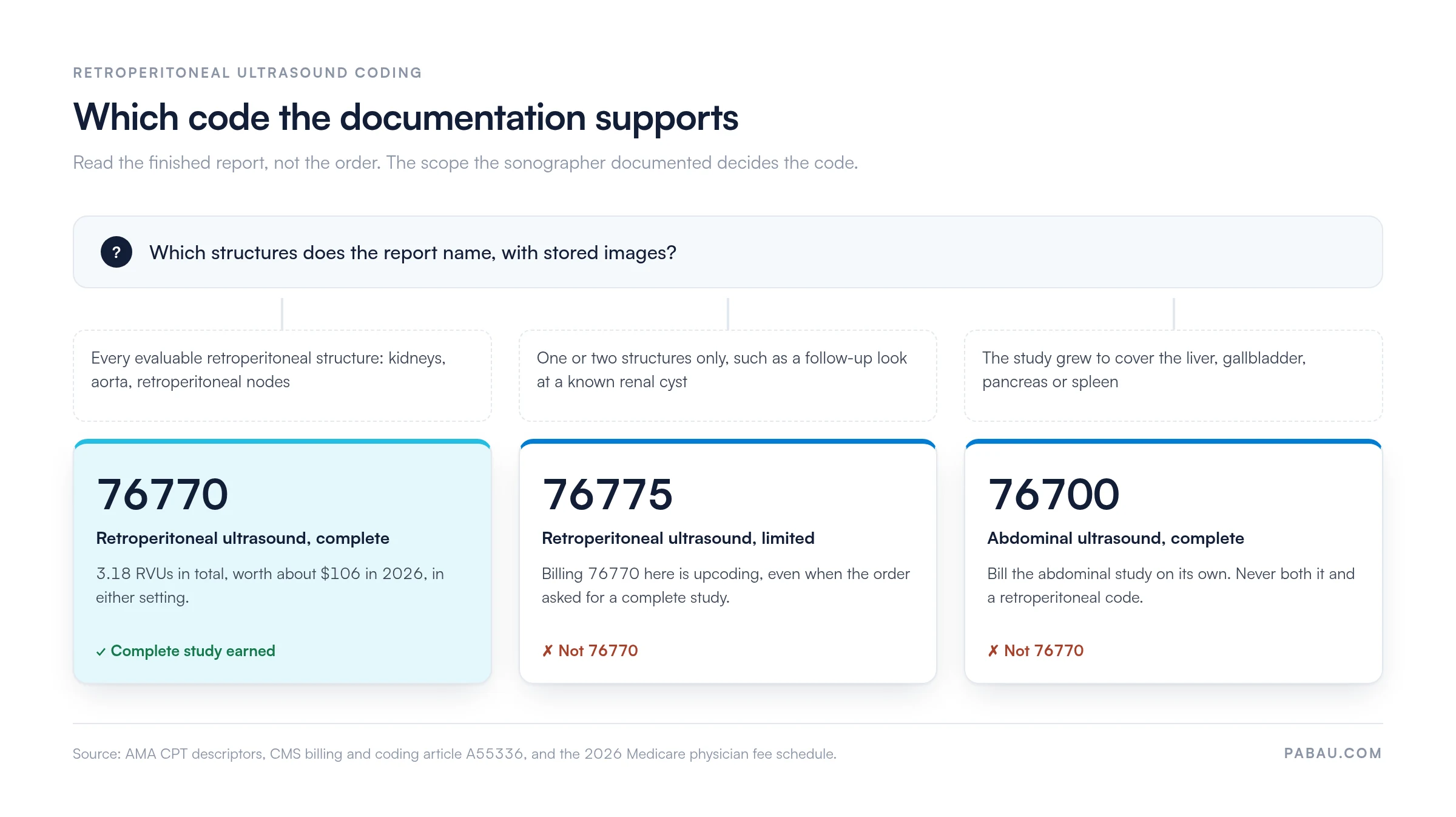
CMS article A55336 settles most arguments about the complete code. The report has to name every evaluable retroperitoneal structure, including the ones that looked normal. If the sonographer checked only the kidneys during a cyst follow-up, the code is 76775.
The same article carries a rule that gets missed far more often. Never bill a retroperitoneal study and a complete or limited abdominal study for one exam that expanded mid-scan. And when the physical findings point at the liver, gallbladder, or spleen, the abdominal study is the one to perform and bill.
Split billing between a radiologist and the site that owns the scanner is where modifiers earn their keep. Pick the wrong one and the claim either denies outright or trips a duplicate-payment flag.
When one physician performs and reads the study in their own office, bill 76770 bare. That is global billing, and no modifier belongs on the line. Modifier 26 applies only when two different entities split the components. Sending 26 and TC together from a single provider is an error most clearinghouses catch.
Medical necessity for 76770 rests on the diagnosis code. LCD L34577 and its billing and coding article A55336 list the covered indications for retroperitoneal ultrasound.
A diagnosis outside that list denies, however well the study was performed. Our ICD-10-CM code library covers the diagnosis side in more depth.
One absence from that list trips people up. R59.0, localized enlarged lymph nodes, is not a covered diagnosis under A55336, even though retroperitoneal nodes are a classic reason to scan.
Code the confirmed or suspected condition instead, and expect a medical necessity denial when R59.0 is all the chart supports.
The table above is not exhaustive, and coverage articles get revised. Check the current version before you submit an unusual indication.
Also, never pick a diagnosis because it appears on a coverage list. An auditor reads that as reverse engineering.
Documentation is what turns a payable claim into a denial, or into a post-payment audit two years later.
For 76770, the file has to show the clinical reason and the technical scope. A coder should never have to call the ordering physician to work out which code fits.
Audit your 76770 claims that carried modifier 52 once a month. If the report gives no reason why a structure could not be seen, the claim is weak on re-audit. Bowel gas, body habitus, and prior surgery are all acceptable reasons, but somebody has to write them down. Give your sonographers a short phrase library to use when a structure is obscured.
The path is short, and every step on it has a failure mode.
Here is how a clean 76770 claim travels, from referral through to remittanc:
Steps three and four are where the money leaks. A report that only says the kidneys look unremarkable cannot support a complete study. The order does not rescue it, and neither does the sonographer’s memory of the scan.
76770 lands on denial lists more often than most radiology codes, because it sits on the boundary between complete and limited.
These five come up again and again in billing audits:
Those five questions take about a minute per claim. Compare that against the cost of an appeal, or a records request from a post-payment auditor.
Most 76770 errors are not knowledge problems. Coders know the rule. The report sits in the imaging system, the diagnosis sits in the chart, and the claim gets typed somewhere else. Each hand-off is another chance to drop a field.
Practice management software like Pabau keeps the patient record and the claim in one place. Our claims management software pre-fills the claim form from the record, pulling the client, insurance, rendering provider, and diagnosis details across.
Before the claim goes out, it checks that the fields the clearinghouse requires have been completed.
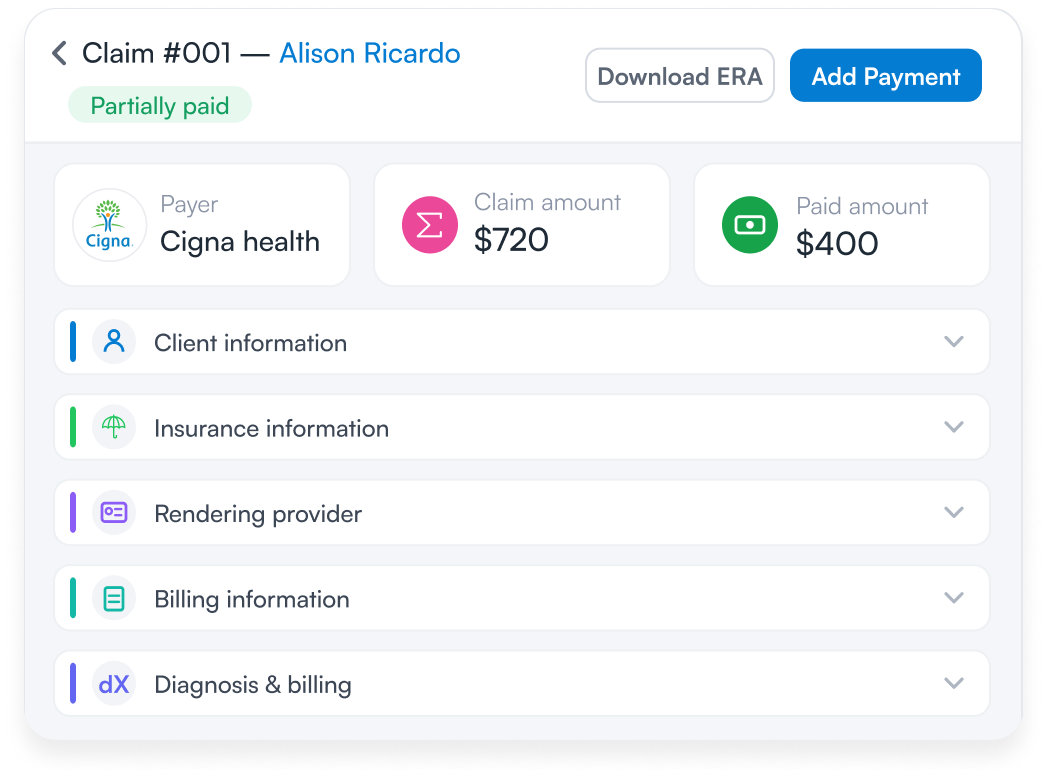
From there the claim submits electronically to the Claim.MD clearinghouse, and the remittance advice lands back against the same record. Eligibility checks run in the same place, so coverage gets confirmed before the patient is scanned rather than after.
One limit is worth naming plainly. The software will not choose between 76770 and 76775 for you, and it does not second-guess your modifiers. That judgment belongs to the coder and the report, which is exactly where CMS expects it to sit.

Pabau pre-fills claim forms from the patient record and checks the fields your clearinghouse requires before submission. Eligibility checks and remittance advice sit in the same place, so imaging teams chase fewer incomplete claims.

76770 is a simple code with one hard edge. The word complete has to be earned in the report every single time. Payers audit it precisely because so often it is not.
Two figures are worth carrying away. The code is worth roughly $106 in 2026, and it pays the same in an office as in a hospital outpatient department. So the place of service field is a compliance question here, not a revenue lever.
Build the check into the workflow rather than into the appeal. Book a demo to see how Pabau gets imaging claims out of the practice complete, with the diagnosis and the documentation already matched.

Need a framework for managing claim denials systematically? Denial management in healthcare covers the end-to-end process for tracking, appealing, and preventing denials across billing codes.
Want to understand how clearinghouses validate claims before submission? Medical claims clearinghouse guide explains how 837P files, eligibility checks, and ERAs work together in a compliant billing workflow.
Working out which diagnosis code fits a renal finding? ICD-10-CM renal mass codes walks through the documentation each of those codes needs.
Looking for revenue cycle fundamentals to share with your billing team? What is revenue cycle management provides a grounded overview of how imaging and procedure claims move from order to payment.
76770 covers a renal ultrasound when the report documents the whole retroperitoneum, aorta and nodes included. When only the kidneys were examined, the code is 76775.
No. G0389 is the one-time abdominal aortic aneurysm screening ultrasound for eligible beneficiaries. 76770 is a diagnostic study, so it needs a documented sign, symptom, or known finding.
Medicare fee-for-service does not require prior authorization for diagnostic ultrasound. Many Medicare Advantage and commercial plans do, often through a radiology benefit manager. Check the plan before the patient is scanned.
There is no national frequency limit on 76770. Each study still needs its own documented indication, and contractors review repeats. For aneurysm surveillance, the interval follows the measured size of the aorta.
A sonographer usually performs the scan, and the interpreting physician reads and signs the report. Payer policy and accreditation programs may require a registered sonographer, and state scope rules apply.
Not necessarily. Commercial rates are negotiated, so the allowed amount often differs from the Medicare figure. Check the fee schedule in your own contract before quoting a rate.