

HCPCS code E0198: Water pressure pad billing guide
HCPCS code E0198 is a water pad for a standard mattress HCPCS code E0198 is the ...

Last Updated: Oct 13, 2026
37221 was the CPT code for revascularization, endovascular, open or percutaneous, iliac artery, unilateral, initial vessel, with transluminal stent placement. The AMA deleted it effective January 1, 2026, together with the rest of the 37220-37235 family.
Iliac stent placement is now reported from the 37254-37299 territory codes, split by lesion complexity. Use 37258 for a straightforward lesion, which CPT defines as a stenosis. Use 37260 for a complex lesion, which CPT defines as a 100% occlusion. Claims submitted with 37221 for a 2026 date of service are rejected.
Let Pabau's smart automation suggest the right codes, reduce claim denials, and keep your practice compliant—effortlessly.
Automate repetitive tasks and focus on what matters most—your patients.
Reduce coding errors and ensure compliance with the latest regulations.
Clean claims, fewer denials, and faster reimbursements.
Powerful insights and reporting to help your practice thrive.
HIPAA compliant SOC 2 certified GDPR-compliant Trusted by 4,000+ clinics worldwide

CPT code 37221 was deleted effective January 1, 2026, along with the entire 37220-37235 lower extremity revascularization family.
Iliac artery stent placement is now reported with 37258 for a straightforward lesion or 37260 for a complex lesion.
CPT defines straightforward as a stenosis and complex as a 100% occlusion, so the operative note must state which was treated.
The new codes bundle vascular access, selective catheterization, lesion crossing, angioplasty in the same artery, and all imaging supervision and interpretation.
Claims submitted with 37221 for a 2026 date of service are rejected, so rebill legacy cases under the correct territory code.
CPT code 37221 is no longer a valid code. The American Medical Association (AMA) deleted it effective January 1, 2026, together with the whole lower extremity revascularization family from 37220 through 37235. Claims submitted with 37221 for a 2026 date of service are rejected.
Through 2025, 37221 carried this descriptor:
Revascularization, endovascular, open or percutaneous, iliac artery, unilateral, initial vessel; with transluminal stent placement(s), includes angioplasty within the same vessel, when performed.
That wording is now historical. It still matters when you work a 2025 claim, and nowhere else.
In its place, CPT 2026 introduced 46 codes running from 37254 to 37299. They are organized by vascular territory rather than by vessel name, and within each territory they split by lesion complexity. The four territories are iliac, femoral/popliteal, tibial/peroneal, and a newly recognized inframalleolar territory.
Each deleted code maps to two successors, not one. The table below is the crosswalk for the iliac family that 37221 belonged to, as published in the SCAI 2026 lower extremity revascularization code guide. The angioplasty-only sibling 37220 splits the same way, into 37254 for a straightforward lesion and 37256 for a complex one.
Iliac artery stent placement, unilateral, initial vessel, is now reported with either 37258 or 37260. The choice rests entirely on how the operative note characterizes the lesion.
Both codes are arterial. A stent placed in the iliac vein is reported with 37238 for the initial vein instead.
The official descriptor for 37258 runs to four clauses:
37260 carries identical wording, ending instead with complex lesion, initial vessel. The two codes differ by one clause, and that clause moves the payment by thousands of dollars.
Three reporting rules govern the iliac territory:
That third rule has a corollary worth stating plainly. Never use an add-on code for another lesion in a vessel you have already coded.
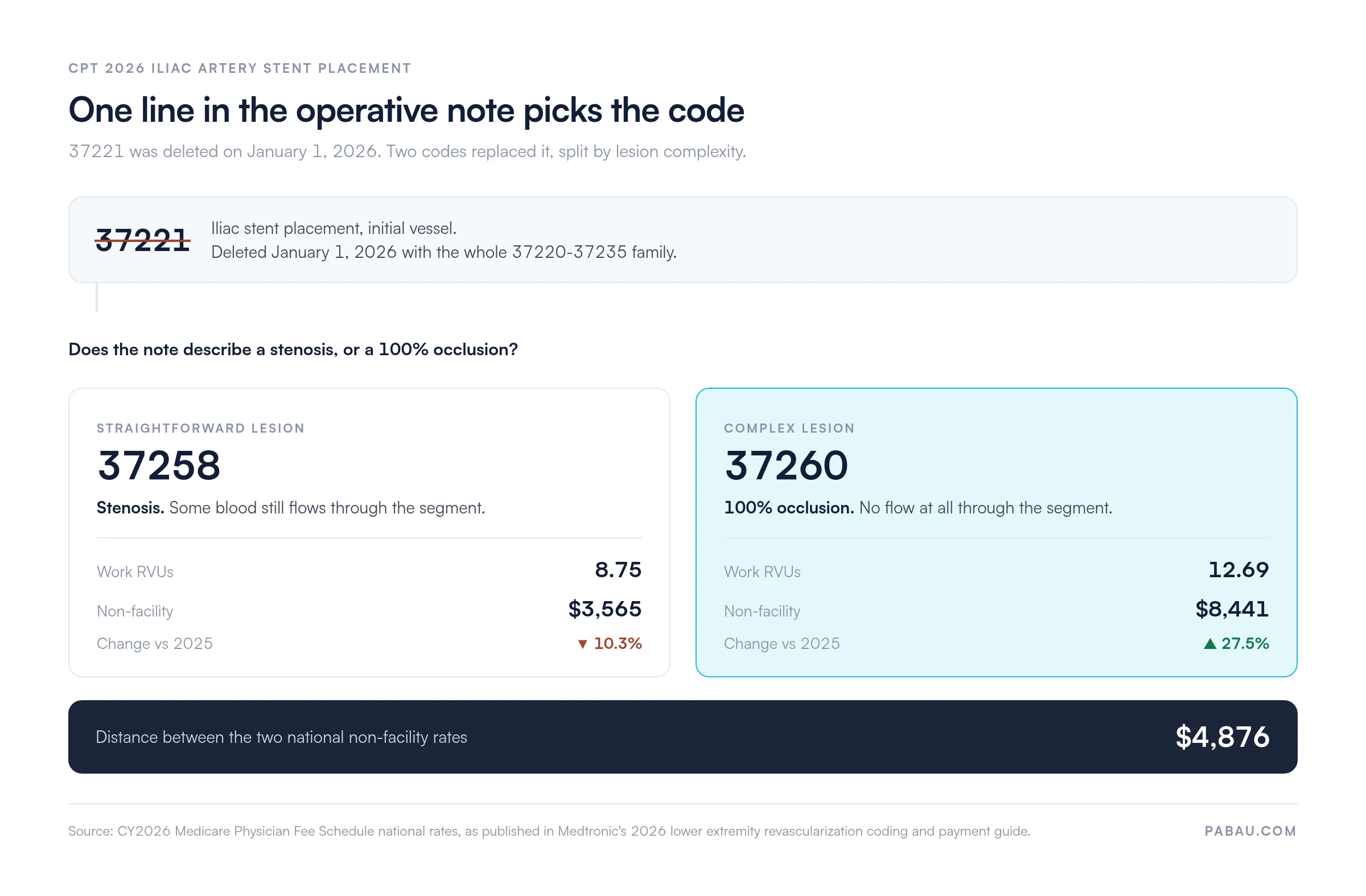
CPT 2026 defines the two lesion categories narrowly. A straightforward lesion is a stenosis, meaning some blood still flows through the segment. A complex lesion is a 100% occlusion, with no flow at all.
There is no middle category, and a severe stenosis is still straightforward. The chart below sets the two codes side by side with what each one pays.
Under 37221 the stent itself decided the code, so operative note templates were built to capture stent make, model, and size. None of those fields answer the question CPT now asks.
Say the note reads high-grade stenosis of the left common iliac, with no word on whether flow was preserved. The coder cannot pick between 37258 and 37260, and has to query the physician.
Add one line to your iliac operative note template that records lesion character as stenosis or 100% occlusion. That single field now decides between 37258 and 37260, and most legacy templates never captured it.
The 2026 descriptors absorb far more work than the codes they replaced. Reading the descriptor closely is the fastest way to avoid an unbundling denial. The list of included services now sits inside the code text itself.
Bundled imaging rewrites the charge template more than any other item in that list. Practices that routinely added diagnostic angiography supervision and interpretation lines to an iliac stent claim will see those lines reject.
Diagnostic angiography that precedes the decision to intervene is a separate question. Payer policy on it varies, so confirm the rules with your MAC before you strip codes out of your charge templates.
Coders working from operative reports need to recognize the procedural steps behind an iliac stent claim. The typical workflow follows this sequence:
The underlying diagnosis is almost always peripheral arterial disease (PAD), most often atherosclerotic iliac occlusive disease causing claudication or chronic limb-threatening ischemia. Correct ICD-10 pairing supports medical necessity and is a leading denial driver.
Both 37258 and 37260 are unilateral codes, so laterality has to reach the claim somehow. Getting that wrong is a frequent source of rework on iliac stent claims.
The kissing iliac stent technique places stents in both common iliac arteries at once, usually at the aortic bifurcation. Because the codes are unilateral, this is two lines, not one code with a units multiplier. Work through it in this order:
Payer policy on modifier -50 against RT and LT still varies, so confirm the format with the payer or MAC before billing. A mismatch here is a frequent cause of denials on otherwise clean vascular claims.
The split by lesion complexity moved money as well as code numbers. Under the CY2026 Medicare Physician Fee Schedule, the straightforward iliac stent code pays less than 37221 did, while the complex code pays considerably more. The figures below come from Medtronic’s 2026 lower extremity revascularization coding and payment guide, which reproduces the CY2026 national rates.
Read those two percentages together. A practice that mostly stents stenoses takes a cut in 2026, while one that mostly reopens occlusions gains. Roughly $4,900 separates the two non-facility rates. A vague operative note therefore carries a price in dollars as well as in coder time.
National figures work as a planning tool rather than a payment forecast. Your locality, your billing setting, and your geographic practice cost index all move the number. Look up the amount that applies to you in the CMS Physician Fee Schedule Look-Up Tool, which gives facility and non-facility rates by geographic locality.
CMS Local Coverage Article A57590 governs Medicare coverage for non-coronary vascular stents, iliac artery interventions included. Revision 5 of that article took effect January 1, 2026. It removed the deleted 37220-37235 codes and added the 37254-37299 range, so the coverage criteria now attach to 37258 and 37260.
Covered indications typically include symptomatic peripheral arterial disease with documented hemodynamic significance, failure of conservative management, and imaging confirmation of the lesion. Key documentation requirements include:
Prior authorization requirements depend on the payer and the care setting. Medicare Fee-for-Service traditionally does not require it for most outpatient vascular procedures, but Medicare Advantage plans often do. Commercial payers set their own thresholds. Confirm the requirement with the payer before the procedure is scheduled. Your MAC may also publish Local Coverage Determinations that add criteria beyond A57590.
A complete record for 37258 or 37260 has to carry several specific elements. A missing element is the root cause of most medical necessity denials on these claims. Treat the operative report as the claim’s first line of defense.
Practices that run a documentation checklist before submission catch these omissions early. The claim can still be fixed at that point, before a denial lands.
Run a report on every 2026 date of service still carrying a code between 37220 and 37235. Those lines will not pay. Rebill them under the matching territory code before the timely filing window closes.
The code you report follows the date of service, not the date you send the claim. A procedure performed on or before December 31, 2025 stays on 37221 forever. You will keep using the deleted code on corrected claims, appeals, and late submissions for those cases, and that is correct.
Only a 2026 date of service moves to 37258 or 37260. Three practical consequences follow:
The same date-of-service rule covers the rest of the deleted family. A 2025 femoral/popliteal case treated with a stent and atherectomy still reports 37227.
AAPC’s Codify entry for 37221 now carries the deleted-code flag. That is a quick status check when a payer questions an old line.
Knowing why these claims get denied is the fastest path to a cleaner first-pass rate. The table below covers the triggers seen most often since the 2026 codes took effect.
Pabau’s 837P claim submission workflow through Claim.MD flags coding mismatches before claims reach the payer, which cuts preventable denials on peripheral vascular claims.
Diagnosis pairing is the second half of a payable iliac stent claim, and it receives far less attention than the procedure code. The diagnosis must reflect the documented clinical condition and satisfy the payer’s coverage criteria.
Verify each code against the current ICD-10-CM tabular list for the applicable fiscal year. Our ICD-10-CM code library covers the individual diagnosis codes in more detail.
Two pairings go wrong often enough to be worth naming. Claudication in a patient with established atherosclerosis belongs on I70.21-, not on a symptom code such as R26.89, because the etiology is documented. And I70.92 never stands alone, since the tabular list instructs you to code the underlying atherosclerosis first.
Thromboembolic occlusion is the third case worth checking. Where the operative report describes an embolus or a thrombus rather than plaque, I74.5 is the diagnosis that carries the claim.
Cross-reference your chosen diagnosis against the payer’s coverage list before the claim goes out. Pabau’s remittance workflow flags CARC denial reason codes tied to ICD-10 mismatches, which gives billing teams a clear route to appeal or correction.
A code-set change on this scale exposes how much of a practice’s billing logic lives in habit. Charge templates still list the deleted codes. Superbills still name 37221. The coder still reaches for the stent detail rather than the lesion character, because that is what mattered for a decade.
Practice management software like Pabau keeps that logic in one place instead of in muscle memory. Charge codes, payer-specific modifier rules, and documentation prompts sit in the system. A change to the code set becomes an update your team applies once.
Claims go out through the Claim.MD clearinghouse, which submits electronic CMS-1500 claims to thousands of US insurance payers. It returns electronic remittance advice for reconciliation.
The outcome your billing team feels is a shorter loop between the procedure and the payment. Coding errors surface before submission instead of in a denial letter six weeks later. The people working those accounts spend their time on payer disputes that matter.

Pabau’s claims management software holds your charge codes, payer-specific modifier rules, and documentation prompts in one place. A CPT update then becomes a settings change your team applies once.

CPT 37221 is gone, and no amount of payer-by-payer checking will bring it back. For any 2026 date of service, iliac artery stent placement is 37258 when the lesion is a stenosis. It is 37260 when the lesion is a total occlusion.
The rest of the claim follows from that one determination, including the roughly $4,900 difference in national non-facility payment. So the work in front of a vascular billing team is narrow and finite.
Purge the deleted range from your charge templates and add a lesion character field to the operative note. Then strip the imaging supervision lines that the new codes now absorb.
Pabau handles the rest of the loop with clearinghouse submission, eligibility verification, and remittance reconciliation, so more of your claims get paid first time. Book a demo to see how it handles a specialty billing workflow end to end.

Working a denied vascular claim? Denial management in healthcare shows how to triage, appeal, and stop the same denial coming back.
Want fewer rejections at first pass? What makes a clean claim covers the fields a payer checks before it releases payment.
Checking coverage before the procedure? Insurance eligibility verification explains what to confirm at scheduling and how to record it.
Curious what the payer actually receives? The 837 claim file walks through the electronic format behind every submitted claim.
Building a pre-submission checklist? Medical billing compliance lists the documentation rules that hold up in an audit.
No. The AMA deleted 37221 effective January 1, 2026, along with the rest of the 37220-37235 family. Claims carrying it for a 2026 date of service are rejected. Iliac artery stent placement is now reported with 37258 or 37260.
Two codes replaced it, split by lesion complexity. Report 37258 for iliac stent placement on a straightforward lesion, which CPT defines as a stenosis. Report 37260 when the lesion is a complex 100% occlusion. Add-on codes 37259 and 37261 cover additional vessels in the same territory.
Straightforward means a stenosis, where some blood still flows through the segment. Complex means a 100% occlusion, with no flow at all. The operative note has to say which one was treated, because that single fact decides both the code and the payment.
No. The 2026 descriptors bundle all imaging guidance and radiological supervision and interpretation needed to perform the stent placement. Vascular access, selective catheterization, crossing the lesion, and angioplasty in the same artery are bundled as well.
The iliac codes are unilateral, so each side is reported on its own merits with laterality attached. Payers generally expect either modifier -50 or RT and LT. The two sides can also carry different codes, since one iliac may be stenosed while the other is occluded.
Under the CY2026 Medicare Physician Fee Schedule, 37258 carries 8.75 work RVUs and 37260 carries 12.69. National non-facility payment runs about $3,565 for 37258 and $8,441 for 37260. Look up the rate for your own locality with the CMS fee schedule tool.
Keep 37221 on it. The code you report follows the date of service, not the date you bill. A procedure performed in 2025 stays on 37221 through corrected claims and appeals. Only a 2026 date of service moves to the new territory codes.



