HCPCS code J3471: Hyaluronidase ovine injection billing guide
HCPCS code J3471: Descriptor, code type, and quick-reference data HCPCS code J34...

Last Updated: Oct 14, 2026
73070 is the CPT code for radiologic examination, elbow; 2 views.
View count decides the code. A supplemental oblique or a third projection moves the study to 73080, and billing 73070 anyway produces a mismatch denial. The signed radiology report must confirm exactly two views, and the clinical indication must justify the study. Modifier selection then depends on whether the facility or the physician is the billing entity.
Let Pabau's smart automation suggest the right codes, reduce claim denials, and keep your practice compliant—effortlessly.
Automate repetitive tasks and focus on what matters most—your patients.
Reduce coding errors and ensure compliance with the latest regulations.
Clean claims, fewer denials, and faster reimbursements.
Powerful insights and reporting to help your practice thrive.
HIPAA compliant SOC 2 certified GDPR-compliant Trusted by 4,000+ clinics worldwide

CPT code 73070 covers a radiologic examination of the elbow limited to exactly 2 views, with no oblique or stress projections.
Choosing between 73070 and 73080 depends on the view count in the signed radiology report, never on clinical complexity.
The two most common denials are billing 73070 against a 3-view report and pairing -26 with -TC on one line.
Under the 2026 CMS fee schedule, 73070 carries 0.88 total RVU, of which 0.70 is practice expense.
Pabau’s claims management software links the code, modifier, and diagnosis inside the patient record, catching mismatches before submission.
CPT code 73070, as maintained by the American Medical Association’s CPT code set, carries the official descriptor: “Radiologic examination, elbow; 2 views.” The code belongs to the 73000-series musculoskeletal radiology section of the CPT manual. It applies only to plain-film (conventional) X-ray of the elbow joint.
The two views covered are the anteroposterior (AP) and lateral projections. These are the minimum clinically accepted projections for evaluating elbow alignment, joint space, and gross bony architecture. The code does not include fluoroscopy, CT, MRI, or ultrasound of the elbow.
CPT 73080 describes a radiologic examination of the elbow with 3 or more views. The selection rule is mechanical. Count the views documented in the signed radiology report. If the report confirms two projections, use 73070. If three or more projections are documented, use 73080. Clinical complexity, fracture severity, and ordering provider specialty are irrelevant to the code selection.
The most common billing error in this pair is upgrading to 73080 because the radiologist added an oblique view at their own discretion. When the order was written for 2 views and a third projection is taken anyway, the documentation must reflect the views actually captured. Always code from the finalized radiology report, not the order.
CPT code 73070 sits within the 73000-series, which covers diagnostic radiology for the upper extremity. The same view-count logic runs across the whole section, so the rule you apply here transfers to the wrist, the forearm (73090), and the shoulder. The table below maps the adjacent codes coders encounter most alongside 73070.
Every CPT 73070 claim must be supported by four documentation elements. Missing any one of them gives payers grounds for denial on a medical necessity or completeness basis. The order has to precede the study; one created after the fact will not survive an audit.
Practices that build charges from a superbill should make sure it captures the ordered view count. It also needs the final view count from the radiology report. A mismatch between the two is the root cause of most 73070 downcoding audits.
Run a monthly audit comparing the view count on radiology orders against the view count in finalized radiology reports for all 73070 and 73080 claims. A pattern of discrepancies usually means coders are billing from the order rather than the report. Catching that internally costs far less than receiving a payer audit letter.
Modifier selection for CPT code 73070 depends on the billing entity and the laterality of the study. Radiology codes follow global service billing rules. When one entity owns both the equipment and the reading, the code is billed globally with no modifier. When the functions are split, modifiers -26 and -TC apply separately.
One NCCI edit rule matters more than the rest. Modifiers -26 and -TC may never appear on the same claim line for the same code, from the same provider, on the same date. Appending both is a bundling error that triggers an automatic rejection. The global service already encompasses both components, so a genuine split sends each one to its own billing entity on a separate claim.
Medicare reimbursement for CPT code 73070 is set annually through the CMS Medicare Physician Fee Schedule (MPFS). Rates are expressed in relative value units (RVUs), then converted to dollars using the annual conversion factor. Geographic Practice Cost Indices (GPCI) then adjust that figure for each locality. The 2026 values below come from the CMS Physician Fee Schedule lookup tool. Rates change with each Final Rule, so verify them there before you rely on them.
Those four numbers are worth reading as proportions rather than as a lookup. Practice expense makes up roughly four-fifths of what the code pays. That is why the technical side of a split-billed elbow X-ray is worth more than the read.
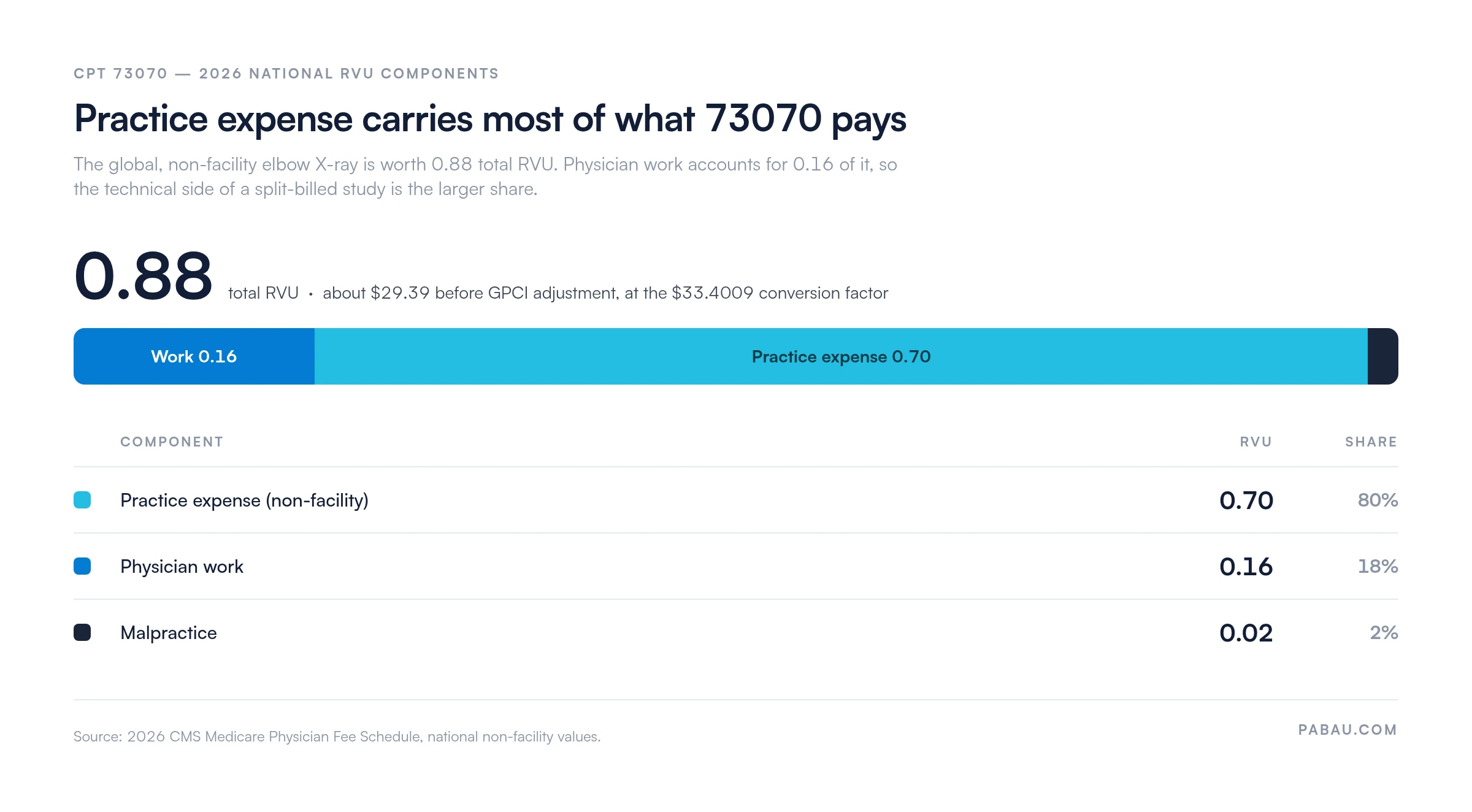
Splitting the service reassigns those components rather than adding to them. Modifier -26 carries the work RVU and the professional share of practice expense. Modifier -TC carries the technical practice expense and no work RVU. Pull the exact -26 and -TC values for your own locality before quoting either figure to a patient.
The FastRVU 2026 lookup tool provides locality-specific RVU calculations if your practice needs to verify rates by GPCI area before submitting.
Most 73070 denials fall into six patterns, and each one can be stopped at charge entry. Effective denial management workflows address these root causes before the claim goes out, not after the remittance comes back.
Submitting a clean claim the first time eliminates rework costs. For 73070, that means confirming the radiology report view count, the modifier pairing logic, and the paired ICD-10 code before the claim leaves the practice.
The ICD-10-CM diagnosis code on a 73070 claim establishes medical necessity. Payers evaluate whether the coded diagnosis logically warrants an elbow X-ray. Choosing a vague symptom code when a specific diagnosis is documented is a compliance risk. Choosing a specific diagnosis the record does not support is a fraud risk. Browse the wider ICD-10-CM code set when the documented diagnosis falls outside the pairings below.
For fracture follow-up visits, confirm whether a new study is being ordered or whether the prior study is being re-read. The diagnosis on the claim has to be supported by the clinical documentation, not selected because it pays.
Medicare does not require prior authorization for plain-film diagnostic X-rays under the standard Medicare Physician Fee Schedule. Medical necessity documentation requirements still apply and are subject to audit. This is consistent with CMS coding and billing guidance under Part B. Commercial payer rules vary significantly by plan and state.
A standardized billing workflow reduces the view-count and modifier errors behind most 73070 denials. The six steps below apply the general rules of radiology charge entry to this one code.
Flag 73070 and 73080 as mutually exclusive codes in your charge entry system. That blocks both from being posted for the same patient, same date, same elbow. Most practice management platforms support charge-level edit rules. Setting this up takes 15 minutes and removes one of the most common duplicate-billing denial triggers for elbow radiology claims.
A practice that keys radiology charges by hand is working from two places at once. The signed report sits in one system and the charge goes into another, often typed from the order rather than the report. That separation is what lets a 2-view charge go out against a 3-view study.
Practice management software like Pabau holds the code, the modifier, and the linked ICD-10 diagnosis on the patient’s own record. Those fields feed accurate claims management software, which checks the pairing at charge entry instead of after the remittance arrives. A -26 and -TC conflict or a missing referring-provider NPI surfaces while someone can still fix it.
Claims then route through Claim.MD clearinghouse scrubbing, which flags common bundling and modifier errors before the payer sees them. Electronic remittance advice returns into the same patient record. The paid amount can then be reconciled against the expected fee schedule rate, with no separate spreadsheet.

Pabau’s claims management workflow links CPT codes, modifiers, and ICD-10 diagnoses inside the patient record. Catch view-count mismatches and modifier errors before submission, not after.

CPT code 73070 fails in two predictable ways. Coders bill it against a report documenting 3 views, or they put -26 and -TC on one line and trigger an NCCI rejection. Coding from the finalized report and validating the modifier logic before submission prevents both.
The RVU split is worth carrying into any decision about how to bill. Practice expense accounts for 0.70 of the 0.88 total. A practice that owns the equipment and bills globally keeps considerably more than one billing only the read.
Book a demo to see how Pabau links charge entry, modifiers, and diagnosis codes so 73070 claims go out clean the first time.

List Item #1
List Item #2
CPT code 73070 covers a radiologic examination of the elbow with exactly 2 views, specifically the anteroposterior (AP) and lateral projections. The code includes the technical performance of the study. When billed globally or with modifier -26, it also covers the radiologist’s interpretation and written report. It does not include oblique projections, stress views, CT, MRI, or imaging of the forearm or shoulder.
The difference is view count. 73070 applies when the radiology report documents exactly 2 views, and 73080 applies when the report documents 3 or more views. The clinical complexity of the case, the indication, or the ordering provider’s specialty does not determine the code. Always code from the finalized, signed radiology report, not from the order.
Six modifiers apply. Use -26 for the professional component, meaning the radiologist’s interpretation only, and -TC for the technical component supplied by the facility. Use -LT and -RT for laterality, -50 for bilateral, and -52 for reduced services. Medicare typically wants a bilateral study billed as two lines with -LT and -RT rather than one line with -50. Modifiers -26 and -TC must never appear on the same claim line from the same billing entity.
The national non-facility estimate for the global service is approximately $29.39 before geographic adjustment. That figure is 0.88 total RVU at the 2026 conversion factor of $33.4009. Geographic Practice Cost Indices then move that figure up or down by locality. The professional and technical components are paid separately when the service is split. Verify the exact rate for your locality using the CMS MPFS lookup tool at cms.gov before relying on any published figure.
Under the 2026 CMS MPFS, CPT 73070 carries a work RVU of 0.16 and a malpractice RVU of 0.02. The non-facility practice expense RVU is 0.70. That gives a total of 0.88 RVU for the non-facility global service. Practice expense is therefore about four-fifths of the value of the code. Use the CMS MPFS search to pull locality-specific values for your practice’s service area.
Yes, a written or electronic physician order is required to support a 73070 claim for medical necessity purposes. Medicare and most commercial payers require the order to precede the date of service. The ordering provider’s NPI must appear on the claim form in Box 17b. A missing or retroactively created order is one of the most common audit findings for outpatient diagnostic radiology claims.