HCPCS code E0198: Water pressure pad billing guide
HCPCS code E0198 is a water pad for a standard mattress HCPCS code E0198 is the ...

Last Updated: Oct 13, 2026
T4537 is the HCPCS Level II code for incontinence product, protective underpad, reusable, bed size, each. It covers a washable pad placed on the bed, not a garment the patient wears.
Most claim errors on T4537 come from three mix-ups. Suppliers bill T4540 when the pad is chair size. Others reach for a disposable underpad code such as T4541 or T4542 when the product is washable. The third error is a missing physician order. Medicaid is the dominant payer, because Medicare Part B excludes routine incontinence supplies.
Let Pabau's smart automation suggest the right codes, reduce claim denials, and keep your practice compliant—effortlessly.
Automate repetitive tasks and focus on what matters most—your patients.
Reduce coding errors and ensure compliance with the latest regulations.
Clean claims, fewer denials, and faster reimbursements.
Powerful insights and reporting to help your practice thrive.
HIPAA compliant SOC 2 certified GDPR-compliant Trusted by 4,000+ clinics worldwide

HCPCS code T4537 describes a reusable, bed-size protective underpad billed per unit, separate from the disposable underpad codes T4541 and T4542.
Medicare Part B does not cover routine incontinence supplies, so Medicaid is the primary payer and coverage varies by state program.
The most common denial trigger is billing T4540, the chair-size reusable pad, for a product that is bed size.
T4536 is numbered next to T4537 but covers a pull-on garment, so it is never the alternative to an underpad code.
Practice management software like Pabau automates eligibility checks and tracks denial patterns across T-code claims.
HCPCS code T4537 is a Level II supply code maintained by the Centers for Medicare and Medicaid Services (CMS). It bills an incontinence product, protective underpad, reusable, bed size, per each unit.
The code sits within the T4521-T4545 incontinence supply cluster. That cluster covers briefs, pull-on underwear, liners and underpads in both disposable and reusable forms. The descriptor decides which of them applies, so every term in it is worth parsing.
The “T” prefix signals that this code belongs to the Medicaid-only tier of HCPCS Level II. T-codes are not recognized by Medicare fee-for-service. A claim submitted to Medicare Part B for T4537 denies on the code itself, not just on coverage grounds.
Each qualifying term in the T4537 descriptor carries a specific billing implication. Misreading any one of them leads to a code mismatch or a missing-documentation denial.
Payer-defined product standards for “reusable” underpads often require a minimum wash cycle durability (commonly 50-75 washes) and a minimum absorbency rating. Verify that the specific product being billed meets the payer’s durability criteria before submitting a T4537 claim.
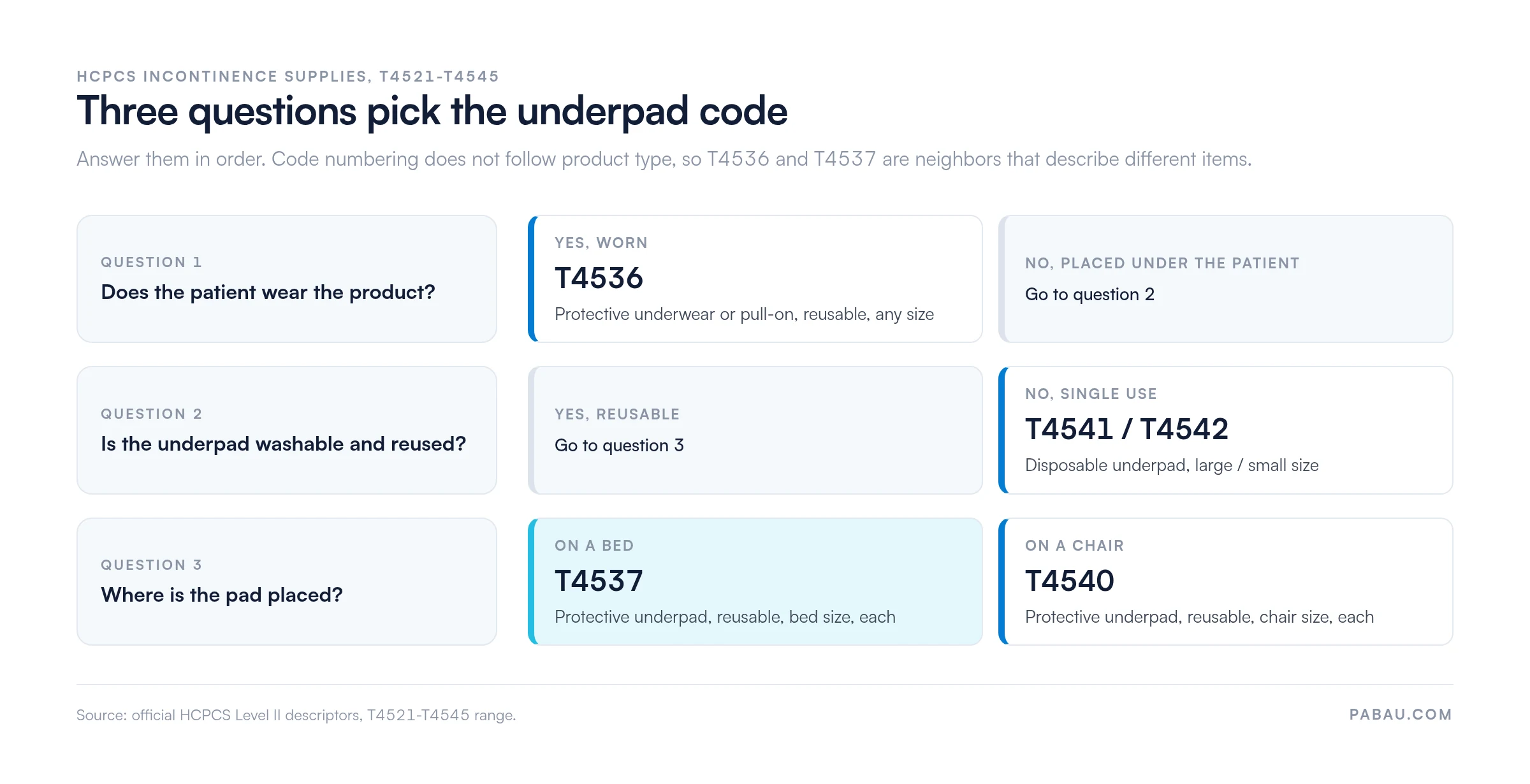
The T4521-T4545 range sorts products by what the item is, then by whether it is washable, then by size. Only four codes in that range describe an underpad, and T4537 is one of them. The code numbered directly before it, T4536, covers a garment the patient wears.
That numbering trap is worth reading carefully. Suppliers who pick the neighboring code by number land on a pull-on product. The pad that sits one size down from T4537 is three codes away, at T4540.
Two separate errors live in this table, and they carry different consequences. The size error is T4537 against T4540, because both codes describe a washable underpad and only the placement differs. A chair-size pad billed as T4537 overstates what was delivered and invites an overpayment demand. A bed-size pad billed as T4540 understates it.
The second error is the reusability error. T4541 and T4542 cover single-use pads. Billing either one for a washable product misstates the item, and it usually breaks the quantity pattern the payer expects to see. A supplier dispensing two washable pads a month looks very different from one dispensing sixty disposable ones.
T4536 belongs to neither error. It covers reusable pull-on underwear in any size, which the patient wears. Choosing it instead of T4537 puts the wrong product category on the claim, so no amount of dimension documentation will defend it. Record the product type, the washability and the intended placement on the delivery note, because those three facts are what support the code at audit.
Those three facts also run in a fixed order, which makes the choice easier to work through than the numbering suggests.
Coverage for HCPCS code T4537 varies sharply by payer type. Knowing which payers will and will not adjudicate the claim prevents wasted submissions.
Medicare Part B: Medicare does not cover routine incontinence supplies for home or long-term care use. This exclusion is explicit in the CMS Medicare Benefit Policy Manual and applies to underpads, briefs, and all other T-code incontinence products.
A T4537 claim submitted to fee-for-service Medicare will deny. Some Medicare Advantage plans have elected supplemental incontinence supply benefits, so verify the individual plan’s evidence of coverage before billing.
Medicaid: State Medicaid programs are the primary payer for T4537, and coverage policies differ by state and program type. California’s Medi-Cal program covers incontinence supplies for beneficiaries in long-term care settings under its bulletin framework. New York Medicaid manages coverage through its Incontinence Supply Management Program.
Verify current coverage status with each state Medicaid program before you bill. Product-specific coverage, quantity limits, and prior authorization requirements all vary between them.
Commercial insurers: Most commercial plans follow Medicare’s lead and exclude routine incontinence supplies. Some will cover medically necessary incontinence products with a documented diagnosis and prior authorization. Check the individual plan’s benefit summary or call the payer directly before the first claim submission.
Before billing T4537 to any Medicaid program, verify coverage and quantity limits with your state’s Medicaid fee schedule portal. Medi-Cal and New York Medicaid have different monthly unit limits, and submitting above those limits results in automatic denial regardless of medical necessity documentation.
Fee schedule rates for T4537 are set at the state Medicaid level. Because T-codes are Medicaid-only supply codes, there is no CMS national rate for T4537. Each state publishes its own allowed amount, and rates are updated on different cycles (annually for most states, quarterly for a few).
A supplier billing across several states therefore maintains a separate fee schedule reference for each one. There is no single number to quote a patient or a referral source.
Use the CMS Physician Fee Schedule lookup to confirm HCPCS-applicable rates where Medicare Advantage plans are involved. For state Medicaid rates, go directly to the relevant state’s Medicaid fee schedule portal.
Verify any rate from a third-party source against the official state portal before you submit claims. Those sources lag the state’s own updates.
Check the remittance advice on paid T4537 claims to confirm that the allowed amount matches your state’s current fee schedule. A discrepancy usually means a rate change has not yet reached your enrollment file.
A T4537 claim that reaches adjudication without complete documentation will deny. Most state Medicaid programs require the following on file before the claim is submitted.
Keep the documentation in the patient file for a minimum of seven years, consistent with standard CMS record retention expectations. Capture the physician order reference, the diagnosis codes and the product specification at the point of supply. An auditor’s request is then answered from one file.
T4537 claims deny for predictable reasons. Each denial pattern has a specific corrective action that prevents recurrence.
Tracking denial reason codes by payer turns scattered T4537 rejections into a pattern you can fix. A run of CARC 96 (non-covered charge) on T4537 claims almost always signals a payer mix error. CARC 197 (precertification or authorization absent) points at the step where prior authorization is being skipped. Review the denial codes in billing reference regularly, so a systemic issue is caught before it compounds.
A covered diagnosis is mandatory for Medicaid adjudication of T4537. The ICD-10-CM code must appear on the physician order and on the claim. The table below lists the most commonly paired diagnoses.
Code specificity matters. Payers conducting post-payment audits will scrutinize claims that default to R32 (unspecified urinary incontinence) when the patient’s clinical record supports a more specific code. Use the most specific diagnosis the physician order and clinical documentation will support. Never assign an ICD-10 code that is not directly documented by the treating provider.
DME suppliers billing HCPCS code T4537 to state Medicaid programs face a multi-step verification process before each claim is ready to submit. Skipping any step creates a denial that costs more to work than the original claim is worth.
A clean claim for T4537 carries five things. It needs a valid Medicaid member ID and a current ICD-10-CM incontinence diagnosis. It needs the T4537 code with the correct quantity.
It also needs the ordering provider NPI and a place-of-service code matching the care setting. Submit this combination and most Medicaid programs will adjudicate within 30 days.
Keep the manufacturer specification sheet for every reusable underpad you stock, filed against the product code. When a payer asks whether the item billed under T4537 is washable or bed size, that one document answers both questions. Suppliers who file specs at intake rather than at audit close these requests in days instead of weeks.
DME suppliers often run T4537 across three disconnected records. The physician order sits in one folder, the product specification in another, and the state quantity limit lives in a spreadsheet somebody updates by hand. When a denial lands, tracing which of the three failed takes longer than reworking the claim itself.
Pabau holds those records against the same patient file. Eligibility runs before the product is dispensed, so a patient whose plan excludes incontinence supplies is flagged at the order stage rather than after delivery. The order, the diagnosis and the product specification stay attached to the claim, which means an audit request is answered from one screen.
Denial reason codes are tracked across every claim, not one patient at a time. A run of CARC 96 on T4537 surfaces as a payer-mix problem within days instead of at quarter end. Your rework queue arrives sorted by cause, so the correction lands on the workflow that produced the denials.

Pabau’s claims management tools help DME suppliers verify patient eligibility, flag missing documentation, and track denial patterns before claims reach adjudication.

HCPCS code T4537 is narrow in scope but dense in billing requirements. It covers exactly one product: A washable, bed-size protective underpad billed per unit. Medicare will not pay it at all, and Medicaid will only with the right diagnosis, documentation and quantity control.
Most T4537 denials trace back to two errors. The first is billing T4540, the chair-size reusable pad, for a product that belongs on a bed. The second is omitting a supporting ICD-10 diagnosis from the physician order. Neither one is difficult to prevent once the product specification and the order are filed together.
For DME suppliers handling T4537 claims at volume, pre-submission workflow decides the outcome. It separates a steady clean claim rate from a standing denial backlog. Pabau’s claims management tools automate eligibility checks, validate code-diagnosis pairing, and track denial reason codes before they compound into cash-flow problems. To see how the workflow applies to your incontinence supply billing, book a demo.

Need a practical guide to managing claim denials? Denial management in healthcare covers the systematic approach to tracking, appealing, and preventing recurring claim rejections.
Confused about clearinghouse claim formats? 837 claim file format explains how electronic claims are structured and submitted to payers for DME and other supply billing.
Want to understand billing compliance requirements? Medical billing compliance outlines record retention, coding accuracy expectations, and audit-readiness for DME suppliers.
HCPCS code T4537 covers one incontinence product: A protective underpad that is reusable, bed size, and billed per individual unit. It does not cover disposable underpads (T4541, T4542), chair-size reusable pads (T4540), or any garment the patient wears.
Medicare Part B does not cover T4537 or any routine incontinence supply. Medicaid covers T4537 in most states, though coverage terms, quantity limits, and prior authorization requirements vary by state program. Some Medicare Advantage plans include supplemental incontinence supply benefits, so verify each plan individually.
They cover different kinds of product, not different sizes of the same one. T4536 is reusable protective underwear or a pull-on in any size, which the patient wears. T4537 is a reusable underpad placed on the bed. The numbering makes them look adjacent, so suppliers reach for T4536 when they want the smaller pad, which is T4540.
Both codes cover a reusable protective underpad, so the only difference is where the pad is used. T4537 is the bed-size pad and T4540 is the chair-size pad. Record the size and the intended placement on the delivery note, because that record is what supports the code choice at audit.
Prior authorization requirements for T4537 vary by state Medicaid program and sometimes by quantity. New York Medicaid and California Medi-Cal each have their own PA thresholds. Check the specific state’s fee schedule bulletin or provider manual before dispensing quantities that may exceed baseline covered amounts.
The most commonly paired diagnoses are R32 (urinary incontinence, unspecified), N39.3 (stress incontinence), N39.41 (urge incontinence), N39.46 (mixed incontinence), and R15.9 (fecal incontinence). Use the most specific code the physician order and clinical record support. The ICD-10 code must appear on both the order and the claim.
T4537 claims deny for five main reasons. The payer does not cover the code, as with Medicare Part B. The pad is bed size but T4540 was billed. The claim carries no ICD-10 incontinence diagnosis. The units exceed the state Medicaid monthly limit, or a required prior authorization is missing. Each one is preventable with a pre-submission checklist.