HCPCS code E0280: Bed cradle Medicare billing guide
HCPCS code E0280 describes the cradle frame, not the bed HCPCS code E0280 is the...

Last Updated: Oct 15, 2026
95923 is the CPT code for testing of autonomic nervous system function, not elsewhere classified; sudomotor function. It covers the sweat-output pathway, measured through tests such as QSART, the thermoregulatory sweat test, sympathetic skin response, and the silastic sweat imprint.
The code reports the testing session rather than each individual test. It sits in the autonomic testing series 95921-95924, alongside cardiovagal testing under 95921 and adrenergic testing under 95922. When all three pathways are tested in one session, 95924 replaces it.
Let Pabau's smart automation suggest the right codes, reduce claim denials, and keep your practice compliant—effortlessly.
Automate repetitive tasks and focus on what matters most—your patients.
Reduce coding errors and ensure compliance with the latest regulations.
Clean claims, fewer denials, and faster reimbursements.
Powerful insights and reporting to help your practice thrive.
HIPAA compliant SOC 2 certified GDPR-compliant Trusted by 4,000+ clinics worldwide

CPT code 95923 covers sudomotor function testing not elsewhere classified, separate from cardiovagal testing (95921) and adrenergic testing (95922).
QSART, the thermoregulatory sweat test, sympathetic skin response and the silastic sweat imprint all report under this code. The code covers the testing session, not each individual test.
Medicare coverage follows LCD A54954 and A57651, and medical necessity needs a covered ICD-10-CM diagnosis such as E11.43 or G90.3.
Billing 95923 alongside 95924 triggers an unbundling denial, because 95924 already includes the sudomotor component.
Pabau attaches CPT code 95923 and its paired ICD-10-CM codes at the point of care, then routes the claim to a connected clearinghouse.
CPT code 95923 describes testing of autonomic nervous system function, not elsewhere classified, of sudomotor function. The phrase “not elsewhere classified” carries weight here. It places 95923 in the residual category of the autonomic testing series 95921-95924. The code covers the sweat-output pathway, rather than the cardiovagal pathway that 95921 covers or the adrenergic pathway that 95922 covers. The American Medical Association maintains the CPT code set and is the authoritative source for the descriptor language.
Clinically, sudomotor testing evaluates postganglionic sympathetic cholinergic nerve fiber function by measuring sweat output at specified body sites. A normal result across all four sites effectively rules out small-fiber neuropathy affecting the autonomic pathway. An abnormal result supports the diagnosis and guides treatment for conditions such as diabetic autonomic neuropathy and Parkinson’s disease.
The code covers a family of sudomotor tests rather than a single procedure. Any of the following may be performed and reported under 95923, though QSART and the thermoregulatory sweat test are submitted most often. The table below summarizes each component.
QSART is the most widely used, because it produces quantitative, site-specific output that maps onto the documentation requirements in CMS LCDs. Some payers classify the thermoregulatory sweat test as investigational for certain indications, notably Aetna under CPB 0485. Those payers may deny a TST-only claim, so confirm the policy before the date of service.
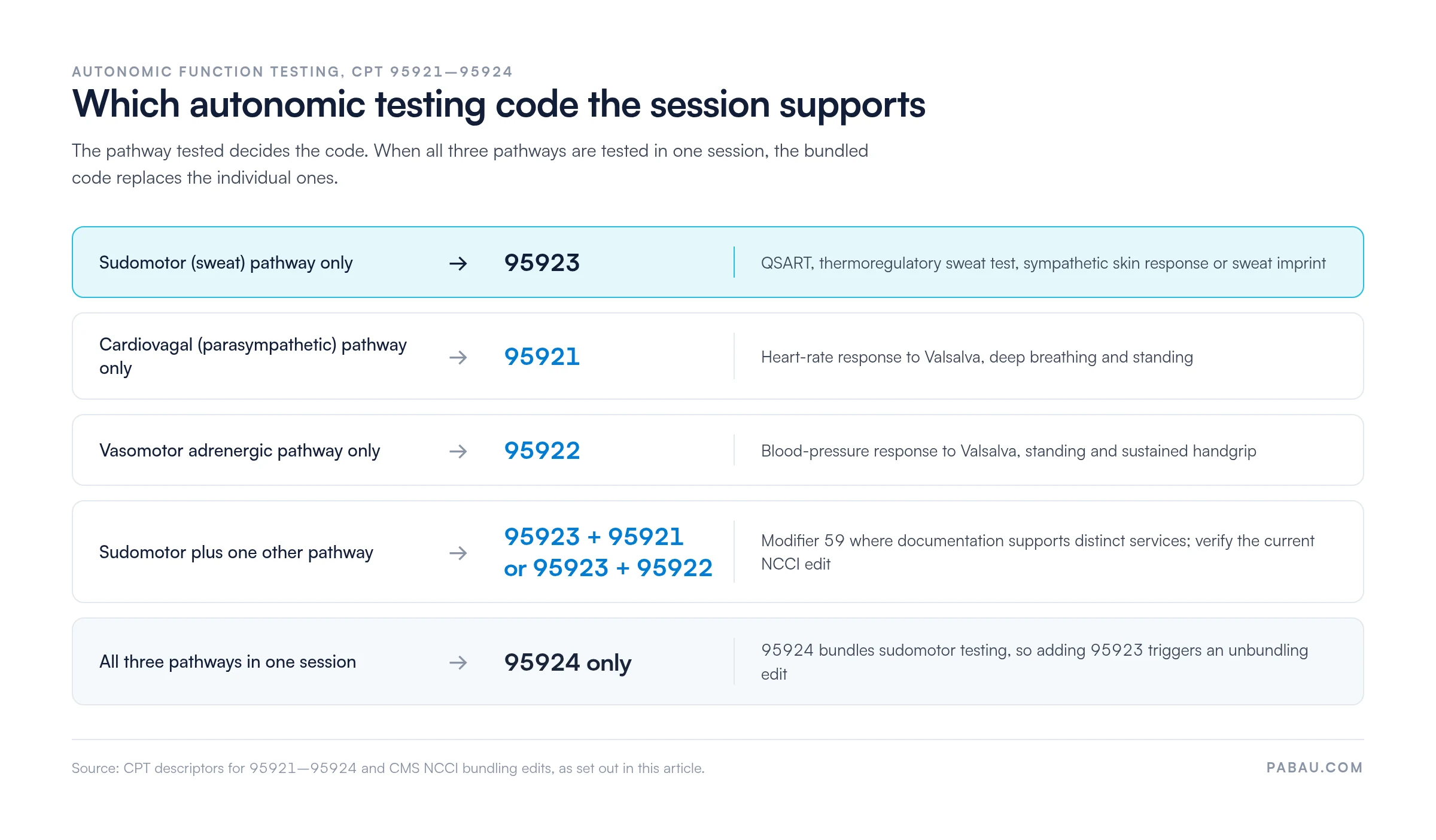
The autonomic testing series covers four different physiologic pathways, and billing the wrong one is a frequent denial trigger. Knowing where each code begins and ends matters as much as the documentation behind it.
95924 is a bundled code that already includes the sudomotor component. When a practice performs a full autonomic evaluation covering cardiovagal, adrenergic, and sudomotor testing in one session, 95924 is the code to submit. Billing 95923 alongside it generates an NCCI edit denial. Verify current bundling edits against the AAPC code reference before submitting.
The chart below maps each testing combination to the code the session supports.
Payers use the submitted ICD-10-CM code to determine medical necessity. A covered test paired with a non-covered diagnosis is denied. The following diagnoses are accepted under Medicare LCD A54954 and aligned commercial policies for autonomic sudomotor testing.
Every diagnosis above sits in the ICD-10-CM code set, and each MAC publishes its own accepted list. Use the CrossCoder crosswalk tool to verify which of them your MAC accepts for 95923. LCD appendices are updated periodically, so confirm the list against your MAC’s coverage database.
Medicare coverage for CPT code 95923 is governed by Local Coverage Determinations A54954 and A57651, issued by the relevant Medicare Administrative Contractors. Checking the applicable LCD before the date of service prevents the most expensive outcome, which is performing the test and absorbing the write-off. The core LCD requirements are:
Commercial payers follow similar frameworks but are not bound by Medicare LCDs. Aetna’s Clinical Policy Bulletin 0485 covers autonomic and sudomotor testing and classifies certain approaches as investigational. BCBS North Dakota’s medical policy takes a comparable position on study indications. Both require prior authorization for most autonomic testing, so checking that requirement before scheduling reduces claim risk.
Before scheduling autonomic testing for a patient with commercial cover, call to confirm the prior authorization requirement. Ask whether the planned test type, QSART or TST, is covered or classed as investigational under the payer’s current policy. A ten-minute call costs far less than writing off the study.
Medicare physician fee schedule rates for CPT code 95923 vary by geographic pricing locality. The figures below reflect the national non-facility rate. Facility rates are lower, because a hospital outpatient department or ambulatory surgery center bills separately for its overhead. Use the CMS Physician Fee Schedule lookup tool to confirm rates for your specific MAC and locality.
For exact 2026 values, use the FastRVU 2026 RVU lookup tool, which pulls directly from CMS data files. Commercial rates vary widely by contract, so treat the Medicare rate as a floor for negotiation rather than a ceiling. Practice management software like Pabau closes the loop after that. Its claims management software sends 837P transactions to a connected clearinghouse and returns ERAs, so billing staff reconcile payments without switching between systems.
Modifier usage is where many 95923 claims break down. The correct modifier depends on what was performed, who performed it, and whether the service overlaps with another code billed on the same date.
Modifier rules change annually. NCCI edit pairs in this family have shifted across recent code cycles. Check your MAC’s current guidance before submitting a claim that uses modifier 59 on the 95921-95924 series.
Documentation carries more weight than any other variable in 95923 billing. A correctly coded, correctly authorized claim is still denied when the medical record does not support medical necessity at audit. Build the requirements into the clinical workflow rather than assembling them during an appeal. The required elements are:
A superbill captures the CPT code, the linked ICD-10-CM codes, and the performing provider in one structured form. That cuts transcription errors between the note and the claim. Clinical note templates can be configured to prompt for each element at the point of documentation, so billers receive complete information without chasing records.
Most 95923 denials fall into a predictable set of patterns. Recognizing them before submission costs far less than working the denial afterward. The table below lists the most frequent denial reasons and the corrective action for each.
Reading the CARC reason codes returned on the remittance tells billing staff which of these patterns is driving the rejection. Pabau surfaces that remittance data inside the billing module, so the denial reason, the original claim, and the patient record sit in one place.
Bundling violations account for a large share of 95923 denials. The NCCI edits for the autonomic testing series are specific about which codes can and cannot be billed together. Check the current edits in the CMS NCCI policy manual before finalizing a multi-code claim.
The remittance returned after a bundling denial usually carries CARC code 97. That code means the service is included in payment for another service on the same date. Treat that code as a prompt to check which other code on the claim absorbed 95923.
In most neurology practices a 95923 claim crosses three systems before it reaches a payer. The technician’s report sits in one place, the physician’s interpretation in another, and the biller retypes the code and the diagnosis into a claim form. Each handoff is a chance for the ICD-10-CM code on the claim to drift from the one documented in the chart.
Pabau keeps those pieces in one record. A clinical note template can prompt for the ordering physician’s rationale, the site-specific results, and the signed interpretation. The elements an LCD audit asks for are then captured during the visit. The CPT and ICD-10-CM codes attach to that same encounter rather than to a separate billing sheet.
From there the claim goes to the clearinghouse, and the remittance comes back against the original claim and the patient record. When a CARC 97 bundling denial arrives, the biller can see which code absorbed 95923 without opening a second system or calling the clinical team.

Attach CPT code 95923 and paired ICD-10 codes at the point of care, route claims through a connected clearinghouse, and track ERAs without switching systems. Book a demo to see the billing workflow in action.

CPT code 95923 is well defined, and its denial rate tracks the documentation, the diagnosis pairing, and the same-date bundling rules behind it. Get the QSART site count into the report, pick an ICD-10-CM code the LCD accepts, and recognize the sessions that belong to 95924. Those three habits move first-pass payment further than any appeal workflow.
Build those checks into the visit rather than the appeal, and the write-offs stop before a claim leaves the practice. Book a demo to see how Pabau connects the autonomic test report, the coded claim, and the remittance in one record.

Need a faster path from clinical note to clean claim? How medical billing works explains the end-to-end workflow from charge capture through payment posting.
Getting ERA rejections you cannot parse? Understanding electronic remittance advice breaks down how to read CARC and RARC codes returned by payers after claim adjudication.
Want to reduce denials before they happen? Clean claim best practices covers the pre-submission checks that catch the most common billing errors before a claim leaves the practice.
CPT code 95923 covers testing of autonomic nervous system function, not elsewhere classified, specifically sudomotor function. Component tests under the code include the quantitative sudomotor axon reflex test (QSART), thermoregulatory sweat test (TST), sympathetic skin response (SSR), and silastic sweat imprint. The code covers the testing session; individual tests within the session are not billed separately.
Yes, Medicare covers CPT code 95923 when medical necessity is established under Local Coverage Determinations A54954 and A57651. Coverage requires a covered ICD-10-CM diagnosis, physician-documented clinical rationale, and a physician-interpreted test report. Testing without a covered diagnosis or without prior documentation of medical necessity will be denied.
Each code tests a different autonomic pathway. 95921 covers cardiovagal (parasympathetic) function and 95922 covers vasomotor adrenergic (sympathetic) function. 95923 covers sudomotor function not elsewhere classified, which is the sweat pathway. 95924 is a bundled code covering all three pathways tested in one session. When all three are tested together, only 95924 should be billed.
Modifier 59 applies when 95923 is billed on the same date as 95921 or 95922 and documentation supports distinct separate services. Modifier 26 applies when the physician interprets results from a technically separate facility. Modifier TC applies when the practice performs the test and a separate provider interprets it. GY and GZ apply to Medicare non-covered or non-medically-necessary scenarios respectively.
Six causes account for most denials. The coding errors are a non-covered ICD-10-CM diagnosis, unbundling with CPT 95924, and a wrong place-of-service code. The documentation failures are a missing physician interpretation, frequency limits exceeded without justification, and no signed ABN where Medicare is likely to deny.
Prior authorization requirements vary by payer. Medicare generally does not require prior authorization for covered CPT code 95923 services. Commercial payers such as Aetna and BCBS typically do require it for autonomic testing. Confirm with each commercial payer before scheduling, as missing an auth requirement results in a preventable denial regardless of clinical necessity.