CPT code 93503: Swan-Ganz catheter billing and modifiers
CPT code 93503: Official descriptor and procedure overview In the AMA CPT code s...

Last Updated: Oct 23, 2026
76391 is the CPT code for magnetic resonance (eg, vibration) elastography, an MRI-based measurement of tissue stiffness. It is used mainly to stage liver fibrosis without a biopsy.
The code covers MR elastography only. FibroScan transient elastography bills 91200, and imaging-based ultrasound elastography (ARFI or shear wave) bills 76981-76983. The base MRI and any contrast agent are billed separately.
Let Pabau's smart automation suggest the right codes, reduce claim denials, and keep your practice compliant—effortlessly.
Automate repetitive tasks and focus on what matters most—your patients.
Reduce coding errors and ensure compliance with the latest regulations.
Clean claims, fewer denials, and faster reimbursements.
Powerful insights and reporting to help your practice thrive.
HIPAA compliant SOC 2 certified GDPR-compliant Trusted by 4,000+ clinics worldwide

CPT code 76391 covers MR elastography only. FibroScan transient elastography bills 91200, and imaging-based ultrasound elastography (ARFI or SWE) bills 76981-76983.
Supported ICD-10 diagnoses include K74.x (liver fibrosis and cirrhosis), B18.x (chronic viral hepatitis), K76.0 (NAFLD), and K70.x (alcoholic liver disease).
Medicare coverage is set by each MAC’s local coverage determination, so check the applicable LCD before you submit the claim.
In 2026, 76391 carries 5.91 total RVUs, a national unadjusted Medicare payment of about $197 before GPCI adjustment.
Pabau, the practice management platform we build, keeps eligibility checks, claim submission, and denial tracking for 76391 in one billing workflow.
CPT code 76391 describes magnetic resonance elastography (MRE), a non-invasive way to measure tissue stiffness on an MRI scanner. A mechanical driver sends shear waves through the tissue, and the scanner images how they travel. The liver is by far the most common target.
The official descriptor reads “Magnetic resonance (eg, vibration) elastography.” The American Medical Association’s CPT code set assigns this code to MR elastography only. Ultrasound elastography has its own codes: 91200 for FibroScan and 76981-76983 for imaging-based studies.
The code bundles two components into one billable unit. The technical component is the elastogram itself: driver placement, the MRI pulse sequence, and wave image capture. The professional component is the interpretation and written radiology report. A global claim includes both, and split billing needs modifiers (covered below).
The most costly billing error in hepatic elastography is applying CPT code 76391 to FibroScan procedures. FibroScan uses vibration-controlled transient elastography (VCTE), an ultrasound-based technology made by Echosens.
It produces no ultrasound image, and it bills under its own code, 91200. A FibroScan billed as 76391 is a miscoded claim that payers deny or flag in a post-payment audit.
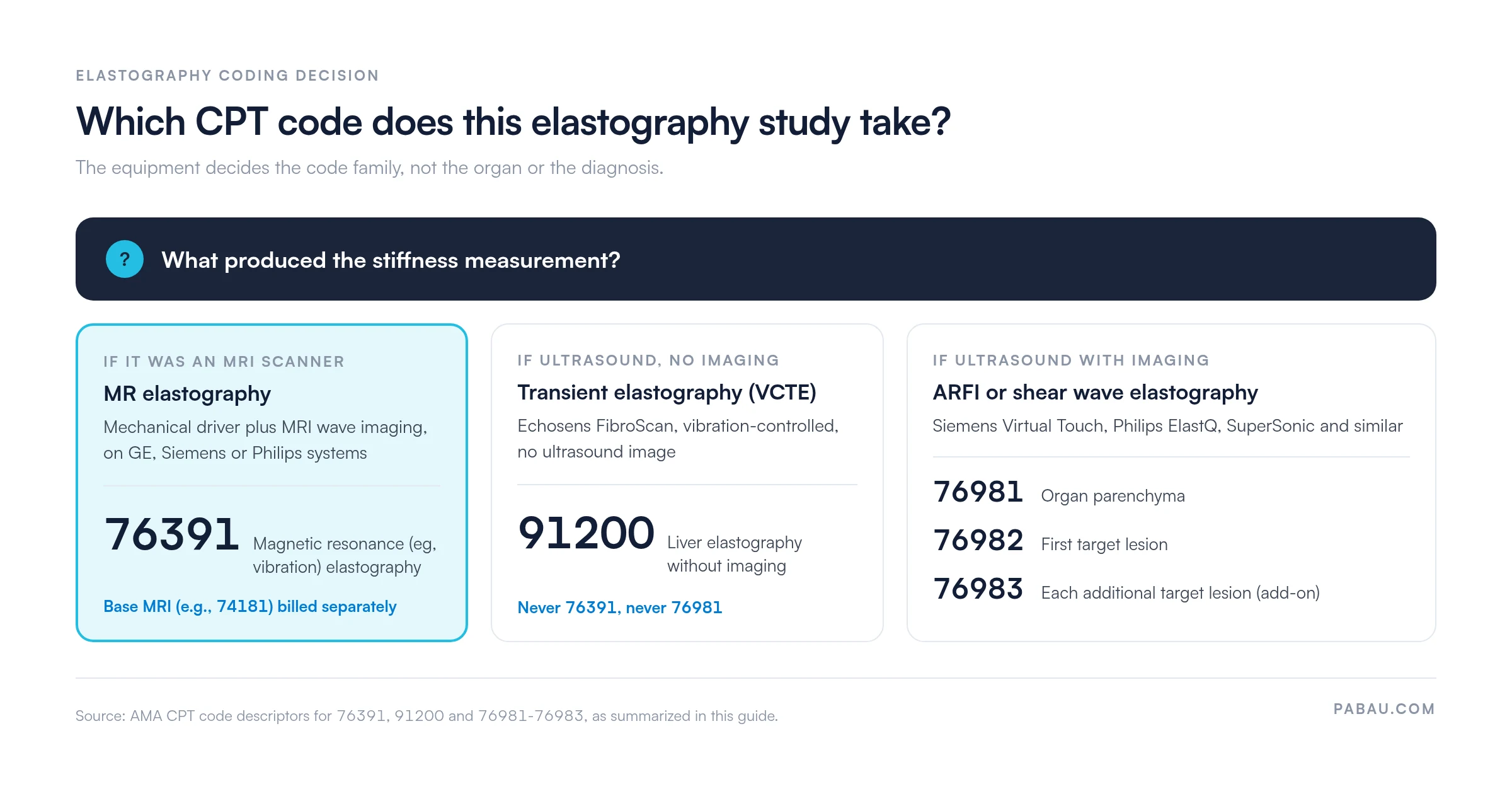
The equipment decides the code. If the study ran on an MRI scanner, bill 76391. If FibroScan or another non-imaging VCTE device produced the measurement, bill 91200.
If an imaging ultrasound system ran ARFI or shear wave elastography, bill from the 76981-76983 range. FibroScan is never correctly billed under CPT code 76391, and the three routes sit side by side below.
Beyond the FibroScan mix-up, 76391 is confused with several abdominal imaging codes. The following table maps the codes billers most often conflate, with the key distinguishing factor for each.
Medical necessity for CPT code 76391 requires an ICD-10-CM code for chronic liver disease that calls for non-invasive fibrosis staging. The groupings below are commonly accepted across MAC jurisdictions.
Payers can still deny the claim when the clinical documentation does not back the diagnosis, so these codes support medical necessity without guaranteeing coverage.
Documenting the clinical context matters as much as the code itself. A claim pairing K76.0 with 76391 is more defensible when the record backs it up. Elevated liver enzymes, prior imaging findings, or a note on why biopsy was deferred all help. Where the record documents cirrhosis without naming its type, the pairing is K74.60.
Before submitting claims for CPT 76391, verify the applicable MAC LCD by searching the CMS Medicare Coverage Database at cms.gov/medicare-coverage-database. Coverage criteria, including which ICD-10 codes are accepted and what prior workup must be documented, vary by jurisdiction and are updated periodically.
Medicare coverage for CPT code 76391 has no national coverage determination. Each Medicare Administrative Contractor (MAC) sets it through its own Local Coverage Determination (LCD).
Coverage criteria, covered diagnoses, and documentation requirements therefore differ depending on which MAC jurisdiction the rendering facility falls under. Key MACs with LCD policies for hepatic elastography include Noridian, Palmetto GBA, CGS, and WPS.
Most LCD policies share three coverage criteria:
Some LCDs also require a prior conventional imaging workup, or a record that liver biopsy was contraindicated or declined. These requirements are not uniform across jurisdictions, so verify them in the applicable LCD before you submit.
For Medicare fee-for-service (traditional Medicare), prior authorization is generally not required for covered services when the LCD criteria are met. Medicare Advantage plans operate differently, and individual plans may impose prior authorization requirements at their discretion. Commercial payers vary widely.
Prior authorization (PA) requirements for CPT code 76391 depend on the payer and the specific plan. Running insurance eligibility verification before scheduling is the most effective way to prevent PA-related denials.
If prior authorization is required and not obtained, most payers deny the claim outright. The denial reason typically reads “service not authorized” or “prior authorization not obtained.” Retro-authorization is rarely granted, so pre-service verification is essential.
Modifier selection for CPT code 76391 depends on the billing setting and which entity is performing each component of the service. The code is a diagnostic imaging code, so the standard technical component (TC) and professional component (-26) split applies.
Hospital outpatient departments bill the facility side on the UB-04 and are paid under the OPPS, without a TC modifier. The radiologist bills the -26 professional component on a separate claim.
Independent imaging centers bill globally when they also bill the interpretation, and append -TC when a radiology group bills the read itself. Physician offices that own the MRI and employ the interpreting physician bill globally with no modifier.
Reimbursement for CPT code 76391 is calculated using the Medicare Physician Fee Schedule (MPFS), which assigns Relative Value Units across three components. The national payment amount is then adjusted by a Geographic Practice Cost Index (GPCI) multiplier.
Rates change every year through CMS rulemaking. The figures below are the 2026 national values, so verify them against the current-year CMS Physician Fee Schedule lookup. Reconcile each payment against the electronic remittance advice to confirm it arrived at the expected rate.
At the 2026 conversion factor of $33.4009, the national unadjusted global payment for CPT code 76391 is about $197 before GPCI adjustment. All 1.07 work RVUs sit in the professional (-26) component, and the technical (-TC) component carries none.
Practice expense and malpractice RVUs split between the two, so check the -26 and -TC rates in the CMS lookup. The FastRVU lookup tool calculates the GPCI-adjusted payment for a specific locality. CMS assigns 76391 the global period indicator XXX, meaning the global surgery concept does not apply.
Billing CPT code 76391 correctly depends on who owns the equipment, who interprets the study, and where the service is rendered. The same procedure produces three different claim constructions across three settings.
A clean claim starts with the right claim form (CMS-1500 or UB-04), the right billing NPI, and the right place of service code. Facility and professional claims from the same encounter are processed independently. The payer still expects only one technical and one professional claim per procedure.
Denials for CPT code 76391 cluster around a predictable set of failure points. Practices with strong denial management catch most of them before the claim is submitted. Claims management software flags incomplete documentation or missing authorizations before claims leave the practice.
For detailed CARC denial reason codes associated with these failure types, see the reference on denial codes in medical billing.
A 76391 claim stands or falls on the radiology report. Payers and MAC auditors look for four elements, and a report missing any one of them invites a medical necessity denial.
Keep the supporting record within reach as well: liver enzymes, prior imaging, and any note on why biopsy was deferred. For a repeat study, document what changed clinically since the last MRE, which also answers a frequency denial before it happens.
Report the liver stiffness value in kilopascals (kPa) and the reference range used in every MR elastography report. Payers increasingly audit 76391 claims for reports without that number, and they treat its absence as evidence that the service was not rendered as described.
Most 76391 errors start before anyone builds the claim. An eligibility check gets skipped at scheduling, a FibroScan gets coded as MRE, or a report goes out without a stiffness value. When those checks live across a scheduler, a spreadsheet, and a clearinghouse portal, they depend on someone remembering them.
In Pabau, eligibility verification, claim submission, and denial tracking sit in one billing workflow. Claims go out through the Claim.MD clearinghouse integration, straight from the billing screen. Built-in CPT and ICD-10 catalogs flag common pairing errors before the claim reaches the payer.
When a denial does come back, it lands against the same patient record and claim. Your billing team corrects and resubmits it in minutes instead of rebuilding it from scratch.

Pabau connects eligibility verification, claim submission, and denial tracking in one place so your billing team spends less time chasing and more time closing claims.

CPT code 76391 is a narrow code, and that narrowness works in your favor. Settle the equipment before anyone picks a code. MRI means 76391, FibroScan means 91200, and imaging ultrasound elastography means 76981-76983.
The second habit is the report. A claim backed by an indication, a kPa value, and an interpretation holds up in an audit. Without them, the payer has an easy reason to take the payment back.
If your team bills imaging codes like 76391 every week, fewer manual handoffs mean fewer of these denials. Book a demo to see how Pabau keeps eligibility, claims, and denials for imaging codes in one workflow.

Need a clearinghouse for submitting radiology claims? How a medical claims clearinghouse works explains the submission and adjudication process for imaging and diagnostic codes.
Want to reduce claim errors before submission? Revenue cycle management fundamentals covers the end-to-end billing workflow from encounter to payment posting.
Dealing with repeat claim rejections? Medical billing compliance guidance outlines the documentation and audit-readiness standards that prevent downstream denials.
CPT code 76391 describes magnetic resonance elastography, most often of the liver. It covers the MRI-based acquisition of shear wave data plus the physician’s interpretation and written report. FibroScan bills 91200, and imaging-based ultrasound elastography such as ARFI or shear wave elastography bills 76981, 76982, or 76983.
FibroScan is billed under CPT 91200, liver elastography without imaging, not under 76391 or 76981. CPT 76391 is reserved for MR elastography performed on an MRI scanner. Codes 76981-76983 cover ultrasound elastography performed with imaging, such as ARFI or shear wave elastography.
Medicare coverage for CPT 76391 is governed by MAC-specific Local Coverage Determinations and varies by jurisdiction. Most LCDs cover MR elastography for chronic liver disease diagnoses including liver fibrosis, chronic hepatitis B or C, and NAFLD when medical necessity is documented. Check the CMS Medicare Coverage Database for the LCD applicable to your MAC region.
Commonly accepted ICD-10-CM codes include K74.x for liver fibrosis and cirrhosis and B18.x for chronic viral hepatitis. K76.0 covers nonalcoholic fatty liver disease. K70.x covers alcoholic liver disease, and K76.89 covers other specified conditions such as autoimmune hepatitis. The clinical documentation must substantiate the diagnosis, because an accepted code alone does not guarantee coverage.
In 2026, CPT 76391 carries 5.91 total RVUs in global billing: 1.07 work, 4.76 practice expense, and 0.08 malpractice. At the $33.4009 conversion factor, that is a national unadjusted Medicare payment of about $197 before GPCI adjustment. Verify current figures in the CMS Physician Fee Schedule Look-Up Tool, as values change annually.
Yes, CPT 76391 can be billed on the same date as an E&M service when both are separately documented. The E&M must be a significant, separately identifiable service beyond the imaging procedure. Modifier -25 on the E&M code is required to indicate the visit was distinct from the radiology service. Verify there are no payer-specific bundling restrictions before billing both on the same claim.