HCPCS Code Q4185: Cellesta flowable amnion billing guide
HCPCS Code Q4185: definition and official descriptor HCPCS Code Q4185 is the Lev...

Last Updated: Nov 20, 2026
76390 is the CPT code for magnetic resonance spectroscopy (MRS). The scan measures tissue chemistry, such as choline, creatine and N-acetylaspartate levels, rather than anatomy.
It is a standalone diagnostic radiology code, not an add-on, so it can be billed without a parent MRI code. Medicare has had no national coverage policy for MRS since 2021. Each MAC decides coverage and sets the carrier-priced rate, so confirm with yours and document medical necessity.
Let Pabau's smart automation suggest the right codes, reduce claim denials, and keep your practice compliant—effortlessly.
Automate repetitive tasks and focus on what matters most—your patients.
Reduce coding errors and ensure compliance with the latest regulations.
Clean claims, fewer denials, and faster reimbursements.
Powerful insights and reporting to help your practice thrive.
HIPAA compliant SOC 2 certified GDPR-compliant Trusted by 4,000+ clinics worldwide

CPT code 76390 reports magnetic resonance spectroscopy (MRS) and is a standalone diagnostic radiology code, so it can be billed without a parent MRI code.
Medicare has had no national coverage determination for MRS since January 1, 2021, so each MAC decides coverage and sets the carrier-priced payment.
No MAC has published an LCD listing covered indications for 76390. Confirm coverage with your MAC and document medical necessity in the order and the report.
Use 76390 when the report describes metabolite peaks and ratios, and 76391 when it measures tissue stiffness with MR elastography.
Pabau, the practice software we build, tracks the prior authorization on the patient’s case and warns staff when one is missing.
CPT code 76390 reports magnetic resonance spectroscopy (MRS), a standalone code in the Diagnostic Radiology section of CPT. Its official descriptor is “Magnetic resonance spectroscopy,” as maintained by the AMA’s CPT Editorial Panel. AAPC’s code listing files it under Other Procedures (76000-76499) in Diagnostic Radiology. The code carries no add-on (+) symbol, so it can sit on a claim with no parent MRI code.
MRS runs on the same scanner as an MRI but answers a different question. A routine MRI shows anatomy. Spectroscopy measures the chemistry of a chosen tissue volume, or voxel, reading metabolites such as choline, creatine, N-acetylaspartate (NAA) and lactate. Radiologists use that chemical profile to characterize brain lesions and to tell recurrent tumor from radiation necrosis.
XXX is the standard global period for diagnostic tests, and it says nothing about add-on status. Add-on codes carry ZZZ instead. Some older billing grids still flag 76390 as an add-on, and a claim editor then rejects a valid standalone line for lacking a primary code. Checking internal templates against the current CPT book belongs in every medical billing workflow.
Report CPT 76390 for the spectroscopy acquisition and its interpretation, whether or not an MRI of the same anatomy is billed that day. When both are performed in one session, each code goes on its own line. The report then has to document each service.
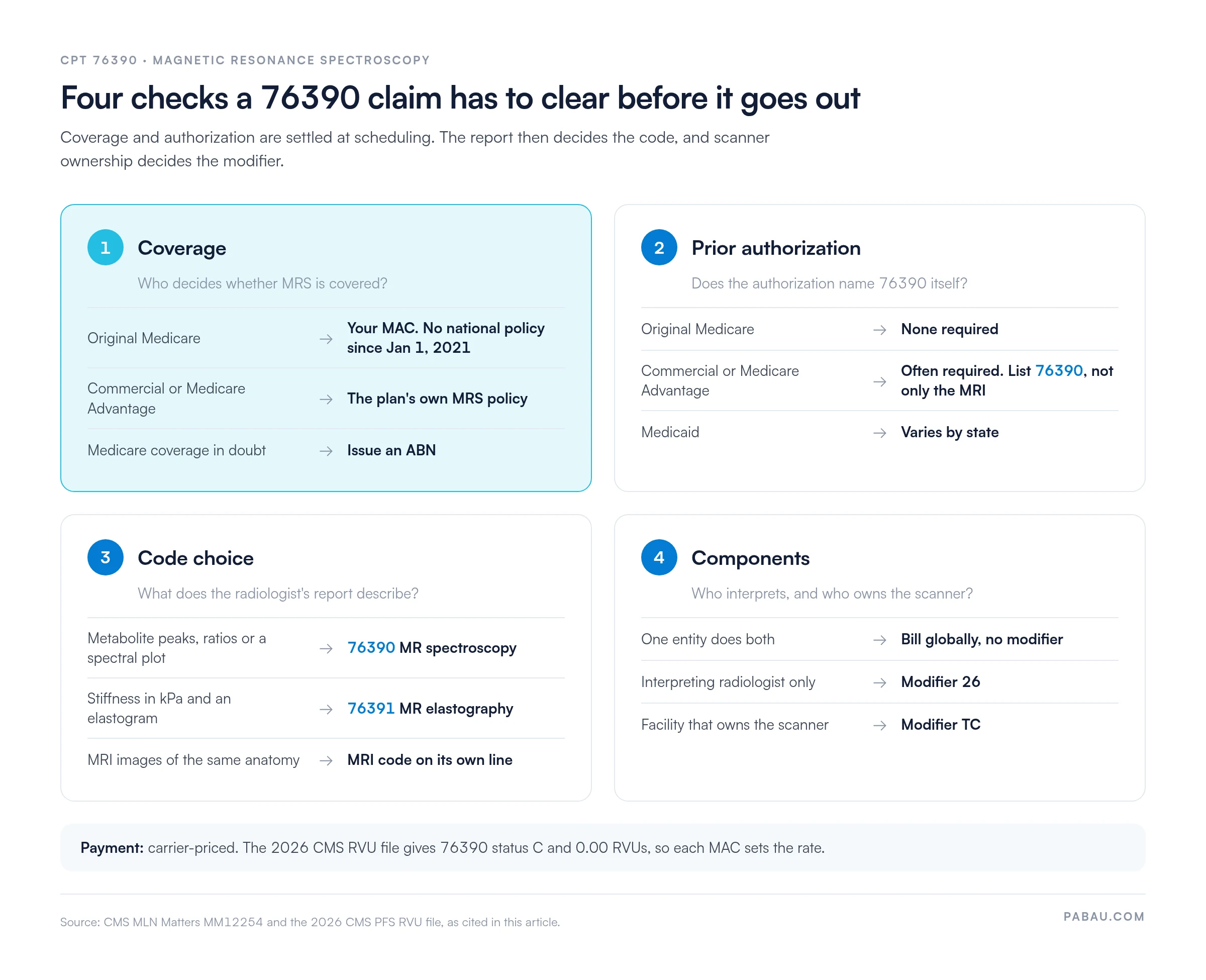
Before any of those lines goes out, a 76390 claim has to clear four checks, in the order shown below.
CPT 76390 reports MR spectroscopy, which measures tissue chemistry. CPT 76391 reports magnetic resonance (eg, vibration) elastography, which measures tissue stiffness. The AMA added 76391 to CPT in 2019. Both are standalone diagnostic radiology codes, and neither is an add-on.
The radiologist’s report decides the code. Metabolite peaks, ratios or a spectral plot point to 76390. A stiffness value in kilopascals and an elastogram point to 76391. If one session produces both studies, report each code once and document each finding.
Original Medicare has no national coverage policy for MR spectroscopy. CMS removed NCD 220.2.1, Magnetic Resonance Spectroscopy, in the Calendar Year 2021 Physician Fee Schedule final rule. Under MLN Matters MM12254, coverage reverted to each MAC’s discretion for dates of service on and after January 1, 2021.
No MAC has published a coverage policy for MRS since then. No current Local Coverage Determination (LCD) lists covered indications for 76390. The only current Medicare Coverage Database document that names the code is Billing and Coding article A58559, Independent Diagnostic Testing Facilities (IDTF). It sets supervision requirements and lists no indications.
Payment follows the same pattern. The 2025 and 2026 CMS physician fee schedule RVU files give 76390 status indicator C, which means carrier-priced, with 0.00 RVUs. The MAC sets the payment amount, so there is no national rate to quote.
For every Medicare spectroscopy claim, that leaves three steps:
Commercial payers write their own MRS policies, and many are narrow. Aetna’s clinical policy bulletin 0202 covers MRS for a short list of indications. These include grading gliomas, telling recurrent brain tumor from radiation necrosis, and certain metabolic disorders and leukodystrophies. It treats MRS as experimental for other uses, including prostate cancer and epilepsy.
Medicare Advantage plans may add their own criteria, and Medicaid rules vary by state. Checking the plan’s current policy at scheduling, rather than at submission, is the core of clean claim submission for 76390.
No Medicare source lists the ICD-10-CM codes that support 76390, so there is no national crosswalk to copy. Code the diagnosis that prompted the study, at the highest specificity the record supports. That might be a confirmed brain malignancy, a lesion under evaluation, or a suspected metabolic disorder.
Commercial plans that cover MRS name their indications in the policy itself. Match the diagnosis on the claim to one of those indications, and make sure the order states the clinical question spectroscopy will answer. A listed diagnosis paired with an order that never mentions it still invites a medical necessity denial.
Every 76390 claim needs a record showing that spectroscopy was ordered, performed and interpreted as a service in its own right.
A report that describes the MRI findings and adds one sentence about spectroscopy will not support the code. The spectroscopic interpretation should read as a complete finding on its own.
Many commercial payers and Medicare Advantage plans require prior authorization for CPT 76390, often through an advanced imaging review program. Original Medicare has no prior authorization requirement for 76390. Rules differ by plan and region, so confirm them before the study.
Conducting insurance eligibility verification before the procedure is the first checkpoint. It surfaces both the patient’s benefit coverage and the specific authorization requirements for the code.
Medicare pays CPT 76390 at a rate each MAC sets, because the code is carrier-priced. The CMS Medicare Physician Fee Schedule carries 0.00 RVUs for it, so a national lookup returns no usable dollar figure.
Ask your MAC for its 76390 pricing, or check its own fee schedule where it publishes one. Commercial rates come from each payer contract. Lookup tools that read the CMS file, such as FastRVU, cannot give a national figure for a carrier-priced code.
US practices can send radiology claims through Claim.MD, the clearinghouse Pabau connects to. It sends CMS-1500/837P claims, runs eligibility checks and returns electronic remittance advice (ERA). A short-paid 76390 line then shows up against the original claim.
Modifier 26 and modifier TC split the professional and technical components of a radiology service. For CPT code 76390, the split is relevant whenever the physician interpreting the study and the facility owning the MRI equipment bill separately.
The professional component (modifier 26) covers the radiologist’s interpretation and report. The technical component (TC) covers equipment use, technologist time, and supplies. Never apply both modifiers to the same claim line from the same billing entity. An entity that provides both components bills the code globally, with no modifier.
Before billing 76390 with modifier 26 at a hospital outpatient department, confirm whether the facility is submitting a separate UB-04 claim for the TC. Duplicate billing between the physician practice and the facility is an audit red flag and can result in overpayment demand letters from Medicare.
Most CPT 76390 denials trace back to coverage, documentation or code choice. Each one below is preventable with a check before the claim goes out.
Structured denial management workflows catch these patterns early. When the same reason code repeats across several 76390 claims, the fix belongs in scheduling or reporting. Review the denial codes in medical billing reference to map each CARC and RARC to its remediation path.
Spectroscopy claims fail for reasons that start well before submission. Coverage has to be confirmed with the MAC or plan, and the authorization has to name 76390. The report also has to describe the spectroscopy findings. When those checks live in email threads and spreadsheets, one of them gets missed under volume.
Pabau keeps those steps on the patient’s case. The prior authorization code, its dates and its sessions sit on the case, and Pabau warns staff when an authorization is missing. US claims then go out through Claim.MD from the same record, and Pabau’s claims management software tracks each one to payment.
The result is fewer spectroscopy claims sent back for paperwork, and a clear record of who confirmed coverage and when. Billing staff can then spend their time on the claims that need a payer conversation. For a wider view of the options, see our guide to medical billing software.

Pabau tracks prior authorizations on the patient’s case and sends US claims through Claim.MD. Each 76390 claim leaves with its authorization already on record.

CPT code 76390 is a standalone code, so the billing work sits in coverage and documentation rather than code pairing. Medicare left MRS coverage to the MACs in 2021, and no MAC has published covered indications since. The practice has to confirm coverage, record medical necessity and keep the radiology report specific.
Build those checks into scheduling, and spectroscopy claims stop depending on who is at the billing desk that day. Skip them, and denials arrive weeks after the scan. Book a demo to see how Pabau tracks authorizations and claims for radiology practices.

Requesting approval before a commercial imaging study? UnitedHealthcare prior authorization form explains how to complete the request before an imaging study is scheduled.
Seeing high denial rates across your CPT codes? Denial management in healthcare covers systematic workflows for reducing claim rejections and recovering revenue.
Want to understand the full revenue cycle behind billing? What is revenue cycle management breaks down each stage from patient registration through final payment posting.
CPT code 76390 describes magnetic resonance spectroscopy (MRS). The study measures tissue metabolites, such as choline, creatine and NAA, to characterize brain lesions and metabolic disorders. It is a standalone diagnostic radiology code with an XXX global period.
No. CPT 76390 is a standalone diagnostic radiology code with no add-on (+) symbol, so it can be billed without a parent MRI code. Its XXX global period is the standard setting for diagnostic tests. Add-on codes carry ZZZ instead.
Coverage is each MAC’s decision. CMS removed the national coverage determination for MR spectroscopy, NCD 220.2.1, for dates of service from January 1, 2021. No MAC has since published an LCD with covered indications, and the code is carrier-priced. Confirm coverage with your MAC and document medical necessity.
CPT 76390 reports magnetic resonance spectroscopy, which measures tissue chemistry. CPT 76391 reports magnetic resonance (eg, vibration) elastography, which measures tissue stiffness and is used mostly to stage liver fibrosis. Both are standalone codes. Metabolite ratios in the report point to 76390, and stiffness values point to 76391.
Yes, modifier 26 and modifier TC both apply to CPT 76390 in split-billing scenarios. Modifier 26 is used by the radiologist who interprets the study when a separate facility owns the MRI equipment. Modifier TC is used by the facility for the technical component (equipment, technologist time, supplies). When a single billing entity performs and owns both components, no modifier is needed.
Billing CPT 76390 requires a physician order specifying MR spectroscopy with a documented clinical indication. The radiologist’s report must describe the spectroscopic findings in detail, not just confirm the study was done. The ICD-10-CM code must match the indication, and any required prior authorization number must be on the claim.
There is no national Medicare rate for CPT 76390. The code is carrier-priced, with status indicator C and 0.00 RVUs in the 2026 CMS fee schedule files. Each MAC sets the payment, so ask your MAC for its current pricing.