CPT code 52648: Laser ablation of the prostate billing guide
What CPT code 52648 covers, and what it bundles in CPT code 52648 is the code fo...

Last Updated: Oct 21, 2026

CPT Code 76377 describes 3D rendering with interpretation and reporting of CT, MRI, or ultrasound performed on an independent workstation under concurrent physician supervision
The independent workstation and the concurrent supervision are what separate 76377 from 76376, which makes supervision documentation the primary audit and denial trigger
Multiplanar reformats and coronal or sagittal reconstructions do not qualify for 76377 billing, and CMS and commercial payers both audit that distinction
Practice management software like Pabau helps imaging practices build documentation checklists and track claim status for codes like 76377
CPT Code 76377 covers 3D rendering with interpretation and reporting, performed on an independent workstation under concurrent physician supervision.
It is an add-on code, billed alongside the CT, MRI, or ultrasound study it reconstructs. The American Medical Association (AMA) maintains the CPT code set and publishes the descriptor that defines those requirements.
This reference covers the descriptor, the 76376 distinction, documentation requirements, modifiers, and Medicare reimbursement. It also covers the denial reasons that cost imaging practices the most, and the ICD-10 codes that support medical necessity.
CPT Code 76377 describes 3D rendering with interpretation and reporting of computed tomography, magnetic resonance imaging, ultrasound, or other tomographic modality. The image post-processing is performed on an independent workstation under concurrent physician supervision. The code sits within the Other Diagnostic Radiology Procedures section of the AMA CPT codebook.
The independent workstation and the concurrent supervision carry the most billing weight in that descriptor. Both must be documented in the medical record for the claim to hold up under payer review. Neither is implied by the underlying imaging study alone.
The Other Diagnostic Radiology Procedures subsection ends with 76499, the unlisted code for a radiographic procedure that no code between 70010 and 76498 describes. Post-processing work that meets neither the 76376 nor the 76377 descriptor is reported there.
The word that separates these two codes is “independent.” CPT Code 76376 covers the same 3D rendering service without requiring an independent workstation or concurrent physician supervision. Payers, including Medicare, audit whether practices are upgrading from 76376 to 76377 without meeting the higher requirements.
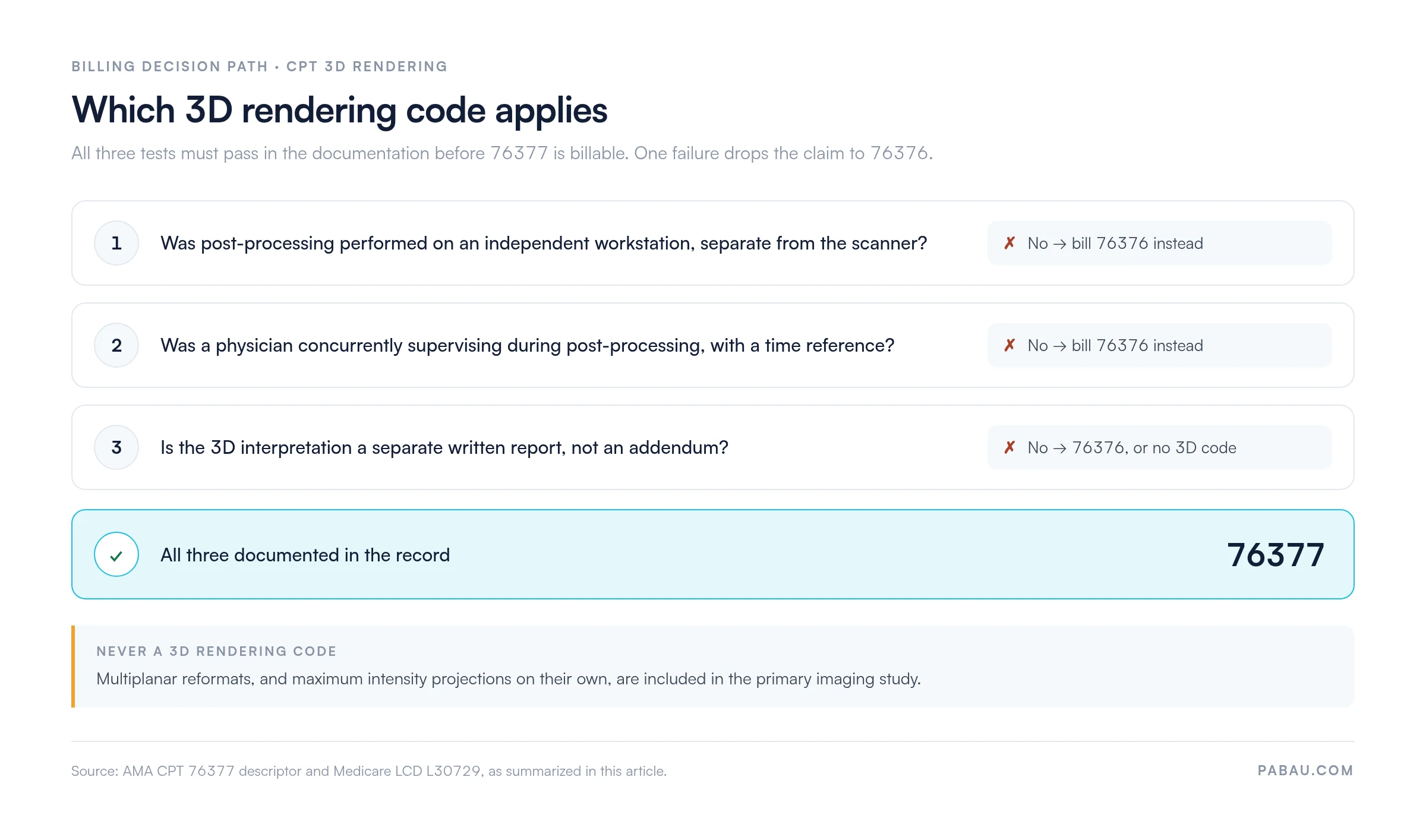
A practice using the same scanner workstation for acquisition and post-processing cannot bill CPT Code 76377, even with a physician present. The independent workstation must be a physically separate system dedicated to image post-processing. Three documentation tests decide which code a session earns, and the path below runs through them in order.
Incomplete documentation is the leading cause of 76377 denials. Payers want evidence of every qualifying condition, not just the final interpretation report. Billing staff should confirm each element below is in the record before the claim goes out. That works only when the record is built at the point of care, rather than during claim scrubbing.
The primary study reference should name the code billed for that underlying study. For a limited or localized follow-up CT, that code is 76380, and 76377 is appended to it.
Practices managing high imaging volumes should build templated note structures that prompt for each required element. The burden falls hardest on add-on codes like this one, because they carry billing criteria the primary study does not establish.
Modifier selection for CPT Code 76377 determines which component of the service is being billed, and by whom. Incorrect modifier use is a common source of both underpayment and overpayment recoupment.
Facility settings typically require separate billing by the hospital (TC) and the radiologist (modifier 26). Non-facility settings where the radiologist owns the equipment allow global billing. Verify modifier rules against the current Physician Fee Schedule, since they vary by contractor jurisdiction.
Medicare reimburses CPT Code 76377 under the CMS Physician Fee Schedule, with rates varying by geographic locality and setting. The professional and technical components price separately, so the modifier on the claim decides what Medicare pays.
CMS publishes fee schedule data annually, and the amount paid depends on the locality and the place of service. The table below shows how each billing component prices, rather than one national figure. Look up the current amount for your MAC jurisdiction in the CMS fee schedule tool before you submit.
Medicare coverage for CPT Code 76377 is governed by Local Coverage Determination L30729 (RAD-037). Confirm your MAC has issued no additional contractor-specific restrictions before billing. A clearinghouse validates payer-specific edits before a claim reaches the payer, which catches modifier errors and locality mismatches early.
Commercial payer policies for 3D rendering codes vary significantly. Medicare LCD L30729 sets the baseline, and private payers may impose stricter or different criteria. Reading the landscape first reduces avoidable denials.
The CMS list of CPT and HCPCS codes for physician self-referral identifies designated health services under the Stark Law. It is a referral-compliance list, not a guide to what a commercial payer covers. When a payer’s own policy is unclear, request a written copy of their 3D rendering coverage determination. That costs less than building documentation processes around an assumed payment.
Most 76377 denials are preventable, because the common thread is documentation failure rather than eligibility failure. Building the documentation triggers into the imaging workflow, instead of treating them as billing department tasks, is what brings the denial rate down.
Tracking denial reason codes at the procedure level shows whether 76377 denials cluster around one missing element. Diagnosis coding errors compound procedure coding errors, so audit both together rather than in sequence.
Run a quarterly audit of 76377 claims against denial reason codes. If supervision documentation is the top cited reason, rebuild the attestation step into the imaging workflow itself, not the billing workflow. Documentation captured at the point of care is far more defensible during a payer audit than a retrospective addition.
ICD-10 diagnosis codes paired with CPT Code 76377 must support the medical necessity of the 3D rendering, not just the underlying imaging study. Payers do not automatically accept a diagnosis code that justifies the primary CT or MRI. The AAPC CPT-to-ICD-10 crosswalk gives a starting point, but payer LCD criteria and clinical policies govern what is finally accepted.
Before a diagnosis code goes on the claim, confirm its current wording and billable status in the ICD-10-CM code index. A code that was billable last year may have been split or retired in the annual update.
These are common pairings, not guaranteed coverage triggers. In neurological imaging, intracranial aneurysm planning and vascular malformation characterization are among the higher-volume contexts for 76377. Document why 3D imaging was needed for this patient’s diagnosis or surgical planning. The diagnosis code alone does not establish medical necessity.
Knowing what does not qualify matters as much as knowing what does. The line between volumetric 3D rendering and routine post-processing is a primary audit target for CMS and commercial payers.
Multiplanar reformats do not qualify. Coronal, sagittal, and oblique reformatted images generated from axial data are standard post-processing outputs, included in the primary imaging study. They are not 3D renderings. Neither 76376 nor 76377 should be reported when the documented procedure is a multiplanar reformat only. CMS guidance states this explicitly, and ACR and SIR coding resources confirm it.
Maximum intensity projections (MIPs) typically do not qualify. MIP images are frequently generated during CT angiography or MR angiography. Unless volumetric 3D rendering with physician supervision and interpretation was also performed, MIPs alone do not support 76377 billing.
When a practice generates 3D reconstructions routinely, ask one question before coding. Was a physician concurrently supervising post-processing on an independent workstation, and producing a separate interpretation report? If any part of that is no, the session earns 76376 or no 3D code at all.
The documentation requirements for CPT Code 76377 are not hard to meet. They are hard to meet consistently, on every session, across a high-volume imaging practice. That consistency is what a structured clinical workflow buys you.
Pabau’s medical claims management tools connect clinical documentation to billing submission, which creates an audit trail from the procedure note to the claim. Templated notes can prompt for the supervision attestation, the workstation identifier, and the separate interpretation report that 76377 requires. When all three are captured at the point of care, billing staff stop chasing radiologists for addenda.
Pabau’s reporting surfaces rejection patterns at the procedure level. When 76377 claims keep failing on the same reason code, that pattern shows up across the practice instead of sitting buried in individual claim queues. The fix then lands on the workflow rather than on one coder.
Pabau also integrates with Claim.MD for electronic claim submission in the US, so claims are validated against payer edits before they are sent. That shortens the time between the imaging session and the payment on codes like 76377, where payer edits are common.

Pabau helps imaging and radiology practices build structured clinical notes and track claim status. It also surfaces denial patterns, so your team spends less time on re-work and more on patient care.

CPT Code 76377 pays more than 76376 because it demands more. It needs an independent workstation, concurrent physician supervision, and a separate interpretation report. Two of those three are equipment and process decisions you make once. The third has to be captured live, every single time.
So the honest question is not whether your practice qualifies for 76377, but whether your imaging workflow can prove it on demand. If it cannot yet, bill 76376 and fix the attestation step first. A defensible 76376 is worth more than a 76377 that a payer recoups eighteen months later.
Book a demo to see how Pabau builds 76377 documentation prompts into the imaging workflow and surfaces denial patterns at the procedure level.

Need to understand medical billing fundamentals for your practice? Revenue cycle management overview covers the full claim lifecycle from patient encounter to payment posting.
Working to reduce claim denials across your billing team? Denial codes in medical billing provides a reference guide to CARC codes and prevention strategies.
Managing billing compliance across multiple modalities? Superbill documentation guide explains how to structure procedure-level documentation for clean claim submission.
Want fewer add-on codes rejected on first submission? Clean claim submission walks through the scrubbing checks that catch modifier and locality errors early.
Preparing for a payer audit of your imaging claims? Medical billing compliance sets out the record-keeping standards an auditor expects to find.
CPT Code 76377 is a billing code for 3D rendering with interpretation and reporting of computed tomography, MRI, ultrasound, or other tomographic imaging. The post-processing is performed on an independent workstation under concurrent physician supervision. It sits within the Other Diagnostic Radiology Procedures section of the AMA CPT codebook, and is billed as an add-on to the primary imaging study.
The key difference is the independent workstation and concurrent physician supervision requirements. CPT 76376 covers 3D rendering without requiring a separate workstation or concurrent supervision. CPT 76377 requires both, which makes it eligible for higher reimbursement but also more vulnerable to denial if documentation is incomplete.
Five elements. The record must confirm that post-processing happened on an independent workstation. It must show concurrent physician supervision during post-processing, with a time reference. It must contain a separate written interpretation report, distinct from the primary imaging report. It must document the clinical indication that establishes medical necessity. It must also reference the underlying imaging study.
Modifier -26 applies when the physician performs only the professional component and does not own the equipment. The -TC modifier applies when a facility bills only the technical component, meaning the equipment and staff. No modifier is used when the same entity provides both components, which is the global service. Incorrect modifier use is a frequent source of both underpayment and recoupment.
The most common reason is missing concurrent supervision documentation. Others include no confirmation that an independent workstation was used, billing 76377 when only multiplanar reformats were performed, and no separate interpretation report. Claims also fail when nothing links the 3D rendering to a specific clinical decision. Most of these denials are preventable through documentation process changes.
Yes. Concurrent physician supervision during post-processing on the independent workstation is a mandatory billing requirement for CPT Code 76377. General supervision, or supervision at the point of interpretation only, does not satisfy the requirement. The physician must be present, and the record must document that with a time reference.
Appropriate ICD-10 codes are diagnoses where 3D rendering directly supports clinical decision-making. Examples include aortic aneurysm (I71.4) for endovascular planning, complex fractures for surgical reconstruction planning, oncologic staging, and structural cardiac anomalies. The diagnosis code must justify the 3D rendering specifically, not just the underlying imaging study. Verify paired codes against the applicable LCD or payer policy.