CCSD code F3070: Suture of palate billing guide
CCSD code F3070 covers stitching a wound in the palate CCSD code F3070 is the co...

Last Updated: Oct 12, 2026

CPT code 76376 is an add-on code for 3D rendering done on the same workstation as the primary scan, so it never bills alone.
Use 76376 when post-processing stays on that workstation, and 76377 when a separate independent workstation is required.
Both codes need a formal written interpretation and report, and a missing report is the leading cause of denials.
Medicare’s 2026 non-facility national average is roughly $25, built from a 0.76 total RVU.
Pabau, practice management software with claims handling built in, connects to Claim.MD for eligibility checks, 837P submission, and ERA posting.
CPT code 76376 covers 3D rendering with interpretation and reporting, done on the same workstation that acquired or read the primary imaging study. It is an add-on code, so it always travels with a parent CT, MRI, or ultrasound line.
One fact decides most 76376 claims, and that is the workstation. Same workstation means 76376. A separate, dedicated 3D workstation means 76377 instead. Choose the wrong one and the claim either underpays or invites a review, which is why the workstation belongs in the report itself.
From here the sections work through the descriptor, the documentation payers ask for, modifiers, 2026 Medicare rates, RVUs, CCI edits, and the ICD-10 pairings.
The American Medical Association defines CPT code 76376 as 3D rendering with interpretation and reporting.
It applies to computed tomography, magnetic resonance imaging, ultrasound, and other tomographic modalities. The post-processing happens under concurrent supervision, and it must not require an independent workstation.
Four facts define the code for billing purposes:
The code works across modalities, from CT and MRI through to ultrasound. Common uses include 3D reconstructions for orthopedic fracture assessment, vascular mapping before an intervention, and craniofacial surgical planning from CT data.
The workstation is the only structural difference between the two codes, and it changes the money. Bill 76376 where 76377 applies and you underbill the study. Bill 76377 on same-workstation work and you invite a review.
Decision rule: Bill 76376 if the radiologist did the 3D post-processing without leaving the scanner console or the primary reading workstation. Bill 76377 if the work moved to a separate, dedicated 3D workstation, wherever that machine sits. Never put both codes on the same imaging session.
Thin documentation is the leading denial trigger for CPT code 76376. Payers want evidence that the clinical need and the technical process both meet the code’s criteria, and they read the report to find it.
Most of this belongs in the reporting template rather than on a billing checklist. A template that prompts for the workstation and forces a separate 3D interpretation field changes the odds.
The radiologist fills those fields before signing, so the coder never has to chase them.
This code is not exotic once the charge is right. What makes it fragile is its dependence on another line of the same claim, so it can fail at points a standalone code never reaches.
Steps two and three are where 76376 usually dies. The workstation note and the separate report both sit with the radiologist, not the billing team.
That is why a reporting template prevents more denials than an appeal ever recovers.
Modifier choice on this code is narrower than on a primary radiology line, and several familiar modifiers have no role at all. The table sorts the ones worth knowing.
One correction worth making here. CPT 76376 carries a work RVU of 0.20 alongside its practice expense, so component billing does not fail simply because the code is an add-on.
Look up the code’s PC/TC indicator in the current MPFS relative value file, then match the modifier to whoever owns the workstation.
Beyond that, payer policy governs. Medicare and commercial payers disagree on modifier use for add-on codes, so submit without a modifier first. Append one only when a denial specifically cites bundling or component billing.
Medicare pays roughly $25 for CPT code 76376 in 2026. That figure comes from a 0.76 total RVU multiplied by the $33.40 conversion factor, before any locality adjustment.
Practices in high-cost areas such as Manhattan or San Francisco collect more once the Geographic Practice Cost Index is applied. Run the number for your own MAC locality with the Medicare Physician Fee Schedule lookup rather than working from the national average.
The RVU file gives 76376 a work value, which surprises anyone expecting an add-on code to carry none. Work sits at 0.20, practice expense at 0.54, and malpractice at 0.02.
Practice expense still dominates, because it absorbs the workstation, the software, and technologist time. The split below shows how the three parts become a payment.
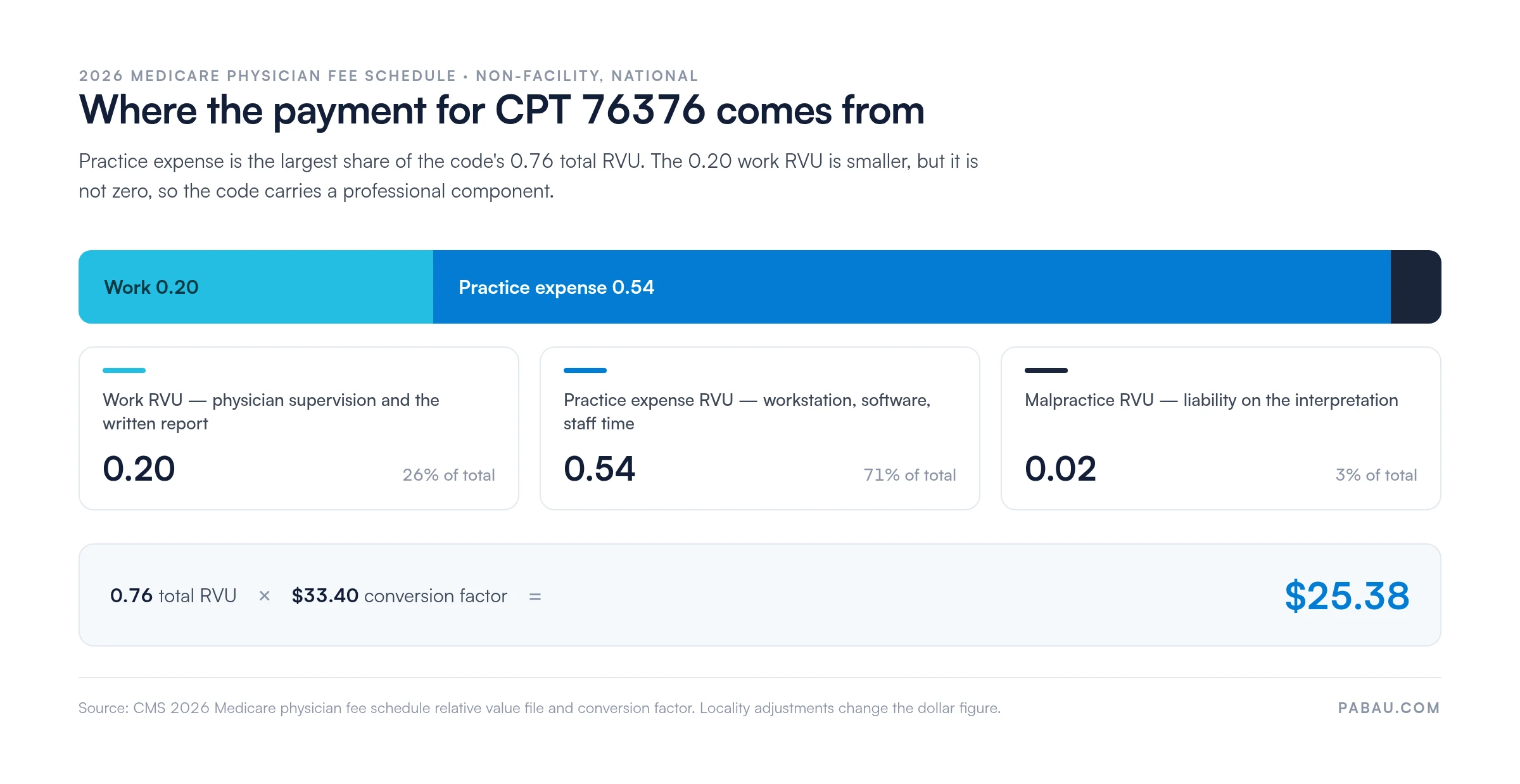
Values move with every final rule, so confirm them before you calculate an expected payment. The FastRVU 2026 lookup tool returns current work, practice expense, and malpractice values for a given MAC locality.
Medicare covers CPT code 76376 under the physician fee schedule when the documentation holds up. Commercial coverage varies far more. Blue Cross Blue Shield of North Carolina, for instance, has applied restrictive policies to 3D radiology codes.
The American College of Radiology formally challenged that position. Read each payer’s medical policy for 3D rendering before you bill, because some require prior authorization and others apply frequency limits.
Run an eligibility check for CPT 76376 before each imaging study, not after. Commercial payer policies on 3D rendering codes change more frequently than most other radiology codes. A payer that covered the code last quarter may have added a prior authorization requirement. Catching this at scheduling prevents a denied claim downstream.
The National Correct Coding Initiative publishes the bundling edits that decide which codes can share a claim. For 76376 the core rule is short. It needs a qualifying primary imaging code, it never stands alone, and it never pairs with 76377 in the same session.
Billing 76376 and 76377 for one imaging encounter is a hard edit, so the claim denies automatically. The table covers the pairings that come up most often.
CMS updates the NCCI edit tables quarterly. Verify any specific pair against the current release before you rely on it for a submission.
One instruction lives in the CPT book rather than the NCCI tables, and it catches people out. The parenthetical notes under 76376 and 76377 list a long set of codes you must not report them with.
CT angiography and MR angiography make up most of that list, because angiographic reconstruction is built into those procedures.
Their values already pay for the 3D work, so adding 76376 bills it twice. Codes 70496 for the head, 71275 for the chest, and 74174 for the abdomen and pelvis are three you will meet often.
Check the parenthetical before you append 76376 to any angiographic study.
A diagnosis code that supports medical necessity matters as much as the procedure code here. Payers read the ICD-10 code to judge whether the extra post-processing was warranted.
Our ICD-10-CM code reference covers the code sets that pair with imaging studies. The CMS ICD-10 codes page carries the current tabular and index files.
This crosswalk shows common clinical scenarios, not a payer-approved list. Check that the code you submit matches the indication written in the chart. A diagnosis that contradicts the clinical narrative is a medical necessity denial waiting to happen.
Denials on this code cluster around a short list, and catching them at charge entry costs far less than appealing them later. Good denial management starts by treating these six as scrub rules rather than a training topic.
Six questions, asked at charge entry, catch nearly all of the above:
CPT code 76376 sits inside a small family of radiology codes, and knowing them helps you pick the right parent line.
The AAPC CPT code reference carries the full descriptor text for each one below:
One of those primary codes has to appear on the same claim as 76376, on the same date of service. Check the parenthetical list in the CPT book as well, because the angiographic version of a study rules 76376 out.
Two other CT parents come up often. A contrast-enhanced head CT billed as 70460 supports 76376 when the rendering carries its own report. A limited or localized follow-up CT, reported as 76380, can serve as the parent line too.
Software cannot pick the workstation code for you. What it can do is stop a correct code from becoming a denied claim, which is where the money leaks on add-on lines.
Pabau is practice management software with claims handling built in, so charge entry sits in the same system as the patient record. Its claims software for radiology connects to Claim.MD, which submits 837P claims to more than 4,000 US payers.
Eligibility checks run before the imaging study, so a prior authorization requirement surfaces while there is still time to meet it. Required-field validation holds an incomplete claim back instead of letting it bounce.
Remittance returns as an 835 file, and the CARC codes on it point at the step that failed.
The outcome is narrower than it sounds, and more useful. The six errors above come back as named reasons on a remittance file. A biller reads the reason instead of reverse-engineering a stack of rejections.

Pabau connects to Claim.MD for real-time eligibility checks, required-field validation, and 837P submission to more than 4,000 US payers. Remittance comes back as 835 files with CARC codes your team can act on.

The workstation decides the code, and the report decides whether the code survives. Same workstation, concurrent supervision, and a separate signed interpretation is the whole test for CPT code 76376.
So the practical fix sits upstream of billing. Put the workstation line and the 3D interpretation into the reporting template, and the claim stops depending on anyone remembering. Appeals recover a fraction of what a template prevents.
Pabau’s claims workflow runs eligibility checks before the study and returns remittance data with usable CARC codes. Book a demo to see how it handles radiology and specialty practice billing end to end.

Need a clearinghouse that handles CPT add-on codes? Claim.MD clearinghouse overview explains how electronic claim submission works across 4,000+ US payers with real-time eligibility and ERA returns.
Want to understand denial patterns for radiology claims? Denial management in healthcare billing covers CARC code interpretation, appeal workflows, and how to reduce denial rates systematically.
Want fewer rejections on add-on lines? What makes a clean claim walks through the fields payers check first and the edits that stop a claim at the clearinghouse.
Need to decode a rejection on a 76376 line? Denial codes in medical billing lists the CARC and RARC codes payers use and what each one asks you to fix.
Ready to compare medical billing clearinghouse options? Claim.MD vs Office Ally breaks down which clearinghouse fits which practice type and billing volume.
Yes. A technologist may run the post-processing, but a physician has to supervise it as it happens. The physician also writes and signs the interpretation. Without that concurrent supervision, the work does not meet the descriptor.
No. Diagnostic radiology codes carry no global surgical period, so 76376 has no pre-operative or post-operative window attached to it. No global rule bundles a later claim into it.
Only if a physician supervised the post-processing while it happened. A technologist who rebuilds images days later, with no physician present, does not support the code. Concurrent supervision is part of the descriptor, not a documentation preference.
No. Printing a physical model is a separate service with its own Category III codes. CPT 76376 pays for on-screen rendering with an interpretation and report. Reporting it for a printed model is the wrong code.
The add-on falls with it. An add-on code has no standing on its own, so you cannot appeal 76376 separately. Fix the denial on the primary imaging code first, then resubmit the pair together.