CPT code 52648: Laser ablation of the prostate billing guide
What CPT code 52648 covers, and what it bundles in CPT code 52648 is the code fo...

Last Updated: Oct 21, 2026

CPT Code 74183 describes MRI of the abdomen performed without contrast material first, then with contrast material and further sequences
The distinct pre-contrast series is what separates 74183 from 74182, which covers a single contrast-enhanced acquisition
Documentation must establish medical necessity, name the contrast agent, and show that both imaging phases were acquired and interpreted
Missing or vague medical necessity documentation is the leading cause of 74183 claim denials
Pabau’s claims management software integrates with Claim.MD to automate 837P submission and ERA reconciliation for radiology practices
CPT Code 74183 is the billing code for magnetic resonance imaging (MRI) of the abdomen.
The study runs without contrast material first, then with contrast material and further sequences. It sits within the Diagnostic Radiology section of the AMA’s CPT code set.
The two-phase design is the point of the code. The unenhanced series gives the radiologist a baseline. The post-contrast series then shows how each tissue takes up the gadolinium-based agent.
Radiologists and radiology billers have to separate this code from its siblings, 74181 and 74182. Getting that separation wrong produces undercoding, overcoding, and the denials that follow.
The code is ordered to evaluate liver lesions, pancreatic masses, adrenal pathology, retroperitoneal lymphadenopathy, and bowel disease. In each of those cases, comparing the pre- and post-contrast appearance is what produces the diagnosis.
This reference covers the official code descriptor, the 74181-74182-74183 comparison, and the ICD-10 codes that support the claim. It also covers contrast agent billing, documentation requirements, modifiers, 2026 Medicare rates, billing tips, and common denial reasons.
The AMA’s official descriptor for CPT 74183 reads: Magnetic resonance imaging, abdomen; without contrast material(s), followed by with contrast material(s) and further sequences.
One code covers the entire session, both phases included. Reporting 74181 for the unenhanced series and 74182 for the enhanced series is unbundling, and payers deny it. The code does not cover pelvic structures, which belong to the 72195-72197 family.
The procedure is performed in a facility, such as a hospital outpatient department or imaging center, or in a non-facility setting. Place of service directly affects the payment amount, so settle that distinction before you bill.
For practices handling high imaging volumes, a charge-capture template cuts coder workload at the point of billing. It pre-populates the contrast agent, the sequences performed, and the clinical indication.
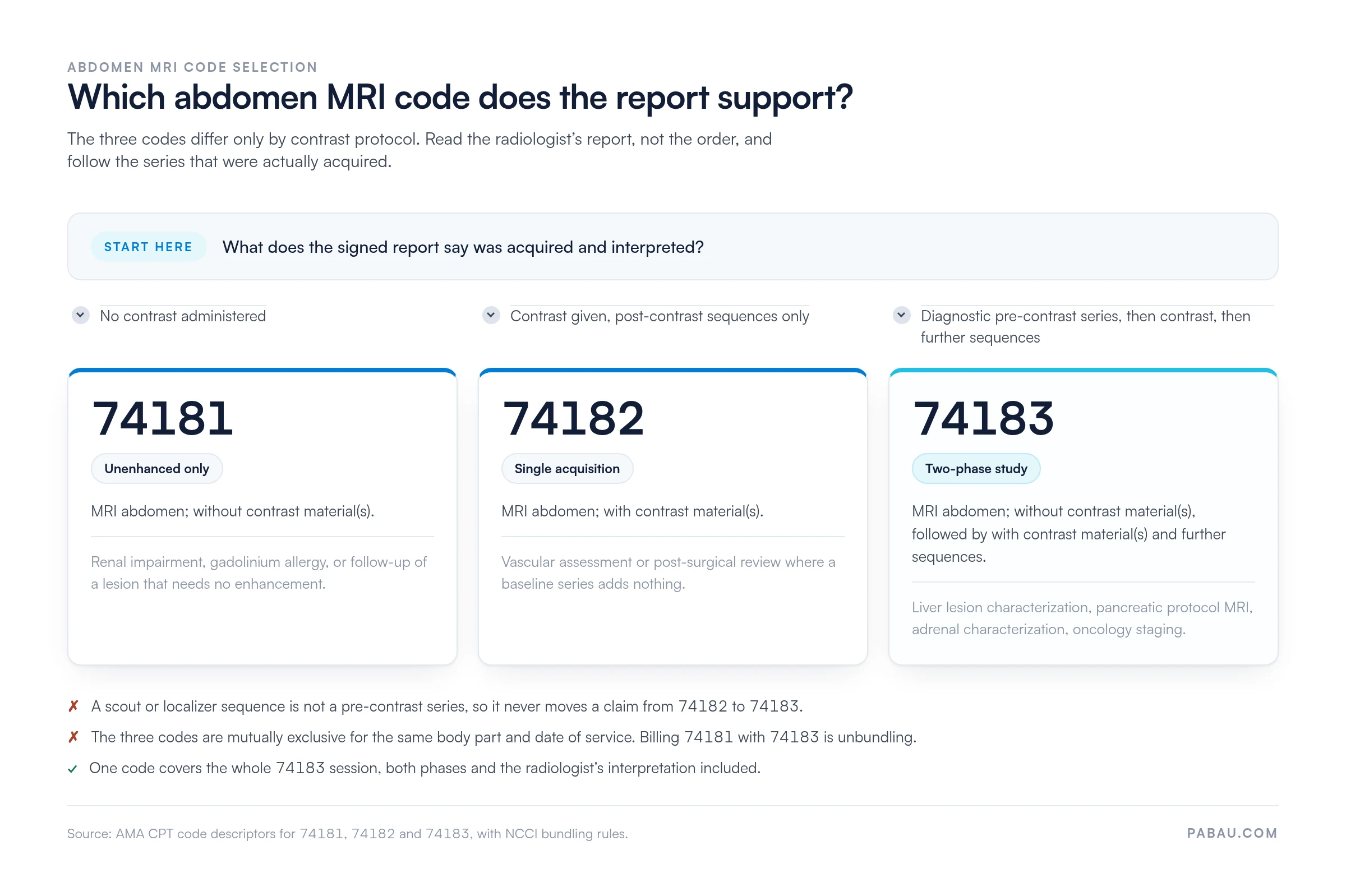
Use 74183 only when the report shows a diagnostic pre-contrast series, then contrast, then further sequences. The three abdomen MRI codes differ only by contrast protocol, and picking the wrong one is the most common error in abdominal MRI billing.
The radiologist’s report decides the code, not the order. Confirm which series were actually acquired before you assign one.
The feature that defines 74183 is the pre-contrast series, acquired as its own diagnostic acquisition before contrast is given. If the radiologist administered contrast and ran only post-contrast sequences, 74182 is the correct code.
A scout or localizer image does not count as a pre-contrast series. Read the report narrative for “without and with contrast” or “pre- and post-contrast” as the signal that 74183 applies. The diagram below runs the same decision from the report to the code.
Every 74183 claim needs a supporting ICD-10-CM diagnosis code that establishes medical necessity for a two-phase study. The diagnosis has to match the clinical indication in the physician order. The codes below are the ones most often paired with contrast-enhanced abdominal MRI.
Coverage is decided locally. Medicare Administrative Contractors publish Local Coverage Determinations that list which diagnosis codes support abdominal MRI in their jurisdiction. Confirm the pairing for your MAC before the claim goes out, because a code covered in one jurisdiction can be denied in another.
CPT 74183 pays for the imaging, not for the contrast agent itself. In the non-facility setting, the practice that supplies the gadolinium-based agent reports it separately with the matching HCPCS Level II code, billed by volume. Getting this wrong leaves money on the table on every enhanced study.
Report the number of units that matches the dose recorded in the imaging report. Note the unit on A9575, which is billed per 0.1 mL rather than per mL. A standard adult dose therefore runs to a large unit count. In the hospital outpatient setting the agent is typically packaged into the facility’s OPPS payment and is not billed separately.
The same packaging rule governs device codes on outpatient claims. A coated stent reported under C1875 carries status indicator N, so the procedure’s APC absorbs its cost.
Payers want documentation that justifies the study, the contrast, and the second imaging phase. Insufficient documentation is the primary driver of 74183 denials. The medical record must contain all of the following elements to support the code.
Under the CMS Physician Fee Schedule, medical necessity has to be supported by an ICD-10-CM diagnosis code consistent with the procedure ordered.
Local Coverage Determinations issued by Medicare Administrative Contractors specify which diagnosis codes are covered for abdominal MRI. Coverage varies by jurisdiction, so cross-reference the applicable LCD before billing to confirm the diagnosis code maps to a covered indication.
Run a pre-authorization check for CPT 74183 before you schedule the study. Many commercial payers require prior authorization for advanced imaging, and skipping that step is the fastest route to a preventable denial. Build the auth check into your scheduling workflow as a standard step.
Modifiers for CPT 74183 record how the study was performed, who performed each component, and whether the service was complete or reduced. The wrong modifier, or a missing one, triggers edits that hold or deny the claim.
The table below covers the modifiers used most often in abdominal MRI billing. Verify each one against current National Correct Coding Initiative (NCCI) edits before you submit.
Medicare payment for CPT 74183 is calculated with the Resource-Based Relative Value Scale (RBRVS). The total RVU assigned to the code, multiplied by the annual conversion factor set by CMS, produces the national rate.
Geographic Practice Cost Indices then adjust that rate up or down by locality. Use the CMS Physician Fee Schedule lookup tool to confirm the figure for your MAC jurisdiction before billing.
The table below shows approximate 2026 Medicare national rates for CPT 74183. Figures are rounded and based on the CMS 2026 MPFS, so verify the exact amount at the time you bill. Because 74183 carries both imaging phases, its allowable sits above 74182 and well above 74181.
Private payer rates for CPT 74183 vary considerably. Commercial contracts typically pay between 110% and 250% of the Medicare allowable, depending on the payer, the market, and the negotiated terms. Verify your contracted rate rather than assuming the Medicare benchmark applies.
Most 74183 billing errors are avoidable. The guidelines below cover the highest-risk areas. Those are phase documentation, contrast detail, bundling, sequencing, and prior authorization.
Handling these requirements by hand invites errors. Documentation checklists applied at the point of ordering cut downstream rework, and verifying eligibility before the patient arrives prevents a whole class of denials.
Practice management software like Pabau connects documentation capture to claim generation. Fewer coding steps then happen by hand, and more claims clear on first submission.
When you submit 74183 claims electronically, the standard format is the 837P electronic claim format. Check that your billing system generates compliant 837P transactions before routing them to a clearinghouse. Validation at the clearinghouse catches formatting errors before they reach the payer.
74183 denial rates run higher than average for diagnostic radiology codes. The contrast and two-phase documentation requirements give payers several technical grounds to reject a claim. Knowing the common denial categories lets billers build preventive steps into the workflow instead of spending the month on appeals.
When a 74183 claim is denied, read the denial reason codes on the remittance advice before you appeal. Grouping denials by reason code each month surfaces patterns that point to a broken workflow rather than a one-off claim error. Submitting a correct claim the first time is still the most effective denial strategy available.
Review your 74183 denial reports monthly and group them by Claim Adjustment Reason Code. If more than 20% of denials share the same CARC, you have a workflow problem rather than a run of one-off errors. Fix the root cause in scheduling, documentation, or coding instead of working each denial individually.
Reference tools such as AAPC’s CPT code lookup give you the code description and stop there. Radiology billing teams working at volume need a system that joins documentation, coding, and submission into one workflow.
Pabau integrates with Claim.MD, a US clearinghouse that reaches thousands of payers. The integration generates 837P electronic claims, verifies insurance eligibility in real time before the appointment, and reconciles ERA and 835 remittances after payment.
For a practice billing 74183 regularly, automated eligibility checks remove two of the most common preventable denials. Those are lapsed coverage and prior authorization that was never obtained.
Documentation templates in Pabau can prompt for the contrast agent, the dose, and both imaging phases at the point of care. The record then already holds what the claim needs before billing starts. That matters for 74183, because payers audit the two-phase requirement closely.
Claim.MD also returns rejections in real time, so a formatting error surfaces at the clearinghouse rather than at the payer weeks later. Practices already on Pabau submit claims and reconcile remittances without leaving the system.

Pabau integrates with Claim.MD to handle 837P claim formatting, real-time eligibility verification, and ERA reconciliation. Cut the manual billing steps and get paid faster for CPT 74183 and other radiology codes.

With 74183, the report is the claim. A study can be ordered as a two-phase exam and still support only 74182 if the pre-contrast series was never acquired.
Claims fail for one of three reasons most of the time. The first is selecting the wrong member of the 74181-74182-74183 family. The second is a report that never documents both phases and the contrast agent. The third is a diagnosis code that does not map to a covered indication under the payer’s LCD.
All three are fixable at the point of documentation and coding rather than at the appeals stage.
Pabau’s software for radiology billers connects documentation capture to 837P submission and ERA reconciliation through Claim.MD. That removes the manual steps behind those errors. To see how Pabau handles radiology and imaging billing, book a demo with the team.

Need a framework for managing claim rejections? Denial management in healthcare covers root-cause analysis methods and workflow fixes for reducing rejection rates.
Want to understand the full billing lifecycle? Revenue cycle management explained walks through each stage from patient scheduling to final payment posting.
Looking for clearinghouse options for US practices? Medical claims clearinghouse guide explains how clearinghouses validate and route claims to payers.
Billing the unenhanced study instead? CPT Code 74181 covers MRI abdomen without contrast, including its own documentation and coverage rules.
CPT Code 74183 is magnetic resonance imaging of the abdomen performed without contrast material first, then with contrast material and further sequences. One code covers both phases of the same session: a diagnostic pre-contrast series, intravenous gadolinium-based contrast, and post-contrast imaging. It sits in the Diagnostic Radiology section of the AMA CPT codebook.
74181 is MRI abdomen without contrast. 74182 is MRI abdomen with contrast, covering a single contrast administration and the post-contrast series. 74183 is MRI abdomen without contrast followed by with contrast, so it requires a distinct pre-contrast diagnostic series before contrast is given. Code selection follows the protocol documented in the radiologist’s report, not the ordering physician’s request.
No. A scout or localizer sequence positions the patient and is not a diagnostic acquisition. CPT 74183 requires a pre-contrast diagnostic series, usually T1- and T2-weighted images of the abdomen, acquired and interpreted before contrast is administered. If the report shows no such series, the correct code is 74182.
The 2026 Medicare national non-facility rate for CPT 74183 is approximately $330-$360 for the global service. In a facility setting the physician bills modifier 26 and receives the professional component only, roughly $75-$95. The facility bills the technical component separately under OPPS. Exact rates depend on locality, so confirm yours with the CMS Physician Fee Schedule lookup.
The modifiers used most often with CPT 74183 are modifier 26 for the professional component and TC for the technical component. Modifier 52 covers reduced services, used when the study was not completed. Modifier 59 marks a distinct procedural service billed alongside another imaging code on the same date. Modifier GC applies in Medicare teaching settings.
No. CPT 74183 and CPT 74182 are mutually exclusive for the same body part on the same date of service. 74183 already includes the post-contrast series that 74182 reports, so billing both charges the payer twice for the same work. NCCI edits bundle the pair and will deny one unless documentation supports a distinct, separate service.
In the non-facility setting, yes. CPT 74183 pays for the imaging only. The gadolinium-based agent is reported separately with the matching HCPCS A-code, such as A9575 for gadoterate meglumine, billed by documented volume. In the hospital outpatient setting the agent is typically packaged into the facility’s OPPS payment instead.
The most frequent denial reasons for CPT 74183 are medical necessity not established and prior authorization not obtained from a commercial payer. A contrast agent missing from the radiology report is another. Incorrect code selection also features heavily, usually 74183 billed when only a single post-contrast series was performed. NCCI bundling edits round out the list, including 74181 billed alongside 74183 for the same session.