



CCSD code G5100: Bypass of duodenum billing guide
CCSD code G5100 bills a bypass that leaves the duodenum in place CCSD code G5100...

Last Updated: Oct 16, 2026

CPT Code 74181 describes magnetic resonance imaging of the abdomen performed without contrast material, classified under Diagnostic Radiology.
Three codes cover abdominal MRI: 74181 without contrast, 74182 with contrast, and 74183 with and without contrast. Picking the wrong one is a top denial trigger.
Medicare requires medical necessity documentation aligned with NCD 220.2, and many private payers also require prior authorization for advanced imaging.
Practice management software like Pabau validates the details a payer needs before a claim is sent, so omissions get caught early.
CPT Code 74181 is the billing code for magnetic resonance imaging of the abdomen performed without contrast material. It belongs to a three-code family with 74182 and 74183, and the three differ only by contrast. That single distinction drives most of the denials on this code.
This reference covers the official descriptor, the modifiers that apply, and how 74181 compares to 74182 and 74183. It also sets out common ICD-10 pairings, 2026 Medicare reimbursement data, documentation requirements, and the denial patterns radiology practices hit most.
CPT Code 74181 is defined by the American Medical Association (AMA) as: Magnetic resonance (eg, proton) imaging, abdomen; without contrast material(s). It also sits within the Diagnostic Radiology section of the AMA CPT code set, under the Procedures of the Abdomen grouping. Pelvic MRI is a separate family, 72195 to 72197.
The procedure captures proton MRI images of the abdominal region. No contrast agent is administered, so this code differs from 74182 and 74183. Use CPT Code 74181 when the ordering physician specifies a non-contrast study. It also applies when renal function, allergy history, or a clinical protocol rules contrast out.
Selecting the wrong member of the abdominal MRI family is the single most common cause of CPT Code 74181 claim rejections. The three codes differ only by contrast usage, but payers treat them as distinct procedures with distinct medical necessity criteria.
Never report both 74181 and 74182 for the same session. If contrast is given after a non-contrast sequence is performed, report only 74183. The combined-phase code captures both components and is not unbundled into 74181 plus 74182. Payers will deny both codes when they appear together on the same date of service for the same beneficiary.
CPT Code 74181 (MRI abdomen without contrast) is appropriate when the clinical indication does not require contrast enhancement or when contrast is contraindicated. Under CMS National Coverage Determination 220.2, Medicare covers abdominal MRI when ordered by a treating physician and supported by a covered diagnosis. Coverage is not automatic; the physician order and clinical record must establish medical necessity.
Common clinical indications for a non-contrast abdominal MRI include the following scenarios:
The ordering physician must document the clinical indication in the referral or order. Without this, the claim risks a medical necessity denial no matter how appropriate the study was.
Every CPT Code 74181 claim requires a supporting ICD-10-CM diagnosis code that establishes medical necessity. The diagnosis must align with the clinical indication documented in the physician order. The codes below are the diagnoses most frequently paired with 74181, consistent with the conditions CMS NCD 220.2 covers.
Use the most specific ICD-10-CM code available. R10.9 is acceptable for an initial workup, but payers may want a more specific code on follow-up claims. Unspecified codes on repeat claims for the same patient are a known audit trigger.
Medicare reimbursement for CPT Code 74181 is determined by the Medicare Physician Fee Schedule (MPFS), published annually by CMS. So rates vary by geography (using geographic practice cost indices) and by place of service. The CMS Physician Fee Schedule lookup tool also provides current-year rates by locality. The figures below are national averages for 2026. Verify your locality rate before quoting reimbursement to your finance team.
Still, actual rates vary by Medicare Administrative Contractor (MAC) locality. High-cost areas such as San Francisco and New York usually reimburse 15-25% above the national average, while rural localities may reimburse below it. Confirm the work, practice expense, and malpractice RVU values for 74181 against the CMS relative value files.
Relative Value Units (RVUs) are the foundation of Medicare reimbursement calculations. CPT Code 74181 carries separate RVU values for the work component, practice expense, and malpractice cost. The total RVU is multiplied by the CMS conversion factor (updated annually) and the geographic adjustment to produce the final payment rate. Confirm current RVU values against the published MPFS data file, as these are subject to annual adjustment.
Private payer rates for CPT Code 74181 are negotiated through contracting and usually exceed Medicare rates. Depending on the payer and the practice’s market position, that can run from 120% to 200% of the Medicare rate. Avoid quoting specific dollar amounts in patient-facing communications, because contracted rates are plan-specific. So your revenue cycle team should compare negotiated rates against the payer’s current fee schedule at each contract renewal.
The modifier on CPT Code 74181 matters most when the professional and technical components are billed by separate entities. Get it wrong, and the payment splits the wrong way, so one component often goes uncollected.
The global billing scenario (no modifier) applies when the same entity performs both the technical and professional components. Free-standing outpatient imaging centers that own their equipment and employ their radiologists usually bill the global code without a modifier. Instead, hospitals bill 74181-26 for the radiologist’s interpretation and submit the technical component under the Outpatient Prospective Payment System (OPPS) separately.
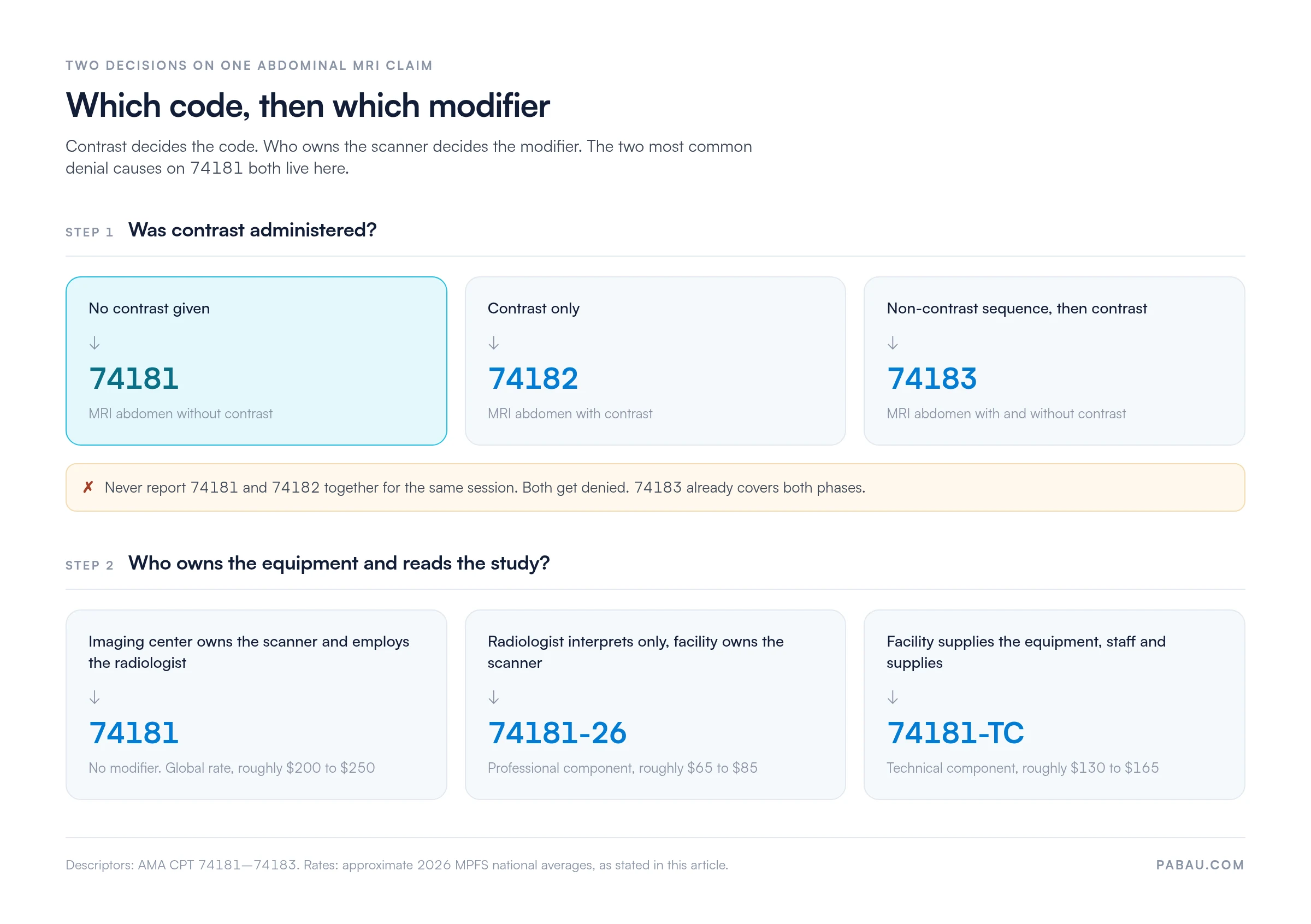
Audit your modifier usage quarterly. A common error is applying modifier 26 in a non-facility setting where the imaging center owns the equipment. This splits payment incorrectly and leaves technical component revenue uncollected. Run a modifier-by-place-of-service report in your billing system to catch this pattern before it compounds across thousands of claims.
Poor documentation is the top cause of Medicare medical necessity denials for abdominal MRI. Every CPT Code 74181 claim has to be supported by a complete clinical record, from the physician order through to the signed report.
Required documentation elements for CPT Code 74181:
Prior authorization requirements for CPT Code 74181 vary by payer and plan. Traditional Medicare fee-for-service does not require prior authorization for abdominal MRI. Many Medicare Advantage plans do, through their own advanced imaging authorization programs. Commercial payers vary widely: some require prior auth for all outpatient MRI, others waive it for contracted radiology groups or urgent cases.
Verify authorization requirements with each payer at the time of order, before the patient appointment. Confirm the following through the payer’s provider portal or by phone:
Radiology billing teams report that CPT Code 74181 denials cluster around five root causes. Still, catching them at the claim scrubbing stage stops most of them from reaching the payer at all. Our denial reason codes reference covers the CARC and RARC patterns behind each one.
Manual claim review for CPT Code 74181 leans on coders remembering modifier rules, ICD-10 pairing requirements, and payer-specific prior auth protocols. Across hundreds of claims a week, that reliance on memory is where the denial patterns above come from.
In Pabau, the claims management dashboard runs validation checks in the background every time a claim goes out. Where a payer needs a membership number or an authorization code, the send button stays disabled until that field is filled. Fewer rejections means fewer resubmissions to chase.
Pabau connects to Claim.MD, a clearinghouse that reaches thousands of US payers. Claim.MD publishes no single payer total, so confirm your own payers are covered rather than trusting a headline figure. Through that connection, a radiology billing team can:

For a radiology team billing CPT Code 74181 at volume, the effect is fewer claims coming back and a shorter secondary review queue. Payment cycles shorten because the common 74181 denial triggers get caught before transmission.
Run a monthly ICD-10 linkage audit on your CPT 74181 claims. Pull every claim billed with an unspecified diagnosis code, such as R10.9 or K76.9, and compare it against the physician notes for that date. Practices that run this audit typically find 10-20% of follow-up claims carrying an unspecified code that should have been updated. Correcting them before the next submission cycle reduces repeat denials on the same patient.

Pabau validates every insurance claim before it leaves the practice, so a missing authorization code or insurer detail gets caught rather than denied. Claims, invoices, and patient records stay in one system, which shortens the payment cycle for imaging practices.

The three-code family is where 74181 goes wrong most often, and the fix is simple, not flashy. A coder who checks contrast, then diagnosis specificity, then place of service catches nearly every preventable denial on this code.
The trade-off worth remembering is that a non-contrast study invites scrutiny, because a payer will ask why contrast was not used. Document the contraindication or the clinical reason in the order, and that question answers itself.
Build those checks into the billing workflow rather than the coder’s memory. Book a demo to see how Pabau validates a radiology claim before it leaves the practice.

Want to know how a clearinghouse handles a radiology claim? What is a medical claims clearinghouse? explains how an 837P transaction is validated before it reaches the payer.
Getting CARC reason codes you do not recognize? Claim.MD clearinghouse review covers how integrated clearinghouse reporting surfaces denial patterns by code.
Losing MRI claims to missing authorizations? The prior authorization process sets out a step-by-step workflow for checking requirements before the appointment.
Need the same billing detail for a spine MRI? CPT code 72146 covers thoracic spine MRI without contrast, under the same component-billing rules.
Building superbills for outpatient imaging? What is a superbill? covers the required fields and how to structure one that pre-populates claim data.
CPT Code 74181 is the billing code for magnetic resonance imaging of the abdomen performed without contrast material. It sits within the Diagnostic Radiology section of the AMA CPT code set. Radiologists and outpatient imaging centers report it for non-contrast abdominal MRI studies.
The 2026 national average Medicare reimbursement for CPT 74181 is approximately $200-$250 for the global (non-facility) service. The professional component alone (modifier 26) reimburses approximately $65-$85. Verify your specific locality rate using the CMS Physician Fee Schedule lookup tool, as geographic adjustment factors vary a lot by region.
Three modifiers do most of the work on CPT Code 74181. Modifier 26 covers the professional component, where the radiologist interprets but does not own the equipment. Modifier TC covers the technical component, billed by the facility. Use modifier 59 to mark a distinct procedural service, where 74181 runs alongside another procedure with bundling edits. Teaching physician settings call for modifier GC.
Prior authorization requirements for CPT 74181 vary by payer and plan. Many commercial insurers and Medicare Advantage plans require prior auth for outpatient advanced imaging. Verify requirements with each payer at the time of order, before scheduling the patient, to avoid non-covered service denials. Traditional Medicare fee-for-service does not generally require prior auth for 74181, but payer-specific rules always take precedence.



