CCSD code H4180: Full or partial thickness rectal biopsy
CCSD code H4180: definition and procedure scope CCSD code H4180 is listed in the...

Last Updated: Oct 22, 2026

CPT code 74150 reports a CT scan of the abdomen with no contrast given at any phase.
Picking the wrong contrast variant, 74160 or 74170, is the most common reason CT abdomen claims deny.
A study that also covered the pelvis belongs to 74176, 74177 or 74178, never to 74150.
Medicare paid about $136 for 74150 in the non-facility setting in 2026, before the locality adjustment.
Practice management software like Pabau pre-fills the CMS-1500 from the client record, so the billed code matches the visit.
CPT code 74150 covers a CT scan of the abdomen with no contrast material at any phase. Two questions separate it from the codes around it. Did contrast go in, and did the scan stop at the abdomen? Answer either one wrong and the payment changes.
The difference grows at volume. Medicare paid roughly $136 for 74150 in the non-facility setting in 2026, while 74160 paid about $230. One habit at the code-selection step, repeated across a few hundred scans, shows up in the month’s revenue. So the contrast question comes first.
The American Medical Association’s CPT code set gives the descriptor as computed tomography, abdomen; without contrast material. The code sits in the Diagnostic Radiology section, the 70000 series. It applies when a radiologist performs and interprets a CT of the abdominal region. No contrast agent goes in at any point in the study.
The global period is XXX, so no pre- or post-operative services bundle into it. Check the current Medicare Physician Fee Schedule data file before you bill.
A non-contrast study earns 74150 when contrast would hide the finding or harm the patient. Convenience is not an indication. The documentation has to show which reason applied.
The indications that come up most often:
One line in the report does most of the work here. The radiologist has to state that no contrast was given. If the wording is ambiguous, the payer asks for records and payment slips by weeks.
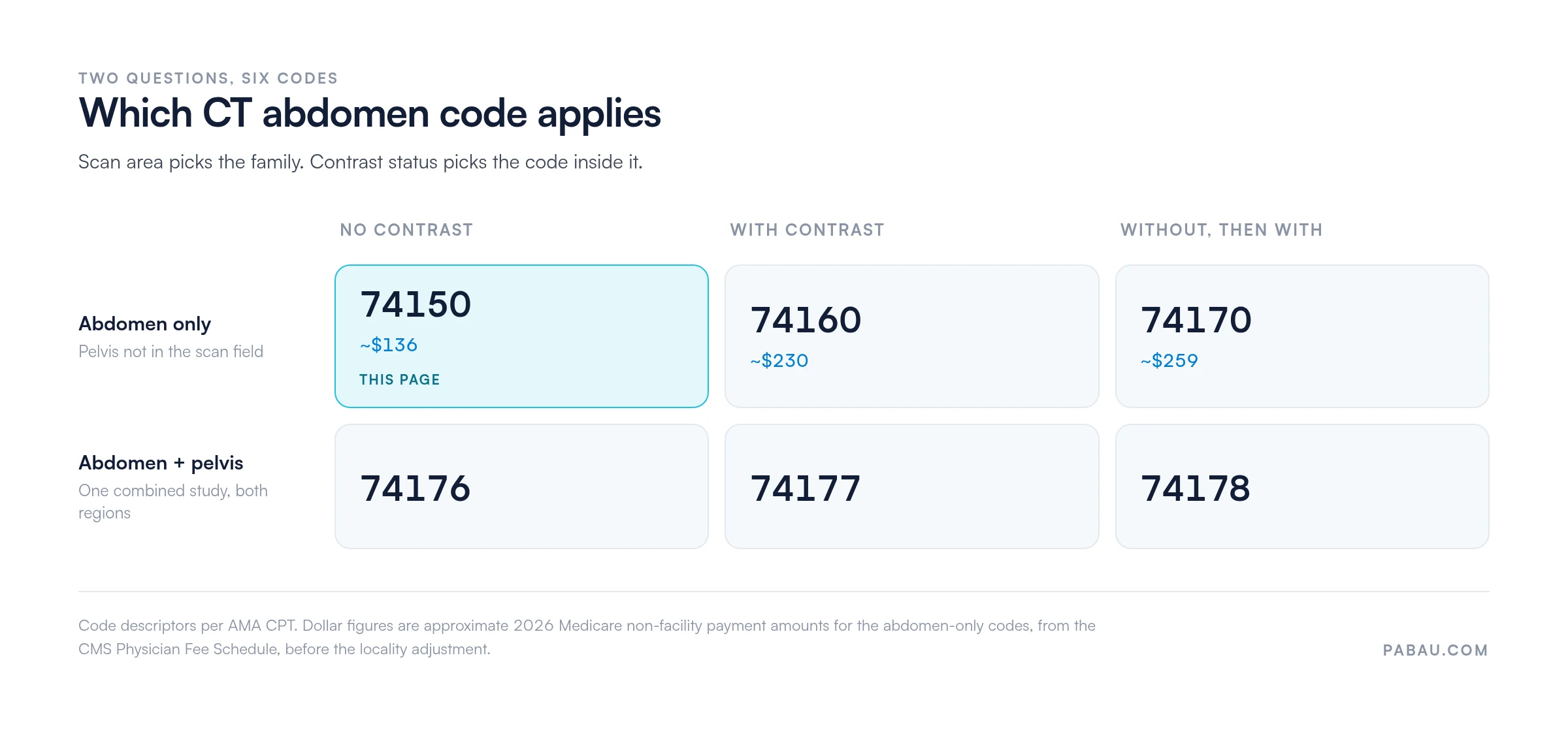
All three codes cover the abdomen and nothing beyond it. Contrast status is the only thing separating them, which is also why one of them so often gets billed in error.
The table below shows where each sits.
Key rule: a without-contrast series and a with-contrast series in one session is 74170, not two codes. Billing 74150 and 74160 on the same date for the same patient is unbundling. The NCCI edits are built to catch it, and an overpayment demand can follow if it slips through.
Always code from the radiologist’s report, not the technologist’s worksheet. If the report does not explicitly state “no contrast was administered,” request a clarification addendum before submitting the claim. An ambiguous report paired with 74150 will trigger a payer request for additional documentation.
The 74150 series stops at the abdomen. When one study covers the abdomen and the pelvis together, the claim moves to 74176, 74177 or 74178. The two families are not interchangeable, and the scan field decides which one applies.
Common mistake: billing 74150 after a protocol that covered both regions. If the report describes the bladder, uterus or sigmoid colon, the pelvis was in the field. The correct code is then 74176, and 74150 undercodes the study.
Two questions get you to the right code every time. The grid below runs them in order.
The diagnosis code is what proves medical necessity. Payers publish covered diagnoses in Local Coverage Determinations, and those LCDs vary by MAC region. So check the LCD for your jurisdiction before you assume a diagnosis pays.
Diagnoses commonly paired with a non-contrast CT abdomen:
Specificity matters as much as coverage. Pick the most specific diagnosis the ordering physician’s notes support, then keep that same code on the order, the report and the claim. Our ICD-10-CM code guides list the descriptors if you need to check one before submission.
A CT has two billable halves. The technical component covers the scanner, the staff and the overhead. The professional component covers the radiologist’s read. The modifier tells the payer which half you are billing.
When one physician owns the scanner and reads the images in the office, bill the global code with no modifier. Most imaging center arrangements split it instead. Confirm which applies with the radiology group before the claims run, because that detail causes most modifier denials on 74150.
The Medicare Physician Fee Schedule sets the rate, and CMS updates it every year. Payment shifts with the setting, facility or non-facility, and with your locality through the Geographic Practice Cost Index.
Verify the current figure in the CMS Physician Fee Schedule lookup tool before you quote it.
Two figures explain most rate surprises. The first is the locality adjustment, which moves the national number up or down. The second is the component split. A professional-only claim pays a fraction of the global rate.
Track expected against received payment per code, and the pattern shows up long before the quarter closes.
Six steps take a CT abdomen charge from order to payment:
Stalls cluster at steps three and four. A code read off the technologist’s worksheet instead of the report will come back. So will a claim sent without a member number. Neither one takes clinical judgment to prevent.
Medicare covers 74150 when the order documents a covered indication and the claim carries a supporting ICD-10 code from the applicable LCD.
A screening CT of the abdomen, ordered with no symptom behind it, is not covered. A clinically sound scan still denies without that linkage.
What the payer expects to find:
Which format the claim takes depends on who bills. A professional claim goes out as an 837P, an institutional claim as an 837I. Pabau submits both through the Claim.MD clearinghouse, which reaches thousands of US payers.
A CT abdomen claim rests on four records. When one contradicts another, the claim denies or draws a post-payment audit.
Five things to confirm on a CT abdomen charge. They take a minute, and they catch most of what would otherwise come back.
Clearing those five is most of what clean claim submission means in radiology. The rest is keeping the record and the claim form in agreement.
Six patterns account for most CT abdomen denials. Each has a fix that lives in the workflow rather than in the appeal.
Run this list against your remittance data every month. Repeat denials on 74150 usually trace back to one habit at charge entry, not to a run of bad luck.
Imaging billing is repetitive by design, with high volume and a code family that looks alike. The claim is only as good as the charge-entry step.
When someone reads the code off a worksheet and retypes it into a separate billing system, one small error repeats across hundreds of claims.
Practice management software like Pabau closes that loop. Its claims tools for imaging pre-fill the CMS-1500 from the client record, so the CPT code attached to the service lands on the charge line.
The ICD-10 slots are seeded from the recorded problem list. Built-in ICD-10-CM and CPT lookup libraries let billing staff check a descriptor without leaving the claim.
Pabau also checks that claim-required fields are complete before the send button unlocks. A missing membership or authorization number gets caught in the practice, not by the payer.
In the US, the Claim.MD connection handles real-time eligibility checks, claim-status tracking, ERA remittance posting and CMS-1500 export.
Coding judgment stays with your coders. What changes is how much they have to re-enter, and how many claims leave with a detail the record could have supplied.

Pabau pre-fills the CMS-1500 from the client record and checks that required claim fields are complete before submission. In the US, imaging teams submit through Claim.MD, with eligibility checks and ERA posting in the same place.

Coding 74150 correctly comes down to reading the report before choosing the code. Contrast status and scan field are both stated in there, and both decide which code is right. Everything after that is process.
The trade-off worth remembering is speed against certainty. A charge posted straight from a worksheet moves faster, but it risks a code the report will not support. Asking for a clarification addendum costs a day. A denied claim, reworked and resubmitted, costs a month.
If the same denials keep landing, the fix usually sits upstream of billing. Pabau pre-fills the claim from the client record, so the code on the form is the code attached to the visit. Book a demo to see how it handles radiology claims, eligibility checks and remittance in one workflow.

Want the full billing picture behind the code? What is medical billing walks through how a charge becomes a paid claim, step by step.
Denials piling up on imaging claims? Denial codes in medical billing explains the CARC codes you see most and what each one is asking for.
Need to read the remittance file properly? Electronic remittance advice covers how an 835 file maps back to the claim you submitted.
Building a denial workflow instead of firefighting? Denial management in healthcare sets out a process for catching patterns early.
Worried about audit exposure on repeat codes? Medical billing compliance covers the documentation habits that hold up under review.
Original Medicare does not require prior authorization for an outpatient CT abdomen. Medicare Advantage and commercial plans often do, and many route the request through a radiology benefit manager. Check the plan before the scan, because a retroactive authorization is rarely granted.
Yes, when a second non-contrast CT abdomen was medically necessary and documented. Append modifier 76 for a repeat by the same physician, or 77 for a different one. The report should say why the study was repeated.
Place of service 11 covers a physician office, 22 an on-campus hospital outpatient department, and 23 an emergency room. That code drives whether Medicare pays the facility or the non-facility rate, so it changes the amount you receive.
No. 74150 is a diagnostic scan. CT guidance for needle placement is reported with 77012, alongside the code for the procedure itself. Billing 74150 for the guidance portion of a biopsy is a coding error.
No. CMS paused the Appropriate Use Criteria program in the 2024 fee schedule rule, so claims no longer carry consultation data or an AUC G-code. Individual payers may still run their own utilization review, so plan rules still apply.