

HCPCS Code E0272: Foam rubber mattress billing guide
HCPCS Code E0272: official descriptor and code overview HCPCS Code E0272 is the ...

Last Updated: Nov 6, 2026
61343 is the CPT code for a suboccipital craniectomy with cervical laminectomy, with or without dural graft. Its official descriptor names the purpose as decompression of the medulla and spinal cord, for example in Arnold-Chiari malformation.
Surgeons perform it most often for Chiari I malformation. They remove part of the occipital bone and the C1 lamina, sometimes C2, to restore cerebrospinal fluid flow at the foramen magnum. The dural graft is part of the descriptor, so no separate graft code applies whether or not duraplasty was performed.
Let Pabau's smart automation suggest the right codes, reduce claim denials, and keep your practice compliant—effortlessly.
Automate repetitive tasks and focus on what matters most—your patients.
Reduce coding errors and ensure compliance with the latest regulations.
Clean claims, fewer denials, and faster reimbursements.
Powerful insights and reporting to help your practice thrive.
HIPAA compliant SOC 2 certified GDPR-compliant Trusted by 4,000+ clinics worldwide

CPT code 61343 covers suboccipital craniectomy with cervical laminectomy for decompression of the medulla and spinal cord, with or without dural graft.
Arnold-Chiari syndrome (Q07.00, or Q07.02 with hydrocephalus) is the primary paired ICD-10 diagnosis. Syringomyelia (G95.0) is a common secondary code.
The dural graft is part of the 61343 descriptor, so billing it with a separate code is a compliance risk.
Most commercial payers and many Medicare Advantage plans require prior authorization. Document MRI findings, symptom severity, and failed conservative management.
Pabau, the practice software we build, sends 61343 claims through Claim.MD with real-time eligibility checks and electronic remittance advice.
CPT code 61343 is the procedure code for a suboccipital craniectomy with cervical laminectomy, with or without dural graft. The official descriptor names its purpose as decompression of the medulla and spinal cord, with Arnold-Chiari malformation as the example. It sits in the craniectomy or craniotomy procedures range (61304-61576) of the CPT code set, which the American Medical Association maintains. The descriptor has three components, and each one shapes how the operative report is reviewed.
The “with or without” language in the descriptor is deliberate. Coders sometimes assume duraplasty must trigger an add-on code or a modifier. It doesn’t, because 61343 captures all three surgical elements whether or not the dura is grafted.
Posterior fossa decompression is a neurosurgical procedure for conditions where the cerebellar tonsils herniate through the foramen magnum, obstructing cerebrospinal fluid circulation. Most coders encounter it in the context of Chiari I malformation, though it may also address other posterior fossa crowding pathologies. Understanding the surgical steps helps coders audit operative reports before submission.
The operative report must explicitly confirm the posterior fossa approach, the extent of bone removal, the C1 lamina status, and whether the dura was opened. Vague documentation such as “posterior cervical decompression” without specifying the craniectomy is a common reason these claims are denied.
The diagnosis code must independently support medical necessity for posterior fossa decompression. Payers cross-reference the ICD-10 code against Local Coverage Determinations (LCDs) issued by Medicare Administrative Contractors (MACs). Search for applicable LCDs in the CMS Medicare Coverage Database. Confirm each diagnosis code itself in the CDC/NCHS ICD-10-CM tool.
ICD-10 code pairs for CPT code 61343 should reflect what MRI imaging confirms, not just the surgical indication alone. Pre-operative MRI reports showing tonsillar herniation below the foramen magnum (typically 5 mm or more) strengthen the medical necessity argument for Q07.00 or Q07.02. Verify these pairings against the applicable MAC LCD before billing, as coverage criteria vary by contractor.
Several decompression codes sit side by side in the 61304-61576 range, and the anatomical approach decides between them. That approach must be clearly documented in the operative report. Consult the AAPC Codify CPT lookup to verify code descriptors when cross-checking adjacent codes.
A craniectomy permanently removes bone. A craniotomy replaces the bone flap once the intracranial work is complete. CPT code 61343 is explicitly a craniectomy, so check the operative report against three questions before selecting it.
The flow below runs the three checks in the order a coder meets them, with the code each “no” answer points to.
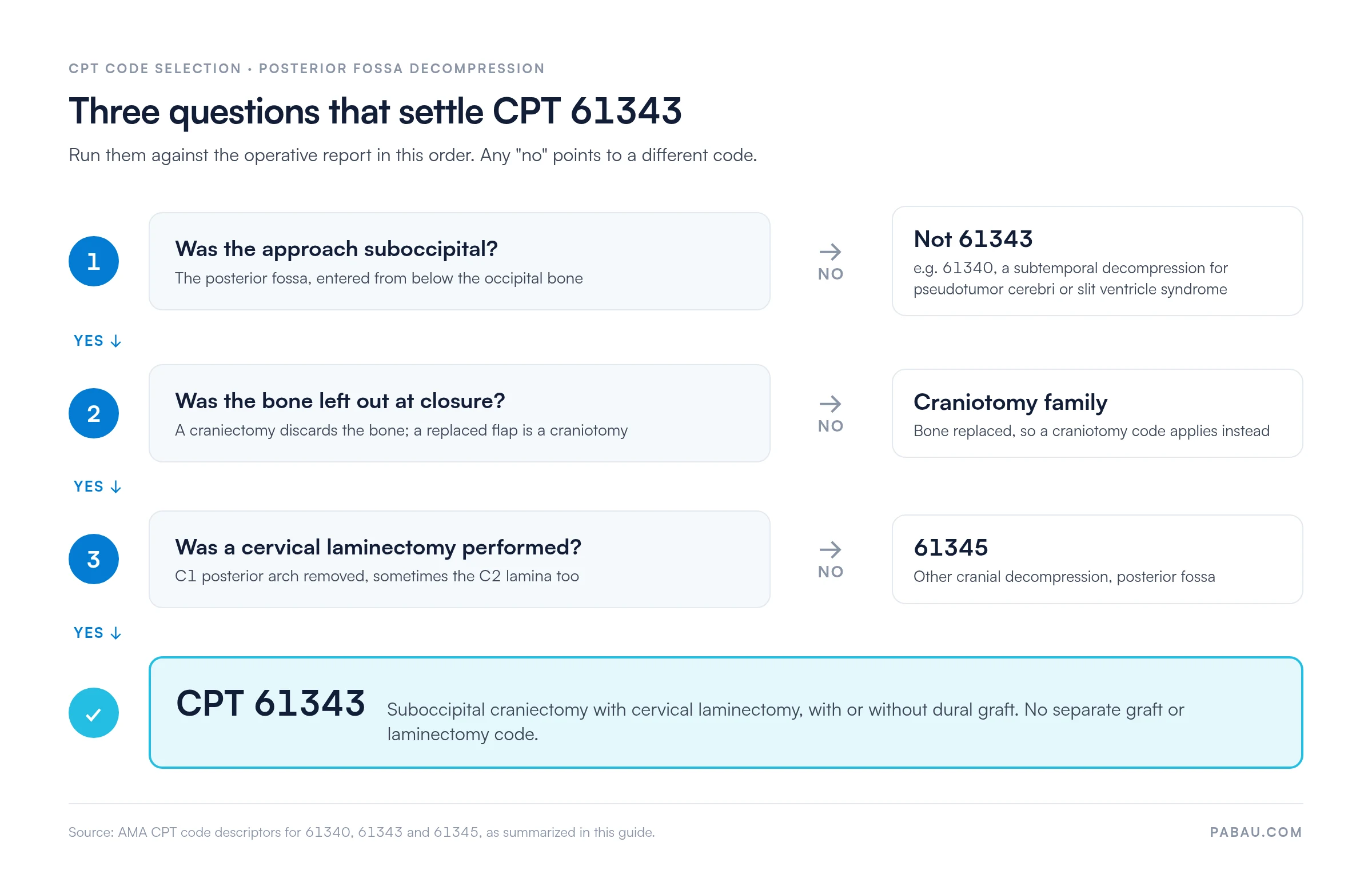
Misidentifying a craniotomy as a craniectomy is an audit trigger. Payers can request the operative report under postpayment review, and the bone-replacement detail is quickly spotted.
Incomplete operative documentation sits behind many CPT code 61343 denials. The record has to establish medical necessity and confirm each element of the descriptor, not just name the procedure. Medical billing fundamentals start with clear operative documentation, and neurosurgical claims demand particular specificity given their high-value global package.
A neurosurgical superbill that captures every operative element at the point of service keeps under-documented cases from reaching the billing team. Submitting a clean claim for CPT code 61343 depends on every descriptor element being verifiable in the operative record before the claim leaves the practice.
Flag 61343 claims for pre-submission review whenever the operative report uses vague anatomical language. Run a checklist against the three descriptor components: Suboccipital approach confirmed, laminectomy level documented, dural management stated. Claims that clear all three checks submit cleanly. Those that fail go back to the surgeon for an addendum before they reach the clearinghouse.
Medicare pays for CPT code 61343 under the Physician Fee Schedule using relative value units (RVUs). The work RVU reflects physician effort. Total facility RVUs add the practice expense and malpractice components. Payment rates are adjusted by locality and updated every year. Verify current figures in the CMS Physician Fee Schedule lookup tool before quoting a rate.
The 90-day global surgical package means that routine post-operative visits within 90 days of surgery are bundled into the 61343 payment. An unrelated E/M visit in that window takes modifier 24, and an unrelated procedure takes modifier 79.
Most commercial payers and many Medicare Advantage plans require prior authorization before 61343 will be covered. Traditional Medicare Fee-for-Service does not mandate prior authorization but does require documented medical necessity that meets the applicable MAC LCD criteria.
Authorization requirements vary significantly by plan and geographic region. Never assume that an approved authorization for a related procedure covers CPT code 61343. The specific code must be named in the authorization letter.
Modifier selection for CPT code 61343 depends on the complexity of the case and the team composition in the operating room. Incorrect or unsupported modifiers are a common audit trigger on high-value neurosurgical claims, where payers expect specific documentation to justify each one. Proper modifier use feeds into a well-managed revenue cycle management workflow for surgical practices.
Modifier -62 is worth examining carefully for 61343. Because the procedure crosses the cranial-cervical junction, practices sometimes split care between a neurosurgeon and a spine surgeon. Both surgeons report CPT code 61343 with modifier -62, and each is paid 62.5% of the usual fee schedule amount.
Each surgeon’s operative note must confirm their own contribution. A shared note, or one that doesn’t split responsibility, can lead to denial of one or both claims.
CPT code 61343 claims fail for predictable reasons. Each denial pattern has a prevention step the practice can build into its pre-submission workflow. A structured denial management workflow is designed to catch these issues before the claim leaves the practice. Knowing the common medical billing denial codes speeds up the appeal when a 61343 claim comes back.
Build a 61343 pre-submission checklist into your clearinghouse workflow, with five checks. The auth number is present and covers 61343. Q07.00 or Q07.02 is sequenced first. The operative note states suboccipital craniectomy and C1 laminectomy. No separate cervical spine code sits on the same claim, and the global period is tracked. Claims that pass all five submit cleanly.
If a CPT code 61343 claim is denied on medical necessity grounds, build the appeal around three documents. Include the pre-operative MRI report, the neurosurgical consultation note on symptom progression, and any record of failed conservative treatment. A detailed letter of medical necessity from the operating surgeon strengthens the appeal significantly.
On a high-value neurosurgical code, billing teams often rekey operative details into a separate claims tool. Each rekey is another chance to drop the laminectomy level or attach the wrong Q07 code.
Pabau keeps the consultation notes, operative documents, and invoice on one patient record. Our neurosurgical claims management software then sends the 61343 claim through Claim.MD, Pabau’s US clearinghouse partner.
Claim.MD checks the patient’s eligibility in real time and returns electronic remittance advice once the payer responds. Your team sees a coverage problem before surgery day and posts payments without retyping the payer’s response.
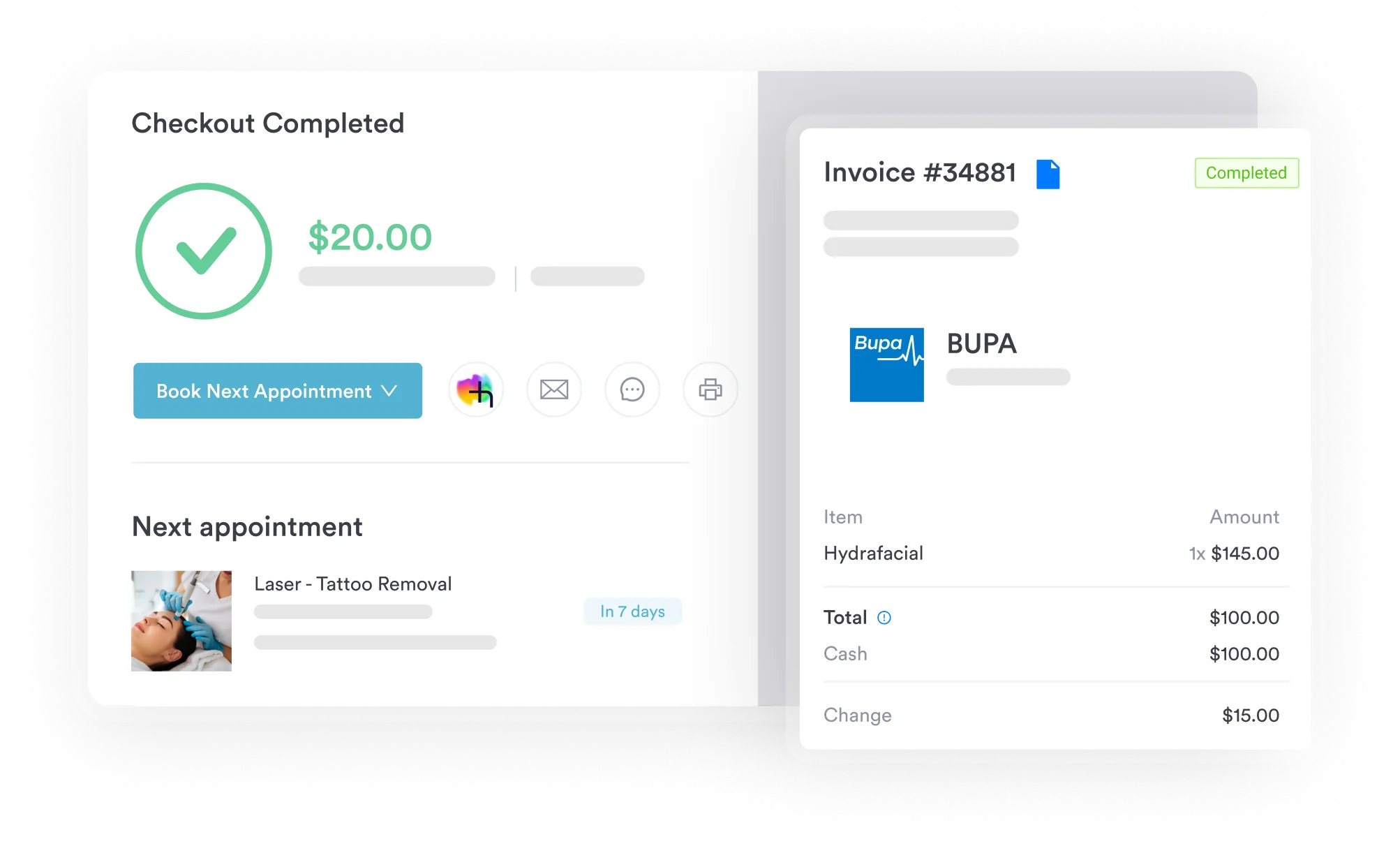

Pabau connects with Claim.MD’s clearinghouse to run real-time eligibility checks and deliver electronic remittance advice into your billing workflow. Your team catches coverage problems on a CPT code 61343 claim before it goes out.

CPT code 61343 pays for three surgical steps in one code, so the operative report has to prove all three. A single 61343 payment also covers 90 days of routine follow-up, which makes each denial expensive to absorb.
Check the report before you code it. Confirm the suboccipital approach, the bone left out, and the C1 arch removal, then match the diagnosis to the MRI and the payer’s LCD. A few minutes of review per case is far cheaper than an appeal.
Book a demo to see how Pabau checks eligibility and posts remittance advice for your neurosurgical claims.

Need to understand clearinghouse claim submission? How Claim.MD clearinghouse works explains how electronic claims move from your practice to Medicare and commercial payers.
Confused about electronic remittance processing? Electronic remittance advice covers how ERA 835 files post payments and communicate denial reasons automatically.
Looking to reduce claim errors across your neurosurgical practice? Medical billing compliance outlines the documentation and audit-readiness standards that keep high-value surgical claims clean.
CPT code 61343 is the billing code for suboccipital craniectomy with cervical laminectomy, with or without dural graft, performed to decompress the posterior fossa. It is most often used for Chiari I malformation surgery. The surgeon removes occipital bone and the C1 posterior arch to restore cerebrospinal fluid (CSF) flow at the foramen magnum.
The dural graft is bundled into CPT code 61343 by the code descriptor itself, which reads “with or without dural graft.” Billing a separate code for the duraplasty or graft material is not supported by the descriptor and creates a compliance risk under NCCI bundling rules. The same code applies whether or not duraplasty was performed.
CPT 61340 is a subtemporal cranial decompression for pseudotumor cerebri or slit ventricle syndrome. CPT 61343 is a suboccipital craniectomy with cervical laminectomy for posterior fossa decompression. The approach documented in the operative report decides between them.
Yes, Medicare covers CPT code 61343 when documentation establishes medical necessity, including MRI confirmation of tonsillar herniation and symptoms that support surgery. Traditional Medicare fee-for-service does not require prior authorization, but the claim must satisfy the applicable MAC Local Coverage Determination. Medicare Advantage plans often add prior authorization requirements.
The operative report must confirm the suboccipital approach and the size of the craniectomy defect. It must also name the cervical levels decompressed (C1, C2, or both), state whether the dura was opened and grafted, and give the pre-operative diagnosis. Pre-operative MRI with a tonsillar herniation measurement and a neurosurgical consultation note documenting symptom severity support medical necessity.
The most common primary diagnosis is Q07.00 (Arnold-Chiari syndrome without spina bifida or hydrocephalus), or Q07.02 when hydrocephalus is present. G95.0 (syringomyelia) is often added as a secondary diagnosis when imaging confirms a syrinx. The diagnosis must reflect what the pre-operative MRI documents and meet the payer’s medical necessity criteria.




