HCPCS Code Q4185: Cellesta flowable amnion billing guide
HCPCS Code Q4185: definition and official descriptor HCPCS Code Q4185 is the Lev...

Last Updated: Nov 20, 2026
61312 is the CPT code for craniectomy or craniotomy for evacuation of hematoma, supratentorial; extradural or subdural. It covers open surgery to remove an epidural or subdural clot above the tentorium, whether the bone flap goes back in or not.
The code turns on two facts in the operative report: site and lesion type. A clot inside the brain above the tentorium is 61313, and an extradural or subdural clot in the posterior fossa is 61314.
Let Pabau's smart automation suggest the right codes, reduce claim denials, and keep your practice compliant—effortlessly.
Automate repetitive tasks and focus on what matters most—your patients.
Reduce coding errors and ensure compliance with the latest regulations.
Clean claims, fewer denials, and faster reimbursements.
Powerful insights and reporting to help your practice thrive.
HIPAA compliant SOC 2 certified GDPR-compliant Trusted by 4,000+ clinics worldwide

CPT code 61312 covers craniotomy or craniectomy for a supratentorial extradural or subdural hematoma. An intracerebral clot above the tentorium is 61313.
The posterior fossa counterpart is 61314 for extradural or subdural blood, and 61315 for an intracerebellar hematoma.
Pair 61312 with an epidural or subdural diagnosis such as S06.4X-, S06.5X-, I62.0- or I62.1, never with I61 intracerebral hemorrhage.
The 90-day global period bundles routine post-op visits, so an unrelated E/M in that window needs modifier 24 and its own documentation.
Medicare doesn’t allow modifier 50 on 61312, so two separate evacuations go on two lines with a distinct-procedure modifier and LT or RT.
CPT code 61312 is the code for craniectomy or craniotomy for evacuation of hematoma, supratentorial; extradural or subdural. As AAPC’s Neurosurgery Coding Alert sets out, the 61312 to 61315 family splits on two facts in the op note: site and lesion type.
The code sits in the AMA’s CPT code set under Surgical Procedures on the Skull, Meninges and Brain. Within that, it belongs to the Craniectomy or Craniotomy subheading, which runs roughly from 61304 to 61323.
Before you assign it, the operative report has to confirm three things:
The descriptor carries no laterality. The side shows up in the op note and imaging report, and many payers also want the LT or RT modifier.
Coding errors in this family usually come from checking only one of those two facts. The grid shows how the pair lands on a single code.
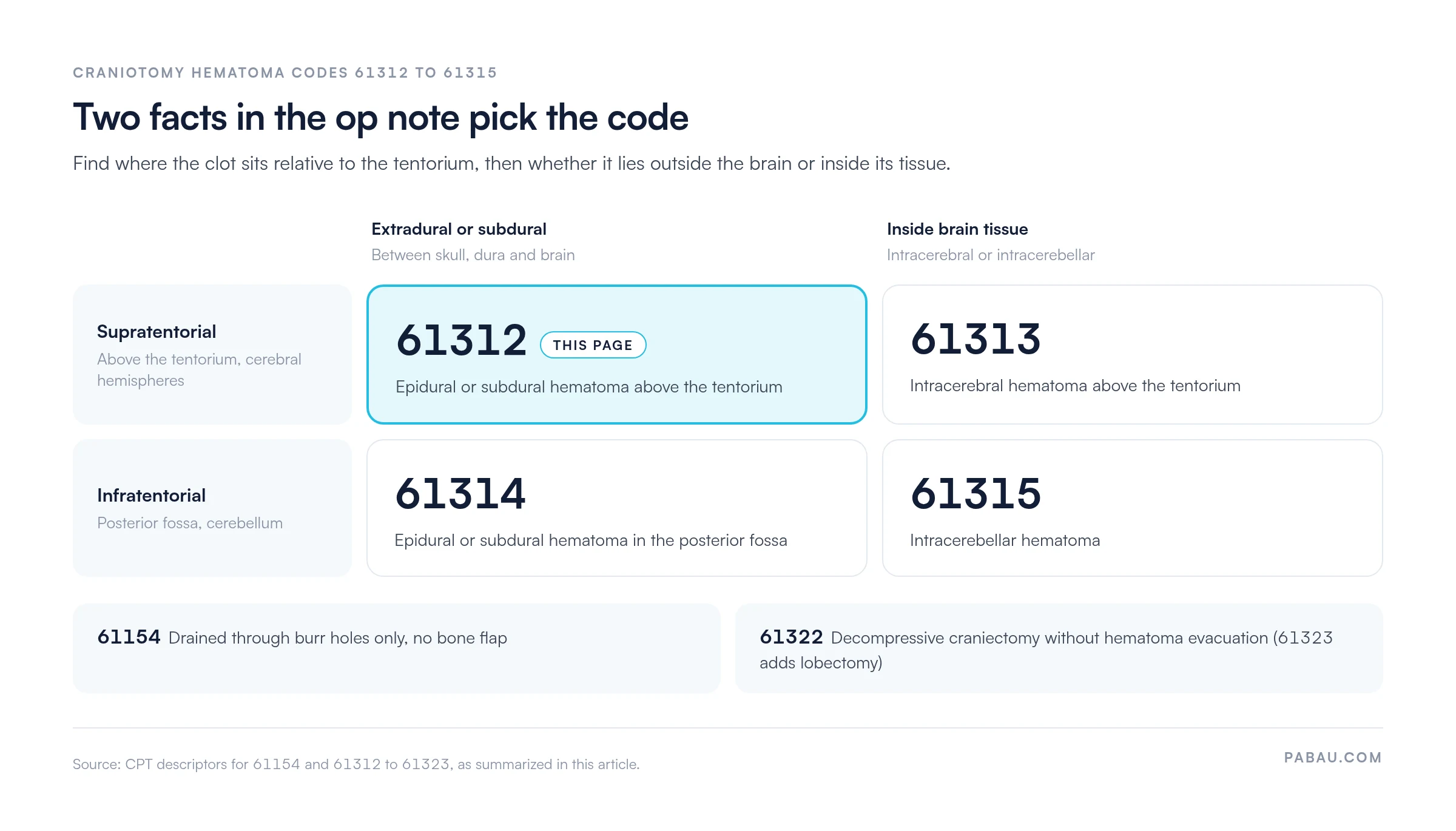
The supratentorial split, 61312 versus 61313, is the easiest one to get wrong. Both sit above the tentorium, but 61313 covers blood within the brain substance. The infratentorial counterpart of 61312 is 61314, used when the extradural or subdural clot sits in the posterior fossa.
The approach matters too. When the surgeon drains a subdural collection through burr holes without raising a flap, report 61154 instead.
Knowing the operative sequence helps you confirm that the documentation supports 61312 and not a neighboring code. A typical supratentorial evacuation runs through five phases:
Each phase should appear in the report. A note that reads only “craniotomy performed, hematoma evacuated” leaves the payer guessing at site and lesion type. A vague note like that invites a medical-necessity denial.
CPT code 61312 carries a 90-day global period under the CMS Physician Fee Schedule. The table shows what the surgeon’s fee covers and what still bills on its own.
Anesthesia sits outside the surgeon’s package too. The anesthesia provider reports it with 00211, the anesthesia code for craniotomy or craniectomy to evacuate a hematoma.
Check NCCI edit pairs for 61312 each quarter in the CMS NCCI files. Edits update quarterly, so a pair that billed cleanly last year may now need a modifier or be bundled.
Every 61312 claim needs a diagnosis that shows an extradural or subdural hematoma. Payers check the ICD-10 code against the procedure, so the main choice left is traumatic versus nontraumatic.
An intracerebral diagnosis, such as I61 nontraumatic intracerebral hemorrhage, belongs with 61313 rather than 61312. For a spontaneous subdural, I62.00 is the unspecified code, so use I62.01 to I62.03 when the report names the stage.
Use the most specific code available, because unspecified codes can draw extra scrutiny from Medicare Administrative Contractors. When imaging gives the side and site, carry that detail into the diagnosis.
These modifiers come up on 61312 claims, and each one needs its own documentation to avoid a rejection.
Bilateral evacuations need the most care on a 61312 claim. AAPC’s bilateral craniotomy guidance points to the 0 indicator and recommends a second 61312 line with modifier 59. The op note must show two separate hematomas and two separate approaches, not one bifrontal exposure.
Confirm the current bilateral indicator in the CMS fee schedule before you submit, since payers deny 61312-50 outright.
Medicare pays CPT code 61312 under the CMS Physician Fee Schedule, using relative value units (RVUs). The national RVUs are the same in the facility and non-facility settings, at about 60.03 in total. Dollar amounts still vary by locality and year, so confirm them in the CMS PFS tool.
Pull the exact dollar amount for CPT code 61312 from the CMS Physician Fee Schedule Look-Up Tool for the current year and your MAC locality. Prior-year rates and third-party tools may differ. For an independent RVU check with locality adjustment, FastRVU offers a free 2026 lookup built on CMS data.
Run through this list before a 61312 claim leaves the office. Each item answers a question the payer will ask.
Submitting a clean claim for 61312 means every field on the CMS-1500 or 837P traces back to this list. If an item is missing, hold the claim until the record is complete rather than submitting and appealing.
CPT code 61312 is almost always an emergency or urgent procedure, so prior authorization is rarely possible. Payer notification rules still apply, and medical billing teams handle them differently by payer type:
A missed notification can bring an “authorization not obtained” denial, even when the surgery was medically necessary. The appeal has to show that the emergency made pre-authorization impossible and that notice came within the contract window.
So log three times in every high-acuity neurosurgery case: the emergency call, the start of surgery and the payer notification.
Denials on 61312 tend to trace back to five root causes. Each one has a prevention step you can build into the pre-submission workflow.
When a denial comes back, the medical billing denial codes guide maps each CARC and RARC code to its next step. Building denial management workflows around these five causes cuts rework on 61312 claims.
When payer policy changes, check the current CPT code guidelines through AAPC’s Codify platform.
Each quarter, audit the 61312 claims submitted in the prior 90 days. Flag any claim where the op report’s site or lesion type doesn’t match the ICD-10 code. That one check catches wrong-code and diagnosis-mismatch denials before they reach the payer.
In many neurosurgery billing offices, a 61312 claim passes through dictation, coding and a separate clearinghouse portal. Each handoff adds days before the payer sees it.
Pabau, the practice management platform we build, assembles the claim from the patient record. The CPT code on the service lands on the charge line, and the ICD-10 slots are seeded from the recorded problem list. Required fields are checked before the claim can be sent.
In the US, Pabau’s end-to-end claims management submits through Claim.MD, then posts ERA remittances and tracks claim status. Your team sees the denial reason as soon as the ERA arrives, so appeals start without status calls.

Pabau connects to Claim.MD to submit 61312 claims electronically, post ERA responses and show denial reasons as they arrive. Your billing team spends its time on appeals, not status calls.

Settle the site and the lesion type before you touch the rest of the claim. Those two facts decide 61312 over 61313, 61314 or 61315, and they decide the diagnosis code too.
After that, a 61312 claim pays or stalls on paperwork. Hold it until the imaging, op report and signature are in the record, and track the 90-day window from the surgery date. A claim held one more day costs far less than an appeal cycle.
Book a demo to see how Pabau takes a neurosurgery claim from the patient record to posted payment.

Need a clearinghouse that handles neurosurgery claims? Claim.MD clearinghouse overview explains how the integration routes 837P claims and returns ERA remittances.
Want to understand what goes on a clean claim? Superbill guide covers the fields required on a CMS-1500 for surgical procedures.
Looking for denial code definitions? Denial codes in medical billing maps common CARC and RARC codes to their resolution steps.
It covers both. The code is the same whether the bone flap goes back in or stays out. Note which approach was used, because a later cranioplasty is a separate procedure.
Yes, when the surgeon evacuates it through a craniotomy or craniectomy. Drainage through burr holes alone is 61154. A spontaneous chronic subdural pairs with I62.03.
The anesthesia provider reports 00211, anesthesia for craniotomy or craniectomy to evacuate a hematoma. It’s billed separately from the surgeon’s 61312 fee.
Only when the hematoma sits at a separate site. NCCI bundles a clot removed from the tumor bed into the excision code, such as 61510. A clot at a distinct site can go on its own line with modifier 59.
Nationally, 61312 carries 29.42 work RVUs and about 60.03 total RVUs. The figures are the same in facility and non-facility settings, and payment still varies by locality.