CCSD code H4430: Examination of rectum under anaesthetic
CCSD code H4430 pays for the examination alone CCSD code H4430 is the UK private...

Last Updated: Oct 20, 2026
51720 is the CPT code for bladder instillation of anticarcinogenic agent (including retention time). It covers passing a catheter, filling the bladder with a cancer drug such as BCG or mitomycin, and supervising the dwell time.
The drug itself is never included, so every 51720 claim needs its own HCPCS drug line. The harder part is the company 51720 keeps. A same-day office visit, a TURBT, or a catheter code can each trigger a denial. Below, you'll find how to handle each pairing, where each modifier goes, and what the procedure note must show.
Let Pabau's smart automation suggest the right codes, reduce claim denials, and keep your practice compliant—effortlessly.
Automate repetitive tasks and focus on what matters most—your patients.
Reduce coding errors and ensure compliance with the latest regulations.
Clean claims, fewer denials, and faster reimbursements.
Powerful insights and reporting to help your practice thrive.
HIPAA compliant SOC 2 certified GDPR-compliant Trusted by 4,000+ clinics worldwide

CPT code 51720 covers the catheter, the drug instillation, and the dwell time, so never add 51702 for the same catheter.
The drug goes on its own line, such as J9030 for BCG, J9280 for mitomycin, or J9201 for gemcitabine.
Modifier 25 belongs on a same-day E/M, while 59 or XE goes on 51720 only when it follows TURBT in a separate session.
Non-cancer instillations, such as DMSO for interstitial cystitis, are reported with CPT 51700 instead of 51720.
Claims management software like Pabau pre-fills claim lines from the patient record and sends clean 837P files through Claim.MD.
CPT code 51720 describes “bladder instillation of anticarcinogenic agent (including retention time).” The physician passes a urethral catheter and fills the bladder with a cancer drug.
The drug stays in place for a set dwell time, and then the patient drains or voids it. That whole sequence is one service, and it bills as one line.
Most of these claims come from non-muscle invasive bladder cancer (NMIBC) care. After a transurethral resection of bladder tumor (TURBT), urologists often give intravesical therapy to lower the chance of recurrence.
BCG and mitomycin C are the usual agents. Gemcitabine, valrubicin, and docetaxel appear in specific protocols.
Since the code already includes the catheter, the bundling question comes up on almost every claim.
Under National Correct Coding Initiative (NCCI) edits, CPT 51702 for simple catheterization is included in 51720. Bill both for the same catheter and the payer will deny 51702 as bundled. CPT 51701 for a non-indwelling catheter falls under the same rule, so it does not get its own line either.
The drug works the other way. 51720 pays for delivering the agent and managing retention, and it pays nothing toward the drug. So the matching HCPCS J-code goes on the same claim as its own line.
Every intravesical agent has its own HCPCS code, reported on the same claim as CPT code 51720.
For BCG, that code is J9030, billed per 1 mg. It replaced J9031, which Medicare stopped paying on July 1, 2019. Old charge masters still carry J9031, so check yours.
Check codes and units against the current HCPCS file before you submit. Unit rules for biologics, BCG especially, can change at each annual update.
Billing 51720 on the same date as a TURBT (CPT 52234, 52235, or 52240) is one of the most denied pairings in urology. Even so, the answer is not a flat no. It depends on timing.
Here is how to walk through it. First, find where the dose was given. A single mitomycin dose given in the operating room, right after resection, counts as part of the TURBT. That instillation is not billed separately.
Next, check whether the dose came later. If the urologist instilled the drug in a separate session, such as the recovery room, 51720 can be billed with modifier 59. The more specific X-modifier here is XE, which marks a separate encounter.
Submit TURBT and 51720 together only after confirming the payer’s NCCI policy. Pull the payer’s online billing manual or call the provider relations line. Then log the call or portal lookup in your billing notes, so future audits have a clear rationale trail.
Most modifier mistakes on 51720 come from putting the right modifier on the wrong line. Three modifiers apply, each in its own scenario. The chart below shows which lines each type of visit produces.
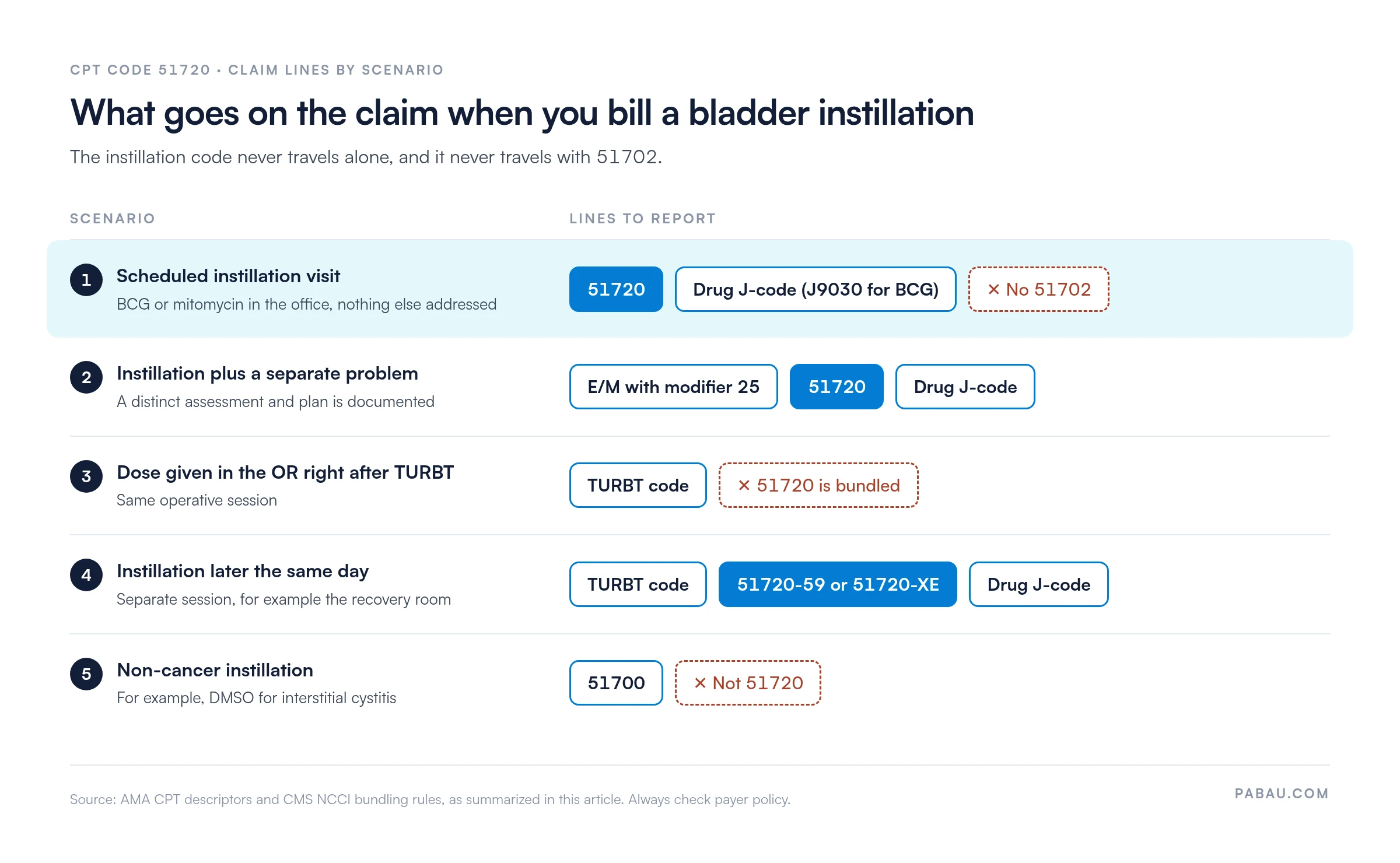
The American Medical Association’s CPT code set guidance expects every modifier to reflect a clinical distinction the record supports. For modifier 25, the E/M note needs its own assessment and plan, beyond the scheduled instillation.
CPT 51702 is a simple catheter insertion, while CPT code 51720 is a catheter plus a cancer-drug instillation.
Coders mix them up because every instillation needs a catheter. CPT 51700 adds a third option, covering irrigation or instillation of drugs that are not anticancer agents.
In practice, keep 51702 off any claim that carries 51720. The only exception is a payer-confirmed one, backed by a separate reason for the catheter in the record. And when the drug treats interstitial cystitis rather than cancer, the service moves to 51700. Contrast instilled to image the bladder rather than treat it makes the study CPT code 51600.
For BCG, CMS publishes Local Coverage Article A56754, and it is worth reading before you bill a Medicare patient.
Mitomycin and the other agents have no dedicated coverage document. Their claims stand on general medical necessity, so the record has to make the case.
Eligibility needs checking before each session, not just the first one. Many commercial payers require prior authorization for a BCG induction course, and some ask again for each maintenance cycle.
Where the instillation happens decides both the rate and who bills the drug. The non-facility rate is higher because the practice carries the overhead.
Check current figures with the CMS Physician Fee Schedule lookup tool, since rates change every year and by locality.
On top of that, a geographic adjustment applies to every Medicare rate. A practice in Manhattan and one in rural Mississippi will see different allowed amounts for CPT code 51720. Use the lookup with the locality that matches your billing address.
Every 51720 claim needs a procedure note that proves medical necessity and shows the service was finished as billed. Picture an auditor pulling one BCG visit from week three of a course.
These are the six points they will look for:
The 837P electronic claim that carries 51720 also needs matching details. Check the service date, POS code, rendering provider NPI, and the diagnosis pointer linking the ICD-10 code to 51720. A mismatch in any of these usually brings an instant technical denial.
Linking the right ICD-10 code to CPT code 51720 is how the claim proves medical necessity. Payers expect the diagnosis to explain why a cancer drug went into the bladder.
Never use Z85.51 (personal history) as the only diagnosis on an active treatment claim, unless the payer has confirmed it supports ongoing instillation. Most payers expect an active cancer or CIS code during induction or maintenance. Keep Z85.51 for surveillance-only encounters.
With the rules above in hand, a short check before submission catches most problems. Run it on every instillation claim, including the tenth dose of a course.
Even with a clean process, some claims come back. A denied 51720 claim usually falls into one of five groups.
Tracking denials against them points to the workflow fix, instead of fixing claims one by one. Reviewing the medical billing denial codes on each remittance shows which group is hitting your practice most.
When a 51720 denial arrives, pull the electronic remittance and read the claim adjustment reason code. That code tells you which of the five groups you are dealing with, and which appeal route fits.
In many urology practices, a biller keys each instillation by hand. They add the J-code, count the units, and phone the payer to confirm coverage for the next dose. Across a six-week BCG course, that adds up to a lot of retyping for one patient.
Practice management software like Pabau takes that retyping away. With Pabau’s time-saving claims management, the codes attached to each service land on the claim lines.
ICD-10 slots are seeded from the patient’s problem list. The claim cannot send until required fields, such as membership numbers and authorization codes, are complete.
For US practices, claims go out as 837P files through Claim.MD. The same connection runs real-time eligibility checks before each session and posts remittances when payers respond. That frees your team to focus on the few claims that do come back.

Pabau fills claim lines from the codes on each service and checks required fields before the claim can send. US claims go out through Claim.MD, with real-time eligibility checks before each session.

Getting 51720 paid comes down to two questions: when did the instillation happen, and what else did the visit produce? Answer those, and the lines and modifiers on the claim follow.
If your team adopts one habit, make it the same-day check. Confirm the payer’s bundling policy before the claim goes out, and let the procedure note carry the proof. It costs a few minutes per claim, which is far cheaper than an appeal.
Book a demo to see how Pabau keeps each instillation, drug line, and eligibility check on one clean claim.

Billing the BCG itself? HCPCS code J9030 covers units, waste modifiers, and coverage for the drug line.
Pairing instillation with a cystoscopy? CPT code 52000 explains how diagnostic cystourethroscopy is billed.
Want to build a cleaner urology claim from the start? Clean claim submission best practices walks through every required field on a CMS-1500 form.
Need to see what an 837P file carries? The 837 file explained breaks down the segments payers read first.
Need to understand how clearinghouse claims routing works? Medical claims clearinghouse guide explains how 837P files reach payers and where edits occur.
J9030 is reported per 1 mg, so the units match the milligrams instilled. One vial of TICE BCG holds about 50 mg, which is typically billed as 50 units. Check the vial label and your payer’s unit rules before you submit.
Yes, for Medicare Part B drugs from single-dose containers. Add JZ when no drug was discarded. When some was thrown away, report the discarded amount on its own line with JW. Medicare has required this since July 1, 2023.
Yes. Each instillation is a separate service on its own date, so each one gets its own 51720 and drug line. A standard induction course runs six weekly doses, and maintenance cycles follow. Payers may cap the count, so track doses against the authorization.
Often, yes. In the office, a trained nurse can instill the drug while the physician supervises. For Medicare incident-to billing, the physician generally has to be in the office suite. State scope rules and payer policy still apply, so confirm both first.