

CPT Code 30801: Superficial turbinate ablation billing guide
CPT Code 30801: Official descriptor and procedure overview The American Medical ...

Last Updated: Nov 27, 2026
47564 is the CPT code for laparoscopic cholecystectomy with exploration of the common bile duct. The surgeon removes the gallbladder through laparoscopic ports, then enters the common duct to find and clear stones.
It is the top code in the 47562-47564 family. A cholangiogram without exploration belongs on 47563, and NCCI bars reporting 47562 or 47563 beside 47564. The claim stands on an operative note that shows how the duct was explored and what it held.
Let Pabau's smart automation suggest the right codes, reduce claim denials, and keep your practice compliant—effortlessly.
Automate repetitive tasks and focus on what matters most—your patients.
Reduce coding errors and ensure compliance with the latest regulations.
Clean claims, fewer denials, and faster reimbursements.
Powerful insights and reporting to help your practice thrive.
HIPAA compliant SOC 2 certified GDPR-compliant Trusted by 4,000+ clinics worldwide

CPT code 47564 reports a laparoscopic cholecystectomy with exploration of the common bile duct, the top code in the 47562-47564 family.
Exploring the duct moves a case onto 47564, while a cholangiogram alone keeps it on 47563.
NCCI bars 47562, 47563 and 49320 beside 47564, and none of those edits accepts a modifier.
A case converted to open is reported with 47610 alone, plus Z53.31 on the diagnosis side.
Medicare’s 2026 file gives 47564 31.78 facility RVUs, about $1,061 nationally before locality adjustment.
CPT code 47564 covers a laparoscopic cholecystectomy in which the surgeon also explores the common bile duct. CMS’s 2026 relative value file lists it at 17.55 work RVUs, against 11.18 for 47563 and 10.21 for 47562.
The code sits in the laparoscopic biliary tract range, 47562-47579, under Surgery and the digestive system. Its descriptor in the AMA CPT code set reads “Laparoscopy, surgical; cholecystectomy with exploration of common duct.”
Surgeons reach for it when imaging or liver tests point to stones in the common duct. The exploration can run through the cystic duct, called transcystic, or through a cut in the duct itself, called a choledochotomy. Either route is reported with the same code.
Each claim follows the same path. Knowing where it breaks tells you where to look first.
Step four is where most of these claims weaken. A note that says “duct cleared” without saying how leaves an auditor guessing.
The three laparoscopic cholecystectomy codes step up by what the surgeon did to the bile duct. So ask two questions, in order.
First, was the duct explored? If yes, report 47564. If not, was a cholangiogram completed and interpreted? That case belongs on CPT 47563, and a case with neither goes on CPT 47562. The chart walks that path and shows the RVUs each answer carries.
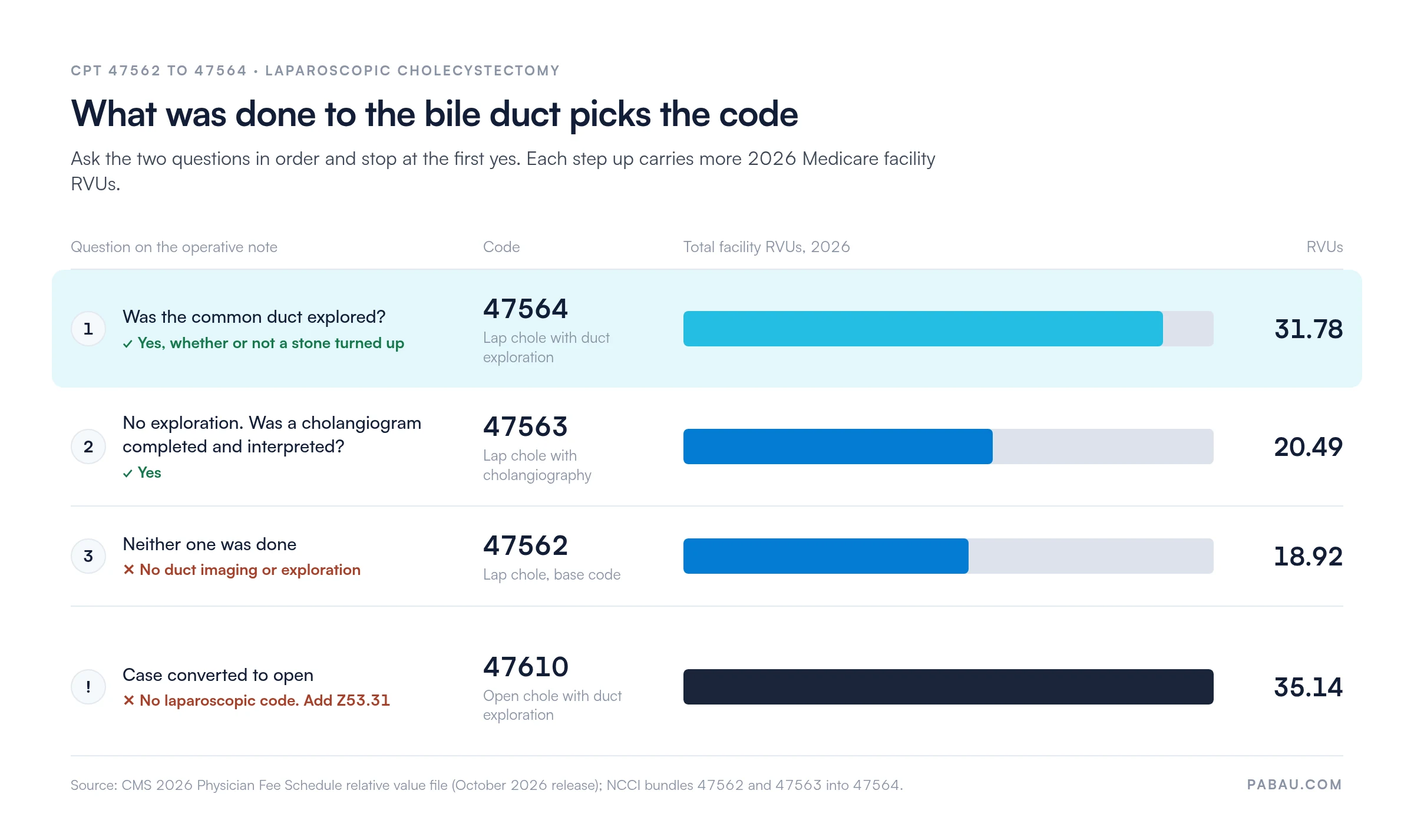
An exploration still counts when no stone turns up. The descriptor pays for entering the duct, whatever came out of it. Likewise, the cholangiogram that led to the exploration adds no second surgical line, because 47563 is bundled into 47564.
Clean cases code themselves. These four come up often enough to need a house rule.
The CMS National Correct Coding Initiative practitioner table effective October 1, 2026 sets these pairings. A modifier indicator of 0 means no modifier can unlock the pair. A bundled pair that goes out anyway comes back denied, with a reason code on the remittance.
Our guide to medical billing denial codes explains what each one means.
The 74300 row is the one coders misread. NCCI has no edit between CPT 74300 and 47564. So a surgeon who supervises and interprets the cholangiogram may report 74300 with modifier 26 in a facility.
However, some commercial payers still fold that read into the surgery. Check the payer’s policy before adding the line.
CMS’s fee schedule file carries payment-policy indicators for every code. For 47564, they settle most modifier questions before you open a payer manual.
The 90-day global adds three more. A related return to the operating room takes 78, and an unrelated procedure takes 79. A staged procedure planned at the first surgery takes 58.
Shared care splits the payment too. CMS assigns 9% to pre-op, 81% to the surgery and 10% to post-op care. A surgeon who hands off follow-up bills 47564-54, and the clinician who takes it over bills 47564-55.
The diagnosis has to put the problem in the common duct. ICD-10 code K80.20 explains removing a stone-filled gallbladder. It doesn’t explain opening the duct.
Code from the postoperative diagnosis. If a cholangiogram finds a stone the workup missed, K80.20 becomes K80.70 on the claim.
Medicare prices 47564 in a facility setting only. Its non-facility practice expense is listed as NA, which fits a hospital or surgery center procedure.
Multiply 31.78 by $33.4009 and you get about $1,061 before locality adjustment. That is roughly $377 more than 47563 pays, and it’s the premium an auditor is testing when they read the note.
These figures come from the October 2026 release. Check the January 2027 file, or the CMS fee schedule lookup, before quoting next year’s rate.
Run these checks on every 47564 line. Most take seconds once the note is open.
Surgical claims often bounce on admin details rather than coding logic. A missing authorization number or member ID sends a correct 47564 line straight back.
Pabau, a practice management platform with built-in claims management software, builds each claim from the patient record. The CPT code attached to the service fills the charge line, so the coder starts from the procedure that was booked.
Before a claim goes out, Pabau warns you when an authorization code is missing. US claims then go through Claim.MD, with eligibility checks before the visit and ERA remittances after it. Your coder still makes the coding call, and the paperwork around it stops holding the claim up.

Pabau fills claims from the patient record, flags a missing authorization before sending and sends US claims through Claim.MD. Your billing team spends less time reworking returned claims.

Code 47564 from the note’s account of the duct, not from the plan or the cholangiogram. If the surgeon entered the duct and said how, the case earns the largest payment in the laparoscopic cholecystectomy family. If not, it belongs on 47563 or 47562, and an auditor will reach that answer anyway.
So build the checks in once: route, findings, a duct diagnosis and no bundled codes beside it. That habit protects a $1,061 line far better than any appeal.
Book a demo to see how Pabau keeps surgical claims complete from the patient record to the payer.

Cholangiogram done, but no exploration? CPT 47563 covers laparoscopic cholecystectomy with cholangiography.
Gallbladder removed with no duct work? CPT 47562 is the base laparoscopic cholecystectomy code.
Billing the surgeon’s cholangiogram read? CPT 74300 explains intraoperative cholangiography supervision and interpretation.
Duct cleared by ERCP instead? CPT 43264 covers endoscopic removal of duct stones.
Seeing denials you can’t trace? Denial codes in medical billing maps CARC and RARC codes to the errors behind them.
LCBDE stands for laparoscopic common bile duct exploration. It is the clinical name for the duct work that moves a laparoscopic cholecystectomy onto CPT 47564. Dictated notes often use the abbreviation alone.
No, the surgical code stays 47564, because a robotic case is still laparoscopic. Some commercial payers accept HCPCS S2900 for the robotic assistance. Medicare lists S2900 as invalid, so it never pays that line.
One. The Medicare medically unlikely edit for 47564 is 1 unit, applied per date of service. A second unit is denied automatically.
Only for the operating surgeon. Their package includes complication care that needs no return to the operating room. A gastroenterologist’s ERCP falls outside that package and is billed separately.




