

ICD-10 Code R63.4: Abnormal weight loss
ICD-10 Code R63.4: Definition, billability, and code structure ICD-10 code R63.4...

Last Updated: Nov 13, 2026
Billable Code Specific Code
K80.20 is the billable ICD-10-CM code for calculus of gallbladder without cholecystitis without obstruction. It covers gallstones confirmed on imaging when the record shows no gallbladder inflammation and no blocked duct.
Two neighbors account for most coding errors. K80.21 adds obstruction, and K80.00-K80.19 apply once cholecystitis is documented. A vague note such as "gallbladder disease" points to K82.9 instead, a code that may not support a surgical claim.
Let Pabau's smart automation suggest the right codes, reduce claim denials, and keep your practice compliant—effortlessly.
Automate repetitive tasks and focus on what matters most—your patients.
Reduce coding errors and ensure compliance with the latest regulations.
Clean claims, fewer denials, and faster reimbursements.
Powerful insights and reporting to help your practice thrive.
HIPAA compliant SOC 2 certified GDPR-compliant Trusted by 4,000+ clinics worldwide

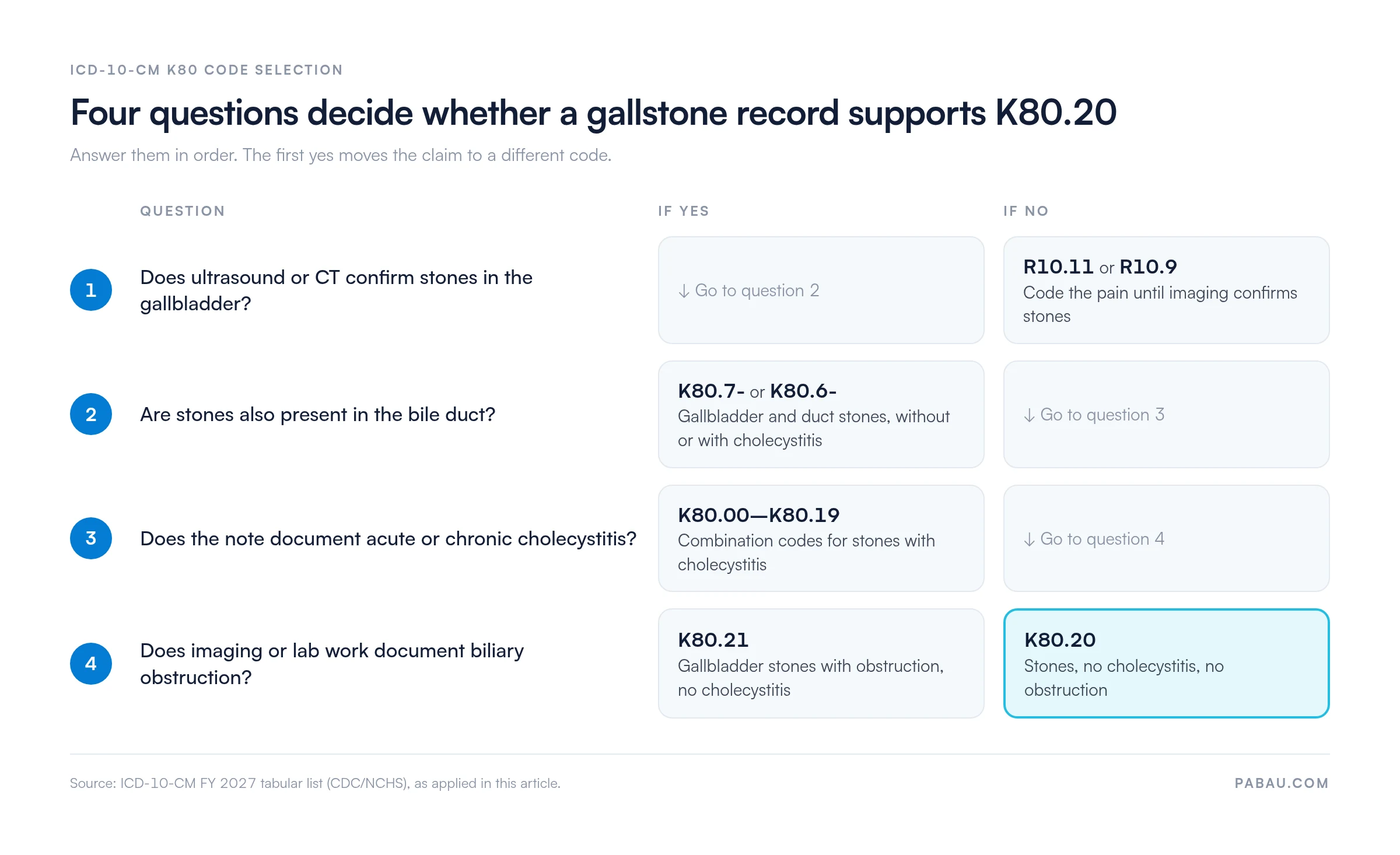
K80.20 applies only when imaging confirms gallbladder stones and the record rules out both cholecystitis and obstruction.
Documented obstruction moves the claim to K80.21, and documented cholecystitis moves it to a combination code from K80.00 to K80.19.
The K81 cholecystitis codes carry an Excludes1 note for K80, so K81.0 and K81.1 never go on a claim with K80.20.
A note that only says gallbladder disease forces a less specific code, which may not support a cholecystectomy claim.
Pabau’s claims management builds the claim and sends it through Claim.MD, which handles eligibility checks and claim scrubbing before the payer sees it.
ICD-10 code K80.20 is the billable ICD-10-CM code for calculus of the gallbladder without cholecystitis, without obstruction. It is a fully billable, specific code requiring no further subdivision. It is valid for FY 2027 claims with dates of service from October 1, 2026.
Per the CDC/NCHS ICD-10-CM web tool, the code sits in Chapter 11, Diseases of the digestive system. Its block is K80-K87 and its parent category is K80, Cholelithiasis.
The two “without” qualifiers carry the weight. Each one maps to its own axis in the K80 structure, and the record has to settle both before the code fits.
K80.20 describes gallstones seen on imaging, with a normal gallbladder wall and no sign of a blocked duct. The classic picture is biliary colic. That means episodes of right upper quadrant pain, often after meals, lasting from 30 minutes to several hours. Fever, a raised white cell count and jaundice are absent. Epigastric pain with a raised lipase points to acute pancreatitis instead. If the physician links it to the stones, it codes to K85.1x, and with no documented cause it codes to K85.90.
Ultrasound is the first-line test. It shows echogenic foci with posterior acoustic shadowing inside the gallbladder. Before you assign the code, check that the chart carries all three of these findings.
Gallstones found by chance in a patient with no symptoms also land here. Some payers, though, want symptom documentation before they approve surgery linked to K80.20.
The K80 category sorts gallstone codes on two axes at once: cholecystitis present or absent, and obstruction present or absent. Get one axis wrong and the claim carries the wrong code. The table maps the subcodes coders mix up most often.
K82.9 is the fallback for gallbladder disease nobody has specified. Don’t reach for it when clear imaging results are already in the chart. The AAPC’s ICD-10-CM code lookup shows the full K80 hierarchy side by side, which helps when the documentation is borderline.
Read the questions below in order, because the first yes takes the claim somewhere other than K80.20.
The CMS ICD-10-CM tabular list attaches its instructional notes at the K80 category level, and they govern every code beneath it.
Reading them correctly keeps conflicting codes off the same claim. These notes are also part of medical billing compliance for every HIPAA-covered transaction.
An imaging report alone can’t carry K80.20. The record as a whole must show stones, and it must show that someone looked for cholecystitis and obstruction and found neither. When any of that is missing, the coder either drops to a less specific code or queries the physician.
Confirm these five elements first:
Take an illustrative patient with three weeks of after-dinner pain under the right ribs. Here is the path from first visit to payment, and the point where it usually goes wrong.
The trip-up comes after surgery. Pathology often reports chronic inflammation in a gallbladder that looked normal on ultrasound. If that finding changes the final diagnosis, query the surgeon before you switch to K80.10, and follow your facility’s policy on coding from pathology reports.
K80.20 is the primary diagnosis behind the most common gallstone procedures in outpatient and surgical settings. The table lists the CPT codes most often submitted with it, and both 47562 and 47563 have their own billing guides.
NCCI bundling edits change every year, so check the edits active on the date of service before you submit. If cholangiography finds a stone in the common bile duct, the principal diagnosis may need revising.
The likely choice is a K80.7- code when gallbladder and duct stones coexist, or K80.6- when cholecystitis is present. K80.5- covers duct stones without cholangitis or cholecystitis. When that duct stone causes no obstruction, assign code K80.50. If the duct stone is then cleared at ERCP after cutting the sphincter, bill the sphincterotomy under ERCP code 43262.
Medicare and most commercial payers treat laparoscopic cholecystectomy linked to K80.20 as elective, so the record has to show why surgery is needed.
The CMS Physician Fee Schedule sets Medicare payment for the procedure. Coverage criteria vary by payer and plan, so check each payer’s policy before you schedule.
Policies change every year, so treat this list as a starting point and confirm the current rules with each payer.
Run eligibility and prior authorization checks before scheduling elective cholecystectomy for K80.20 patients. Document each check date, the payer response, and the authorization number in the patient record. Missing authorization on an elective case is among the most avoidable denial types for gallstone claims.
Each item below closes off one of the denial reasons in the next section. It takes a couple of minutes per claim.
K80.20 denials tend to trace back to a handful of causes, and each one is preventable upstream. Good denial management in healthcare catches them before the claim reaches the clearinghouse.
When one slips through, the remittance carries a reason code you can look up in our guide to denial codes.
Every row in that table is a documentation question. Answer each one before the claim goes out and it becomes a clean claim.
In many surgical practices, the K80.20 paper trail lives in four places. The ultrasound sits in one inbox and the authorization number in a spreadsheet. The surgeon’s note lives in the EHR, and the claim in a separate billing tool. Each handoff is a chance for the documentation to fall out of step with the code.
Pabau, the practice management platform we build, keeps the patient record, the authorization details and the claim together. Its claims management software builds the claim from the visit and sends it through Claim.MD as a CMS-1500 or 837P.
You can run eligibility checks through Claim.MD against the payers it supports, and its claim scrubbing flags errors before the payer sees the claim. ERA remittances come back into Pabau, so your team sees a denial reason next to the patient’s notes.
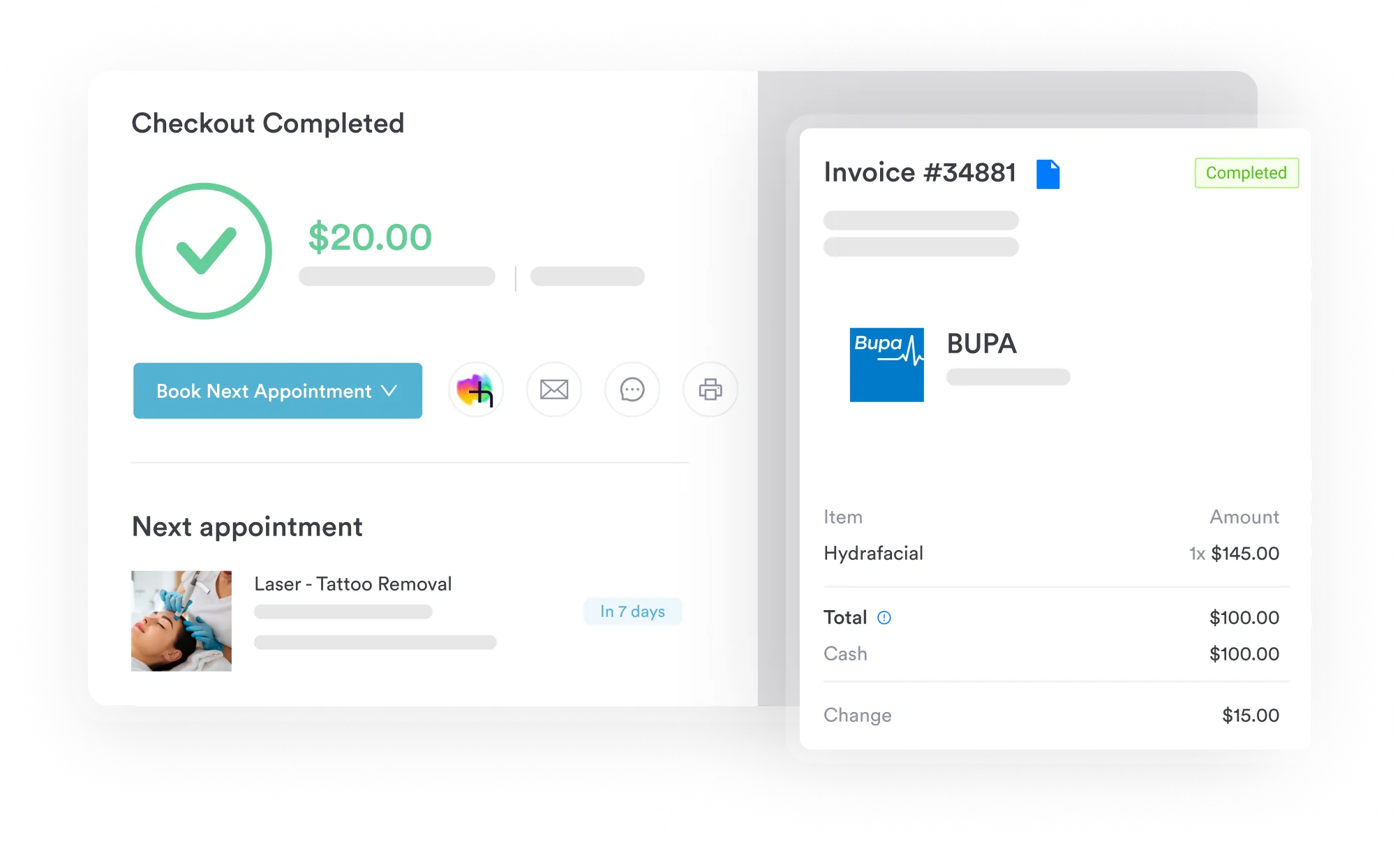

Pabau builds each claim from the patient record and sends it through Claim.MD, with eligibility checks, claim scrubbing and ERA remittances in one place.

K80.20 is the right code more often than coders give it credit for. Under-documented records push it down to K82.9, and over-reading the imaging pushes it up to K80.21. The fix in both cases is the same: get the physician to write down what’s absent.
If you change one habit, make it the query. A short question to the surgeon before submission costs less than a denied cholecystectomy and an appeal. Then keep the imaging, the authorization and the note together so the next claim starts complete.
Book a demo to see how Pabau keeps the record and the claim together, so your gallstone claims go out with the documentation behind them.

Need to understand how clearinghouse submission works for gallstone claims? Claim.MD clearinghouse guide explains how electronic claims are checked and routed through the Claim.MD network.
Looking for a primer on the full billing cycle behind surgical claims? Revenue cycle management overview covers the workflow from code assignment through payment posting.
Want to read what the payer sends back after a K80.20 claim? Electronic remittance advice explained breaks down 835 ERA files and CARC denial reason codes.
Billing the surgery itself? CPT code 47562 billing guide covers how to code and bill a laparoscopic cholecystectomy.
Z90.49, acquired absence of other specified parts of digestive tract, records that the gallbladder is gone. If stones later turn up in the bile duct, code K91.86 for retained cholelithiasis following cholecystectomy. K80 codes no longer apply once the gallbladder has been removed.
Sequence a code from O99.61-, diseases of the digestive system complicating pregnancy, first. Its final character records the trimester. Then add K80.20 to name the gallstones, as long as cholecystitis and obstruction are ruled out.
Gallstone pancreatitis has its own subcategory, K85.1-, biliary acute pancreatitis. K85.10 applies when there is no necrosis or infection. It sits outside K80, so a K80.20 claim never covers pancreatitis.
Yes. A CT for another complaint often finds gallstones by chance. Code the reason for the visit first, then add K80.20 when the provider documents the stones and they affect care.
The ICD-9-CM equivalent was 574.20, calculus of gallbladder without mention of cholecystitis, without mention of obstruction. You’ll only need it when auditing records from before October 1, 2015.



