



CCSD code G5100: Bypass of duodenum billing guide
CCSD code G5100 bills a bypass that leaves the duodenum in place CCSD code G5100...

Last Updated: Oct 16, 2026

CPT code 47563 covers a laparoscopic cholecystectomy performed with intraoperative cholangiography, and that cholangiogram is what separates it from 47562.
Billing 47563 when no cholangiogram was performed or documented counts as upcoding, with False Claims Act exposure.
Modifiers 22, 51 and 59 all apply to 47563, and each one needs its own support in the operative report.
Medicare values 47563 at roughly 20.49 total RVUs in the facility setting, which lands near $680 to $700 before locality adjustment.
Practice management software like Pabau supports 47563 claims with CPT and ICD-10 lookup libraries, required-field checks, and clearinghouse submission.
CPT code 47563 covers a laparoscopic cholecystectomy performed with intraoperative cholangiography. The code holds up only when the operative report proves the cholangiogram happened and records what it showed.
Payers audit that one line closely, because 47563 pays more than 47562 does. Get it wrong and the claim either downcodes or comes back denied.
What follows is the working detail: the modifiers, the ICD-10 pairings, current Medicare RVUs, and the checks to run before you submit.
One operative session, two documented components. That is the whole shape of the code. The American Medical Association’s CPT code set assigns 47563 to minimally invasive gallbladder removal carried out with real-time fluoroscopic imaging of the bile ducts.
In practice the case runs in a set order. The surgeon places four trocar ports, then dissects the cystic duct and the cystic artery. Contrast dye goes into the cystic duct. Fluoroscopy captures the bile duct images, and the surgeon reads them before extracting the gallbladder through the umbilical port.
Every one of those steps belongs in the operative report, not just the cholecystectomy. Report the code once per session. It is major surgery with a 090-day global period, so routine follow-up visits already sit inside the payment.
Ask a single question. Was a cholangiogram performed, and did the report record what it showed? Yes puts the case on 47563. No puts it on 47562, whatever the surgeon intended to do.
Billing 47563 without that documentation is upcoding, and the False Claims Act is the reason coders treat it as a hard line. The CMS National Correct Coding Initiative also treats the two codes as mutually exclusive. Only one of them can be reported per surgical encounter.
Three questions settle the code for almost every gallbladder case, and the diagram below runs them in order.
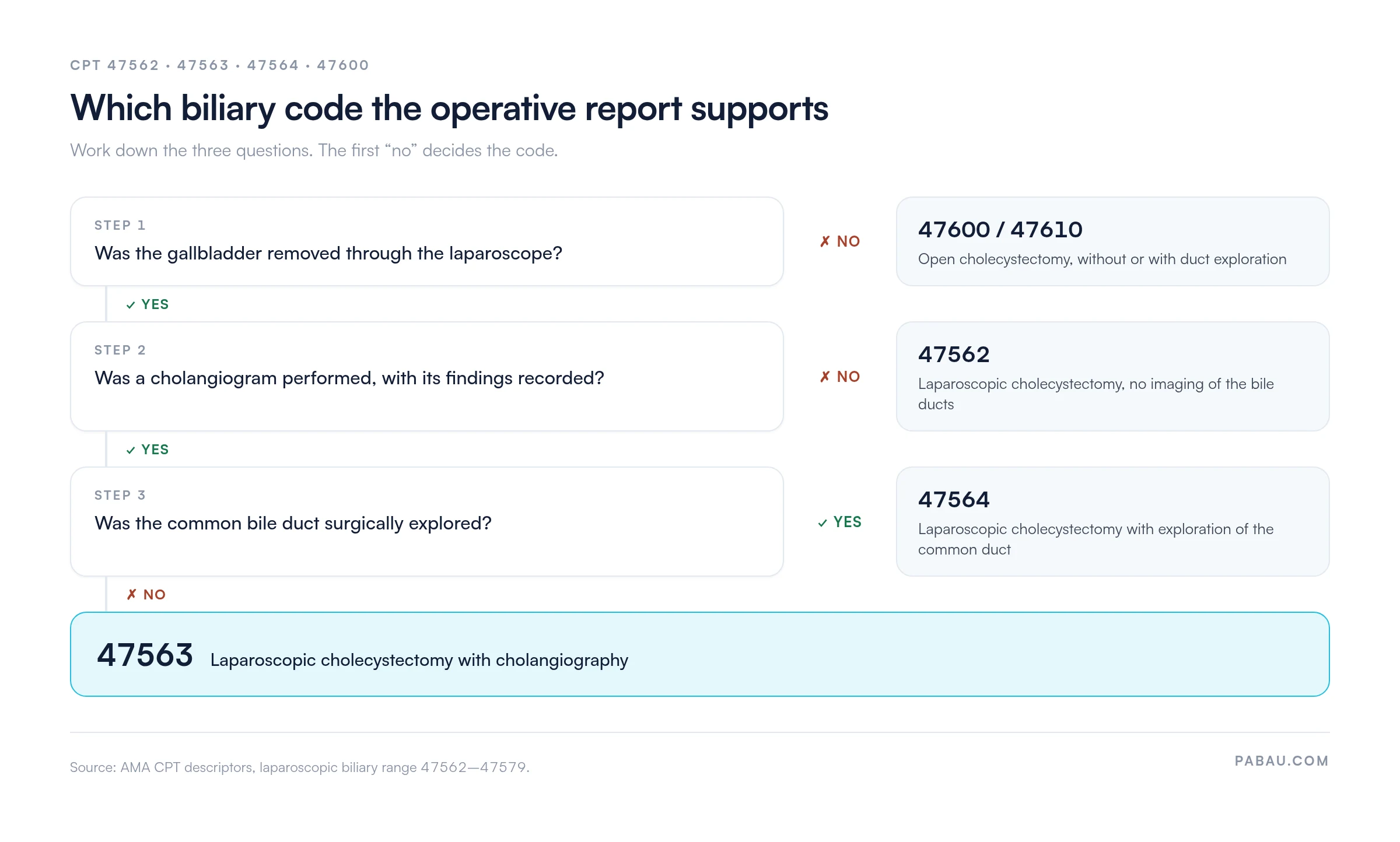
The clean cases code themselves. These two do not, and they show up often enough to be worth a rule.
The cholangiogram was attempted, but no images came out. Cannulation fails, contrast will not run, or the equipment goes down. Nothing was imaged, so nothing supports the imaging component. Report CPT 47562 and let the operative note explain the attempt.
The laparoscopic case converted to an open procedure. Code what was completed, not what was started. A converted case belongs on the open cholecystectomy code, and the laparoscopic approach is not reported on top of it. That code is 47600, or 47610 when the common duct is explored. The report should say when and why the surgeon converted.
CPT 47563 sits inside the 47562-47579 biliary tract range. Reading the adjacent codes first is how coders avoid picking the wrong level of complexity. The AAPC CPT code lookup carries the full descriptors for each one.
The imaging is included in 47563 and is not separately reportable. NCCI edits treat the cholangiography as surgical work the descriptor already captures.
Add a separate cholangiography code beside 47563 and the edit fires automatically, which denies the line.
One modality does need a second look. ICG fluorescence cholangiography uses indocyanine green rather than conventional contrast dye, and payer policies on it are inconsistent.
Some treat it as included, others as a separate service. Confirm the policy for that specific payer before assuming the usual bundling rules apply.
A modifier tells the payer that something unusual happened. It does not create the evidence for it. Append one without matching detail in the operative report and you have a compliance problem rather than a paid claim.
Run an NCCI edit check before you put modifier 59 on any code paired with CPT 47563. Modifier 59 does bypass the bundle edits, but only where the clinical circumstances genuinely support it. Reaching for 59 as a routine fix for denied claims is one of the patterns payer auditors look for.
The diagnosis code has to make both halves of the procedure necessary. Payers deny 47563 when the attached ICD-10 code supports removing the gallbladder but says nothing that would prompt a look at the ducts.
Take a worked example. A patient with symptomatic stones and no duct involvement codes to K80.20, which supports the cholecystectomy on its own. Add jaundice and a dilated duct on imaging and K80.21 or K83.1 becomes the stronger pairing, because both point at the biliary tree.
The ICD-10-CM code list is the place to confirm the fourth and fifth characters before the claim goes out.
Medicare prices 47563 through the Physician Fee Schedule, using three relative value units that are added together.
Work, practice expense and malpractice each carry their own value, and each is adjusted for geographic locality before payment.
The figures below are approximate national facility rates, and they change every January. Verify the current values with the CMS Physician Fee Schedule lookup before you quote a number to anyone.
The arithmetic is simple once you have the components. Add the three RVUs, apply the locality adjustment for each one, then multiply by that year’s conversion factor.
Check the conversion factor every January, because a small change there moves every surgical line on your fee schedule.
The operative report carries the whole claim. Miss one of the six elements below and you are looking at a denial now, or a recoupment after a post-payment audit.
Audit 47563 claims quarterly. Pull a sample of operative reports and check that cholangiography findings are written out, rather than listed as a procedure performed. Payers look for the specifics, such as normal duct caliber, no filling defects and free flow to the duodenum, to confirm the imaging actually happened.
Most 47563 denials come from a short list of preventable errors. Four of them account for the bulk of what billing teams see.
A short pre-submission pass catches almost all of it. Run these seven checks on every 47563 line before it goes out the door.
In most surgical practices this runs on memory and a spreadsheet. A coder reads the operative report, looks the code up somewhere else, types it onto a claim form, and hopes the diagnosis field matches. Every hop between systems is a chance to lose a character.
Practice management software like Pabau closes those hops. Our claims software for surgeons pre-fills the claim straight from the record. The code attached to the service lands on the charge line, and the diagnosis slots seed from the patient’s recorded problem list.
Full CPT and ICD-10-CM lookup libraries sit behind a search icon on the same screen. The send button then stays locked until every required claim field is complete.
From there the claim goes out electronically through Claim.MD, our US clearinghouse partner, which reaches thousands of payers. Eligibility checks, claim status tracking and ERA remittance posting come back into the same record, so nobody re-types a payment.
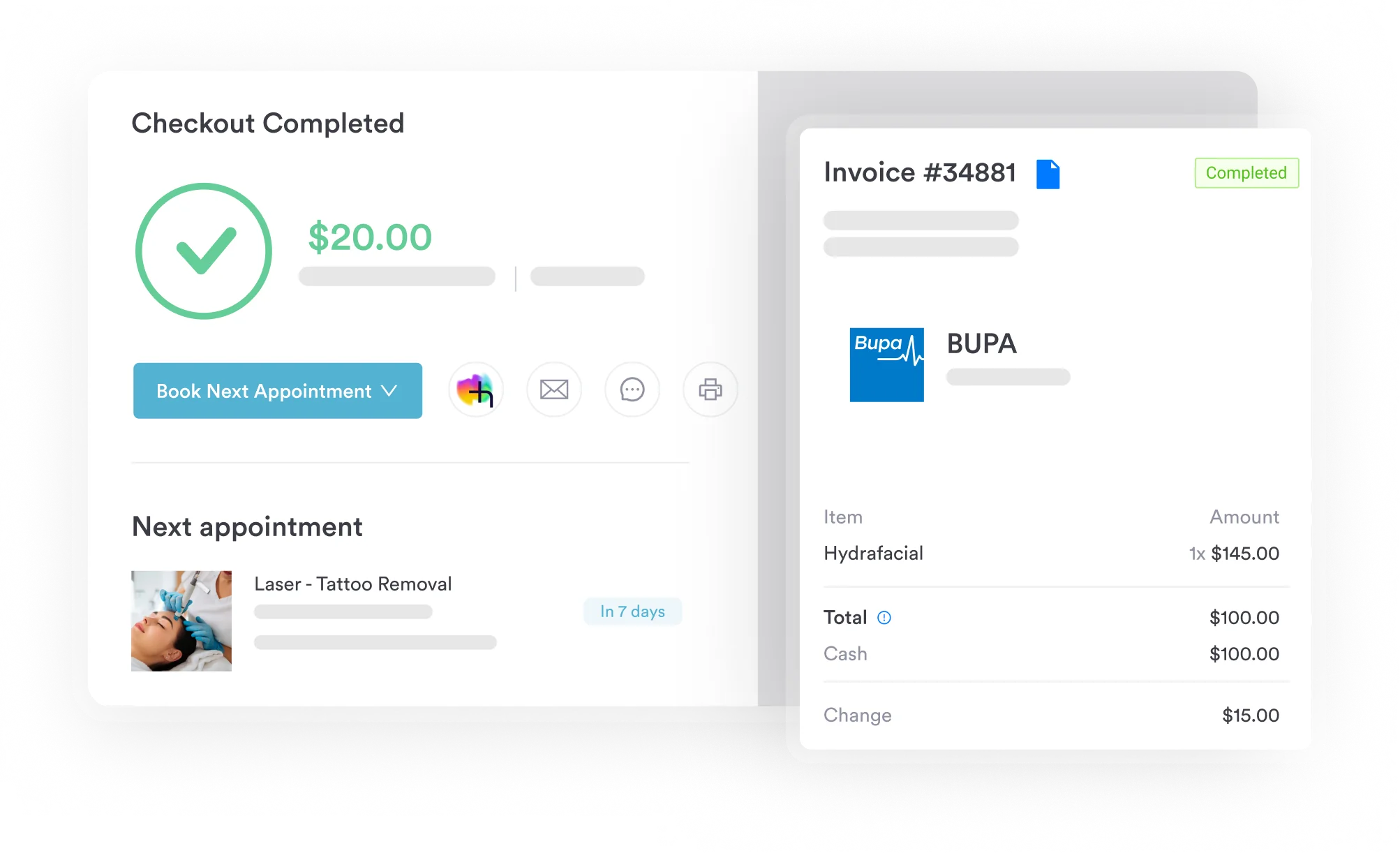
For a group billing 47563 across several surgeons or sites, that matters most at the volume end. Required-field validation stops the routine errors at source. Your billers then spend their time on the coding decisions that need judgment, such as whether the note really supports the cholangiogram.

Pabau pre-fills CPT and ICD-10 fields from the surgical record, checks that every required claim field is complete, and submits electronically through Claim.MD. Your billing team sees the payment come back into the same record.

One documented procedure separates 47563 from 47562. Record the cholangiogram and its findings, and the higher-value code survives any review. Leave the findings out and the claim downcodes at best, or lands in denial.
So the work sits with the operative report, not the claim form. Give your surgeons a template that prompts for duct caliber, filling defects and flow, and the coding follows on its own.
Book a demo to see how Pabau carries that documentation straight onto a surgical claim.

Need a deeper understanding of claim submission errors? Denial codes in medical billing covers how to read and answer the most common payer rejection codes.
Wondering how a clearinghouse handles surgical claims? Claim.MD clearinghouse guide explains how electronic claims reach payers and what happens when an edit fires.
Looking to tighten your billing compliance posture? Medical billing compliance guide walks through the audit risk areas that matter most to surgical specialties.
Want fewer rejections on first submission? What makes a clean claim sets out the fields and checks that decide whether a claim pays on the first pass.
Curious what the payer actually receives? The 837 electronic claim file breaks down the loops and segments that carry your surgical charge line.
Yes. Robotic assistance is still a laparoscopic approach, so 47563 applies when the cholangiogram is performed and documented. Medicare does not pay separately for the robotic platform. Report the surgical work only.
Open cholecystectomy is 47600 without duct exploration, or 47610 with it. Both sit outside the laparoscopic range and carry their own RVU values. Use them whenever the report describes an open approach.
That depends on the payer. Many commercial plans require authorization for elective gallbladder surgery, while Medicare generally does not. Check the plan’s surgical policy before the case is scheduled, not after.
Yes, on separate claims. The surgeon reports 47563 on a professional claim, and the facility bills its own institutional claim for the room, staff and supplies. Different fee schedules price the two.
Routine postoperative care for 90 days after surgery, including the usual follow-up visits and dressing changes. Care for a new problem is separately reportable, with the right modifier on the line.



