

HCPCS Code Q4185: Cellesta flowable amnion billing guide
HCPCS Code Q4185: definition and official descriptor HCPCS Code Q4185 is the Lev...

Last Updated: Nov 20, 2026
74300 is the CPT code for cholangiography and/or pancreatography; intraoperative, radiological supervision and interpretation. It reports the reading of a contrast study of the bile or pancreatic ducts done during surgery, not the surgery itself.
The code covers the first image set, and each additional set takes add-on code +74301. A surgeon who reports 47563 or 47605 doesn't bill 74300, because those codes already include the cholangiography. A separate radiologist who reads the images and signs a report bills 74300-26.
Let Pabau's smart automation suggest the right codes, reduce claim denials, and keep your practice compliant—effortlessly.
Automate repetitive tasks and focus on what matters most—your patients.
Reduce coding errors and ensure compliance with the latest regulations.
Clean claims, fewer denials, and faster reimbursements.
Powerful insights and reporting to help your practice thrive.
HIPAA compliant SOC 2 certified GDPR-compliant Trusted by 4,000+ clinics worldwide

CPT code 74300 reports the radiological supervision and interpretation of a cholangiogram or pancreatogram done during surgery, not the surgery itself.
A surgeon who reports 47563 or 47605 doesn’t bill 74300, because those codes already include the cholangiography.
A separate radiologist who reads the images and signs a report bills 74300-26, plus +74301-26 for each additional image set.
The CMS 2026 fee schedule gives 74300-26 a value of 0.39 total RVUs, while the global and technical lines are carrier priced.
Billing software such as Pabau pre-fills each claim from the patient record, checks required fields and sends it through Claim.MD.
CPT code 74300 reports the radiological supervision and interpretation (RS&I) of a contrast study of the bile or pancreatic ducts done during surgery. CMS’s 2026 relative value files pay it as a professional read, giving 74300-26 a national value of 0.39 RVUs.
The American Medical Association (AMA) descriptor reads Cholangiography and/or pancreatography; intraoperative, radiological supervision and interpretation.
The surgical work of placing the catheter and injecting contrast belongs to the operation’s own code. 74300 covers the first image set, and each additional set takes add-on code +74301.
Two words in the descriptor matter most. “And/or” means one code covers the bile duct, the pancreatic duct or both in the same session. “Intraoperative” means it applies only in the operating room, so studies before or after surgery take other codes.
Intraoperative cholangiography (IOC) is a fluoroscopic contrast study of the bile ducts, taken while the patient is still on the table. Knowing the steps lets a coder check that the record supports 74300.
Fluoroscopy used to complete the study is part of the RS&I code. The NCCI policy manual, chapter 9 says codes such as 76000 aren’t reported separately alongside it.
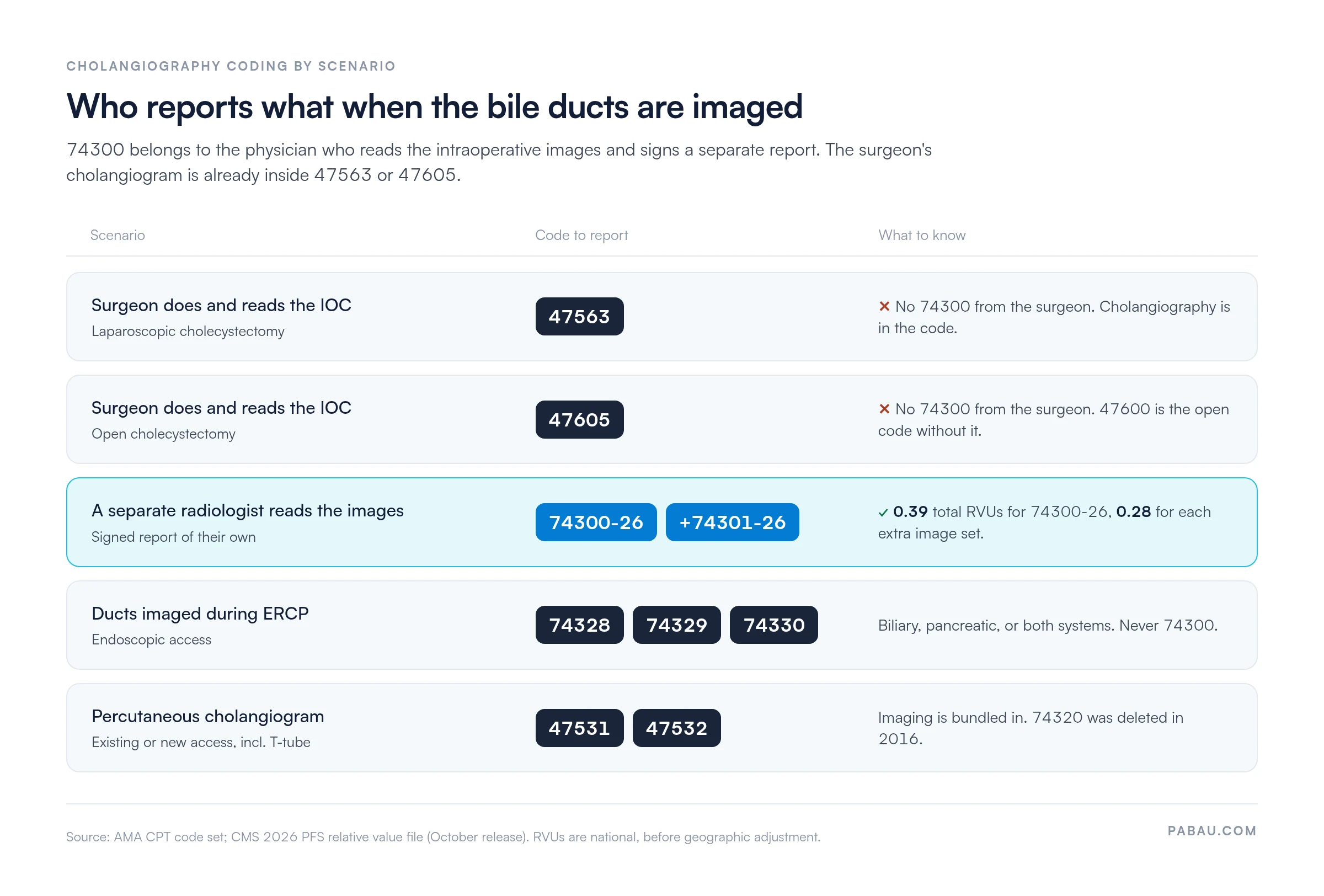
Most 74300 questions start in the gallbladder suite, and the answer turns on the surgical code. 47563 is laparoscopic cholecystectomy with cholangiography. The surgeon’s cholangiography and its RS&I are already inside it, so the surgeon doesn’t add 74300.
The open route works the same way. 47600 is open cholecystectomy without cholangiography, and 47605 is the open procedure with it. Only a separate radiologist who interprets the images and signs a report may bill 74300-26.
The table below sorts each scenario by who reports what, and it’s the quickest way to settle a disagreement between the surgical and radiology billers.
NCCI note: National Correct Coding Initiative (NCCI) edits change quarterly. Check the current CMS edit files, plus each payer’s own policy, before you bill any combination with a surgical code.
The access route in the record decides the code. 74300 is for intraoperative studies only, and its neighbors cover endoscopic and percutaneous routes. 74328 is the most common mix-up, because ERCP images look similar on a report.
Key rule: If the surgeon cannulated the cystic duct in the OR, the RS&I code is 74300. A post-surgical T-tube or drain study is a percutaneous cholangiogram through existing access, coded 47531. The old RS&I code 74320 was deleted in 2016, when percutaneous biliary codes started to include their imaging.
74300 needs a diagnosis that explains why the ducts were imaged. A specific biliary or pancreatic code does that job. Unspecified abdominal pain usually doesn’t.
Gallstone cases often pair the study with K80.20 when no cholecystitis is present. When the surgeon is checking for duct stones, K80.50 tells the payer why imaging was needed. Local coverage determinations can narrow the list in some MAC jurisdictions, so check the one that applies.
RS&I codes split into a professional and a technical component. When the radiologist and the facility bill separately, modifiers keep each claim to its own share.
The -26/-TC split is the everyday case. The radiologist bills 74300-26, and nobody bills the global code. A second image set is +74301 rather than 74300 with a repeat modifier.
The figures below come from the October release of the CMS 2026 PFS relative value file. The global and technical lines are carrier priced, so each Medicare Administrative Contractor (MAC) sets its own rate.
Multiply the total RVUs by the 2026 conversion factor, then apply your locality’s adjustment. Look up the local amount in the CMS Physician Fee Schedule lookup, or cross-check with the FastRVU lookup tool. Commercial rates vary by payer contract.
A 74300 claim rests on two documents, and teams often treat them as one. The operative note alone doesn’t support the RS&I code.
The separate report is the piece most often missing, and its absence is a common cause of denial. Ask for it before charge entry, while the case is fresh.
The radiology claim follows the surgical one, and most errors creep in at the handoffs. Here’s the usual path for a radiologist’s 74300-26.
Take an illustrative case. A surgeon removes the gallbladder laparoscopically for symptomatic gallstones and runs a cholangiogram to rule out duct stones. A hospital radiologist reads the images and signs a separate report.
The surgeon’s claim carries 47563 alone. The radiologist’s claim carries 74300-26 with the gallstone diagnosis. If the surgeon flushes the duct and takes a second set to confirm it’s clear, the radiologist adds +74301-26.
At the 2026 non-QP conversion factor of $33.4009, those lines come to about $13.03 and $9.35 nationally before locality adjustment. Small amounts, which is why a denied 74300 often goes unworked.
Run this list at charge entry, not after a denial. It’s the same idea behind a clean claim: a claim that clears the payer’s edits on the first pass.
74300 sits between surgery and radiology billing, so its denials tend to come from the handoff. These are the patterns to watch for.
For appeal language and the wider list of CARC codes, see our guide to medical billing denial codes.
Before a scheduled cholecystectomy, check the patient’s plan for authorization rules on intraoperative radiology. Medicare generally doesn’t require it for 74300, but some commercial and self-insured plans do. A quick eligibility check before the case costs far less than reworking a CO-197 denial afterward.
Medicare generally doesn’t require prior authorization for intraoperative RS&I codes, because the decision to image is usually made during surgery. Some commercial, Medicaid managed care and self-insured plans do have rules, mostly for elective cholecystectomy.
On paper, the radiologist’s charge depends on someone chasing the report, re-keying patient details and checking the claim by eye. That’s where a missing field or a wrong modifier slips through.
Pabau takes that work off the desk. Its claims management software pre-fills each claim from the patient record. Coders pick codes from built-in CPT and ICD-10 lookup libraries, and Pabau checks required fields before submission.
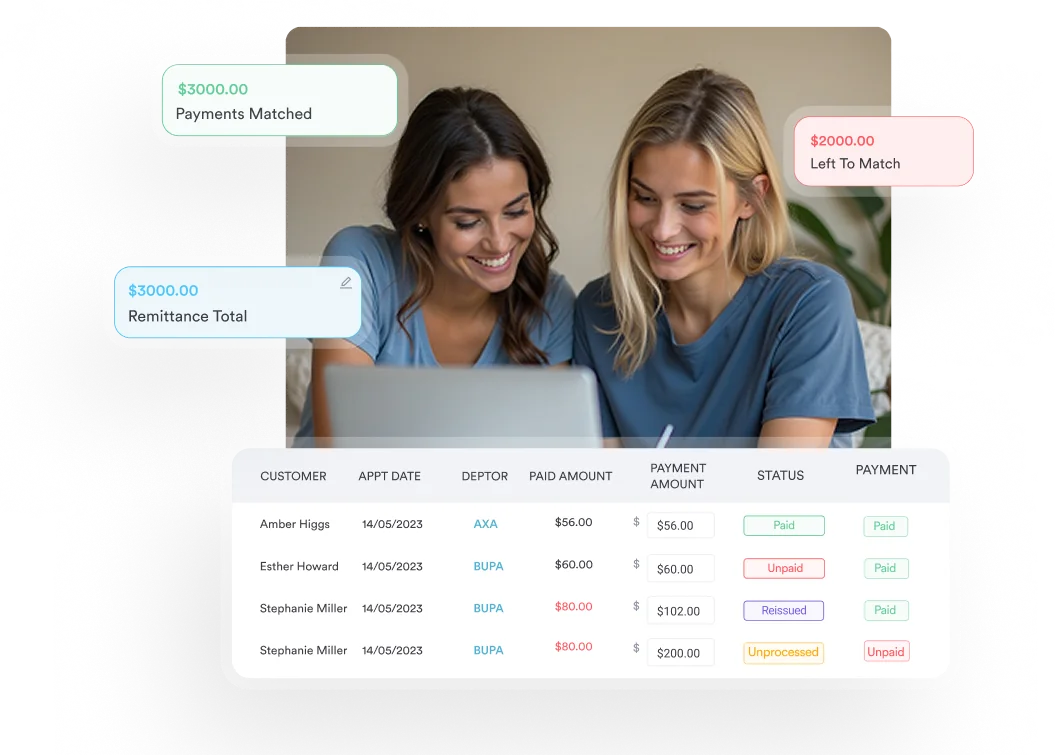
Claims go to the payer through Claim.MD, our US clearinghouse partner, with eligibility checks before the visit. ERA remittances return to the same record, so a denied 74300-26 is easy to spot and rework. Authorization codes and dates sit on the case, with a warning when one is missing.

Pabau pre-fills each claim from the patient record, checks required fields before submission and sends it through Claim.MD. Eligibility checks and ERA remittances come back to the same record.

74300 is a small charge with a narrow rule. It belongs to the physician who interprets the intraoperative images and signs a report of their own. Treat it as part of the surgeon’s claim and it gets denied. Treat it as a separate radiology service with its own documentation and it pays.
Settle the surgical code first, then decide whether a second physician read the study. If you only change one habit, make it requesting the signed report before charge entry.
Book a demo to see how Pabau builds each 74300 claim from the patient record and sends it through Claim.MD.

Need a clearinghouse that handles surgical radiology claims? Our Claim.MD clearinghouse guide explains how claims travel from Pabau through the clearinghouse to the payer.
Confused by the codes on a radiology remittance? Understanding electronic remittance advice breaks down ERA reading, CARC codes and denial follow-up.
Working a backlog of denied radiology claims? Denial management in healthcare sets out a repeatable process for tracking, appealing and preventing denials.
Auditing how your team bills split professional and technical services? Medical billing compliance covers the rules and internal checks that keep claims audit-ready.
Want to see the whole revenue cycle behind surgical billing? Revenue cycle management explained covers the process from charge capture through final payment.
No. 74300 is a standalone code for the first set of intraoperative images. The add-on is +74301, reported for each additional image set in the same session, and it’s never billed without 74300.
At the 2026 non-QP conversion factor of $33.4009, the 0.39 RVUs for 74300-26 come to about $13.03 nationally. Your MAC’s locality adjustment moves that figure up or down.
No. ERCP imaging uses 74328 for the bile ducts, 74329 for the pancreatic duct or 74330 for both. 74300 is only for cholangiography done during an operation.
No. A study through an existing T-tube or drain is a percutaneous cholangiogram through existing access, reported with 47531. That code includes the imaging, so no separate RS&I code applies.
Some payers accept 74300 with modifier 52 for a reduced service when the study starts but can’t be finished. Document why it stopped, and confirm the payer’s policy before you submit.





