HCPCS code J0330: Succinylcholine chloride injection billing guide
HCPCS code J0330: Definition and clinical overview HCPCS code J0330 is the offic...

Last Updated: Nov 2, 2026
43264 is the CPT code for endoscopic retrograde cholangiopancreatography (ERCP) with removal of calculi/debris from biliary/pancreatic duct(s). It applies when the endoscopist captures stones or debris with a basket or balloon and pulls them out of the bile or pancreatic duct.
Claims for this code commonly run into trouble for three reasons. Coders conflate stone removal with stent removal, omit the radiology supervision code, or leave the accessed duct undocumented. Breaking stones up by lithotripsy is a separate code, 43265.
Let Pabau's smart automation suggest the right codes, reduce claim denials, and keep your practice compliant—effortlessly.
Automate repetitive tasks and focus on what matters most—your patients.
Reduce coding errors and ensure compliance with the latest regulations.
Clean claims, fewer denials, and faster reimbursements.
Powerful insights and reporting to help your practice thrive.
HIPAA compliant SOC 2 certified GDPR-compliant Trusted by 4,000+ clinics worldwide

CPT 43264 covers ERCP with removal of stones or debris from the bile or pancreatic duct, while stent removal uses 43275 or 43276.
Breaking stones up by lithotripsy is reported with 43265, which isn’t billed with 43264 for the same stone.
Fluoroscopic supervision (74328, 74329 or 74330) is billed on the professional claim and is typically packaged on the facility claim.
NCCI edits may affect 43262 (sphincterotomy) billed with 43264, so check the current quarterly edit table before billing both.
The 2026 national Medicare physician rate is about $317 (9.50 total RVUs) before locality adjustment, in facility and office settings alike.
CPT code 43264 describes “Endoscopic retrograde cholangiopancreatography (ERCP); with removal of calculi/debris from biliary/pancreatic duct(s),” as defined by the American Medical Association’s CPT code set. The code sits within the 43260-43278 ERCP family. That family was restructured in the 2013 CPT update to separate procedures by the intervention performed.
The key clinical distinction is how the stone leaves the duct. CPT 43264 applies when the gastroenterologist uses a basket or balloon to extract a calculus (stone) from the common bile duct or pancreatic duct. Breaking a stone up by mechanical, electrohydraulic or laser lithotripsy is a separate code, 43265. Placing or exchanging a stent without stone extraction also takes a different code from the family.
The operative note is the coder’s main verification tool for CPT 43264. Knowing the procedural sequence helps you confirm the note describes stone removal rather than a different ERCP intervention.
ERCP for calculus removal follows this sequence, and each step needs to appear in the note:
Some notes describe “ERCP with stone extraction” but never say which duct was accessed. Others describe a cholangiogram without confirming extraction. Both leave the claim exposed to a medical necessity denial.
Correct bundling decisions around 43264 start with knowing what the code covers and what needs its own code. Getting this wrong is a frequent source of NCCI edit denials on ERCP claims.
Direct visualization of the duct with a cholangioscope or pancreatoscope is reported with add-on code 43273 on top of 43264. The note has to describe the scope’s view of the stone for the add-on to hold.
Before submitting any ERCP claim with multiple codes, pull the current NCCI procedure-to-procedure edit table from the CMS website and check the 43264 column. NCCI edits update quarterly, so an edit that did not exist last year may apply today. A modifier bypass is only valid when the additional service is clinically distinct and separately documented.
The 43260-43278 ERCP family separates procedures by intervention type. Select the code that matches the intervention documented, not the broadest ERCP descriptor available. A scope that only images the ducts stays at 43260, and each intervention moves the claim to its own code, as the chart below shows.
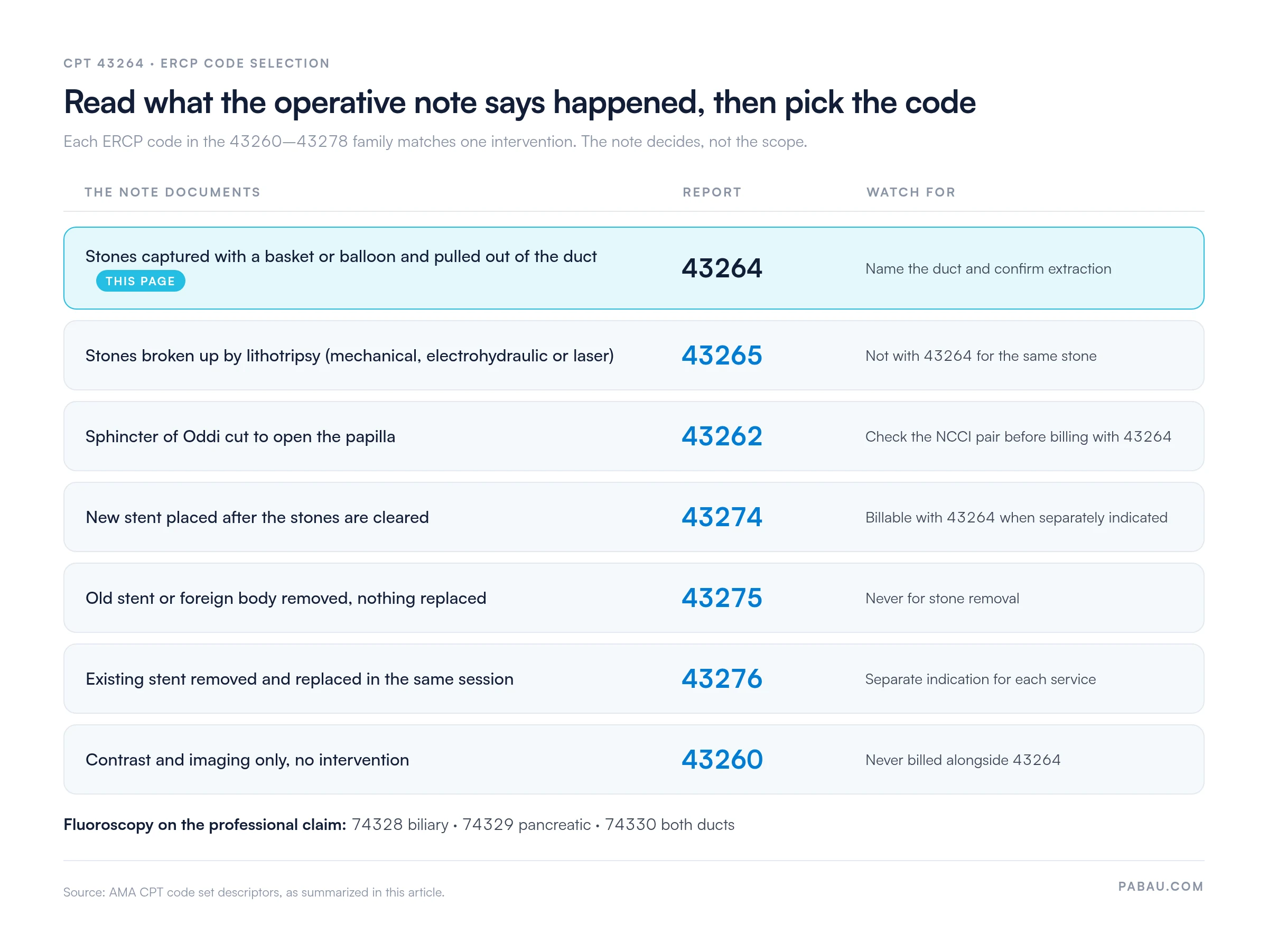
Sphincterotomy (43262) and calculus removal (43264) are distinct procedures, but NCCI edits may treat them as a bundled pair depending on the current quarterly table. Sometimes the endoscopist cuts the sphincter only to reach the stone. Some payers then treat the sphincterotomy as part of the extraction and deny 43262 as a component service.
Others allow separate billing with modifier 59 or modifier XS when the note documents a distinct reason for the sphincterotomy. Check the active NCCI edit pair before billing both codes. Make sure the operative note explains why the sphincterotomy was needed beyond stone access.
A frequent miscoding in the ERCP family is reporting 43275 (stent or foreign body removal) when 43264 (calculus removal) is correct. Stents and stones both come out through the scope, but the procedure codes are entirely separate. Code 43275 applies when a previously placed stent or a non-calculus foreign body is removed. Code 43264 applies when naturally occurring stones are extracted.
When a session involves both stone extraction and a stent exchange, 43264 and 43276 may both be billable. That depends on NCCI edit status and modifier documentation.
After extracting stones, the endoscopist sometimes places a biliary stent to keep the duct draining. This happens most when the duct can’t be fully cleared or swelling is expected after the procedure. When stent placement (43274) happens in the same session as stone removal (43264), both codes are generally billable because they’re distinct therapeutic services.
The operative note must document the clinical indication for each intervention separately. A note that says “ERCP with stone removal and stent placement” without an indication for each won’t defend two procedure codes on audit.
Fluoroscopic imaging is integral to ERCP. How it’s billed depends on who performs the interpretation and whether the claim is a facility or a professional bill.
On a professional claim, the gastroenterologist who performs and interprets the fluoroscopy bills the matching supervision and interpretation (S&I) code alongside 43264. On a facility claim (hospital outpatient or ASC), fluoroscopy is typically packaged into the facility payment and not separately billable. Confirm with the facility’s billing department, because OPPS packaging rules for radiology codes have changed over time.
Linking CPT 43264 to the right ICD-10 diagnosis code is what establishes medical necessity. Payers check the procedure code against the submitted diagnosis to confirm the intervention was clinically indicated. These diagnosis codes support 43264 claims in the common clinical scenarios.
Code to the highest level of specificity available, and use the most specific K80.x code for choledocholithiasis. Don’t report K83.1 (obstruction of bile duct) when a stone causes the blockage. Its Excludes1 note sends cholelithiasis to K80.-, so the obstruction is captured in the K80 code itself.
Medicare MACs apply LCDs, and commercial payers apply their own medical policies. Either may require an obstruction indicator or confirmed cholangitis before ERCP is approved, so check the policy before submitting.
Medicare pays the physician for CPT 43264 under the physician fee schedule (PFS), and the hospital under the outpatient prospective payment system (OPPS). For 2026, the code carries 6.46 work RVUs and 9.50 total RVUs in both settings. That puts the national physician rate at about $317 before locality adjustment.
Rates vary by geographic locality and change with each January update. Use the CMS Physician Fee Schedule lookup tool or the FastRVU lookup to find your MAC-specific rate for the current year.
An ERCP operative note that doesn’t confirm stone extraction from a named duct won’t support a 43264 claim on audit. This checklist reflects the documentation standard most payers and Medicare Administrative Contractors (MACs) apply.
Medicare: Medicare does not require prior authorization for CPT 43264 in most cases. The procedure still has to meet medical necessity under the applicable Local Coverage Determination (LCD). Some MACs publish LCDs for ERCP that list required ICD-10 codes, prior imaging evidence (MRCP or ultrasound) and clinical criteria. Check your MAC’s LCD list at cms.gov before assuming Medicare will approve the claim.
Commercial payers: Many commercial insurers require prior authorization for ERCP as a high-cost outpatient procedure, particularly for non-emergency presentations. Authorization criteria commonly include:
Submit the imaging report and labs with the authorization request. Incomplete submissions are a common reason authorizations are delayed or denied.
Medicaid: Prior authorization rules vary by state Medicaid program. Some states exempt inpatient ERCP from prior authorization, while others require it for outpatient ERCP in all settings. Verify with the state plan and, where applicable, the managed care organization (MCO). Meeting billing compliance requirements at the authorization stage prevents the costliest denial to overturn: a retrospective denial for missing prior authorization.
ERCP claims fail for predictable, fixable reasons, and the table pairs each with its remedy. Strong denial management workflows catch most before submission.
For claims denied despite correct coding, the common denial codes reference explains each Claim Adjustment Reason Code (CARC) and helps you build the right appeal. A clean claim submission is still the fastest path to full payment, because every appeal adds weeks.
Many of the denials above start at the handoff between the endoscopy note and the claim. A biller retypes the duct, the diagnosis and the radiology code from the report, and one missed field sends the claim back.
Pabau, the practice management platform we build, gives you customizable treatment notes and forms that can capture each field on the documentation checklist. Its cleaner claims management then pulls the data already in the patient record into a pre-filled claim.
The claim goes out through Claim.MD, our US clearinghouse partner, which checks eligibility and tracks each electronic remittance advice after the payer adjudicates. Your team fixes a thin note before submission, instead of reworking a denial weeks later.

Pabau captures ERCP documentation in customizable treatment notes and pulls it into a pre-filled claim sent through Claim.MD, with eligibility checks and ERA tracking.

Treat the operative note as the claim’s source document. If it names the duct, confirms the stones came out and says how, 43264 holds up on audit. If the stones were fragmented instead, the note points to 43265, and the code should follow it.
Sphincterotomy and stent work earn their own codes only when the note gives each one its own indication. Get that sentence written at the time of the procedure, because a physician query after a denial costs far more.
Pabau pulls existing record data into a pre-filled claim sent through Claim.MD, with eligibility checks and ERA tracking along the way. Book a demo to see how a complete ERCP note becomes a claim your team doesn’t have to rework.

Need to understand how clearinghouse claims processing works end to end? Medical claims clearinghouse guide walks through how electronic claims move from practice to payer and where errors enter the pipeline.
Submitting ERCP claims electronically? 837 claim file guide explains the EDI 837P transaction format used to send professional ERCP claims to payers.
Looking for guidance on credentialing before billing ERCP to new payers? Insurance credentialing guide covers the enrollment steps a gastroenterologist completes before billing Medicare and commercial payers.
CPT code 43264 covers endoscopic retrograde cholangiopancreatography (ERCP) with removal of calculi/debris from biliary/pancreatic duct(s). It applies when stones are extracted whole during the procedure. Stent placement or removal uses separate codes in the 43260-43278 family, and stones broken up by lithotripsy are reported with 43265.
CPT 43264 covers removal of naturally occurring calculi (stones) from the bile duct or pancreatic duct. CPT 43275 covers removal of a previously placed stent or other foreign body from the biliary or pancreatic system. Both use the same endoscopic approach but address different material. Reporting 43275 when stones were removed is a miscoding that typically triggers a denial.
The 2026 national Medicare physician payment for CPT 43264 is about $317 before locality adjustment. That figure comes from 9.50 total RVUs multiplied by the $33.4009 conversion factor, and the total RVUs are the same in facility and non-facility settings. Rates change every January and vary by MAC locality, so check the CMS fee schedule lookup tool for your jurisdiction.
No. CPT 43260 is the diagnostic ERCP code, and CPT 43264 is a therapeutic ERCP code that already includes the diagnostic component. Billing both on the same date of service is unbundling and will trigger an NCCI edit denial. When stone removal is performed, 43264 is the complete code for the session, so don’t add 43260 as a separate line.