CCSD code H4430: Examination of rectum under anaesthetic
CCSD code H4430 pays for the examination alone CCSD code H4430 is the UK private...

Last Updated: Oct 20, 2026
33361 is the CPT code for transcatheter aortic valve replacement (TAVR/TAVI) with prosthetic valve; percutaneous femoral artery approach.
It applies only when the operative report documents percutaneous femoral access. Any other access site moves the claim to a different code in the 33362-33366 family, so the approach has to be stated explicitly.
Let Pabau's smart automation suggest the right codes, reduce claim denials, and keep your practice compliant—effortlessly.
Automate repetitive tasks and focus on what matters most—your patients.
Reduce coding errors and ensure compliance with the latest regulations.
Clean claims, fewer denials, and faster reimbursements.
Powerful insights and reporting to help your practice thrive.
HIPAA compliant SOC 2 certified GDPR-compliant Trusted by 4,000+ clinics worldwide

CPT Code 33361 is TAVR through a percutaneous femoral artery approach only. Each access site in the 33361-33366 family has its own code, and they are not interchangeable.
CMS assigns 33361 a 000-day global period, so post-operative visits after the procedure day are not bundled into the surgical payment.
CMS NCD 20.32 governs Medicare coverage, and claims without a documented heart team decision are routinely denied.
Practice management software like Pabau tracks prior authorization status and flags missing documentation before TAVR claims are submitted.
CPT Code 33361 is defined by the American Medical Association as: Transcatheter aortic valve replacement (TAVR/TAVI) with prosthetic valve; percutaneous femoral artery approach.
That single qualifier, “percutaneous femoral artery approach,” is what separates 33361 from the rest of the TAVR family. If the operative report documents any other access site, a different code applies.
TAVR replaces a diseased aortic valve without open-chest surgery. A multidisciplinary heart team performs the procedure, typically an interventional cardiologist and a cardiac surgeon working together. The setting is a hybrid operating room or catheterization laboratory. The transfemoral route is the most common approach because it is the least invasive and carries the lowest complication profile in appropriate candidates.
Code 33361 is a comprehensive procedure code. It bundles the catheter insertion, valve positioning, deployment, and post-deployment imaging assessment performed in the same operative session. It does not include separate diagnostic cardiac catheterization, pre-operative echocardiography, or temporary pacemaker insertion when billed as a standalone service on a different date.
The TAVR CPT code family maps one-to-one with surgical approach. Selecting the correct code is a documentation-first decision: read the operative report, identify the access site, then match it to the code below. Billing 33361 when the operative note documents a transapical incision misrepresents the service rendered, and auditors treat it as exactly that.
Transfemoral access now accounts for about 95–96% of TAVR procedures in the United States, according to STS/ACC TVT Registry data. The split that matters most is percutaneous versus open. A femoral artery reached through a surgical cutdown is 33362, not 33361.
When a patient’s iliofemoral anatomy prevents femoral access, the surgeon documents the alternative approach explicitly, and the coder selects the corresponding code. Choosing 33361 by default when the approach is ambiguous is the fastest route to a retrospective audit finding.
The same access-route logic governs the cardiac assist codes. 33990 covers percutaneous ventricular assist device insertion through arterial access alone, while 33991 adds venous access with a transseptal puncture.
The decision below runs the same check a coder makes on every TAVR operative note, starting from the documented access site.
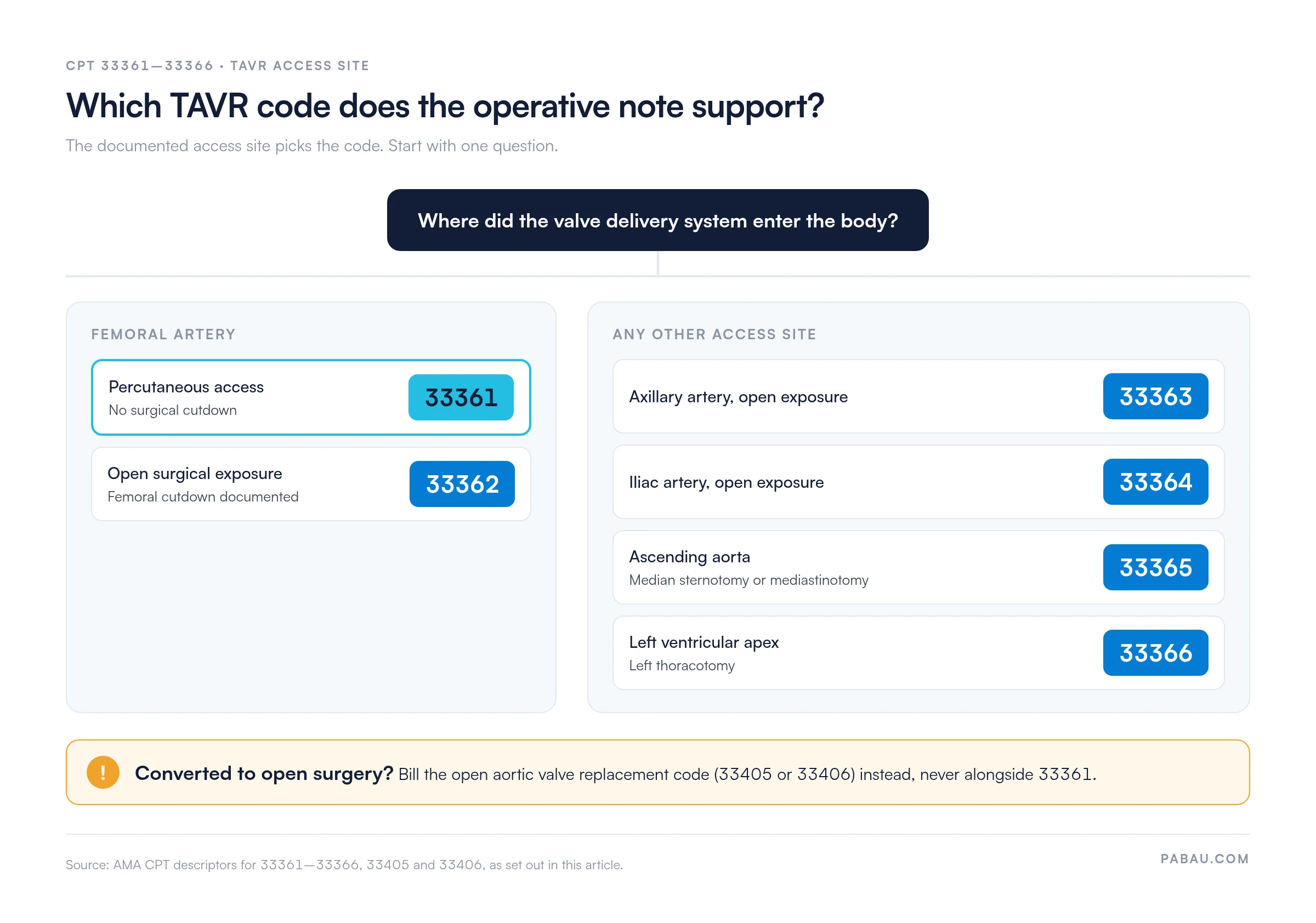
Open surgical aortic valve replacement uses different CPT codes entirely. Confusing the transcatheter and open-surgery families is a common source of claim errors, particularly when a planned TAVR converts to open surgery intraoperatively.
When a TAVR procedure converts to open surgery, bill the open-surgery code (33405 or 33406) that reflects the procedure performed. Do not report 33361 alongside an open AVR code for the same operative session.
Medical necessity for TAVR hinges on documented aortic valve pathology. Nonrheumatic aortic stenosis drives the overwhelming majority of 33361 claims, and its ICD-10-CM code is I35.0. Payers cross-reference the diagnosis code against their coverage policy for TAVR. An unspecified valve disorder code, used when a more specific one exists, is a straightforward denial trigger.
According to the CMS ICD-10-CM coding guidelines, I35.2 is the correct code when both stenosis and insufficiency are documented. Do not report I35.0 and I35.1 separately.
Payers and auditors look for three answers in every TAVR operative report. They check what condition was treated, what approach was used, and who made the clinical decision. Missing any of these three elements is sufficient grounds for denial, regardless of whether the procedure itself was medically appropriate.
For high-complexity cardiac codes, build a documentation checklist into the pre-submission workflow. Each chart then gets checked against these six points before the claim leaves the practice.
Prior authorization for TAVR is required by most commercial payers, though requirements vary. Medicare itself does not require prior authorization for TAVR under traditional fee-for-service, but Medicare Advantage plans may impose their own pre-auth rules. Verifying insurance eligibility before scheduling is the first step in preventing authorization-related denials.
Payer policies for transcatheter heart valve procedures change periodically as FDA indications expand (TAVR was approved for low-surgical-risk patients in 2019). Verify current authorization requirements directly with each payer before each case rather than relying on prior approval experience from 12 or more months ago.
Medicare pays for CPT 33361 through two separate channels. The Medicare Physician Fee Schedule (MPFS) covers the professional (physician) component. The Inpatient or Outpatient Prospective Payment System (IPPS or OPPS) covers the facility component.
The professional reimbursement for 33361 is based on Relative Value Units (RVUs) published in the annual CMS Physician Fee Schedule. Rates change each January 1. The work RVU for 33361 is substantially higher than routine cardiology procedures, reflecting the complexity and time involved.
Geographic adjustment (GPCI) applies. A cardiac surgeon in a high-cost metro area is paid more for the same code than one in a rural market. Before claims go out, the superbill has to carry the correct provider taxonomy, NPI, and place of service.
Inpatient TAVR is grouped into a Medicare Severity Diagnosis Related Group (MS-DRG). The DRG assignment depends on whether a major cardiovascular complication or comorbidity (MCC) is present. Outpatient TAVR (when performed in a hospital outpatient department) is reimbursed under the OPPS Ambulatory Payment Classification (APC) system.
Professional services go out on an 837P claim, while the facility bills on the UB-04 (837I). The electronic remittance advice (ERA/835) shows the DRG or APC assignment used to calculate payment.
Modifier selection for 33361 follows standard CMS rules for a procedure with a 000-day global period, plus a few TAVR-specific patterns. A wrong or missing modifier is a common reason co-surgeon claims and same-day return-to-OR claims are denied.
Modifier 62 is the standard configuration for TAVR professional billing. CMS NCD 20.32 requires the cardiac surgeon and the interventional cardiologist to perform the intraoperative technical work together. Each submits 33361-62 independently and is paid 62.5% of the fee schedule amount. Verify that both providers are enrolled with the payer first. A missing enrollment denies that provider’s claim while the other one processes normally.
CPT Code 33361 carries a 000-day global surgery period in the CMS Physician Fee Schedule. The rest of the TAVR family, 33362 through 33366, carries the same indicator. The global package covers only the day of the procedure. No pre-operative day and no post-operative days are attached to it.
A billing reference that lists 090 for TAVR is out of date or wrong, so check the current fee schedule file. Treating 33361 as a 90-day bundle leaves every follow-up visit after the procedure day unbilled.
Follow-up echocardiography is reported with its own imaging code rather than folded into the TAVR payment. Each co-surgeon billing under modifier 62 reports their own post-operative visits with the E/M code that fits the service. Commercial plans can still set their own rules, so confirm how each payer treats follow-up after structural heart procedures.
Audit your post-TAVR E/M claims quarterly. Because 33361 carries a 000-day global period, follow-up visits after the procedure day are separately billable, so check that none were held back as bundled. Then confirm that same-day E/M claims carry modifier 25 or FT only when the documentation supports a distinct service.
TAVR claims are denied more often than most surgical procedure codes. The main reason is that their documentation requirements go well beyond those for routine cardiology services. The most effective denial prevention happens before submission, with a checklist run against each operative report. Tracking denial reason codes by category helps billing teams identify which step in the workflow is producing the most rejections.
A denial management workflow for TAVR should route every denial into a structured appeal pathway with a 30-day turnaround target. A medical necessity appeal for 33361 should attach the operative report, the heart team note, and pre-procedural imaging. Add the payer’s own coverage policy as an exhibit. Getting a clean claim out the first time is still faster than winning a well-constructed appeal.
Medicare’s coverage of TAVR is governed by CMS NCD 20.32, which sets the patient eligibility criteria, operator qualifications, and facility requirements for Medicare coverage. Commercial payers generally model their policies on NCD 20.32 but may add stricter criteria.
Commercial payers including UnitedHealthcare and BCBS plans generally align with NCD 20.32 criteria. Some add their own requirements, such as approved device models, limits on valve designs, or an independent cardiologist review. Geisinger and similar regional payers publish transcatheter heart valve procedure policies that should be reviewed annually.
Many 33361 denials start with a claim assembled by hand. The coder reads the operative report in one system, checks the payer’s prior authorization in another, and keys the claim in a third. An undocumented access site or a missing heart team note slips through that handoff.
Practice management software like Pabau keeps the note, the codes, and the claim in one place. Its claims management software tracks authorization status and flags missing documentation before the claim leaves the practice. Clean claims then go out as 837 files through Pabau’s Claim.MD clearinghouse integration.

Payments come back as electronic remittance advice, so your team can check each co-surgeon payment against the expected 62.5% share. Denials are tracked by reason, which shows whether the fix belongs in the operative note template or in the authorization workflow.

Pabau tracks authorization status, flags missing documentation, and connects to Claim.MD for electronic submission on complex cardiology codes like CPT 33361.

A 33361 claim stands or falls on one line of the operative report: percutaneous femoral artery access. When that line is explicit, the code holds up under audit. When the note says only “transcatheter,” the claim is exposed to five other codes in the same family.
Correct the global period assumption next. With a 000-day global period, post-operative visits after the procedure day are billable work. A practice still treating them as a 90-day bundle leaves payment uncollected on every TAVR case.
The trade-off is a few extra fields in the operative note template and a quarterly E/M audit. Set against a denied co-surgeon claim or a month of unbilled follow-up, both pay for themselves.
Book a demo to see how Pabau tracks prior authorization and flags missing TAVR documentation before your cardiology claims go out.

Need help tracking denial reason codes across payers? Denial management in healthcare covers how to categorize, track, and appeal claim denials systematically.
Want to understand how 837P files are structured for cardiac claims? 837P claim file guide explains the EDI transaction format used for professional claim submission.
Need a pre-submission review process for complex procedures? Billing compliance standards outlines the pre-submission review process that reduces first-pass denial rates.
Coding an open femoral cutdown instead? CPT code 33362 covers TAVR through an open femoral artery approach and the documentation it needs.
Want fewer TAVR claims bounced on first submission? Clean claims in medical billing sets out what a payer needs to accept a claim the first time.
CPT code 33361 covers transcatheter aortic valve replacement (TAVR) performed via the percutaneous transfemoral approach, where the prosthetic valve is delivered through the femoral artery. The code bundles the catheterization, valve delivery, deployment, and fluoroscopic guidance performed in a single operative session. It does not cover TAVR via other access sites, which are reported with codes 33362 through 33366.
CPT code 33361 has a 000-day global period in the CMS Physician Fee Schedule, the same as the rest of the TAVR family (33361-33366). The global package covers only the day of the procedure. Post-operative E/M visits on later days are separately billable without modifier 24, subject to standard payer rules.
Medicare reimbursement for CPT 33361 is determined annually through the CMS Physician Fee Schedule and varies by geographic location (GPCI adjustment). Rates change each January 1. Use the CMS Physician Fee Schedule Look-Up Tool at cms.gov to obtain the current non-facility and facility rates for your locality. The facility component for inpatient TAVR is paid through the MS-DRG system under IPPS, not through the MPFS.
CPT 33361 covers TAVR through a percutaneous femoral artery approach. CPT 33362 covers TAVR through an open femoral artery approach, where the surgeon exposes the artery through a cutdown. Transapical TAVR is a different code, 33366. The operative report’s documented access method decides which code applies, and 33361 and 33362 are never billed together for the same valve replacement.
Yes, most commercial payers and Medicare Advantage plans require prior authorization for CPT 33361. Traditional Medicare fee-for-service does not, because NCD 20.32 governs its coverage instead. Requirements vary by payer and change as FDA indications expand. Verify authorization requirements with each specific payer before scheduling the procedure, as relying on prior experience can result in surprise denials when policies are updated.
The most common denial reason for CPT 33361 is the wrong approach code, billed when the op note documents a different access site. Missing prior authorization and incomplete heart team documentation under CMS NCD 20.32 follow close behind. Other triggers are an undocumented STS risk score, a site-of-service mismatch, and unbundled services that are integral to TAVR. Most denials are preventable with a pre-submission documentation checklist reviewed before claim transmission.