

CCSD code G5100: Bypass of duodenum billing guide
CCSD code G5100 bills a bypass that leaves the duodenum in place CCSD code G5100...

Last Updated: Oct 16, 2026
K0868 is the HCPCS Level II code for power wheelchair, group 4 standard, sling/solid seat/back, patient weight capacity up to and including 300 pounds. It is billed to Medicare Part B as durable medical equipment.
Group 4 chairs carry higher performance ratings than group 2 and group 3 devices. Prior authorization is required before delivery, and the seating configuration decides whether K0868 or K0869 applies.
Let Pabau's smart automation suggest the right codes, reduce claim denials, and keep your practice compliant—effortlessly.
Automate repetitive tasks and focus on what matters most—your patients.
Reduce coding errors and ensure compliance with the latest regulations.
Clean claims, fewer denials, and faster reimbursements.
Powerful insights and reporting to help your practice thrive.
HIPAA compliant SOC 2 certified GDPR-compliant Trusted by 4,000+ clinics worldwide

HCPCS Code K0868 describes a power wheelchair, group 4 standard, with a sling or solid seat and back. Medicare Part B pays it as durable medical equipment.
Prior authorization is required before delivery, and a claim submitted without an affirmative decision is denied automatically.
K0868 documentation must include a face-to-face examination, a detailed written order, and a mobility assessment, all dated before delivery.
Practice management software like Pabau submits K0868 claims, tracks their status, runs pre-submission validation checks, and reconciles payments.
HCPCS Code K0868 carries the official long description: Power wheelchair, group 4 standard, sling/solid seat/back, patient weight capacity up to and including 300 pounds. The short descriptor used on claims is Pwc gp 4 std sling/solid seat/back.
CMS assigns K-prefix codes to durable medical equipment that no Level I CPT code describes. They form one branch of the wider HCPCS Level II codes. K0868 sits inside the K0800 block, which sorts power wheelchairs by group, weight capacity, and seating configuration.
The table below summarizes the classification details billers need before submitting a K0868 claim.
Medicare reimburses HCPCS Code K0868 under the DMEPOS fee schedule, which CMS updates each January. The allowed amount is capped by a national limitation amount and adjusted by locality. Verify the current figure against the CMS DMEPOS fee schedule before quoting a patient on out-of-pocket cost.
The DMEPOS Competitive Bidding Program has had no active contracts since January 1, 2024, so bid rates do not apply to K0868 today. The next round, scheduled for 2028, does not include power wheelchairs.
These are the payment basics that set what Medicare pays and what the patient owes.
Medicare pays 80% of the allowed amount once the Part B deductible is met. The beneficiary or a secondary insurer covers the remaining 20%. Confirm secondary coverage before delivery, so the patient knows what they will owe.
LCD L33789 and its companion policy article A52498 set the medical necessity criteria for power mobility devices, K0868 included. Medicare Part B covers HCPCS Code K0868 only when the beneficiary meets all of them. The treating physician has to document that a power wheelchair is needed for mobility-related activities of daily living inside the home.
The core coverage criteria for a group 4 standard power wheelchair are:
Group 4 chairs differ from group 2 and group 3 devices in performance. They offer greater range, stronger obstacle climbing, and more stability on difficult terrain. Documenting why a lower-group device falls short is the element most often missing from K0868 audit findings.
Prior authorization is required for HCPCS Code K0868 under Medicare’s prior authorization program for power mobility devices. CMS requires the supplier to hold an affirmative decision before the wheelchair is delivered. A claim filed after delivery without that approval is denied, and medical necessity does not rescue it on appeal.
The request goes to the DME MAC for the supplier’s jurisdiction, such as CGS Medicare or Noridian Healthcare Solutions. It carries the same clinical documentation the final claim will need. Confirm the current requirements with your own MAC before submitting, since contractor instructions and program parameters change.
Incomplete documentation is the leading trigger for K0868 denials and post-payment audits. The supplier carries the collection burden even though the clinical records originate with the prescribing physician. A structured intake checklist that captures every element before the device ships is what keeps claims payable.
Required documentation for a K0868 claim includes:
All of it has to be stored securely and produced on demand during a MAC audit or RAC review. A missing proof of delivery or an unsigned order counts the same as no documentation at all.
The sequence matters as much as the contents, because four of the six steps must be dated before the delivery date.
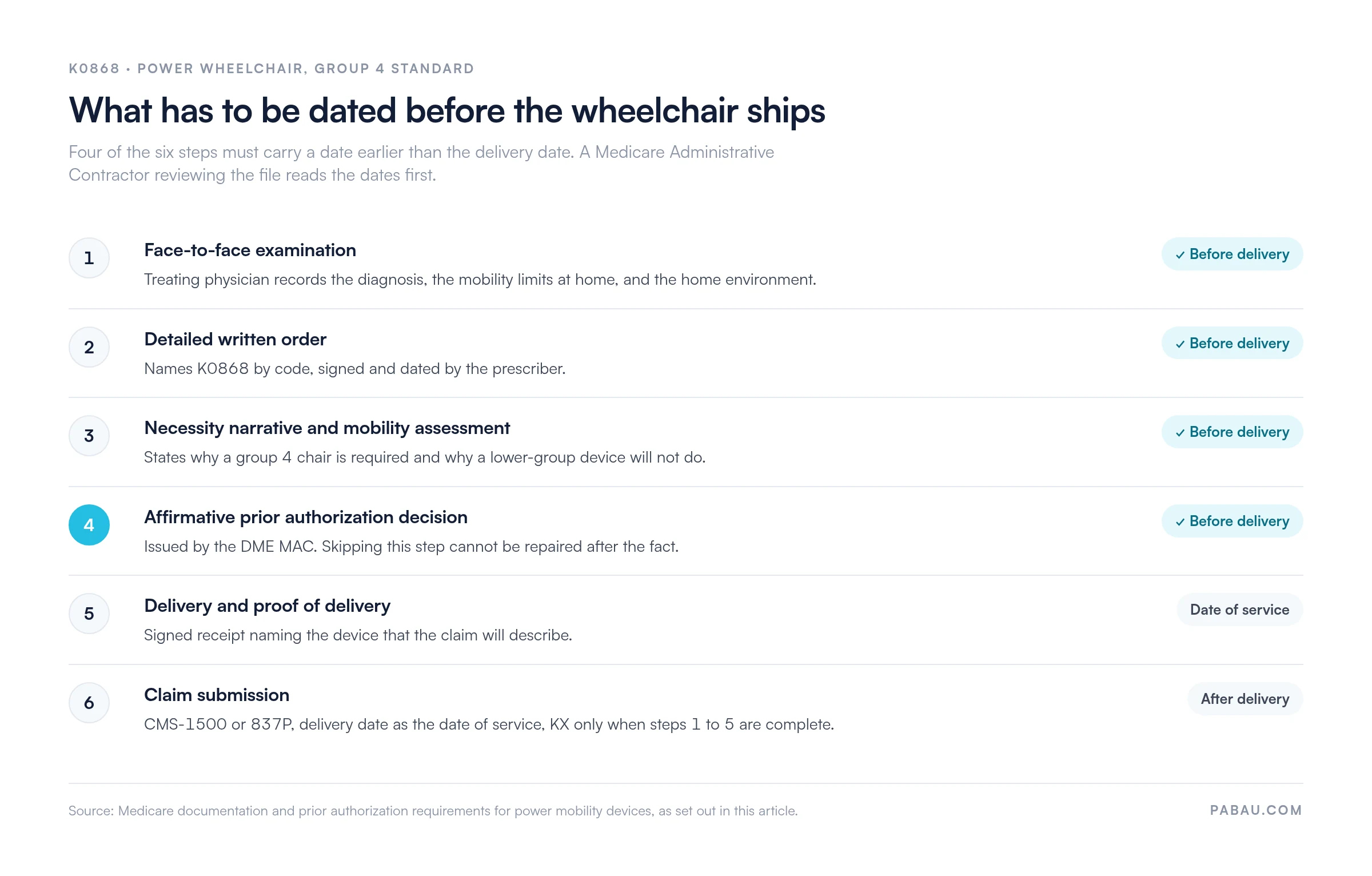
Create a K0868 documentation checklist that runs in parallel with the prior authorization workflow. Flag any missing element before delivery, not after. Claims submitted with incomplete records cannot be corrected retroactively if a MAC conducts a prepayment review.
K0868 billing follows the standard DME rules for Medicare Part B claims. Those claims go on the CMS-1500 form, or the 837P electronic equivalent, with the appropriate place of service code.
The supplier NPI and the beneficiary’s Medicare ID must match the prior authorization file exactly. A clean claim submission also needs the right modifier, the delivery date as the date of service, and the prior authorization number.
The modifier tells the MAC whether the documentation requirements are met. It also decides whether the claim processes automatically or routes to manual review.
Appending KX to a K0868 claim certifies that every medical necessity requirement is met. Submitting it without a complete file creates audit exposure.
If a MAC or RAC requests the records and they fall short, the claim is recouped. Build the process so KX can only be added after someone signs off on a documentation completeness check.
Choosing the wrong code from the K0800 group is a common audit finding. Upcoding to K0868 when a lower-group chair was supplied, or miscoding the seating configuration, both put the claim at risk.
The table below sets K0868 against its neighbors, including the K0869 distinction that billers confuse most often. For a wider lookup across the K-series, the AAPC Codify HCPCS lookup carries the current CMS descriptions.
K0868 and K0869 both describe group 4 standard power wheelchairs rated to 300 pounds. The seating is what separates them. K0868 uses a sling or solid seat and back, while K0869 uses a captain’s chair.
Captain’s chair seating offers different positioning support than a sling or solid back. Bill the code that matches the device delivered, because substituting one for the other is an upcoding or downcoding error.
Neither K0868 nor K0869 carries a power option qualifier in its descriptor. A group 4 captain’s chair with multiple power options is billed under K0885.
CGS Medicare issued a contractor notice in March 2025 on new HCPCS codes for wheelchair accessories. Those accessory codes fall under the Wheelchair Options and Accessories policy article, A52504, not under the policy that governs K0868 itself. Review the CGS Medicare contractor notice to see whether any of them apply to your K0868 claims.
CMS updates the HCPCS code set annually, effective January 1. K0868 remains active. The annual release files on the CMS HCPCS overview page confirm its status for each claim year. Add a code validation step to your DME intake process each October or November, ahead of the January effective date.
Schedule an annual HCPCS code review in Q4 to validate K0868 and all adjacent K-series codes you regularly bill. CMS releases the upcoming year’s HCPCS updates before December, giving suppliers time to update chargemasters, superbills, and training materials before January 1 claims begin.
DME billing teams usually track K0868 claims across a clearinghouse portal, a spreadsheet, and the patient record. The status of any one claim depends on whoever last checked the portal.
Pabau’s claims software for suppliers submits the claim to the insurer, tracks its status, and reconciles the payment when it lands. Pre-submission validation checks run before the claim leaves, so obvious errors surface while they are still cheap to fix.
Every K0868 claim then sits in one record with its documentation. A denial or an audit request no longer starts with a hunt across systems.


Pabau submits your claims to the insurer, tracks each one to payment, and runs validation checks before submission. Payments reconcile against the patient record automatically.

HCPCS Code K0868 sits in one of Medicare’s most audited DME categories, so the margin for a documentation or modifier error is thin. Every claim needs a complete file before delivery, an affirmative prior authorization, and a KX modifier you can defend on audit.
Seating configuration and weight capacity are what separate K0868 from its neighbors, and picking the wrong one puts the whole claim at risk. Get the sequence right once and the rest is repeatable.
Pabau submits each K0868 claim, tracks it to payment, and reconciles what the payer sends back. Book a demo to see how that works for a DME billing team.

Need a framework for handling denied DME claims? Denial management in healthcare covers the root-cause analysis and appeals process for common DME billing denials.
Preparing for a MAC audit? Medical billing compliance guidance outlines the documentation standards suppliers must meet during prepayment and post-payment reviews.
Want to understand how claims move through the system? What is medical billing explains the end-to-end workflow from claim creation to payment posting for DME suppliers.
HCPCS Code K0868 is a Level II HCPCS code for a power wheelchair, group 4 standard, with a sling or solid seat and back. It covers a patient weight capacity up to and including 300 pounds. Medicare Part B and other payers reimburse it as durable medical equipment when the beneficiary needs a group 4 chair for mobility at home.
Yes, K0868 requires prior authorization under Medicare’s prior authorization program for power mobility devices. DME suppliers must receive an affirmative prior authorization decision from the applicable DME MAC before delivering the wheelchair. Claims submitted without a valid prior authorization approval are automatically denied.
Medicare covers K0868 when the beneficiary has a mobility limitation that impairs mobility-related activities of daily living at home. The beneficiary must also be unable to use a manual wheelchair or a lower-group power device, and able to operate the chair safely. The treating physician’s face-to-face examination has to support the group 4 need. LCD L33789 and policy article A52498 carry the full criteria.
Submit K0868 on the CMS-1500 form, or the 837P electronic equivalent, with the correct modifier. KX applies when every documentation requirement is met. Include the prior authorization number, use the delivery date as the date of service, and make sure the supplier NPI matches the prior authorization file.



