CCSD code H4430: Examination of rectum under anaesthetic
CCSD code H4430 pays for the examination alone CCSD code H4430 is the UK private...

Last Updated: Oct 20, 2026
27093 is the CPT code for an injection procedure for hip arthrography without anesthesia. It reports the needle placement and the contrast injection into the hip joint, while the imaging that follows is reported separately.
CPT 27095 is the companion code for the same injection performed with anesthesia. CPT 20610 is the major joint injection code for therapeutic injections and aspiration without diagnostic arthrography.
Let Pabau's smart automation suggest the right codes, reduce claim denials, and keep your practice compliant—effortlessly.
Automate repetitive tasks and focus on what matters most—your patients.
Reduce coding errors and ensure compliance with the latest regulations.
Clean claims, fewer denials, and faster reimbursements.
Powerful insights and reporting to help your practice thrive.
HIPAA compliant SOC 2 certified GDPR-compliant Trusted by 4,000+ clinics worldwide

CPT 27093 covers the contrast injection into the hip joint for arthrography, not the imaging or interpretation, which are billed separately.
CPT 27093 is the without-anesthesia code, and CPT 27095 is the same injection performed with anesthesia.
The most common coding error is billing CPT 20610 instead of 27093 when contrast is injected for diagnostic arthrography.
Laterality modifiers RT or LT are required by CMS and most commercial payers; missing them is the leading denial trigger.
Pabau’s claims management software tracks modifier requirements and flags incomplete documentation before submission, reducing 27093 denials.
CPT code 27093 is defined by the American Medical Association as: Injection procedure for hip arthrography; without anesthesia. It sits in the Musculoskeletal System section of the CPT codebook, under Introduction or Removal Procedures on the Pelvis and Hip Joint.
The code reports the physician’s work in placing the needle, confirming its position under imaging, and injecting contrast into the hip joint capsule.
The imaging performed after the injection is not bundled into 27093. Neither is the supervision and interpretation of that imaging. Both are reported with separate codes.
Key facts about the descriptor that affect coding decisions:
Hip arthrography is used to evaluate labral tears, femoroacetabular impingement, loose bodies, and joint derangement when MRI alone is inconclusive. Understanding the steps helps coders identify what must appear in the operative note to support the claim.
Each of these steps generates documentation the coder needs to verify before submitting the claim. The needle approach, contrast agent name and volume, imaging modality, and laterality must all appear in the procedure note.
A note that says only “hip injection performed” without these specifics is an automatic denial risk. A procedure-note template with each of these fields built in stops them from being left out.
Build a hip arthrography procedure note template with mandatory fields. Include laterality, contrast agent name and volume, needle gauge, imaging modality, and physician signature. A structured template reduces documentation deficiencies, which are the root cause of most 27093 denials.
The 27093 vs 20610 decision is the most common coding error in hip injection billing. CPT 20610 covers major joint aspiration or injection without diagnostic arthrography.
CPT 20610 fits therapeutic corticosteroid or hyaluronate injections, joint aspiration, and other injections that involve no contrast study. When the physician performs a contrast-enhanced arthrographic study under imaging guidance, a 20610 claim gets denied, because that code does not describe the procedure.
CPT 27095 is the same hip arthrography injection, performed with anesthesia. The choice between the two codes turns on anesthesia. The contrast agent and the imaging that follows play no part in it. If the injection is done without anesthesia, bill 27093. If anesthesia is administered for the injection, bill 27095.
Selecting 27093 when the record shows anesthesia was given invites an audit query, because the documentation contradicts the code. The decision path below sorts all three hip injection codes in two questions.
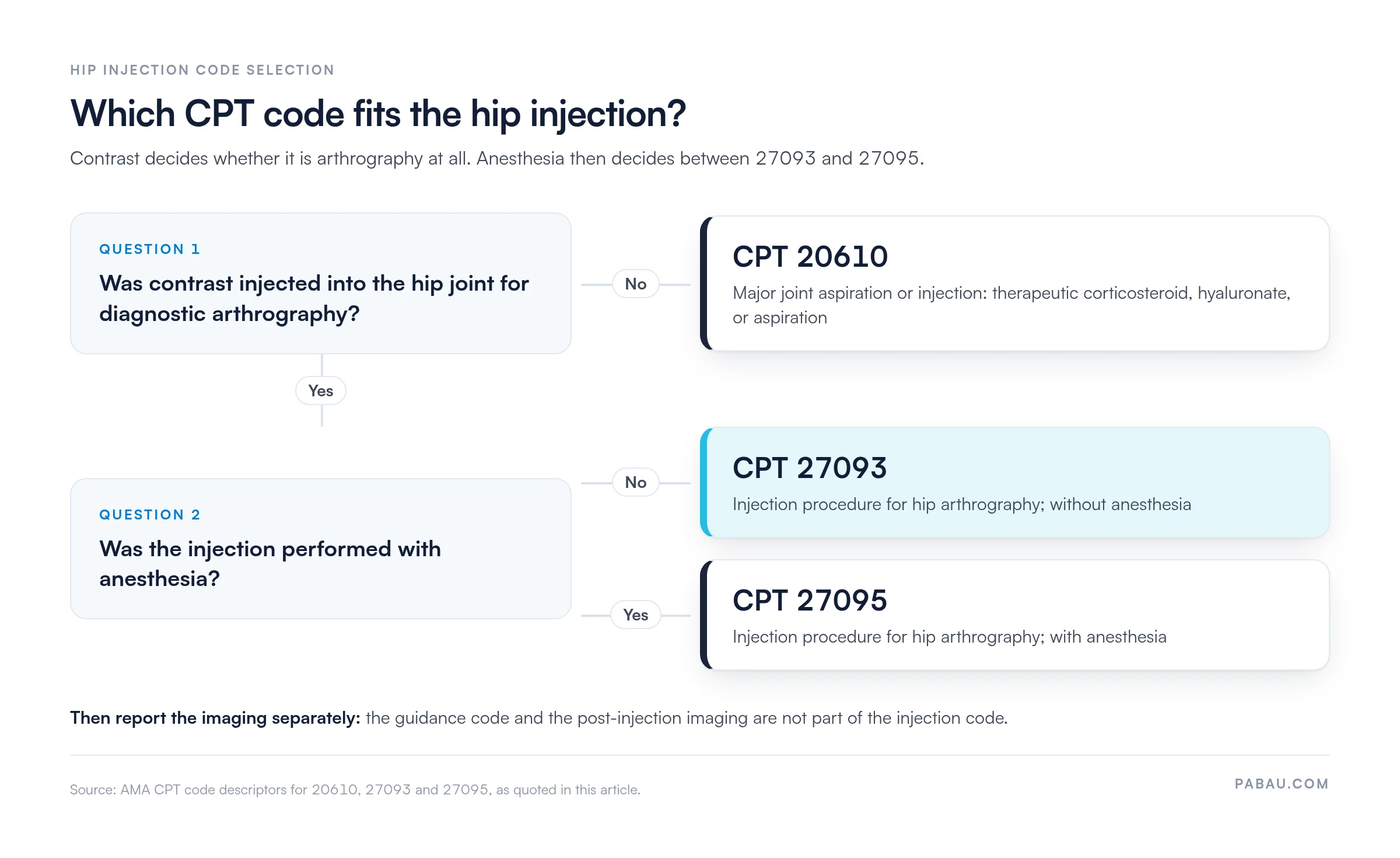
CPT 27093 is an injection-only code. The physician or radiologist who supervises the imaging and provides the interpretation must separately report that work. Missing that split leads to underpayment as well as denials.
Do not bill both 77002 and 76942 for the same procedure. Bill the imaging guidance code that matches the modality used. When the arthrography is followed by MRI, bill 73721 or 73722 for the scan.
Neither MRI code is bundled with 27093, because the injection and the imaging scan are distinct services. Verify current National Correct Coding Initiative (NCCI) edits before billing any code pair, since the NCCI tables are updated quarterly.
Modifier selection for CPT 27093 depends on laterality and on whether the procedure is bilateral. It also depends on how the radiology component is split between a supervising physician and a radiologist.
For most outpatient radiology settings, the radiologist bills 27093-26 for the professional interpretation and the facility bills 27093-TC for the technical component. When a single group performs both components in a non-facility setting, no split modifiers are needed. Always apply RT or LT before 26 or TC on the same claim line (e.g., 27093-RT-26).
Every 27093 claim needs a diagnosis that clinically justifies hip arthrography. The ICD-10-CM code selected must reflect the documented clinical indication, not a convenience code that broadly covers hip pain. Payers use Local Coverage Determinations to review whether the chosen ICD-10 code establishes medical necessity for arthrography specifically.
A diagnosis of hip pain (M25.55x) alone is not always sufficient to establish medical necessity for arthrography. Document failed conservative management, MRI contraindication, or surgical planning rationale in the chart. Coders should verify the specific 7th character for laterality on codes that require it. See the AAPC’s CPT lookup tool for code-to-diagnosis crosswalk guidance.
Imaging that points away from the hip still carries weight on a later claim. Palmetto GBA’s local coverage determination for sacroiliac joint fusion requires imaging that rules out hip pathology before CPT code 27279 is approved. A negative arthrogram helps supply that evidence.
Documentation deficiencies cause more 27093 denials than incorrect code selection. The record must contain enough information that an auditor can verify every element of the procedure independently of what the coder reported.
Required documentation elements for a clean 27093 claim, grounded in CMS and payer audit expectations:
Practices submitting 27093 through a clearinghouse can validate these fields electronically before the claim leaves the practice. Practice management software like Pabau connects to the Claim.MD clearinghouse, which runs eligibility checks and pre-submission validation on 837P claims for thousands of US payers.
A missing modifier or an invalid field gets flagged while the claim can still be corrected. Tying the procedure note to claim submission lets practices build a clean claim at the point of care, instead of fixing errors after a denial.
Many commercial payers require prior authorization (PA) for CPT 27093. Medicare does not currently require PA for this code under most Medicare Administrative Contractor policies. The threshold for commercial payer PA requirements varies significantly by plan.
Molina Healthcare, confirmed by its published prior authorization code lists, requires prior authorization for CPT 27093. Most commercial plans with imaging management programs require PA before the arthrography is performed. That includes plans administered by EviCore, Carelon, or similar radiology benefit managers. Confirm the specific plan’s requirement through insurance eligibility verification and a pre-service authorization inquiry before scheduling.
Typical clinical criteria required to obtain PA for hip arthrography:
When PA is obtained, record the reference number in the medical record and on the claim. Denials for missing or expired PA are not appealable through clinical documentation alone. A process that tracks each PA reference number through to claim submission prevents this category of denial.
Medicare payment for CPT 27093 is calculated under the Medicare Physician Fee Schedule using the Resource-Based Relative Value Scale (RBRVS). The payment rate combines the work RVU, practice expense RVU, and malpractice RVU. Each is multiplied by the Conversion Factor and adjusted by the Geographic Practice Cost Index (GPCI) for the practice location.
The national non-facility rate for CPT 27093 (professional component, global) runs modestly below the rate for the companion imaging guidance code 77002. When both are billed together at a non-facility site, the combined reimbursement is higher than either code alone, reflecting the combined work and practice expense.
Verify current-year national rates using the CMS Physician Fee Schedule lookup tool and geographic-adjusted rates using the FastRVU 2026 RVU lookup. Rates change each January 1 with the annual MPFS final rule.
Medicaid rates vary by state and may be substantially lower than Medicare. Commercial payer rates are negotiated separately and can range from below Medicare to 200% or more depending on the contract.
Submit claims promptly after service to avoid timely-filing denials: most Medicare Administrative Contractors require submission within 12 months of the date of service. Electronic submission through an 837P claim file speeds up processing and lets you track payment through electronic remittance advice.
Most 27093 denials are preventable. The root causes cluster around a small number of billing and documentation failures. For each denial type below, a corrective action is noted so billers know what to fix before resubmitting or appealing.
Checking your 27093 remittances against the common denial codes shows which denial category drives the most volume. Fix that category first, and the resubmission workload drops fastest.
Run a monthly denial report filtered to CPT 27093. If laterality-modifier denials account for more than 20% of rejections, build a pre-submission rule in your billing system. It should flag any 27093 line item missing RT or LT. Preventing the denial is faster and cheaper than appealing it.
Most 27093 denials come from a short list of errors. A claim goes out without RT or LT, without the contrast details, or with a companion code missing. Many billing teams only find those errors when the remittance comes back.
With Pabau, the procedure note, the invoice, and the claim sit in one system. Its denial-reducing claims management flags missing modifiers and incomplete documentation before a 27093 claim reaches the payer.

Denial patterns are surfaced by code, so your billing team can fix the cause at the code level. Nobody has to work through remittances one claim at a time to find it.

Pabau’s claims management tools flag missing modifiers, incomplete documentation, and bundling conflicts before 27093 claims reach the payer. Your team fixes each issue while the claim is still in the practice.

CPT 27093 is a narrow code, and claims fail on it for predictable reasons. Check the anesthesia record first, because it decides between 27093 and 27095. Then confirm laterality, the contrast details, and the companion imaging codes before the claim goes out.
Build those checks into the procedure note once, and the same denials stop coming back each month. Book a demo to see how Pabau keeps hip arthrography claims accurate from the procedure note to payment.

Need to understand how clearinghouse submission works for musculoskeletal codes? Our Claim.MD clearinghouse guide explains how 837P claims are validated before they reach the payer.
Dealing with repeated denials across multiple procedure codes? Our medical billing overview walks through the full claim lifecycle and where errors typically enter the process.
Want a cleaner superbill for arthrography procedures? Our superbill guide covers how to structure billing documents so companion codes and modifiers are captured correctly at the point of service.
Want claims that pass payer edits the first time? Our clean claim guide explains which fields payers check before they accept a claim.
Seeing the same denial reasons every month? Our denial management guide covers how to track, appeal, and prevent recurring denials.
CPT code 27093 covers the injection of contrast material into the hip joint for diagnostic arthrography, performed without anesthesia. It includes needle placement, imaging confirmation, and contrast delivery. It does not include the post-injection imaging. That is billed separately under companion codes such as CPT 77002 for fluoroscopic guidance or CPT 73721 for post-arthrography MRI.
CPT 27093 is used specifically for hip arthrography involving contrast material injection for diagnostic purposes. CPT 20610 covers major joint aspiration or injection without the contrast-arthrography context, such as corticosteroid or hyaluronate injections. Billing 20610 for a contrast arthrography procedure will result in a denial because 20610 does not capture the procedure performed.
Modifier RT (right) or LT (left) is required by CMS and most commercial payers to indicate laterality. Modifier 50 applies for bilateral procedures performed at the same session, though some payers prefer two separate line items. Modifiers 26 and TC are used when the professional and technical components are split between a physician and a facility.
Prior authorization requirements vary by payer. Medicare does not currently require PA for 27093 under most MAC policies, but many commercial plans do, including Molina Healthcare. Check the specific plan’s authorization requirements before scheduling the procedure, as performing arthrography without required PA is typically not appealable on clinical grounds alone.
CPT 77002 (fluoroscopic guidance for needle placement) is billed alongside 27093 when fluoroscopy is used for guidance. CPT 76942 is used instead when ultrasound is the guidance modality. Bill only one guidance code per procedure, matching it to the modality documented in the procedure note.
Not for the same hip in the same session. The two codes describe one injection, performed either without anesthesia (27093) or with anesthesia (27095), so only one can apply. Verify current NCCI edits before billing any 27093 and 27095 combination. If injections were performed on different hips in the same session, use the appropriate laterality modifiers.