
Pabau Engage inbox

Pabau Engage is here: every patient conversation in one inbox.

Learn more
Book a demo Book a demo
☰
CPT Code

CPT code 26445 – Extensor tendon tenolysis billing guide


Code Definition

26445 is the CPT code for tenolysis of an extensor tendon in the hand or finger, reported once for each tendon released. It covers freeing an extensor tendon from scar on the back of the hand or over a finger, so the digit can move again.

The code sits in the 26440-26449 tenolysis range. Flexor releases go to 26440 or 26442, and wrist or forearm releases go to 25295. A complex extensor release on a finger that runs into the forearm is 26449.

Section
10004-69990 Surgery
Subsection
20100-29999 Musculoskeletal system
Code range
26440-26449 Tenolysis (Repair, revision and/or reconstruction procedures on the hand and fingers)
Billable
No
Code also known as
Extensor tendon release, hand or finger
Save time. Improve accuracy. Get paid faster.
Automate coding with Pabau

Let Pabau's smart automation suggest the right codes, reduce claim denials, and keep your practice compliant—effortlessly.

  • AI-powered code suggestions
  • Real-time compliance checks
  • Faster claims, fewer denials
Why practices choose Pabau
Save hours every week

Automate repetitive tasks and focus on what matters most—your patients.

Improve accuracy

Reduce coding errors and ensure compliance with the latest regulations.

Get paid faster

Clean claims, fewer denials, and faster reimbursements.

Grow with confidence

Powerful insights and reporting to help your practice thrive.

HIPAA compliant SOC 2 certified GDPR-compliant Trusted by 4,000+ clinics worldwide

Key takeaways

Key takeaways

CPT Code 26445 reports tenolysis of an extensor tendon in the hand or finger, once for each tendon freed from adhesions

Flexor releases never belong on 26445: palm or finger flexor releases go to 26440 or 26442, and forearm or wrist releases go to 25295

A complex extensor release on a finger that runs into the forearm is one 26449, not 26445 plus 25295

The 2026 CMS fee schedule gives 26445 a work RVU of 4.34, a total of 18.11 and a 90-day global period

The operative note must name each tendon, the digit or hand zone, and the motion gained after the release

CPT Code 26445: definition and official descriptor

CPT Code 26445 is “Tenolysis, extensor tendon, hand or finger, each tendon,” as published in the American Medical Association CPT code set. AAPC’s code reference for 26445 summarizes it as releasing an extensor tendon of the hand or finger from adhesions. In practice, that means freeing the tendon from scar on the back of the hand or over a finger, so it can glide again. The “each tendon” wording means you report one unit for every tendon released, not one per session.

Tenolysis is not tendon repair. Under 26445, no tendon is sutured, grafted or advanced, and the surgeon only releases adhesions. When the extensor tendon is also repaired, the extensor repair codes take over, such as 26410 for the hand and 26418 for a finger.

FieldDetails
CPT code26445
Official descriptorTenolysis, extensor tendon, hand or finger, each tendon
CMS short descriptorRelease hand/finger tendon
Code range26440-26449 Tenolysis, under Repair, revision and/or reconstruction procedures on the hand and fingers
Tendon typeExtensor tendons only
Reporting unitEach tendon released
Global period90 days
2026 work RVU4.34
2026 total RVU18.11 (facility), with no separate office-based value

What extensor tenolysis means clinically

Extensor tendons cross the back of the hand and each finger just under thin skin, lying close against bone. That position makes them prone to adhesions after a metacarpal or phalanx fracture, plate fixation, a crush injury or an earlier extensor repair. Scar tethers the tendon to bone, to hardware or to the skin above it.

The result is a finger that cannot fully bend, straighten, or both, even though the tendon is intact. A typical candidate keeps better passive motion than active motion after a long course of hand therapy. Tenolysis releases the tendon so the motion the joint still has can be used again.

How extensor tendon tenolysis is performed

Knowing the operative steps lets a coder check the note against the descriptor before the claim goes out. A typical hand or finger extensor tenolysis follows this sequence:

  1. Anesthesia and positioning: The hand rests on an arm table under regional block, general anesthesia, or wide-awake local anesthesia with a tourniquet. A wide-awake patient can move the finger on request, which lets the surgeon test active glide during the case.
  2. Dorsal incision: The surgeon makes a longitudinal or gently curved incision over the back of the hand or finger. It is placed so the scar will not sit directly over the released tendon.
  3. Exposure of the extensor mechanism: The tendon is found above and below the scarred zone, then followed into it. Over a finger, this includes the central slip and the lateral bands.
  4. Release of adhesions: Scar is divided between the tendon and the metacarpal or phalanx, the periosteum, any fixation plate, and the overlying skin. Hardware removal or a joint release in the same session is described as its own step.
  5. Glide check: The surgeon pulls the tendon proximally, or asks an awake patient to make a fist and straighten. The note records the motion before and after the release.
  6. Closure and early motion: The wound is closed in layers under a light dressing. Early protected motion with hand therapy starts soon after, to keep the glide the release restored.

What CPT Code 26445 covers and what it excludes

Scope errors are common on tenolysis claims because the neighboring codes split by tendon type, site and complexity. The table below sets out what 26445 includes and where each excluded case goes.

ItemIncluded in 26445Excluded (code instead)
Tendon typeExtensor tendons of the hand or fingerFlexor tendons (26440 or 26442)
Anatomical levelBack of the hand and the fingersForearm and wrist (25295)
ComplexityStandard release, one tendon at a timeComplex extensor release on a finger, including the forearm (26449)
Procedure typeRelease of adhesions onlyExtensor repair at the same site (26410 for the hand, 26418 for a finger)
Reporting unitEach tendon releasedOne unit for several tendons in a session

CPT 26445 vs 26440, 26442, 26449 and 25295: choosing the right tenolysis code

The tenolysis codes split on three questions: which tendon, where, and how complex the release is. 26445 is the standard extensor code for the hand and finger. It also carries the lowest work value in the group, which invites both under-coding and over-coding.

CodeOfficial descriptorTendonWork RVU 2026Total RVU 2026
25295Tenolysis, flexor or extensor tendon, forearm and/or wrist, single, each tendonFlexor or extensor6.5514.88
26440Tenolysis, flexor tendon; palm OR finger, each tendonFlexor5.0319.24
26442Tenolysis, flexor tendon; palm AND finger, each tendonFlexor9.5128.77
26445Tenolysis, extensor tendon, hand or finger, each tendonExtensor4.3418.11
26449Tenolysis, complex, extensor tendon, finger, including forearm, each tendonExtensor8.3819.78

RVUs come from the CMS 2026 physician fee schedule relative value file, October release. Ranked by work value, the five codes show how far 26445 sits below the releases it gets confused with.
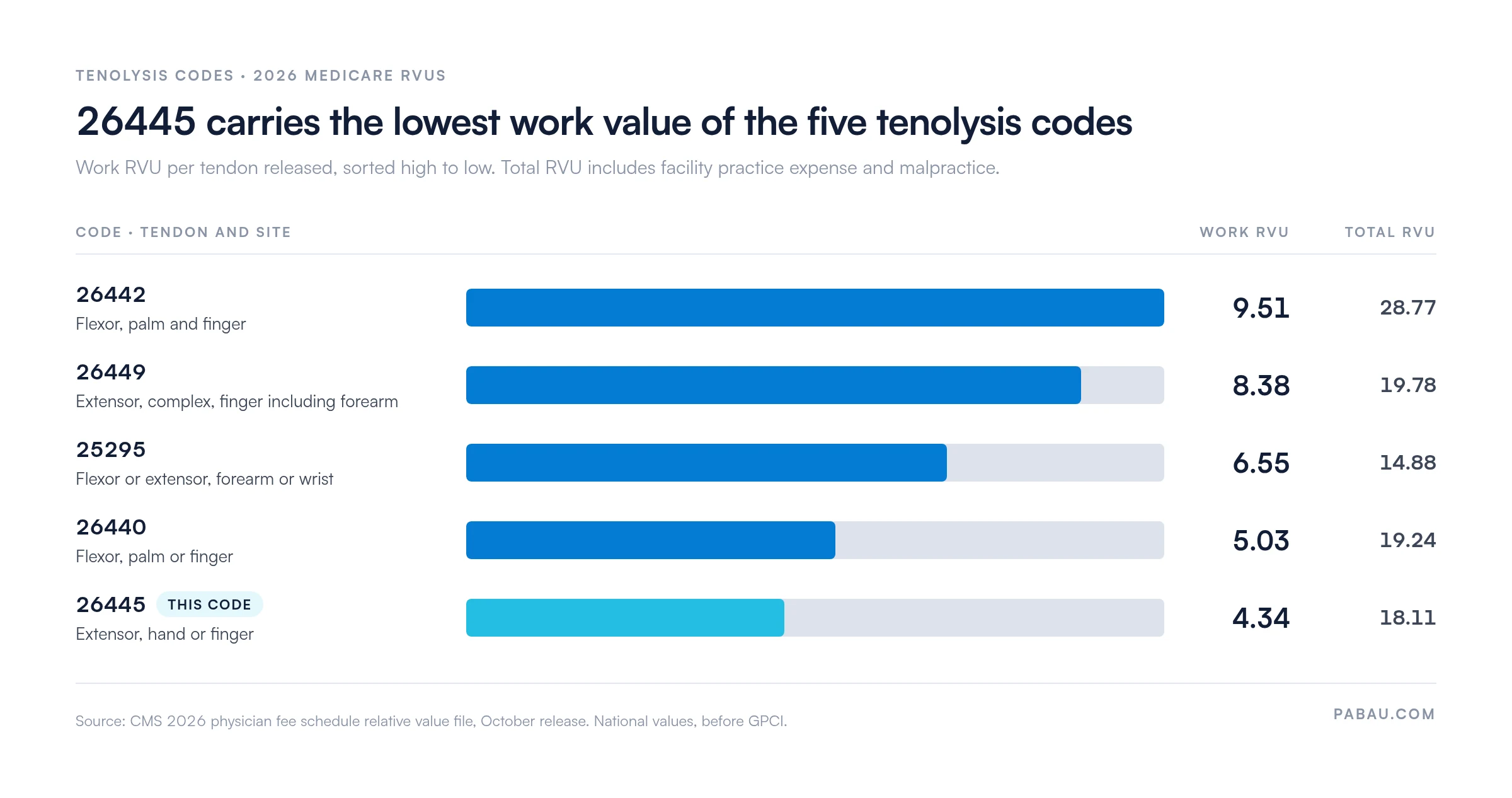
Bar chart of 2026 Medicare work RVUs for tenolysis codes
26445 carries the least surgeon work of the five codes, so a flexor or complex release coded down to it is underpaid on every unit. Values from the CMS 2026 relative value file.

Two decisions cause most coding errors in this group.

First, a flexor release billed as 26445 is the wrong code outright. Check the tendon name in the note before you weigh site or complexity. Second, an extensor release that runs from a finger into the forearm is one 26449, not 26445 plus 25295. The 26449 descriptor already includes the forearm portion.

A session can still release one extensor tendon in the hand and a different tendon at the wrist. Then 26445 and 25295 may both apply. Check the NCCI procedure-to-procedure edits, and use modifier 59 or XS only when the note shows a separate structure.

When the operation goes beyond releasing scar, a different code family usually applies. These are the codes most often confused with 26445 on the extensor side.

CPT codeDescriptor (abbreviated)Use when
25000Incision, extensor tendon sheath, wrist (eg, de Quervain disease)The first dorsal compartment is released for de Quervain tenosynovitis
26410Repair, extensor tendon, hand, primary or secondary, without free graft, each tendonAn extensor tendon on the back of the hand is repaired
26418Repair, extensor tendon, finger, primary or secondary, without free graft, each tendonAn extensor tendon over a finger is repaired

Modifiers for CPT Code 26445

Modifier choice turns on the digit, the side, the tendon count and the global period. The CMS fee schedule file sets three indicators for 26445 that shape it: multiple procedure 2, bilateral surgery 0 and assistant at surgery 1.

ModifierWhen to usePayer notes
FA, F1-F9The released tendon sits on a named digitFA is the left thumb, F1-F4 the left fingers, F5 the right thumb and F6-F9 the right fingers. Digit modifiers show that two units involve different fingers.
RT / LTThe release is on the back of the hand rather than one digitMost payers expect laterality on every hand claim line.
51More than one procedure in the same sessionIndicator 2 applies the standard reduction: the highest-valued procedure at 100% and the others at 50%.
59 / XSAn NCCI edit pairs 26445 with a code done on a separate structureFor example, 25295 at the wrist on a different tendon. The note must show the separate site.
50Both hands in one sessionIndicator 0 means no 150% bilateral adjustment. Medicare pays the two sides as one code, so check your MAC guidance first.
80 / 82 / ASAn assistant helped at surgeryIndicator 1 is a statutory restriction: Medicare does not pay an assistant at surgery for this code. Check payer policy before billing 80, 82 or AS.
58A planned or more extensive procedure inside an earlier global periodCommon when tenolysis follows fracture fixation or a tendon repair still within its 90 days.
78 / 79A return to the OR for a complication (78) or an unrelated procedure (79)Applies inside the 90-day global period of 26445.
24An unrelated E/M visit inside the global periodThe visit diagnosis must differ from the operative diagnosis.

ICD-10 codes supporting medical necessity for CPT Code 26445

Extensor tenolysis is a late procedure, so the diagnosis usually describes the after-effects of an earlier injury or operation. Code the sequela with the 7th character S where the injury code allows it, and include laterality and the digit.

ICD-10-CM codeDescriptionNotes
S66.2- / S66.3-Injury of extensor muscle, fascia and tendon of the thumb (S66.2-) or another finger (S66.3-) at wrist and hand levelAdhesions after an extensor tendon injury or repair. Use the 7th character S for the sequela.
S62.3- / S62.6-Fracture of a metacarpal (S62.3-) or a finger phalanx (S62.6-)Adhesions after a fracture or its fixation. Use the 7th character S for the sequela.
M67.843 / M67.844Other specified disorders of tendon, right or left handTendon adhesions where no injury code fits the history.
M66.241 / M66.242Spontaneous rupture of extensor tendons, right or left handAdhesions after a repaired spontaneous rupture, such as in rheumatoid disease.
M24.541 / M24.542Contracture, right or left handReport alongside the adhesion diagnosis when the joint itself is stiff.

M65.4, radial styloid tenosynovitis (de Quervain), does not support 26445. De Quervain disease affects the first extensor compartment at the wrist, and its release is coded 25000. Pairing it with a hand or finger tenolysis invites a medical necessity denial.

Documentation requirements: what the operative report must include

An operative note that supports CPT Code 26445 contains each of the following elements. A missing element can lead to a wrong-code finding, a units reduction or a denial.

  • Tendon named: For example, extensor digitorum communis to the index finger, extensor pollicis longus or the central slip. “Extensor tendon” alone does not support the unit count.
  • Site documented: Name the digit, or the area of the hand with its extensor zone. Zones VII and VIII lie at the wrist and forearm, which points to 25295 instead.
  • Adhesions described: Record what the tendon was stuck to, such as bone, a plate or the skin, and how far the scar ran.
  • Motion before and after: Record active and passive range of motion before surgery, and the glide gained after the release.
  • Number of tendons: Name each tendon released, because each one is a separate unit.
  • Conservative care: Note the hand therapy and splinting tried before surgery, with the motion trend over that time.
  • Concurrent procedures: Describe hardware removal, joint release or tendon repair in the same session as separate steps.

Prior authorization and payer requirements

Prior authorization rules for CPT Code 26445 vary by payer, so confirm them before you schedule surgery.

Medicare: 26445 is not on the Medicare hospital outpatient prior authorization list. Medical necessity still rests on the clinical record, so the therapy history and the motion deficit must be documented.

Commercial payers: Many commercial plans require prior authorization for elective hand surgery. Send the original injury or fracture history, the hand therapy notes, the range-of-motion trend and the surgical plan together.

Submission best practice: Incomplete packets delay authorizations more often than clinical disputes do. Send the full record in one submission and log the authorization number before the surgery date.

Medicare reimbursement and RVU values for CPT Code 26445

Medicare pays 26445 under the physician fee schedule, adjusted by locality through the Geographic Practice Cost Index (GPCI). The national values below come from the CMS 2026 relative value file. Use the CMS Physician Fee Schedule look-up tool for your locality rate.

Component2026 valueNotes
Work RVU4.34The surgeon’s work across the pre-op, intra-op and post-op periods
Practice expense RVU (facility)12.94CMS sets no office-based practice expense, so the facility values drive payment
Malpractice RVU0.83Professional liability component
Total RVU18.11Work plus practice expense plus malpractice
National paymentAbout $607.91 or $604.89At the $33.5675 conversion factor for qualifying APM participants, or $33.4009 for others, before GPCI
Global period90 daysValued as 10% pre-op, 69% intra-op and 21% post-op care

Pro Tip

Compare 26445 payments against the fee schedule every quarter, by locality. A multi-site hand practice can see different rates for the same release. Underpayments rarely correct themselves unless the practice appeals within the payer’s filing window.

The 90-day global period: what is and is not included

CPT Code 26445 carries a 90-day global surgery period under Medicare. Routine follow-up care related to the release is bundled into the payment and is not billed separately during that window.

Bundled services (cannot bill separately)

  • Wound checks and suture removal
  • Routine post-operative office visits related to the tenolysis
  • Dressing changes by the surgeon or supervised staff
  • Splint adjustments by the surgeon at the operative site
  • Post-operative pain management by the surgeon

Separately billable during the global period

  • Unrelated E/M visits (modifier 24): A visit for a problem unrelated to the hand surgery, such as a blood pressure check.
  • Complications needing the OR (modifier 78): A return to the operating room for a complication such as a wound infection or a tendon rupture.
  • Unrelated surgery (modifier 79): A separate surgical procedure for a different problem.
  • Staged procedures (modifier 58): A second procedure planned at the time of the tenolysis, or one more extensive than the first.
  • Hand therapy: Post-operative therapy from a therapist, not the surgeon, is billed separately. A clean claim for those visits carries the right diagnosis and stays separate from the operative episode.

Common 26445 denials and how to avoid them

Most denials on CPT Code 26445 trace back to a handful of causes. A strong denial management workflow catches these patterns before they become write-offs. The CARC on each remittance names the cause, and a reference of denial code corrections shows the fix for each one.

  • Wrong tendon type: A flexor release is billed as 26445. Fix: Confirm the tendon name in the note before you choose between 26440, 26442 and 26445.
  • Split complex release: A finger-to-forearm extensor release is billed as 26445 plus 25295. Fix: Report one 26449, which already includes the forearm portion.
  • Units without digits: Several units are billed with no digit modifiers or named tendons. Fix: Add FA or F1-F9 to each line and name each tendon in the note.
  • Release bundled with repair: Tenolysis is billed with an extensor repair at the same site. Fix: Check the NCCI edits, and report the release only when the note shows a separate tendon or site.
  • Unsupported diagnosis: M65.4 or an unspecified hand code is linked to the claim. Fix: Use the sequela or tendon disorder code with laterality and digit.
  • Earlier global period ignored: The tenolysis falls inside the 90-day global of a fracture fixation and has no modifier. Fix: Append 58 or 79 based on whether the release was planned or unrelated.
  • Missing authorization: A commercial plan required prior authorization and none was on file. Fix: Verify it at scheduling and track it through a medical claims clearinghouse.

How Pabau keeps hand surgery claims moving

A tenolysis claim depends on records built over months: the injury, the fracture fixation, the therapy notes, the authorization and the operative report. Pabau, a practice management and billing platform, keeps those records on one patient file. Your coder reviews a complete history instead of chasing it across systems.

Pabau’s claims management software builds the claim from data already on the patient record. It submits CMS-1500 and 837P claims through Claim.MD, runs eligibility checks before surgery, and posts ERA remittances back to the same record.

Authorization codes, dates and sessions sit on the patient case, and Pabau warns your team when one is missing. That check matters on commercial plans, where a missing authorization denies an otherwise clean 26445 claim.

Keep hand surgery claims complete before they go out

Pabau keeps the operative note, therapy records and authorization on one patient file, then submits the claim through Claim.MD. See how the billing workflow runs for a hand surgery practice.

Pabau claims management dashboard

Conclusion

CPT Code 26445 is a narrow code: one extensor tendon, in the hand or a finger, freed from scar. Most errors come from reaching for it when the note describes a flexor tendon, a wrist-level release, or a complex release into the forearm.

Read the tendon name and the site first, then count the tendons. With those three facts on the page, the code, the units and the modifiers follow from the note.

Book a demo to see how Pabau keeps the records behind each hand surgery claim on one patient file.

Continue your research

Continue your research

Coding a de Quervain release instead? CPT 25000 covers incision of the extensor tendon sheath at the wrist.

Need a clearinghouse that handles surgical claim submission? The Claim.MD clearinghouse guide explains how claims, eligibility checks and remittances flow to US payers.

Want to reduce underpayments on hand surgery claims? Claims management software from Pabau keeps claim status and remittances on the patient record.

Confused by denial codes on a rejected claim? Denial codes in medical billing breaks down CARC reason codes and the corrective actions each one requires.

Frequently asked questions

What is CPT Code 26445?

CPT Code 26445 is the CPT code for tenolysis of an extensor tendon in the hand or finger, each tendon. It reports surgically freeing one extensor tendon from scar so it can glide again. Report one unit for each tendon released.

What is the difference between CPT 26440 and CPT 26445?

The tendon type separates them. CPT 26440 covers tenolysis of a flexor tendon in the palm or finger. CPT 26445 covers tenolysis of an extensor tendon in the hand or finger. A flexor release billed as 26445 is a wrong-code claim.

When should you use CPT 26449 instead of 26445?

Use 26449 for a complex extensor tenolysis on a finger that extends into the forearm. Its descriptor already includes the forearm portion. Do not bill 26445 plus 25295 for that single release.

What modifiers apply to CPT Code 26445?

Use FA or F1-F9 for the digit, or RT and LT for the hand. Add 51 for multiple procedures, and 59 or XS for a separate structure under an NCCI edit. Modifiers 58, 78, 79 and 24 cover the 90-day global period. CMS sets no 150% bilateral adjustment for this code.

What ICD-10 codes are used with CPT Code 26445?

Common diagnoses are extensor tendon injury sequelae (S66.2- and S66.3- with 7th character S), and metacarpal or phalanx fracture sequelae (S62.3- and S62.6-). M67.843 and M67.844 cover tendon disorders of the hand, and M66.241 and M66.242 cover spontaneous extensor rupture. M65.4 de Quervain does not support 26445.

What is the RVU and global period for CPT Code 26445?

The CMS 2026 fee schedule gives 26445 a work RVU of 4.34 and a total RVU of 18.11. CMS sets no office-based practice expense for the code. It carries a 90-day global period, so routine post-op visits are bundled.


Avatar photo
Despina Petrushevska
Content Writer

Despina Petrushevska is a content writer covering aesthetics, dermatology, and clinic operations, known for making detailed clinical concepts clear and engaging. Outside of work, she enjoys photography, weekend getaways, and finding inspiration in everyday experiences.
×

