HCPCS Code J7314: Fluocinolone acetonide implant
HCPCS Code J7314: code descriptor and quick reference HCPCS Code J7314 carries t...

Last Updated: Nov 24, 2026
26410 is the CPT code for repair of an extensor tendon of the hand, primary or secondary, without a free graft. It is reported once for each tendon repaired.
The repair site decides the code, and neither descriptor limits how soon after the injury the repair happens. A repair on the dorsum of the hand is 26410, and the same repair on a finger is 26418. A free graft moves them to 26412 and 26420.
Let Pabau's smart automation suggest the right codes, reduce claim denials, and keep your practice compliant—effortlessly.
Automate repetitive tasks and focus on what matters most—your patients.
Reduce coding errors and ensure compliance with the latest regulations.
Clean claims, fewer denials, and faster reimbursements.
Powerful insights and reporting to help your practice thrive.
HIPAA compliant SOC 2 certified GDPR-compliant Trusted by 4,000+ clinics worldwide

CPT code 26410 reports repair of one extensor tendon of the hand, primary or secondary, without a free graft, with a 90-day global period.
The split between 26410 and 26418 is anatomical: 26410 is a repair on the hand, and 26418 is the same repair on a finger.
Neither descriptor sets a time limit, so the injury date never decides between the two codes. The repair site in the operative report does.
A free graft moves the repair to 26412 on the hand or 26420 on the finger. Each tendon repaired is reported as its own unit.
Pabau, a practice management platform, checks eligibility, sends 26410 claims through Claim.MD, and tracks each claim until it pays.
CPT code 26410 reports the repair of one extensor tendon of the hand, primary or secondary, without a free graft. Its descriptor in the AMA’s CPT code set reads “repair, extensor tendon, hand, primary or secondary; without free graft, each tendon.” The surgeon reattaches the cut or ruptured tendon ends directly, with no donor graft. The code covers a fresh repair and a delayed one alike, and the same repair on a finger is 26418.
The extensor tendons run along the dorsal (back) surface of the hand and fingers. Surgeons divide them into zones, numbered I through VIII from the fingertip to the forearm. The zone in the operative report tells the coder where the repair happened, and that location is what picks the code.
The surgeon exposes the tendon through a dorsal incision and finds the proximal and distal ends. The ends are then rejoined with a core suture, such as a modified Kessler or figure-of-eight, often followed by a running epitendinous suture. Before coding, confirm these points in the op note.
CPT 26410 is billed per tendon. If two extensor tendons are repaired on the same hand in one session, report 26410 for each one. Many payers want 59 or XS (or RT/LT) on the repeat line, while others want one line with 2 units. Confirm the payer’s rule and the code’s MUE before you bill.
CPT 26410 covers an extensor tendon repaired on the hand, and CPT 26418 covers the same repair on a finger. Both descriptors read “primary or secondary” and “without free graft, each tendon.” Only the site differs, so the op note must say where the tendon was repaired.
The zone settles most cases. A repair over the metacarpophalangeal joint or back of the hand is 26410. One over the proximal or middle phalanx is 26418. Injuries at the edges have their own codes, and the grid below maps each zone.
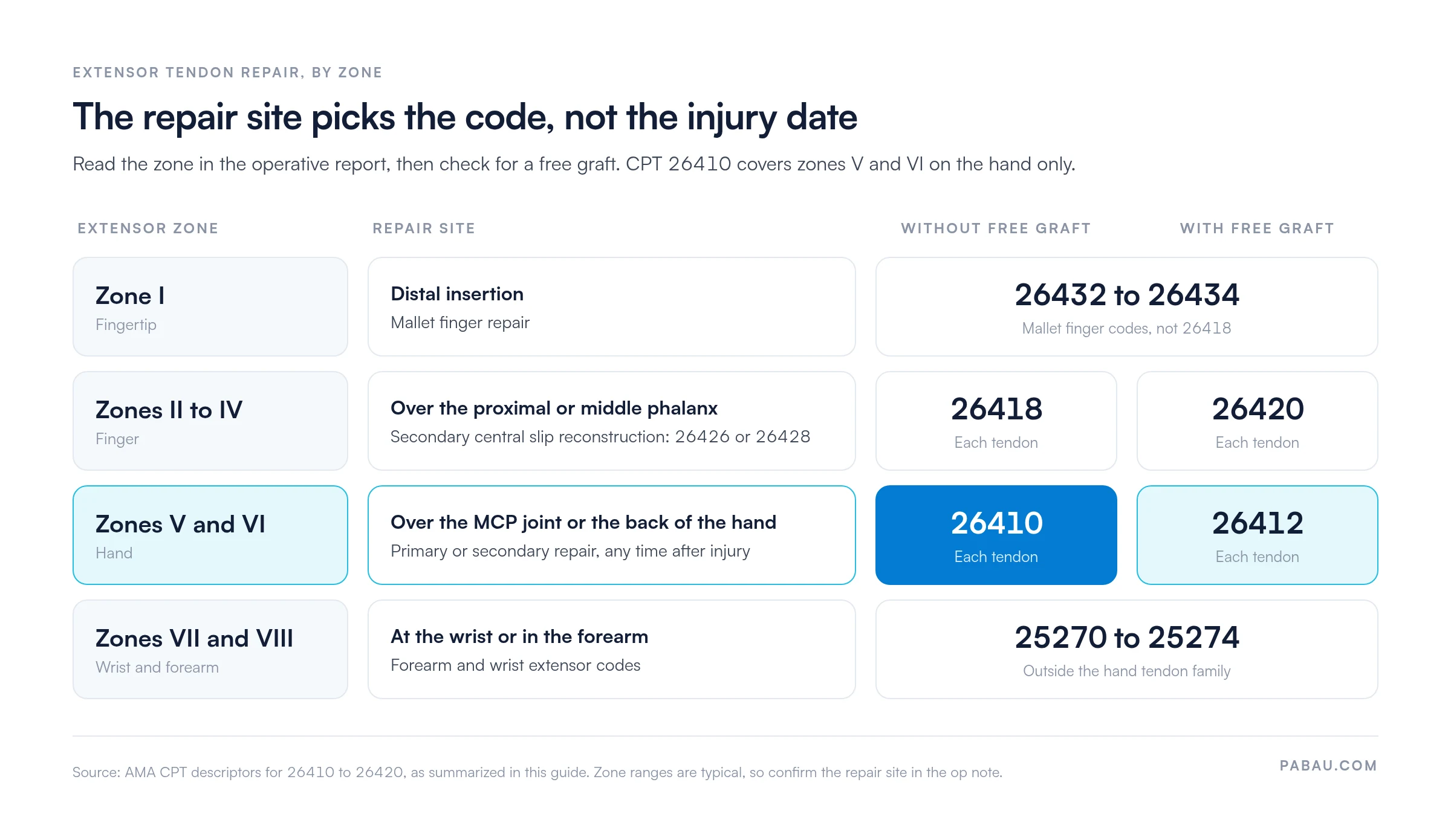
Timing matters clinically but does not change the code. A hand repair two days or two months after injury is 26410 if no free graft was used.
CPT 26410 sits within a family of hand tendon codes. Knowing the adjacent codes prevents both under-coding and inappropriate bundling.
Every CPT 26410 claim needs a supporting ICD-10-CM diagnosis code. Most come from category S66, injury of muscle, fascia and tendon at wrist and hand level. Each one needs a 7th character for the encounter type.
The S66 codes describe the tendon “at wrist and hand level” and name the digit it serves. They do not say whether the cut was over the hand or on the finger, so they cannot choose between 26410 and 26418. Only the op note’s repair site can.
A closed rupture with no laceration falls under the “other injury” codes instead. For the left index finger, that is S66.391A at the initial encounter.
Use “A” (initial encounter) for the surgery itself, and “D” for routine healing visits afterward. Workers’ compensation payers often want an external cause code as well, so check the state fee schedule. Verify current codes against the CDC/NCHS ICD-10-CM web tool before submission.
Auditors look for seven elements in the operative report for a 26410 claim. The repair site carries the most weight, because it is the one fact that separates 26410 from 26418.
Build a repair-site field into the operative note template, with hand and finger as the options and the zone beside it. The coder then reads the code straight off the note, and an auditor sees the same fact the claim was built on.
CPT 26410 is a unilateral procedure billed per tendon. The right modifier combination protects against bundling edits and bilateral denials.
CMS introduced the X modifiers (XE, XS, XP, XU) as more precise alternatives to 59. XS (separate structure) is the better fit for a second tendon on the same hand. Many commercial payers still accept 59, so confirm the payer’s preference before submission.
CMS sets RVU values and Medicare payment for CPT code 26410 each year under the Medicare Physician Fee Schedule (MPFS). The figures below are 2026 national non-facility values from FastRVU’s 26410 page, before geographic adjustment. Confirm the facility rate in the CMS Physician Fee Schedule lookup tool.
The $598.54 figure uses the 2026 conversion factor for clinicians outside a qualifying APM. Geographic Practice Cost Indices (GPCI) then adjust each component, so a practice in Manhattan is paid differently from one in rural Mississippi. Use the FastRVU 2026 RVU lookup or the PCC free RVU calculator to apply local GPCI values.
CPT 26410 carries a 90-day global surgery period under the Medicare Physician Fee Schedule. Routine post-operative care is bundled into the original surgical payment.
The global period clock starts the day after surgery. A wrong date of service on the original repair shifts that window, which can deny legitimate follow-up services as overlapping.
CMS updates the National Correct Coding Initiative (NCCI) edit tables every quarter. They govern which codes cannot be billed together without an edit-bypass modifier. For CPT 26410, most conflicts arise when other hand procedures happen in the same session.
Check current NCCI edit pairs against the quarterly CMS files before each submission cycle. An edit pair that allowed a modifier bypass last quarter may not allow one this quarter.
Denials on CPT 26410 cluster around a handful of predictable causes. Each one has a documentation fix and an appeal path.
Workers’ compensation claims add another layer. State fee schedules may require their own forms, modifier conventions, or approval even for emergency hand surgery. For denial management beyond this code, see the denial management overview and the medical billing denial codes reference.
Prior authorization rules for CPT 26410 vary by payer and change often. Check each payer’s current policy before scheduling a non-emergent extensor tendon repair.
A PA request should carry the injury date, the surgeon’s operative plan, relevant imaging, and the ICD-10 codes. State the planned repair site, hand or finger, so the authorization matches the code you bill. An authorization for 26410 does not cover a repair that ends up on a finger.
Run an insurance eligibility check before the operative date for every elective hand surgery case. One check shows active coverage, deductible status, and any PA requirement, before the claim is built.
Choosing between 26410 and 26418 is a coding decision, but the claim still has to reach the payer clean. Pabau keeps that work on the patient record, with claims management built in.
Pabau’s claims management software runs an eligibility check before the surgery date. Claims then go out through the Claim.MD clearinghouse, and each claim’s status comes back to the same screen.
The operative report, the consent forms, and the claim sit against one patient. When a payer asks whether the tendon was repaired on the hand or the finger, your team finds the op note without leaving the record.

Pabau connects to Claim.MD to check eligibility, submit hand surgery claims, and track each one through to payment. See how the workflow runs in your practice.

The operative report settles the choice between 26410 and 26418. A tendon repaired over the hand is 26410, and a tendon repaired on a finger is 26418. That holds whether the injury was two days old or two months old.
Name every tendon, state where each one was repaired, and record whether a graft was used. Those three facts settle the code and the unit count. Then check each payer’s repeat-line rule before a multi-tendon claim goes out, because that is where clean op notes still get denied.
Book a demo to see how Pabau keeps the op note, the claim, and the payer’s answer on one patient record.

Need a clearinghouse that checks CPT edits before submission? How Claim.MD clearinghouse works with Pabau explains the real-time edit and eligibility workflow for surgical claims.
Seeing repeat claim denials across your hand surgery cases? What is revenue cycle management covers the full claim lifecycle and where most surgical practices lose recoverable revenue.
Want to understand the 837 file your clearinghouse actually submits? 837 file format guide breaks down the electronic claim transaction that carries your CPT codes to the payer.
CPT code 26410 covers repair of an extensor tendon of the hand, primary or secondary, without a free graft. It is billed once per tendon repaired. It applies to a fresh laceration and to a delayed repair alike. The same repair on a finger is CPT 26418 instead.
The repair site. CPT 26410 reports an extensor tendon repaired on the hand, and CPT 26418 reports the same repair on a finger. Both cover primary or secondary repair without a free graft, each tendon. Neither descriptor sets a time limit, so the injury date does not choose between them.
The most common modifiers are RT or LT for laterality, and 59 or XS when billing multiple tendons on the same hand in one session. Modifier 50 applies to a rare bilateral repair. Use 78 for a return to the OR for a related complication, and 79 for an unrelated procedure during the 90-day global period.
CPT 26410 carries a 90-day global surgery period under Medicare. Routine post-operative office visits, wound checks, and related E&M services by the operating surgeon during those 90 days are bundled into the surgical payment. They cannot be billed separately.
The most common reason is reporting 26410 for a repair on a finger, which belongs to 26418. An operative report that never names the repair site is close behind. Others are a missing RT or LT modifier and a diagnosis code that does not match the injured tendon. Multiple tendons billed against the payer’s repeat-line rule also deny.