

HCPCS Code L0472: Hyperextension TLSO billing guide
HCPCS code L0472: Official descriptor and device definition HCPCS code L0472 des...

Last Updated: Nov 5, 2026
CPT code 26418 is the code for repair, extensor tendon, finger, primary or secondary; without free graft, each tendon. It covers suturing a cut or ruptured extensor tendon on the finger itself, with no tendon graft harvested. Timing doesn't change the code, so a same-day repair and a delayed one both land here.
Two details decide most claims. First, the repair must sit on the finger, since the back of the hand is 26410. Second, you report one unit per tendon repaired. Add the F-series modifier for the digit, pair a laceration or rupture diagnosis, and plan for the 90-day global period.
Let Pabau's smart automation suggest the right codes, reduce claim denials, and keep your practice compliant—effortlessly.
Automate repetitive tasks and focus on what matters most—your patients.
Reduce coding errors and ensure compliance with the latest regulations.
Clean claims, fewer denials, and faster reimbursements.
Powerful insights and reporting to help your practice thrive.
HIPAA compliant SOC 2 certified GDPR-compliant Trusted by 4,000+ clinics worldwide

CPT code 26418 reports a finger extensor tendon repair without a free graft. It covers primary and secondary repairs, per tendon.
Location picks the code, not timing. Repairs on the back of the hand go to 26410, and grafted finger repairs go to 26420.
Report one unit per tendon. Each digit also needs its F-series modifier, FA to F4 on the left and F5 to F9 on the right.
Pair a laceration or rupture diagnosis, such as S66.32- or M66.24-. Keep the 7th character A, since surgery is active treatment.
The 90-day global period bundles routine post-op visits. An unrelated visit needs modifier 24, and a return to the OR needs 78.
CPT code 26418 reports one surgical repair of an extensor tendon on a finger, done without a free tendon graft.
The full descriptor reads “Repair, extensor tendon, finger, primary or secondary; without free graft, each tendon.” The American Medical Association maintains it in the hand and fingers repair range, 26340 to 26596.
Each part of the descriptor does a job on the claim. Here is how to read it:
So the code is driven by anatomy and technique. A delayed repair does not need a different code. That surprises coders who learned these codes as a primary and secondary pair.
The extensor tendon codes split on three questions. Is the repair on the hand or the finger? Was a graft used? Does it involve the central slip or the distal insertion? Answer them in order, as the grid below does, and the right code falls out.
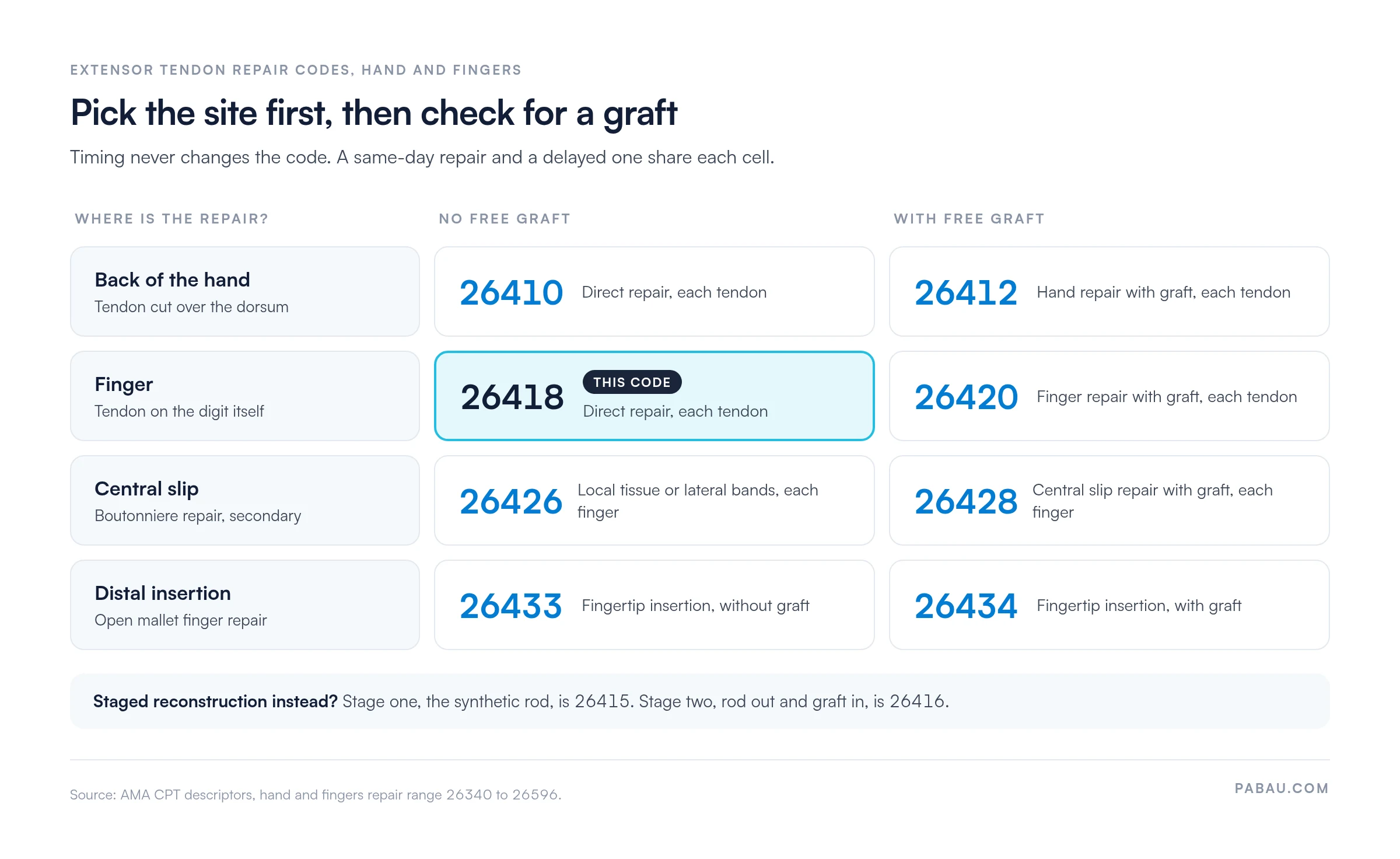
Two boundaries trip coders most. First, a repair at the fingertip insertion is a mallet code, 26433 or 26434, never 26418. Second, a central slip reconstruction has its own codes, 26426 and 26428, even though the tendon sits on the finger.
A clean 26418 claim follows the same path every time. Each step depends on the one before it, so a weak op note weakens the whole claim.
Most rework happens at step three or four. The payer sees units that the note does not support, or a digit that the modifier contradicts. Our CMS-1500 form guide maps the boxes where those units, modifiers and diagnosis pointers go.
Every 26418 line needs a digit modifier, and some need a second one. Start with the F-series, then decide on 51 or 59.
These HCPCS Level II modifiers tell the payer exactly which finger you repaired. The left hand runs FA to F4, and the right hand runs F5 to F9.
Watch out for TA. It identifies the left great toe, so it never belongs on a hand claim.
Modifier 51 flags multiple procedures in one session. Medicare applies its multiple procedure rules on its own, while many commercial payers want 51 on the additional lines. Check each payer’s manual before you append it.
Modifier 59, or the more specific XS, is different. Use it only when an NCCI edit bundles another procedure with 26418. That procedure must also have been done at a separate site. Never add 59 just to get a line paid.
The diagnosis has to match the finger and the cause. Traumatic cuts use the S66.32- laceration codes, while non-traumatic ruptures use M66.24-.
Keep the 7th character at A while the patient is in active treatment, and surgery counts as active treatment. That holds even when the repair is delayed. Character D is for routine healing visits afterward, such as splint checks.
Also avoid the S66.39- codes for a cut tendon. They describe other injuries of the extensor tendon, not lacerations. S66.391A, for example, covers another injury to the left index finger extensor.
CPT 26418 carries a 90-day global period under the CMS fee schedule. Routine care tied to the repair is paid inside the surgical fee. It never goes out as a separate charge.
Confirm the current global indicator on the CMS Physician Fee Schedule lookup for your payment year. Pull RVUs and rates from there too, rather than from an old cheat sheet.
Because the descriptor says “each tendon,” two finger tendons repaired without graft means two units of 26418. Two fingers means at least two lines, each with its own F modifier.
Payers then check the units against a medically unlikely edit, or MUE. Look up the current MUE for 26418 before you submit a multi-tendon claim. Units above it are usually denied, so check how the payer handles appeals with records.
The op note carries all the weight here. It should name each tendon, its finger and the repair done. A line like “multiple extensor tendons repaired” will usually be cut back to one unit.
Most 26418 denials come from a handful of repeat errors. Fix them at the source and the appeals mostly disappear. When one slips through, the remittance’s denial codes tell you which error the payer found.
Run through these checks on every 26418 claim. They take a couple of minutes and catch most avoidable denials.
A clean claim starts with the op note. When the note answers each item above, coding the claim takes minutes rather than a back-and-forth with the surgeon.
Hand surgery billing often means retyping details from the chart into a separate claims tool. Each retyped field is another chance for a wrong digit or a missing authorization number.
In Pabau, the practice management platform we build, the claims management feature fills the CMS-1500 from the patient record. The CPT code on the service lands on the charge line. The ICD-10 slots start from the recorded problem list.
Before the claim can be sent, Pabau checks that required fields like member IDs and authorization numbers are complete. US claims then go out through the Claim.MD clearinghouse, with eligibility checks and claim tracking.
Remittances post back to the same place. Your coder still owns the modifier and unit decisions, but spends less time on data entry.
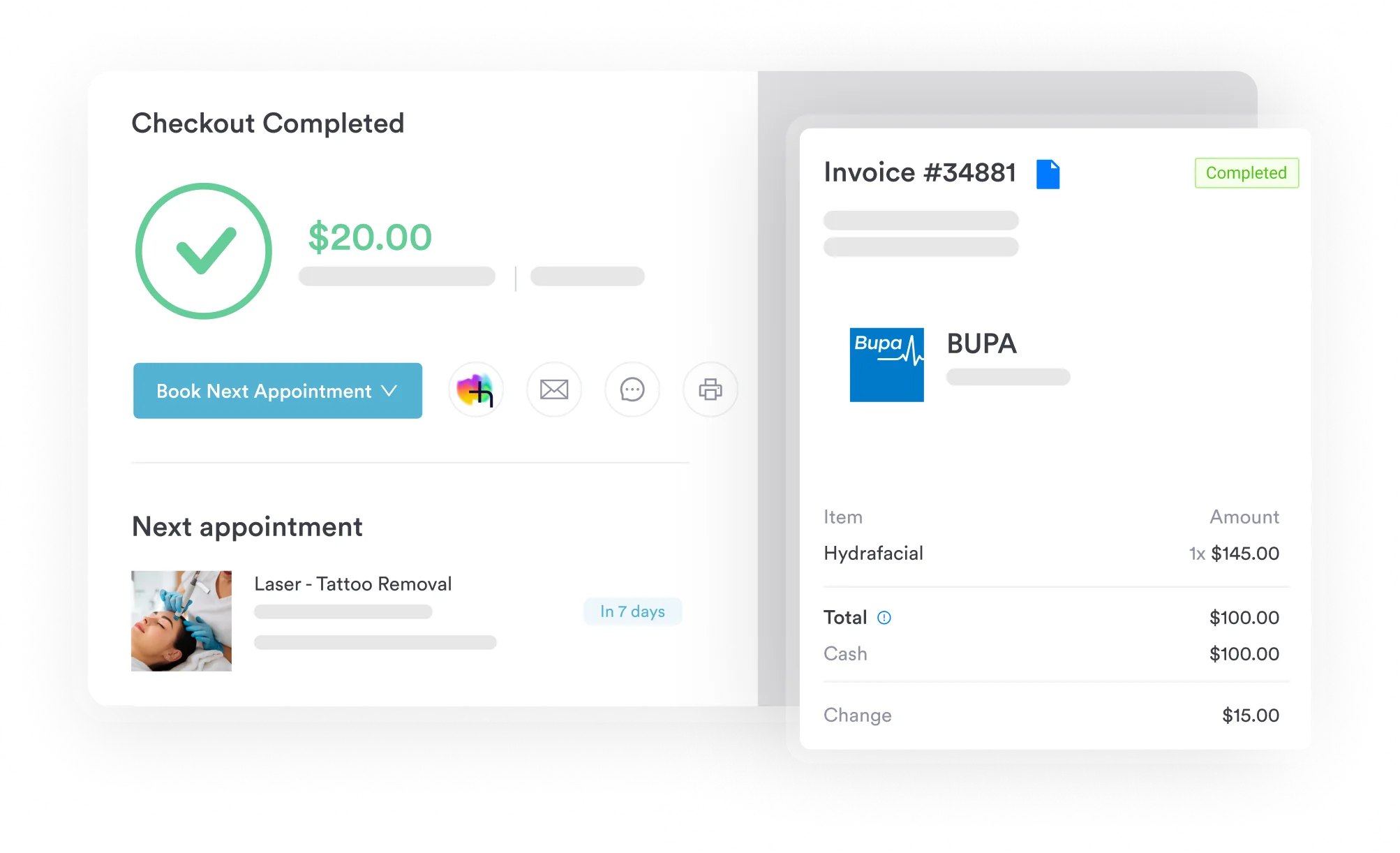

Pabau fills claims from the patient record and checks required fields before sending. US claims go out through Claim.MD with status tracking.

Code 26418 rewards precise op notes. When the note shows a finger-level repair, no graft and a clear tendon count, the code, units and modifiers follow without guesswork.
Most denials come from the edges of the code family. Think hand versus finger, mallet versus shaft, or toe modifiers on a hand. Build those checks into your workflow, and keep reading the payer manual for 51 and MUE rules.
If your team still retypes surgical charges into a separate claims tool, that is the easiest time to win back. Book a demo to see how Pabau turns the chart into a ready-to-send claim.

Want to understand how claim edits work across your codes? Medical billing compliance covers NCCI edit logic, audit triggers and how to build compliant billing workflows.
Need a structured approach to payment posting? Revenue cycle management explains the process from claim creation through payment reconciliation.
Choosing a clearinghouse for surgical billing? Claim.MD clearinghouse overview explains how the integration handles electronic claims and real-time eligibility checks.
Seeing the same denials month after month? Denial management in healthcare shows how to track root causes and stop repeat rejections.
No. CPT 26418 is a standalone surgical code, not an add-on. Each tendon repaired is reported as its own unit, so it never needs a primary code to sit under.
Yes. Under CMS global surgery rules, the splint applied during the repair is part of the surgical package. Later routine splint adjustments for the same repair are bundled too.
No. The global period covers the surgeon’s own post-op care. Therapy from a separate occupational or physical therapist is billed by that therapist under therapy codes.
Yes, when the surgeon repairs it. The descriptor does not require a complete tear. The op note should describe the partial laceration and the repair performed.
Hand surgeons perform most of them, including orthopedic and plastic surgeons with hand training.



