CCSD code H4430: Examination of rectum under anaesthetic
CCSD code H4430 pays for the examination alone CCSD code H4430 is the UK private...

Last Updated: Oct 20, 2026
23700 is the CPT code for manipulation under anesthesia, shoulder joint, including application of fixation apparatus (dislocation excluded). Surgeons report it when they break up adhesions in a stiff shoulder, most often frozen shoulder, while the patient is anesthetized.
Medicare lists a 10-day global period for the code. A sling or immobilizer applied afterward is bundled into it. Reduction of an acute dislocation is excluded and reported with CPT 23655 instead.
Let Pabau's smart automation suggest the right codes, reduce claim denials, and keep your practice compliant—effortlessly.
Automate repetitive tasks and focus on what matters most—your patients.
Reduce coding errors and ensure compliance with the latest regulations.
Clean claims, fewer denials, and faster reimbursements.
Powerful insights and reporting to help your practice thrive.
HIPAA compliant SOC 2 certified GDPR-compliant Trusted by 4,000+ clinics worldwide

CPT Code 23700 covers shoulder joint manipulation under anesthesia, including a fixation apparatus when one is applied. Acute dislocation reduction is excluded.
Adhesive capsulitis (M75.01, M75.02) and shoulder contracture (M24.511, M24.512) are the strongest ICD-10 matches for medical necessity. Dislocation codes invite a denial.
CMS lists a 10-day global period (indicator 010) for the code, so routine post-procedure visits in that window are not separately billable.
Most commercial payers require prior authorization and typically want documented failure of 6 to 12 weeks of physical therapy.
Practice management software like Pabau checks eligibility, submits the claim through Claim.MD, and posts the remittance back to the patient record.
CPT Code 23700 is defined by the American Medical Association (AMA) as: Manipulation under anesthesia, shoulder joint, including application of fixation apparatus (dislocation excluded). That parenthetical is a hard exclusion. Acute shoulder dislocations are reported with CPT 23655 instead.
An orthopedic surgeon or sports medicine physician performs the procedure while the patient is anesthetized. Anesthesia removes voluntary muscle guarding, so the surgeon can apply controlled force and break the adhesions or capsular contracture that limit range of motion.
A sling or shoulder immobilizer applied at the end of the procedure is bundled into CPT Code 23700. Check the operative note for a fixation line before the claim goes out, so the sling is never billed on its own.
Two unbundling errors come up again and again on this code. One is billing the fixation device separately, and the other is stacking arthroscopy codes on the same claim.
The anesthesia separation is especially important for multi-provider claims. The surgeon submits CPT Code 23700 under their NPI. The anesthesiologist submits the anesthesia code from the shoulder and axilla range (01610-01682) under their own NPI. Reporting the anesthesia service under the surgeon’s NPI misstates who performed it and invites an audit.
Payers review operative notes for CPT 23700 against a consistent checklist. A note that omits the anesthesia type or the range of motion (ROM) measurements invites a medical necessity dispute.
Coders validating CPT 23700 claims should confirm all seven elements are present in the operative report. Missing ROM measurements before or after the manipulation are a frequent reason payers dispute the claim. For this code, the operative report is the claim’s primary defense.
Diagnosis code selection decides whether the claim passes initial medical necessity screening. Adhesive capsulitis codes are the strongest pairing. Dislocation codes paired with CPT Code 23700 will trigger a denial, because the descriptor excludes dislocation.
When M75.01 or M75.02 is the primary diagnosis, claims usually pass initial screening, provided conservative treatment failure is in the record. Pain-only codes (M25.511, M25.512) used alone tend to draw a medical necessity review letter.
Watch the neighboring M24.41- codes. They describe recurrent dislocation of the shoulder, not contracture, so they fall under the descriptor’s dislocation exclusion. Confirm the final code and its laterality against the ICD-10-CM code set before the claim goes out.
Modifier selection for CPT Code 23700 determines both reimbursement and claim routing. Nearly all payers require a laterality modifier. Bilateral billing rules are payer-specific, so verify them against the patient’s plan before submission.
For bilateral MUA on the same date of service, check the payer’s billing manual before appending -50. Medicare accepts -50 on a single line for CPT 23700. Many commercial payers require two separate line items with -RT on one and -LT on the other. The wrong format produces a denial that has to be fixed with a corrected claim, which an appeal alone won’t resolve.
Medicare reimbursement for CPT Code 23700 is calculated using the Resource-Based Relative Value Scale (RBRVS). Payment varies by setting (facility vs. non-facility) and by geographic practice cost index (GPCI). Check current rates for your MAC jurisdiction with the CMS Physician Fee Schedule lookup tool. The table below shows how each payment component behaves by setting.
Commercial contracts often pay CPT Code 23700 as a percentage of the Medicare rate, so compare each remittance with your contracted fee schedule. Practice management software like Pabau includes claims management software that submits claims through Claim.MD to thousands of payers. ERA remittances then post back against each claim.
The CMS Medicare Physician Fee Schedule lists CPT 23700 with global surgery indicator 010, a 10-day global period. That marks it as a minor procedure. The window covers the day of the procedure plus the 10 days that follow, 11 days in total.
Confirm the indicator in the fee schedule each plan year before advising on post-procedure billing. The timeline below shows which services fold into the package and which bill separately.
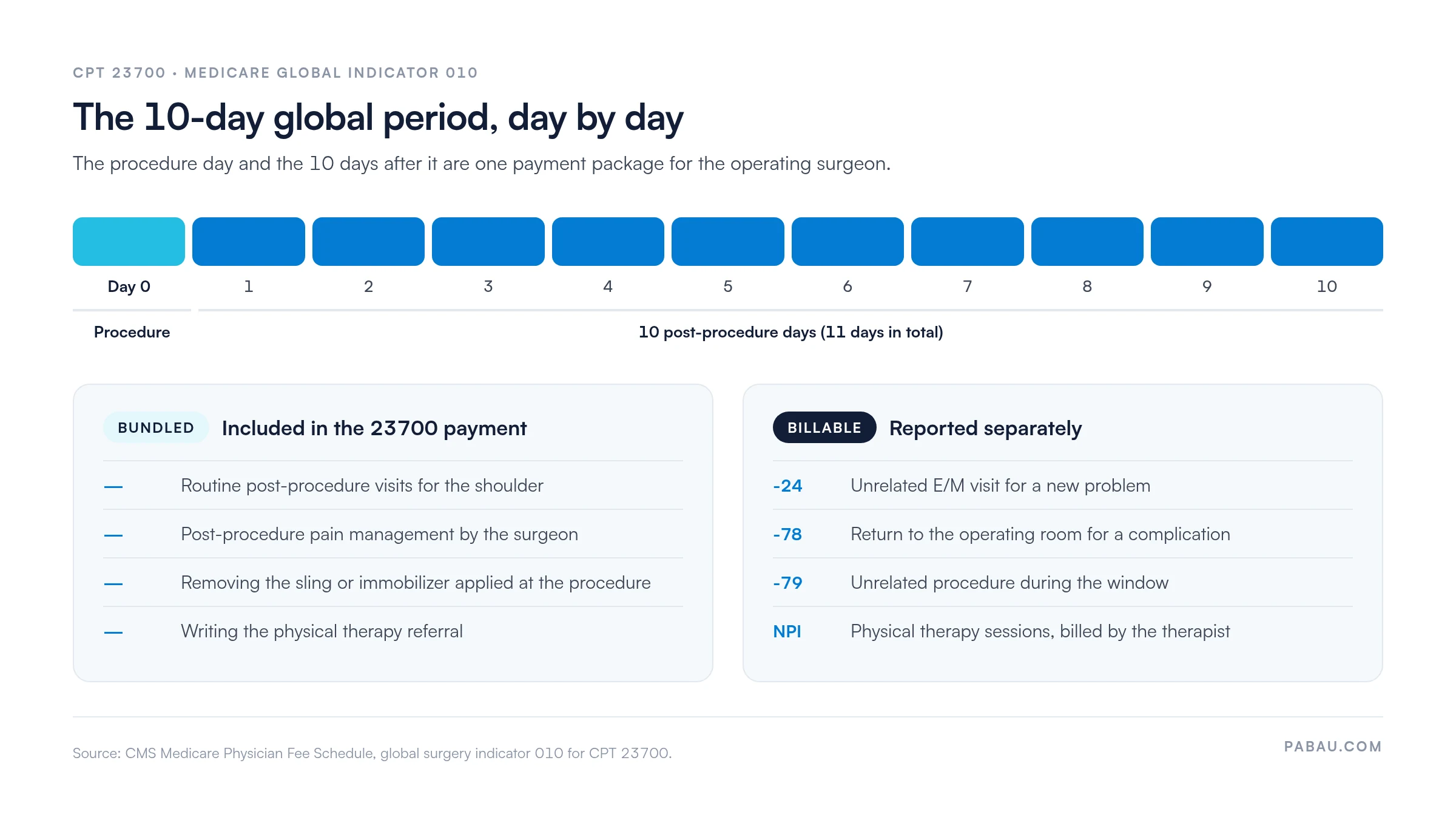
During the 10-day global period, the operating surgeon cannot bill these services separately:
Some services can be billed separately during the window:
Record the global period end date on the patient’s chart at discharge. Any follow-up visit booked before that date then gets a modifier review before the charge is entered.
Most commercial payers require prior authorization for CPT Code 23700. Requirements vary by payer and plan. The criteria below are common across major insurers, including Aetna’s Clinical Policy Bulletin 0204 on manipulation under general anesthesia. Verify the criteria for each patient’s plan before the procedure is scheduled.
Build the prior authorization process into scheduling, capturing the approval date, reference number, and approved CPT codes before the procedure is booked. A claim sent without a required authorization number is one of the most avoidable denials. Verify eligibility at least 48 hours before the date of service to confirm active coverage.
The three most common miscoding errors involve confusing CPT Code 23700 with 23655 (shoulder dislocation), 29825 (arthroscopic lysis of adhesions), and 20610 (joint aspiration/injection). The table below shows when each code applies and whether the codes can be billed together.
Coders should check the 29825 pairing in the current AAPC CPT code reference and the CMS NCCI edit tables every plan year. Edit status on a code pair can change from one year to the next.
CPT Code 23700 denials cluster around six recurring triggers. A pre-submission check catches each of them before the claim leaves the practice.
A clean claim on the first pass needs all six triggers resolved before transmission. Keep the operative report and PT records on file too, because a paid claim can still be audited later.
Coders can hand this checklist to the surgeon before the operative report is signed. Each item answers a question a payer reviewer asks when a 23700 claim is pulled for review.
Flag any operative report for CPT Code 23700 that lacks both pre- and post-procedure range of motion measurements. Without them, a payer has no evidence the manipulation improved motion. Request an addendum from the surgeon before submitting, while the case is fresh.
Orthopedic practices billing CPT 23700 hit the same pressure points on every case. There’s the authorization, the operative note, and the claim itself. When those sit in separate systems, a lapsed coverage check only surfaces as a denial weeks later.
Pabau keeps them on one patient record. Your front desk runs an eligibility check before the procedure day. After the procedure, the claim is pre-filled from details already on the record and submitted through Claim.MD.
Pabau flags missing claim details before submission, so avoidable rejections are caught at the desk. Claim status and ERA remittances post back against each claim. Your billing team sees what paid and what didn’t without chasing paper EOBs.

Pabau checks eligibility, submits claims through Claim.MD, and posts remittances against each claim. Your team spends less time on rework and more time on patient care.

Treat the operative report as the claim. Before a coder touches a 23700 case, check that it names the anesthesia type and carries ROM measurements from before and after the manipulation. Then put the 10-day global end date on the calendar.
Front-loading those checks costs a few minutes per case. A corrected claim or an appeal costs far more, and a dislocation diagnosis on the claim can’t be appealed into a payment at all.
Book a demo to see how Pabau checks eligibility, submits the claim, and posts the remittance for each shoulder MUA from one patient record.

Billing arthroscopy on the same shoulder? CPT code 29825 covers arthroscopic lysis of adhesions and how it interacts with NCCI edits.
Dealing with denial codes after submission? Denial codes in medical billing explains CARC and RARC reason codes and how to build an appeal from the remittance data.
Want to understand the clearinghouse layer between your practice and payers? Medical claims clearinghouse guide covers how electronic claims routing and scrubbing work.
Aiming for first-pass payment? What makes a clean claim lists the fields and checks that keep a claim out of the rejection queue.
Checking coverage before the procedure day? Insurance eligibility verification walks through what to confirm and when.
CPT 23700 covers manipulation of the shoulder joint under anesthesia, including a fixation apparatus when one is applied. Acute dislocation reduction is excluded and coded with CPT 23655 instead.
Most payers require -RT or -LT for laterality. Modifier -50 reports a same-day bilateral procedure, though some payers want two lines with -RT and -LT instead. Modifier -22 supports documented unusual difficulty, and -59 marks a clinically distinct procedure against an NCCI edit.
Adhesive capsulitis codes M75.01 (right shoulder) and M75.02 (left shoulder) are the primary pairings. Shoulder contracture codes M24.511 and M24.512 are also strong matches. Pain-only codes such as M25.511 tend to trigger a medical necessity review when used alone.
CMS lists CPT 23700 with a 10-day global period (indicator 010). Routine follow-up care by the operating surgeon on the procedure day and the 10 days after is bundled. Unrelated visits in that window bill with modifier -24.
Six triggers account for most denials. Three are a missing prior authorization, thin documentation of failed conservative treatment, and a dislocation diagnosis paired with 23700. The others are a missing laterality modifier, an unchecked NCCI pair with arthroscopy codes, and post-procedure visits billed inside the 10-day global period.
Only when the current-year NCCI edit allows it. CPT 23700 and arthroscopy codes such as 29825 are subject to NCCI edits, and some pairs accept a modifier while others don’t. Check the edit table and the payer’s policy every plan year.