HCPCS code J3471: Hyaluronidase ovine injection billing guide
HCPCS code J3471: Descriptor, code type, and quick-reference data HCPCS code J34...

Last Updated: Oct 14, 2026
29825 is the CPT code for arthroscopy, shoulder, surgical; with lysis and resection of adhesions, with or without manipulation. Surgeons use it to release the fibrous adhesions that lock a frozen shoulder. One code covers the work whether or not manipulation is added, so there is no separate variant to choose between.
Most 29825 denials trace back to the paperwork rather than the surgery. Payers want a billable ICD-10 code, an operative report that describes the adhesions, and evidence that conservative care failed first. Get those three right and the claim usually clears on the first pass.
Let Pabau's smart automation suggest the right codes, reduce claim denials, and keep your practice compliant—effortlessly.
Automate repetitive tasks and focus on what matters most—your patients.
Reduce coding errors and ensure compliance with the latest regulations.
Clean claims, fewer denials, and faster reimbursements.
Powerful insights and reporting to help your practice thrive.
HIPAA compliant SOC 2 certified GDPR-compliant Trusted by 4,000+ clinics worldwide

CPT code 29825 covers arthroscopic lysis and resection of shoulder adhesions, whether or not the surgeon adds manipulation.
Medical necessity rests on a billable ICD-10 code such as M75.01 or M75.02, plus documented failure of conservative care.
Add-on code 29826 reports alongside 29825 with no override modifier, while 29815 stays bundled into it.
Laterality, adhesion description and manipulation status all belong in the operative report before the claim goes out.
Pabau’s claims management tools submit 29825 claims, track their status, and surface the denial reasons coming back.
CPT code 29825 is the surgical arthroscopy code for lysis and resection of adhesions in the shoulder.
The American Medical Association’s CPT code set words it as “Arthroscopy, shoulder, surgical; with lysis and resection of adhesions, with or without manipulation.” It sits in the Endoscopy/Arthroscopy subsection of the Musculoskeletal System chapter.
That closing clause carries more weight than it looks. Both presentations bill under 29825, so no second code exists for cases where the surgeon adds closed manipulation during the arthroscopy. Choosing between “with” and “without” is never a coding decision.
The code pays for the whole arthroscopic procedure. That means portal placement, joint visualization, and mechanical or electrothermal release of fibrous adhesions across the glenohumeral joint. Any manipulation through the shoulder’s full range of motion is included too.
The sections below take each requirement in turn. It starts with the diagnosis code that carries medical necessity, then moves to modifiers, NCCI edits, Medicare’s rates, and the six denials worth preventing.
The diagnosis code tells the payer why the surgery happened. Adhesive capsulitis is the usual answer, and the lateralized children M75.01 and M75.02 are what payers expect to see.
The parent code M75.0 is not billable, so it never belongs on a claim.
Beyond that, payers differ on which secondary diagnoses they accept. The diagnosis also has to match what the pre-operative evaluation documented, not simply describe the procedure performed.
Check your Medicare Administrative Contractor’s local coverage determination before the claim goes out.
Confirm code validity for the current fiscal year as well. ICD-10-CM changes every October 1, and an unspecified code used where a lateralized one exists is a routine reason for a returned claim.
An incomplete operative note denies more 29825 claims than any coding error does. Payers audit for a specific set of elements, and a note confirming only that an arthroscopy took place will not clear them. Miss one element and an auditor has grounds to downcode or reject the claim outright.
Turn those six into a pre-submission checklist. A biller who runs it before the claim leaves the practice catches most omissions while the surgeon is still reachable to correct them.
Build a documentation checklist specific to 29825 that your surgeons complete at the time of dictation. Flag cases where the op note lacks laterality, manipulation status, or adhesion description before they reach the billing queue. Catching those omissions upstream cuts the denial rate on this code.
Four modifiers do most of the work on a 29825 claim. Each answers a different payer question, so the wrong one changes how the claim adjudicates. Laterality is the only modifier you will use on every single case.
CMS increasingly favors the X-modifiers for their specificity, though modifier 59 remains widely accepted by commercial payers. Before submission, confirm the current guidance for the exact pair you are reporting with a tool such as the AAPC Codify CPT lookup.
Four distinct operations sit in adjacent code numbers, which is why coders hesitate when an operative report describes several at once. The choice turns on what the report names as the primary surgical action. Region treated alone will not settle it.
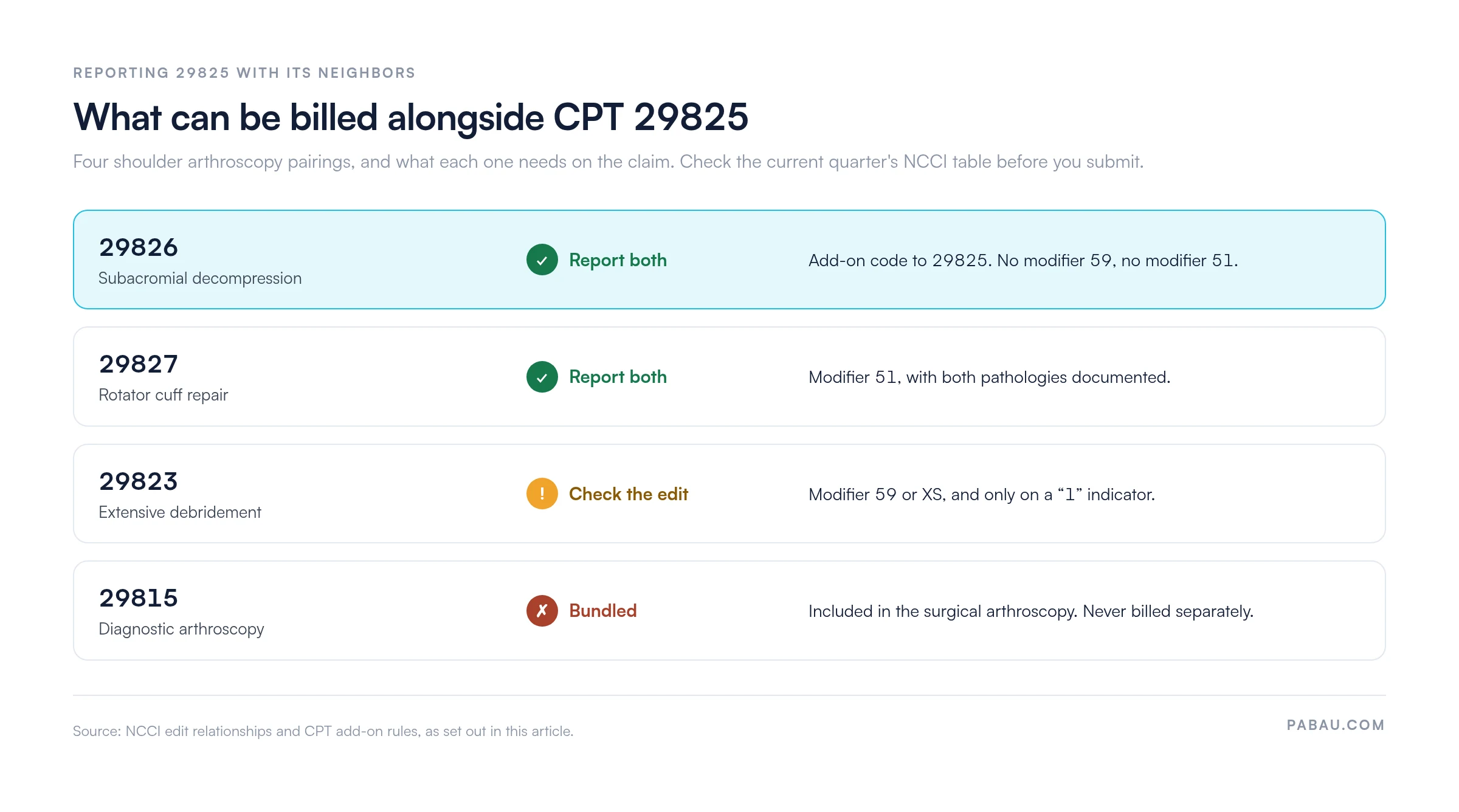
Of these, the 29825 and 29823 pairing is the one most likely to draw an NCCI review. Where the operative report describes extensive debridement and adhesion lysis as separate surgical steps, billing both with modifier 59 is defensible.
If the debridement was incidental to the release, reporting 29823 separately counts as unbundling. Decompression is the other frequent companion, and its own billing rules are set out on 29826.
The National Correct Coding Initiative defines which procedure pairs may be reported together and which are bundled.
Those relationships change quarterly, so the status of any 29825 pairing has to be read off the current quarter’s table. Reviewing it once at the start of the year leaves three quarters unchecked.
One column decides the 29823 question. Before applying modifier 59 to override that edit, read the indicator for the pair in the current quarter’s table. A “1” means a modifier is allowed. An indicator of “0” means it is not, and submitting one anyway still produces a denial and can raise an audit flag.
The chart below collapses all four pairings into a single view.
Medicare pays 29825 under the Physician Fee Schedule, at two different rates. The facility rate applies when the case is done in a hospital or an ambulatory surgery center. An office-based case falls under the non-facility rate instead.
For 2025, the national average non-facility rate is roughly $672 and the facility rate roughly $347, before geographic adjustment, according to CMS MPFS data. The schedule updates every January 1, so confirm the figure for your own GPCI locality with the CMS Physician Fee Schedule lookup tool.
Those two numbers explain a question billers field often. A case moved to an ASC pays the surgeon roughly half the office rate. The facility carries the overhead and bills its own claim for it. That drop is the fee schedule working as designed.
Medicare fee-for-service does not require prior authorization for most shoulder arthroscopy. Plans under Medicare Advantage frequently do, and so do most commercial payers and Medicaid managed care organizations. Check the individual plan rather than assuming the program.
Four elements make up nearly every request:
Once authorization comes through, enter the number in box 23 of the CMS-1500. A claim that needed one and went out without it draws an automatic denial, and an appeal rarely fixes that without a fresh request. Track expiration dates too. An authorization that lapses before the date of service will not cover the claim.
Denials on 29825 repeat themselves. Six causes account for most of them, and each has an appeal route, though preventing the denial upstream is the stronger play.
The table pairs each cause with the evidence that answers it.
Record the CARC and RARC values from every 29825 remittance. A reason code that repeats across several claims points at a workflow problem worth fixing, not a one-off payer dispute.
The reference on denial codes in billing maps each value to a corrective action. Claims management software can log them for you and flag the reason codes that keep returning.
Request the payer’s Local Coverage Determination (LCD) for shoulder arthroscopy from your Medicare Administrative Contractor (MAC) directly. MACs like Novitas, CGS, and Palmetto GBA publish LCDs that specify the exact diagnosis codes, documentation standards, and conservative treatment timelines they require for 29825. Align your pre-authorization and documentation templates to the LCD criteria for your MAC region.
Most orthopedic billing teams push 29825 claims out through a clearinghouse portal, then track what comes back in a spreadsheet.
Claim status sits in one system, the patient record in another, and the denial history in a third. Reconstructing a pattern across all three takes an afternoon nobody has.
Practice management software like Pabau keeps the three together. Claims leave as CMS-1500 or 837P files through Claim.MD, our US clearinghouse integration, which reaches thousands of US payers.
Each claim then carries its own status on the dashboard, from submitted through processing to paid or error.
Electronic remittance advice lands back in the same record, so the reason code on a denied 29825 claim sits beside the patient it belongs to. A days-overdue count surfaces the submissions that stalled.
Your coder still chooses the modifiers, and Pabau shows you which of those choices payers sent back.
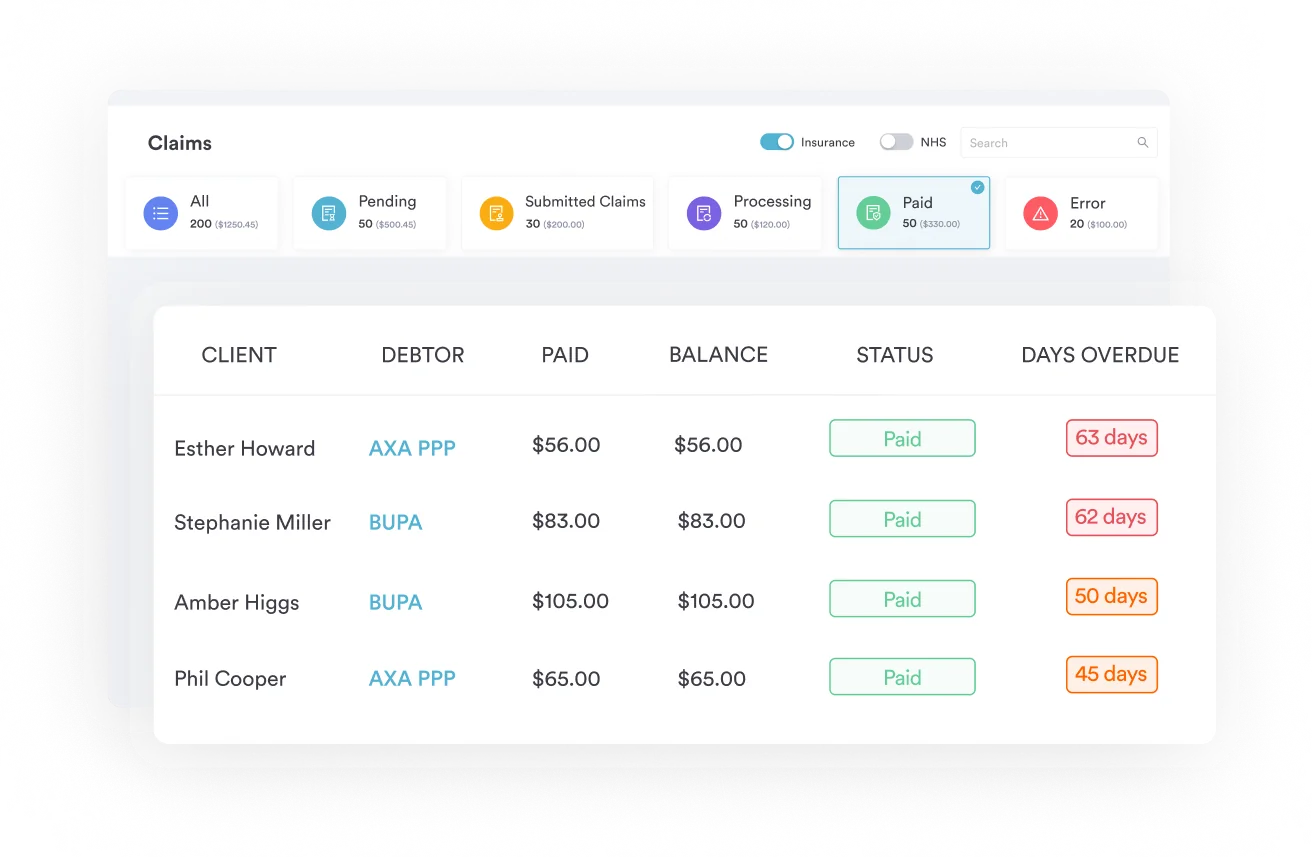

Pabau submits 29825 claims electronically, shows each one’s status from submission to payment, and reports the denial reasons coming back from payers. Orthopedic billing teams see the pattern before it becomes a backlog.

29825 is a straightforward operation with a demanding paper trail. The coding question is usually settled by one line of the descriptor. What decides payment is whether the pre-op notes, the operative report, and the diagnosis code tell the same story.
Build the checklist once, then run it on every case. Six documentation elements, one billable ICD-10 code, the right laterality modifier, and a current NCCI check will clear most claims first time. The appeals you still file will be shorter for it.
What comes back matters as much as what goes out. Book a demo to see how Pabau submits 29825 claims, follows each one to payment, and shows the denial reasons your billing team keeps meeting.

Need to understand how clearinghouse submission works for surgical CPT codes? Medical claims clearinghouse guide explains how electronic claims reach payers and what happens at each step of the adjudication process.
Seeing recurring denials on your surgical claims? Getting credentialed with insurance companies covers the enrollment and credentialing steps that prevent payer-relationship denials before they start.
Want to understand how billing software reduces coding errors? Best medical billing software for US practices reviews the features that matter most for high-volume surgical billing teams.
Yes. 29826 is an add-on code, so it is reported in addition to 29825 and needs no override modifier. Modifier 51 does not apply to add-on codes, and modifier 59 is not required for this pair. The operative report still has to document the subacromial decompression as its own step.
No. 29825 requires the arthroscopic lysis and resection of adhesions. A closed manipulation performed without arthroscopy is reported with 23700 instead. The “with or without manipulation” clause covers only manipulation added during the arthroscopic procedure itself.
Most 29825 cases are done in a hospital outpatient department (POS 22) or an ambulatory surgery center (POS 24). That is why the lower facility rate applies to the majority of claims. The non-facility rate applies only when the procedure is performed in an office, POS 11.
One unit per shoulder. Report the side with the RT or LT modifier instead of raising the unit count. A second shoulder treated in the same session goes on its own claim line, with its own laterality modifier. Payer rules on bilateral cases vary.