



CCSD code G5100: Bypass of duodenum billing guide
CCSD code G5100 bills a bypass that leaves the duodenum in place CCSD code G5100...

Last Updated: Oct 16, 2026
CPT code 23330 reports the surgical removal of a foreign body from the subcutaneous tissue of the shoulder, when the object sits above the fascia. Typical examples include metal fragments, glass, splinters, and retained surgical materials. If removal reaches below the fascia, CPT 23333 applies instead.

CPT Code 23330 describes surgical removal of a foreign body from the subcutaneous tissue of the shoulder.
Depth determines the code: use 23330 for subcutaneous removal, CPT 23333 for deep (subfascial or intramuscular) removal.
Documentation must confirm the foreign body’s location, imaging findings, and the surgical approach taken.
Pabau’s claims management software helps orthopedic and surgical practices streamline CPT 23330 billing, reduce denials, and maintain compliant records.
Orthopedic surgeons, emergency physicians, and general surgeons use CPT Code 23330 when they surgically remove a foreign body from the subcutaneous tissue of the shoulder. The sports medicine and surgical practices that bill this code most frequently include outpatient surgical centers, hospital-based departments, and private orthopedic offices performing minor soft-tissue procedures.
The official descriptor, as the American Medical Association (AMA) maintains it,, reads: Removal of foreign body, shoulder; subcutaneous. It falls within the Introduction or Removal Procedures on the Shoulder section, CPT range 23330-23350, which itself sits under Surgical Procedures on the Musculoskeletal System (codes 20000-29999).
Foreign bodies that prompt this procedure include metal fragments, glass shards, splinters, pellets, and retained surgical materials. The defining clinical criterion is location: the object must be confirmed in the subcutaneous layer, above the fascia. Anything deeper requires a different code entirely.
The single most common coding error with CPT Code 23330 is upcoding to 23333 when the operative note does not clearly document the depth of the foreign body. The two codes differ only by anatomical depth.
| Code | Descriptor | Foreign body location | Relative complexity |
|---|---|---|---|
| 23330 | Removal of foreign body, shoulder; subcutaneous | Above the fascia, in subcutaneous fat | Lower |
| 23333 | Removal of foreign body, shoulder; deep (subfascial or intramuscular) | Below the fascia, within or deep to muscle | Higher |
If the operative report documents that the surgeon opened or retracted the fascia to retrieve the object, CPT 23333 applies. If the procedure stayed entirely within the subcutaneous plane, 23330 is correct. Payers audit depth documentation closely on these two codes, and a missing or vague operative note is the leading cause of downcodes and denials.
A related code worth knowing is CPT 24200 (removal of foreign body, upper arm or elbow area; subcutaneous). When the foreign body sits distal to the shoulder joint itself, in the upper arm proper, 24200 is the correct selection rather than 23330. Confirm anatomical landmarks in the operative report before code selection.
Anatomic site drives foreign body code selection throughout the CPT surgery section. A foreign body impacted inside the uterine cavity is removed hysteroscopically and reported under CPT 58562, which sits in a different code family.
Document the foreign body’s exact depth in every operative note before billing CPT Code 23330. A phrase like ‘dissection carried through subcutaneous fat without violation of the fascia’ is sufficient. Missing depth documentation is the primary reason payers downcode or deny these claims.
Medical necessity requires a diagnosis code that supports the foreign body removal. Payers will reject CPT Code 23330 if the accompanying ICD-10 code is unspecific or does not describe a foreign body in or around the shoulder. Select the most specific code available based on the nature and location of the foreign body.
Always code the laterality (right vs. left shoulder) when documented. Payers using National Correct Coding Initiative (NCCI) edits will flag unspecific laterality codes when site-specific options exist. The surgical CPT code references framework for specificity applies across all musculoskeletal procedures: use the most granular available code.
A chiropractic platform links every spinal or joint procedure to its treatment schedule and the outcome you record.
Incomplete documentation is the root cause of most CPT Code 23330 claim denials. Orthopedic coders consistently flag three areas where notes fall short: depth confirmation, imaging correlation, and surgical approach description.
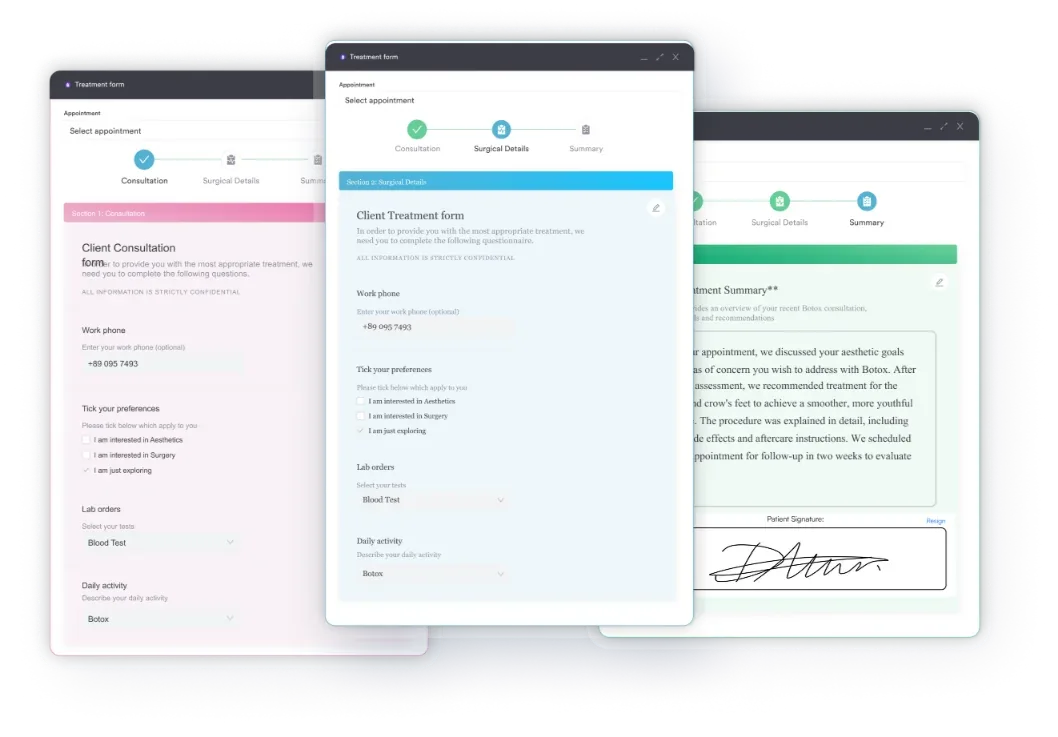
The operative report must include each of the following to support a clean claim:
For HIPAA-compliant documentation practices in surgical settings, surgeons must complete operative notes within 24 hours of the procedure. Late documentation is a red flag during payer audits and can result in claim recoupment even after initial payment.
Modifiers clarify billing circumstances that the base code does not capture on its own. Several are commonly relevant to CPT Code 23330 claims.
Practices using surgical practice EMR solutions should build modifier-selection logic into their charge capture workflows. Selecting the wrong modifier or omitting a required one accounts for a significant share of preventable denials on CPT 23330 claims.

Pabau’s claims management tools help orthopedic and surgical practices track CPT code accuracy, manage documentation requirements, and submit cleaner claims from the first attempt.

Medicare reimbursement for CPT Code 23330 follows the Medicare Physician Fee Schedule (MPFS). Because CMS updates MPFS rates annually and varies them by geographic locality, always verify current figures directly through the CMS Physician Fee Schedule lookup tool rather than relying on third-party summaries. The rates below reflect general benchmark ranges reported in the 2025-2026 period; contract your MAC for definitive amounts.
Commercial payer rates vary substantially — individual contracts set them independently. Some payers use a percentage of Medicare rates (typically 110-150% for outpatient surgical procedures); others use proprietary fee schedules. Certain commercial payers require prior authorization for CPT 23330 depending on the plan, member benefit design, and state. Verify PA requirements with each payer before scheduling the procedure.
The global surgery period for CPT 23330 is designated as 10 days by CMS. This means pre-operative visits on the day before or day of surgery, the intraoperative service, and related post-operative care within 10 days bundle into the single surgical payment. Separate E/M visits within the global period require modifier -24 (unrelated E/M during post-op) or -79 (unrelated procedure during post-op) to be paid separately. Tracking the patient record management timeline carefully prevents inadvertent bundling of separately reimbursable services.
The National Correct Coding Initiative (NCCI) publishes quarterly edits that define which code pairs cannot be billed together without a modifier override. For CPT Code 23330, the most commonly triggered edits involve imaging guidance and evaluation and management services.
Practices can use claims management software to flag potential NCCI edit conflicts before submission. Catching bundling issues prior to claim filing is significantly more efficient than managing post-denial appeals. The billing compliance checklist approach applies here: systematic pre-submission review catches the majority of preventable denials. Review the AAPC Codify CPT lookup for the current NCCI bundling status of any code you plan to report alongside 23330.
Check NCCI edits quarterly. CMS updates the National Correct Coding Initiative four times per year, and edits that were not applicable in Q1 may apply in Q3. Automated pre-claim scrubbing that pulls live NCCI tables prevents bundling denials that stale reference guides miss.
Understanding the full CPT 23330-23350 family helps coders select correctly when the procedure or documentation differs from a standard subcutaneous removal. The CPT coding workflows for shoulder and musculoskeletal procedures require familiarity with adjacent codes to avoid upcoding or undercoding errors.
| CPT code | Description | Key distinction from 23330 |
|---|---|---|
| 23333 | Removal of foreign body, shoulder; deep (subfascial or intramuscular) | Depth: below the fascia |
| 23334 | Removal of foreign body, shoulder; deep with arthrotomy | Joint entry required to access the foreign body |
| 23350 | Injection procedure for shoulder arthrography | Injection, not removal; different clinical purpose |
| 24200 | Removal of foreign body, upper arm or elbow area; subcutaneous | Anatomical location: distal to shoulder joint |
| 28190 | Removal of foreign body, foot; subcutaneous | Anatomical location: foot |
For foreign bodies in the shoulder joint space itself, involving the glenohumeral joint, an arthroscopic or open approach with arthrotomy (CPT 23334) is the appropriate code. Using 23330 when the joint was entered is a significant documentation and coding error with potential compliance consequences. The CPT documentation standards principle applies: the operative report must clearly reflect the actual procedure performed, and code selection follows the documentation, not the other way around.
Anesthesia can also steer code selection. CPT 23330 is usually a local-anesthetic procedure. A shoulder case that needs general or regional anesthesia may call for a different code, such as CPT 23700 for manipulation of the shoulder joint.
Orthopedic and surgical practices billing CPT Code 23330 frequently encounter the same failure points: incomplete operative notes, missed modifier requirements, and post-submission NCCI conflicts. Pabau’s claims management software addresses these upstream by integrating documentation and billing into a single workflow.
Surgeons can complete structured operative notes within Pabau that prompt for depth documentation, imaging references, and modifier selection before the record is finalized. The result is a claim-ready note that reduces the back-and-forth between clinical and billing staff. Pabau also supports prescription and procedure documentation workflows alongside billing, keeping the full patient encounter in one place rather than across disconnected systems.

For practices managing multiple providers or locations billing musculoskeletal CPT codes, Pabau’s reporting tools provide visibility into denial rates by code, modifier, and provider, so teams can identify systemic billing issues before they become audit risks. Learn more about how Pabau fits into a broader practice management software strategy for surgical and specialty practices.
CPT Code 23330 is a precise, depth-dependent code. The subcutaneous designation is its defining clinical criterion, and documentation that fails to confirm the foreign body’s location above the fascia creates the conditions for downcoding, denial, and audit exposure. Correct ICD-10 pairing, appropriate modifier selection, and NCCI edit awareness close the remaining gaps.
Pabau helps surgical practices eliminate the documentation gaps that generate preventable denials on CPT 23330 and similar musculoskeletal codes. Book a demo to see how Pabau’s claims management and documentation tools work together for orthopedic and surgical teams.

Coding hypertension as a comorbidity? Essential hypertension coding guide covers how ICD-11 BA00.Z replaces ICD-10 code I10 for primary hypertension without secondary causes.
Coding a COPD diagnosis too? COPD coding guide explains how ICD-11 CA22 replaces the ICD-10-CM J44 series for chronic obstructive pulmonary disease.
Coding a lower respiratory infection? Acute bronchitis coding guide covers how ICD-11 CA42.Z classifies acute inflammation of the bronchial airways in Chapter 12.
CPT Code 23330 is used to report surgical removal of a foreign body from the subcutaneous tissue of the shoulder, when the object sits above the fascia. Common examples include metallic fragments, glass, splinters, and retained surgical materials.
The distinction is depth: 23330 applies when the foreign body is in the subcutaneous layer above the fascia, while 23333 applies when removal requires entering the subfascial or intramuscular plane. The operative note’s description of the dissection plane determines the correct code.
The most common modifiers are -RT/-LT (laterality), -51 (multiple procedures), -59 (distinct procedural service), and -25 (separately identifiable E/M on the same date). Modifier -22 applies when the removal was significantly more complex than typical.
Rates vary by geographic locality and setting — non-facility rates are generally higher than facility rates. Use the CMS Physician Fee Schedule lookup tool for the current figure in your locality.
Medicare generally does not require prior authorization for CPT 23330, but commercial payers and Medicaid managed care plans may. Verify requirements with each payer before scheduling the procedure.
The operative note must confirm the foreign body’s subcutaneous location, describe the dissection approach, reference pre-operative imaging, and confirm the surgeon did not enter the fascia. A site-specific ICD-10 code such as M79.A21 or M79.A22 must accompany the claim to establish medical necessity.



