



HCPCS code E0198: Water pressure pad billing guide
HCPCS code E0198 is a water pad for a standard mattress HCPCS code E0198 is the ...

Last Updated: Oct 13, 2026

CPT Code 22850 covers removal of posterior nonsegmental instrumentation (e.g., Harrington rods, sublaminar wires) placed during a prior spinal fusion or deformity correction.
22850 applies to nonsegmental hardware only; segmental instrumentation removal is coded separately as CPT 22852, and mixing the two is a common audit trigger.
Medicare pays about $716.78 for CPT 22850 in 2026, and the rate is identical in facility and non-facility settings, before geographic adjustment.
Pabau, practice management software for medical practices, embeds CPT entry, modifier selection, and ICD-10 pairing in one workflow. Spine teams then submit clean claims without manual transcription.
CPT Code 22850 covers the surgical removal of posterior nonsegmental spinal instrumentation, such as a Harrington rod. The code applies when the original construct anchored at only two points. Removal of a segmental pedicle screw-rod system is coded separately, as CPT 22852.
The American Medical Association (AMA) maintains the CPT code set. Within it, 22850 sits in the musculoskeletal surgery section, under spinal instrumentation procedures. Orthopedic spine surgeons, neurosurgeons, and their coding teams bill it at hospitals, ambulatory surgery centers (ASCs), and outpatient facilities.
Hardware removal sits at the tail of a long medical billing workflow, so a 22850 denial usually traces back to the original fusion’s paperwork.
This guide works through the official descriptor, the clinical indications, the modifiers, and the 2026 Medicare rates. It then covers the ICD-10 crosswalk, the documentation an auditor asks for, and the wider spinal instrumentation code family.
CPT Code 22850 describes the surgical removal of posterior nonsegmental instrumentation from the spine. The AMA’s official short descriptor is “removal of posterior nonsegmental instrumentation.”
The long descriptor names the Harrington rod parenthetically, as the canonical example of the hardware type covered.
Posterior nonsegmental instrumentation refers to spinal fixation constructs that attach at only two points (end vertebrae) without intermediate fixation. Harrington rods are the most widely cited example.
Other devices in this category include single-hook constructs and sublaminar wires, both used for scoliosis correction before segmental pedicle-screw systems became standard. The critical distinction for billing is that nonsegmental hardware does not grip individual vertebral segments along the construct’s length.
Medical necessity documentation must clearly support why the hardware is being removed. Payer policies vary, but the following indications are commonly accepted across Medicare and commercial plans. Each must be explicitly stated in pre-operative documentation and linked to a supporting ICD-10 code on the claim.
Practices managing orthopedic and spine practice software workflows will recognize these as the most common operative drivers.
Payer-specific Local Coverage Determinations (LCDs) from Medicare Administrative Contractors (MACs) may impose additional medical necessity criteria. Always verify against the applicable MAC’s LCD before submitting claims.
The single most common coding error on spinal hardware removal claims is billing 22850 when 22852 (removal of posterior segmental instrumentation) is the correct code.
The distinction turns entirely on the type of construct originally placed. Using 22850 for segmental hardware removal invites an audit and payer recoupment. One question routes the claim, as the diagram below shows.
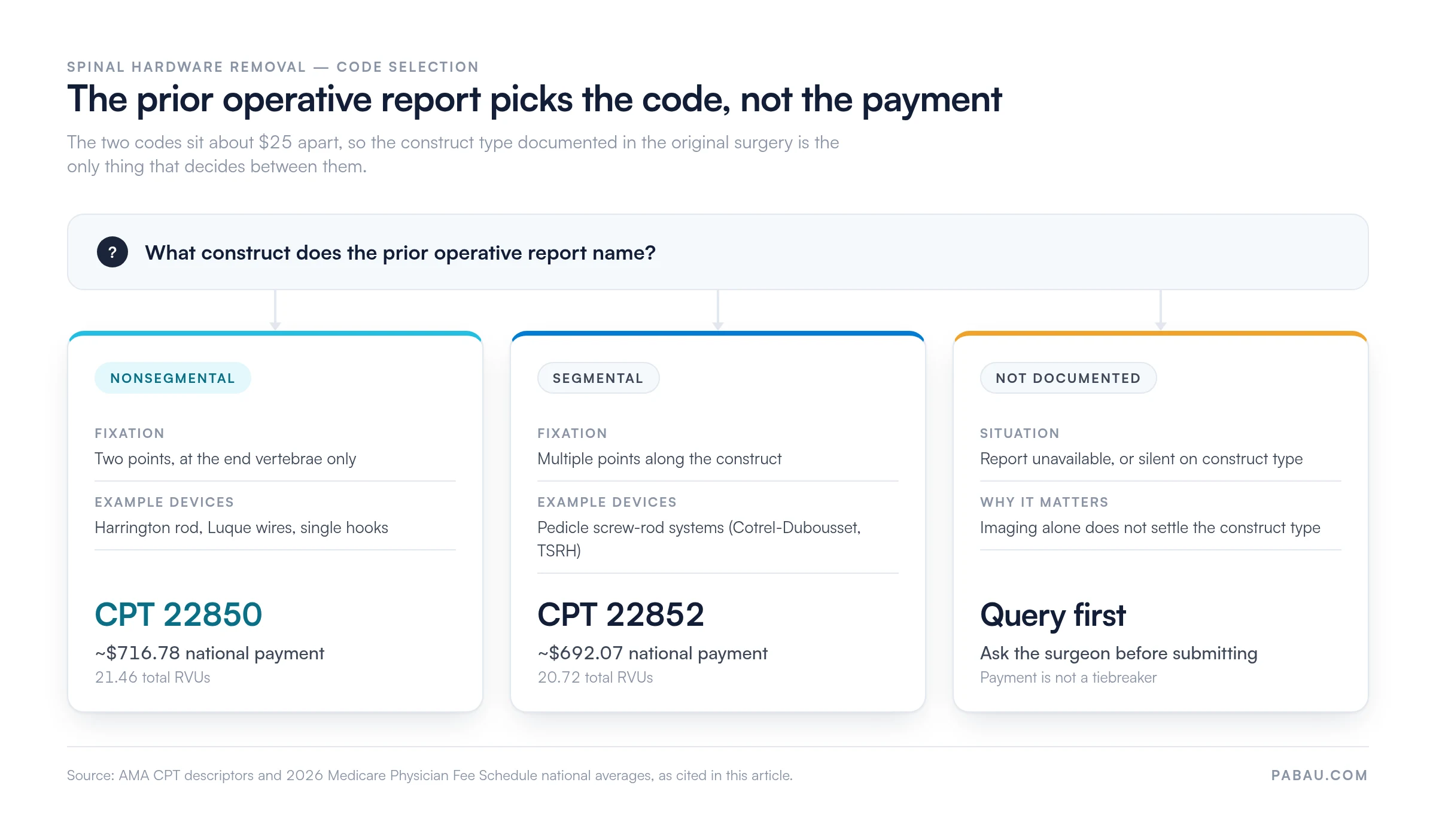
When the prior operative report is unavailable or does not specify the construct type, the coder should query the surgeon before submitting. Payment is not a tiebreaker here. The two codes sit about $25 apart in 2026, and 22850 is the higher-paying of the pair. Guessing in either direction creates compliance exposure with no offsetting upside.
Modifier selection materially affects reimbursement and claim acceptance. The table below summarizes the modifiers most commonly applied to CPT 22850, along with their usage rules. Note that payer-specific policies can override AMA modifier guidance; always verify with the applicable payer before submitting.
When billing -78, the operative note must clearly state the return was unplanned and related to a complication from the index procedure. Planned staged removal does not qualify for -78. Bill 22850 without a modifier in that case, or with -58 for staged procedures where payer policy allows.
Medicare pays about $716.78 for CPT Code 22850 in 2026, and that figure holds in both facility and non-facility settings. Geographic locality is the only variable that moves it. The figures below reflect Medicare Physician Fee Schedule (MPFS) national averages.
Use the CMS Physician Fee Schedule lookup tool to retrieve locality-adjusted rates for your practice address. Tracking payer trends over time is a core element of revenue cycle management for spine practices.
These figures are approximate national averages subject to the annual conversion factor update and local geographic adjustment. Verify current rates using the FastRVU 2026 RVU lookup tool, which mirrors CMS data and calculates locality-adjusted payment.
Commercial payers typically negotiate rates as a percentage of Medicare. Contracted rates run from 110% to 200% of MPFS, depending on the payer and the market. Reviewing electronic remittance advice (ERA) data after each claim cycle helps practices identify systematic underpayments against contracted rates.
The Medicare payment is calculated from three relative value unit (RVU) components. Work RVUs capture surgeon effort; practice expense (PE) RVUs capture overhead; malpractice RVUs cover professional liability.
Each is multiplied by a geographic practice cost index (GPCI) and the annual conversion factor. For 2026 that factor is $33.4009, rising to $33.5675 for qualifying alternative payment model participants.
Site of service does not change what Medicare pays for CPT 22850. The practice expense RVUs are the same in a hospital and in an office suite, so the payment lands near $716.78 either way. Spend the scheduling conversation on surgical need instead. The lever that protects this claim is the operative note, which has to name the construct as nonsegmental.
Every 22850 claim requires a paired ICD-10-CM diagnosis code establishing medical necessity. The codes below represent the most commonly used pairings based on clinical indication.
Payer LCDs may restrict coverage to specific diagnosis codes; verify against your MAC’s applicable LCD. The same crosswalk logic applies to the insertion counterpart, CPT 22840, where a prior procedure later generates a removal or revision claim.
Use the AAPC Codify CPT lookup crosswalk feature to verify current ICD-10 pairings for CPT 22850 against your payer’s accepted diagnosis list. When coding infection cases, verify whether the payer requires a septicemia code as a secondary diagnosis in addition to the implant infection code.
A clean CPT 22850 claim rests on an operative note that supports every element of the code. That means the posterior approach, the nonsegmental hardware type, the reason for removal, and the relationship to prior surgery.
Missing any of these elements is a common audit trigger. Think of the operative note as your superbill documentation foundation; without it, modifiers and diagnosis codes cannot stand on their own.
For modifier -22 claims, the surgeon should add a separate paragraph to the operative note quantifying the additional complexity. Examples include the time required to extract a broken rod, or the management of peri-implant bone loss. Auditors look for objective measurements, not general statements that the case was “difficult.”
CPT 22850 generates a predictable set of claim errors that lead to denials and audit exposure. Sound medical billing compliance practices require proactively addressing each of the following before submission.
Effective denial management workflows for spine practices should flag every 22850 denial and categorize it by denial reason code. The most common reason codes for hardware removal denials are CO-97 (payment included in another service) and CO-18 (exact duplicate claim). A CO-97 denial on 22850 often signals an NCCI bundling conflict with a same-day primary spinal procedure.
Check whether modifier -59 or -XS properly separates the two services. If neither applies, the removal was incidental and not separately billable. Consistent review of these patterns supports better procedure code billing guidelines across your surgical billing team.
CPT 22850 is one of several codes in the spinal instrumentation section (22840-22855 range). Coders working on spinal surgery accounts should be familiar with the full family to avoid miscoding or missed billing opportunities.
Reference coding guides tell you what code to use. What they do not solve is the manual step between code lookup and clean claim submission. Most spine surgery billing teams still copy CPT codes, modifiers, and ICD-10 pairings from a reference tool into their billing system manually. Every transcription step is a point of error and a source of rework.
Pabau, practice management software with built-in claims management, embeds CPT code entry, modifier selection, and ICD-10 pairing directly in the treatment record. A surgeon or coder entering CPT 22850 attaches the modifier and the diagnosis code in the same interface used to document the encounter.
The completed claim then goes out as an electronic claim via Claim.MD, Pabau’s clearinghouse partner, which validates it against payer-specific edits first. Catching those edits before submission is what keeps CO-97 and CO-18 denials off spinal hardware removal claims.
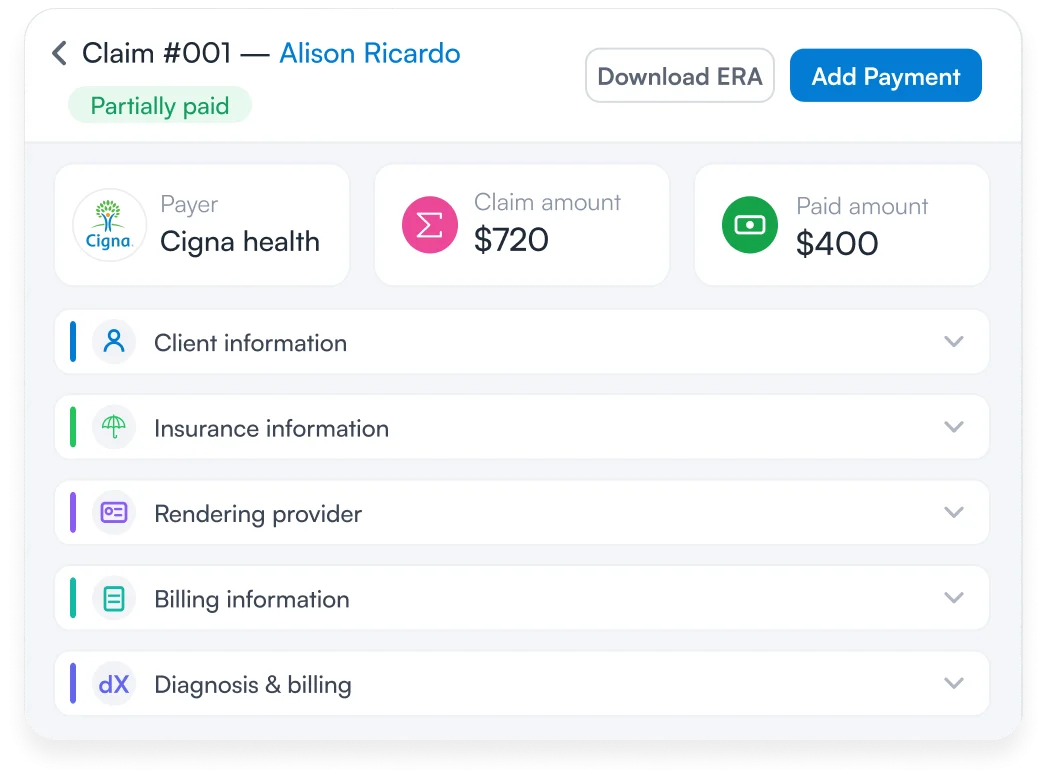
Pabau also surfaces procedure-level revenue data through its reporting module, so practices can track reimbursement for codes like 22850 across payers and periods. A payer that consistently underpays against contracted rates becomes visible without a separate analytics tool.
The Claim.MD clearinghouse integration adds real-time eligibility verification, ERA matching, and denial reason code tracking in the same platform.
Review your 22850 ERA data after each remittance cycle. Sort denials by reason code. CO-97 (bundling conflict) and CO-18 (duplicate) together account for the majority of spinal hardware removal denials. Each cluster points to a specific fix: CO-97 needs an NCCI edit review, CO-18 needs a duplicate claim audit in your billing queue.

Pabau connects CPT code entry, modifier selection, ICD-10 pairing, and claim submission in one workflow. Spine surgery practices using Pabau reduce manual transcription errors and submit cleaner claims faster.

CPT Code 22850 is a straightforward code in description but an audit magnet in practice. Most denials originate in three places. They are the nonsegmental/segmental distinction from 22852, the medical necessity requirement for every removal indication, and the NCCI bundling rules around concurrent procedures.
Pabau’s claims management workflow removes the manual transcription step between code lookup and claim submission. That helps spine practices get CPT 22850 claims right on the first pass. To see how it handles modifier selection, ICD-10 pairing, and Claim.MD submission in a single workflow, book a demo with the Pabau team.

Want to reduce claim denials across your practice? Denial management in healthcare explains how to categorize, appeal, and prevent the most common payer rejections.
Looking for guidance on clean claim submission standards? Clean claim best practices outlines the fields and documentation required to pass clearinghouse edits on the first submission.
CPT Code 22850 covers the surgical removal of posterior nonsegmental spinal instrumentation. That includes Harrington rods, single-hook constructs, and sublaminar wires placed during a prior fusion or deformity correction. It does not cover removal of segmental instrumentation (pedicle screw-rod systems), which is coded as CPT 22852.
CPT 22850 applies to removal of nonsegmental instrumentation (two-point fixation constructs like Harrington rods), while CPT 22852 applies to segmental instrumentation (multi-point pedicle screw-rod systems). The distinction is based entirely on the type of hardware originally placed; confirm from the prior operative report before selecting the code.
Medicare’s 2026 national payment for CPT 22850 is approximately $716.78, based on 21.46 total RVUs and a conversion factor of $33.4009. The rate is the same in facility and non-facility settings, because CMS assigns the code identical practice expense RVUs in both. Geographic locality adjustment still applies, so use the CMS fee schedule lookup tool for your practice address.
Five modifiers cover most CPT 22850 claims. Use -22 for increased complexity, which requires supporting documentation, and -51 for multiple procedures in the same session. Use -62 for co-surgery with two distinct surgeon roles. Use -78 for an unplanned return to the OR during the global period, and -80 for an assistant surgeon. Verify payer-specific modifier policies before appending any modifier, as individual payers can override AMA guidance.
CPT 22850 is generally eligible for billing at ambulatory surgery centers (ASCs) when the procedure is on the CMS ASC-covered procedures list. The facility bills under the ASC fee schedule, while the surgeon bills the professional component separately. Medicare pays that professional component at the same amount in either setting. Confirm current ASC eligibility against the CMS ASC covered procedures list for the applicable fiscal year before scheduling.
Four pairings cover most CPT 22850 claims. Use T84.84XA for pain due to an orthopedic implant, and T84.63XA for infection due to an internal fixation device of the spine. Use T84.226A for displacement of an internal fixation device of the vertebrae, and Z47.89 for orthopedic aftercare following a staged removal. Verify against your MAC’s applicable LCD, as covered diagnosis codes vary by payer and region.



