

CPT Code 30801: Superficial turbinate ablation billing guide
CPT Code 30801: Official descriptor and procedure overview The American Medical ...

Last Updated: Nov 27, 2026
W3122 is the CCSD code for harvesting for autologous chondrocyte transplantation into knee (including arthroscopy). It bills stage 1 of autologous chondrocyte implantation: the arthroscopic biopsy of healthy cartilage that a laboratory then cultures.
The implantation weeks later is a separate claim under W3123, or W3140 for an Advanced Therapy Medicinal Product, with its own authorisation. The arthroscopy is included in W3122, so no arthroscopy code is billed alongside it.
Let Pabau's smart automation suggest the right codes, reduce claim denials, and keep your practice compliant—effortlessly.
Automate repetitive tasks and focus on what matters most—your patients.
Reduce coding errors and ensure compliance with the latest regulations.
Clean claims, fewer denials, and faster reimbursements.
Powerful insights and reporting to help your practice thrive.
HIPAA compliant SOC 2 certified GDPR-compliant Trusted by 4,000+ clinics worldwide

CCSD code W3122 bills the arthroscopic cartilage harvest for knee ACI, and the arthroscopy is included in the code.
The harvest is stage 1 of two. The implantation weeks later is billed separately under W3123, or W3140 when an ATMP is used.
W3122 cannot share a claim with W3123, W8520 knee arthroscopy or the other arthroscopic knee codes on AXA Health’s exclusion list.
NICE TA477 supports ACI only for defects over 2 cm² with minimal osteoarthritis and no previous cartilage repair surgery.
Pabau, a practice management platform, tracks each stage’s authorisation code and submits UK claims through Healthcode.
CCSD code W3122 is the procedure code for harvesting cartilage for autologous chondrocyte transplantation into the knee, with the arthroscopy included. AXA Health’s specialist fee schedule lists it under 16.10 Knee as a Major procedure, with a £500 procedure fee. The code covers the biopsy operation only, so the cells harvested here are implanted at a second operation billed under its own code.
The official descriptor reads: Harvesting for autologous chondrocyte transplantation into knee (including arthroscopy). Two billing facts follow from it. The procedure is knee-specific, and the arthroscopy is bundled, so it is never billed as a separate line item.
The Clinical Coding and Schedule Development (CCSD) Group maintains the schedule that UK private medical insurers use. W3122 sits in chapter 16, under knee repair and reconstruction. Its neighbours in the UK CCSD code library include the other knee cartilage and arthroscopy codes. Core decompression for early osteonecrosis of the knee sits in the same section, billed under the W3090 code.
W3122 applies to patients with a focal, full-thickness cartilage defect of the knee that is unlikely to heal without biological repair. It does not suit generalised osteoarthritis, where the cartilage damage is diffuse. Where the knee is also out of alignment, surgeons may correct it with a tibial osteotomy, which is coded separately under W1660.
The clinical pictures that typically lead to a W3122 harvest include:
NICE technology appraisal guidance TA477 sets the evidence standard that insurers lean on when they assess medical necessity. It recommends ACI for symptomatic knee cartilage defects only when four conditions are met:
The consultant orthopaedic surgeon’s authorisation request should address each of these, plus lesion size, patient age and body mass index. NICE TA508 separately covers chondrosphere, the ACI product sold as Spherox.
The W3122 harvest is an arthroscopic day-case procedure performed under general or regional anaesthesia. The operative note should follow the same sequence, because insurers check it against the descriptor.
Each step belongs in the operative note in enough detail for an insurer’s reviewer to match it to the W3122 descriptor. A structured note template captures the same fields every time, so no step depends on the surgeon’s memory.
Autologous chondrocyte implantation is always a two-stage procedure, and W3122 covers only stage 1. The stages are separate surgical episodes, billed independently and usually several weeks apart while the cells are cultured. The timeline below shows which code and which authorisation each stage needs.
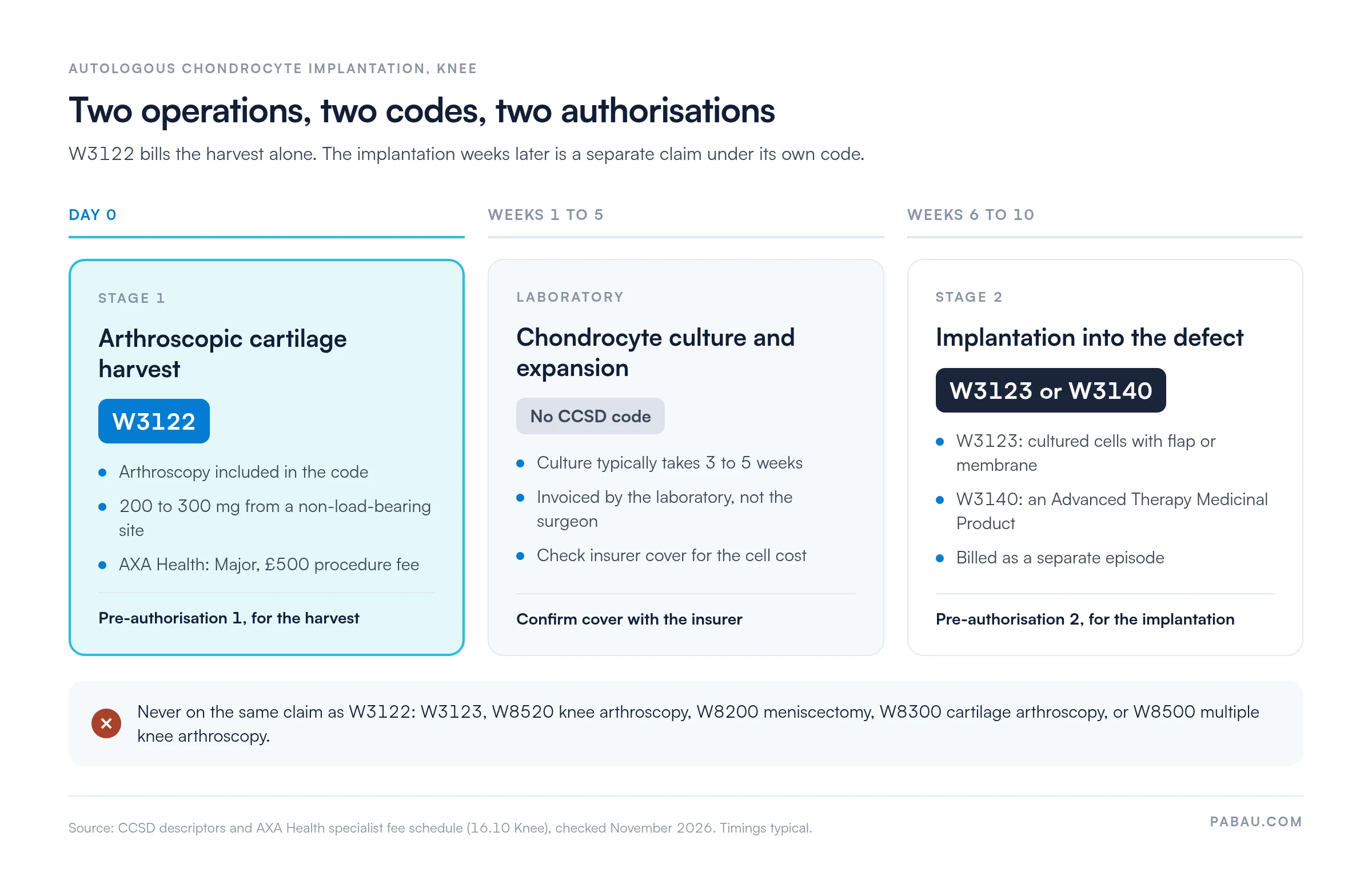
Prior authorisation must be obtained separately for each stage. An authorisation granted for the harvest does not cover the implantation, so the second request goes in before the patient is listed again.
Request the stage 2 authorisation as soon as the laboratory confirms the culture date, before the patient is listed for implantation. A W3122 authorisation never stretches to cover W3123 or W3140, and that assumption drives most implantation-stage denials. Quote each stage’s own reference on its Healthcode invoice.
Several CCSD codes cover knee cartilage work, and choosing the wrong one is a common cause of rejection. The table maps the closest codes and when each applies.
W8520 is the code most often added in error, because the harvest starts with a diagnostic look inside the joint. Descriptors change between schedule releases, so confirm the stage 2 code against the insurer’s current list before each claim.
The W3122 descriptor includes the arthroscopy. Coders meeting the code for the first time often miss this, and unbundling the arthroscopy leads to claim adjustment or rejection.
UK private medical insurers treat ACI as a high-value elective orthopaedic procedure that needs prior authorisation before the harvest. A W3122 claim without a valid authorisation reference is the most common reason for denial. Policies change, so confirm current requirements with the insurer at booking.
Our guide to Bupa CCSD procedure codes explains how Bupa ties its authorisation requirements to codes across orthopaedic specialties.
A W3122 claim with incomplete documentation is unlikely to be paid first time. Together, the operative note and the claim must confirm every element of the descriptor.
The operative note must include:
The Healthcode claim must carry the prior authorisation reference, W3122, the relevant WHO ICD-10 diagnosis code, and the consultant’s recognised provider number.
W3122 is denied more often than routine arthroscopy codes, because it is high-value, specialised, and tied to specific medical necessity criteria. Most denials fall into five categories.
A denied W3122 claim can still be paid. Bupa, AXA Health and Aviva all run a formal appeal process, and a well-evidenced appeal succeeds. Timelines and routes vary, so confirm the current process with each insurer’s provider helpline.
Log the denial date, the appeal date and each insurer response. If an insurer misses its own stated response time, that delay can support a later escalation.
Matrix-induced autologous chondrocyte implantation (MACI) seeds the harvested cells onto a collagen membrane before implantation. Its harvest is the same arthroscopic biopsy from a non-load-bearing donor site.
The CCSD schedule splits the variants at the implantation stage, not at the harvest. W3123 covers implantation with a periosteal flap or membrane cover. W3140 covers implantation using an Advanced Therapy Medicinal Product, such as the chondrosphere product NICE assessed in TA508.
The W3122 descriptor does not name a product, so the harvest is coded the same way for each route. Insurers still differ on which ACI products they fund, so confirm cover for the stage 2 product before the harvest is booked.
Before the harvest, ask the insurer which stage 2 code it will fund: W3123 for cultured cells under a membrane, or W3140 for an ATMP. Write the adviser’s name, the date and the answer into the patient’s billing file. If the insurer later disputes the implantation claim, that record is your evidence.
Today, a W3122 episode often lives in three places: the operative note, an authorisation spreadsheet, and the billing system. The two stages fall weeks apart, so the second authorisation is the step that slips.
Pabau records the authorisation code, its dates and its sessions on the patient’s case, and warns staff when a booking has none. Its private practice claims software submits UK claims through Healthcode and Bupa from the same record as the operative note.
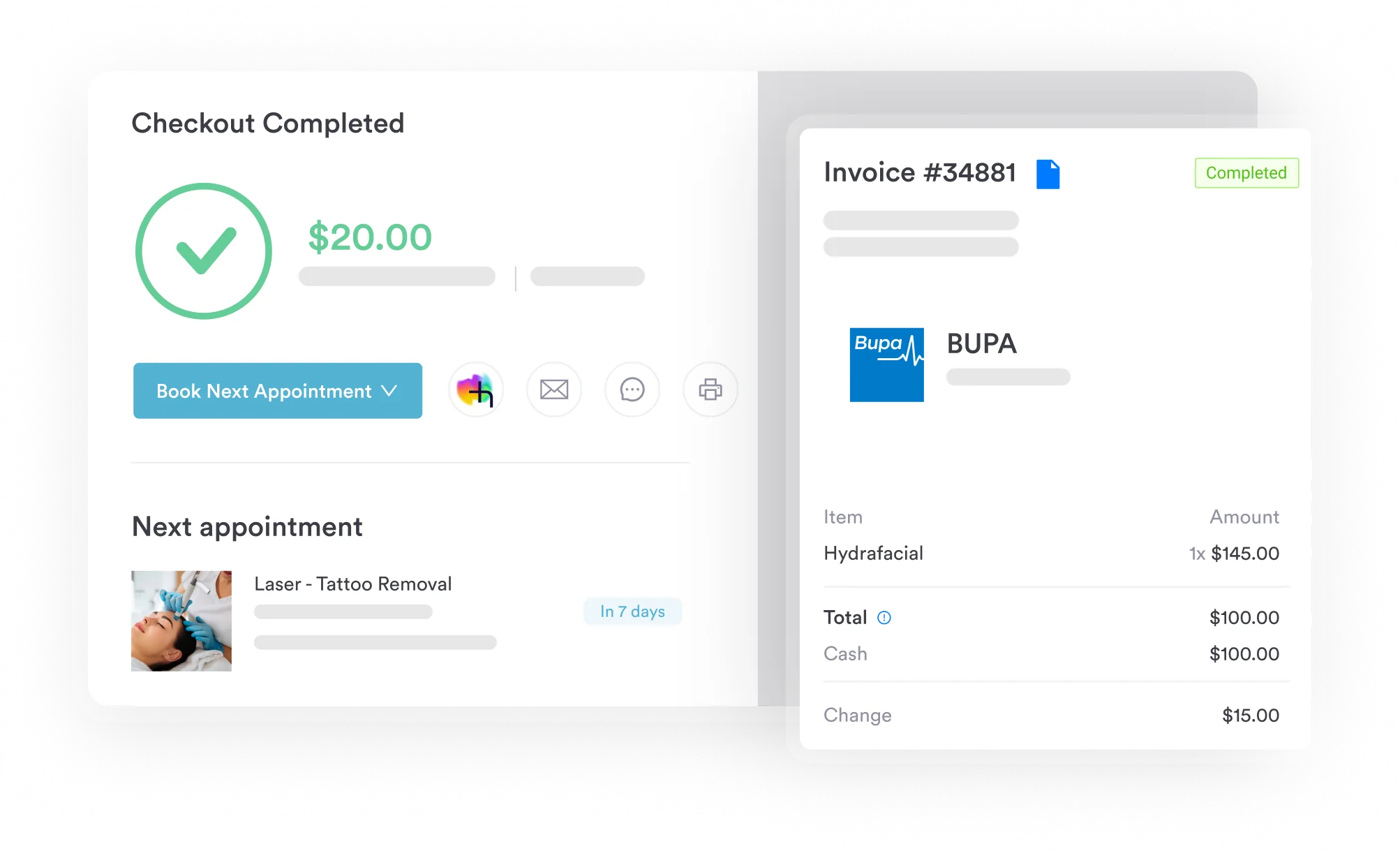
The harvest claim and the implantation claim each go out with the right code and reference. Nobody has to rebuild the history from email.

Pabau tracks each stage’s authorisation on the patient’s case and submits CCSD claims through Healthcode, so the implantation is never billed against the harvest reference.

W3122 is a small claim that decides whether a much larger one gets paid. A harvest billed without a lesion size, or with W8520 added, invites the insurer to question the whole ACI episode.
So treat the harvest note as the clinical case for stage 2. Record the defect over 2 cm², the absence of prior repair surgery, and the stage 2 product the insurer has agreed to fund. Book a demo to see how Pabau keeps both ACI authorisations and claims on one patient record.

Coding a manipulation under anaesthetic instead? CCSD code W9240 explains joint manipulation billing, another code AXA Health bars from a W3122 claim.
Working through other knee repair codes? CCSD code W0630 covers patellectomy, a neighbour of W3122 in the knee repair and reconstruction section.
CCSD code W3122 is the code for harvesting cartilage for autologous chondrocyte transplantation into the knee, including the arthroscopy. It covers the arthroscopic biopsy from a non-load-bearing area, the assessment of the defect, and dispatch of the specimens to the laboratory. It does not cover the implantation stage or the laboratory culture.
The arthroscopy is included within W3122. The official descriptor reads “including arthroscopy,” so a separate arthroscopy code such as W8520 is never added to a W3122 claim. Billing one alongside W3122 is unbundling and a common cause of adjustment or rejection.
W3122 covers only stage 1, the arthroscopic harvest. The implantation at stage 2 is billed under W3123, or W3140 when the cells are an Advanced Therapy Medicinal Product. It takes place at a separate encounter, typically 6-10 weeks later, with its own authorisation reference.
Bupa, AXA Health and Aviva all require prior authorisation before W3122 is performed and billed, subject to clinical review. Policies change, so confirm current requirements with each insurer’s provider helpline before listing a patient for the harvest.
No. The harvested cells spend several weeks in culture before they can be implanted, so the two stages never fall on the same day. AXA Health also lists W3123 as an unacceptable combination with W3122. Each stage needs its own claim and authorisation reference.
The harvest is coded W3122 for every ACI route, because the descriptor does not name a product. The variants split at stage 2. W3123 covers implantation under a flap or membrane, and W3140 covers implantation using an Advanced Therapy Medicinal Product. Confirm which one the insurer funds before the harvest.




